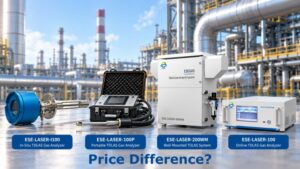




Volatile organic compounds are often difficult to see, hard to identify by smell alone, and easy to underestimate in industrial production. When VOC emissions are not monitored accurately, factories may face unexpected emission exceedances, unstable waste gas treatment performance, safety risks, and environmental compliance pressure. For industries such as petrochemical processing, coating, printing, pharmaceuticals, electronics manufacturing, and waste gas treatment, a reliable VOC monitoring solution is no longer optional. At ESEGAS, we help industrial users understand, select, and apply VOC analysis systems that support cleaner emissions, safer operation, and more stable process control.
A VOC Analyzer is a gas analysis instrument used to detect and measure volatile organic compounds in industrial gas streams, ambient air, exhaust ducts, or process pipelines. It helps enterprises monitor VOC concentration, evaluate emission control efficiency, detect abnormal operating conditions, and meet environmental compliance requirements. Depending on the application, a VOC Analyzer can be used for continuous emission monitoring, process optimization, safety warning, or on-site inspection.

Knowing the definition is only the first step. In real industrial environments, VOC measurement is affected by gas composition, humidity, temperature, dust, corrosive components, concentration range, and regulatory requirements. That is why choosing the right VOC Analyzer requires a clear understanding of what it measures, how it works, where it is used, and which technical parameters matter most.
What Does a VOC Analyzer Measure?
VOC emissions can create a serious challenge because they are not a single gas with one fixed property. A production line may release benzene compounds, hydrocarbons, alcohols, ketones, esters, aldehydes, or other organic vapors at the same time. If a plant only relies on rough estimation or manual inspection, hidden emission changes may go unnoticed until compliance or safety problems appear. A properly configured VOC Analyzer helps turn these invisible risks into measurable data.
A VOC Analyzer measures volatile organic compounds that evaporate easily at normal temperatures and enter the air or process gas stream. In industrial applications, the monitoring target may be total VOC concentration, usually called TVOC, or specific organic compounds depending on the process and regulatory requirement.
Common VOC categories include:
| VOC Category | Typical Compounds | Common Industrial Sources |
| Aromatic hydrocarbons | Benzene, toluene, xylene | Petrochemical, coating, printing |
| Aliphatic hydrocarbons | Methane-related hydrocarbons, hexane, heptane | Refining, chemical processing |
| Alcohols | Methanol, ethanol, isopropanol | Pharmaceuticals, electronics cleaning |
| Ketones | Acetone, MEK | Coating, adhesive production |
| Esters | Ethyl acetate, butyl acetate | Printing, packaging, paint production |
| Aldehydes | Formaldehyde, acetaldehyde | Resin, chemical manufacturing |
At ESEGAS, we do not treat every VOC application as the same measurement task. Some users need continuous TVOC monitoring at a stack outlet, while others need to track a specific solvent in a process line. The right VOC Analyzer should be selected according to the actual gas composition, concentration range, temperature, humidity, pressure, and sampling conditions.
How Does a VOC Analyzer Work?
Many factories know they need VOC monitoring, but the difficulty begins when they compare different detection technologies. A wrong technical choice can lead to unstable readings, frequent calibration, high maintenance workload, or inaccurate emission data. To avoid these problems, it is important to match the VOC Analyzer principle with the real application conditions instead of choosing only by price or appearance.
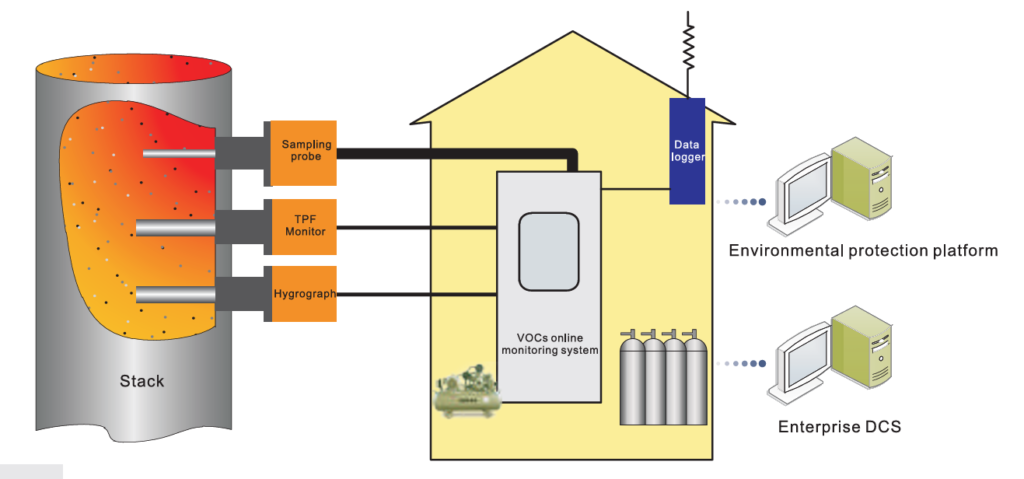
A VOC Analyzer can work based on several detection principles. Each technology has its own strengths and limitations.
PID: Photoionization Detection
PID technology uses ultraviolet light to ionize VOC molecules and measure the resulting electrical signal. It is commonly used for detecting low-concentration VOCs and is suitable for many field monitoring and safety inspection applications.
PID is useful when fast response and high sensitivity are required. However, it may respond differently to different VOC compounds, so correction factors and gas composition should be considered carefully.
FID: Flame Ionization Detection
FID technology burns organic compounds in a hydrogen flame and measures the ions produced during combustion. It is widely used for total hydrocarbon and VOC emission monitoring because it provides good sensitivity and stable response to many organic compounds.
For continuous emission monitoring, an FID-based VOC Analyzer is often selected when reliable TVOC or total hydrocarbon measurement is required. It usually requires fuel gas, combustion air, and a suitable sampling system.
NDIR: Non-Dispersive Infrared Detection
NDIR technology measures gas concentration based on infrared absorption. It is more commonly used for gases with strong infrared absorption characteristics. For VOC applications, NDIR may be suitable for certain specific organic gases, but it is not always ideal for complex VOC mixtures.
FTIR: Fourier Transform Infrared Spectroscopy
FTIR technology can identify and measure multiple gas components by analyzing infrared absorption spectra. It is suitable for applications where several compounds need to be monitored at the same time.
An FTIR-based VOC Analyzer can be valuable in complex industrial processes, but the system configuration, spectral analysis, and sampling conditions must be carefully designed.
GC: Gas Chromatography
Gas chromatography separates gas components before detection, making it suitable for measuring specific VOC compounds with higher selectivity. It is often used when users need compound-level analysis rather than only total VOC concentration.
GC systems are powerful for detailed VOC analysis, but they may have longer measurement cycles compared with direct-reading analyzers.
Where Is a VOC Analyzer Commonly Used?
VOC emissions may come from raw materials, solvents, reaction processes, storage tanks, cleaning operations, drying ovens, coating lines, and waste gas treatment systems. When these sources are not monitored continuously or accurately, enterprises may lose control over both emission performance and production efficiency. A well-designed VOC Analyzer system helps identify where VOCs are generated, how they change, and whether treatment equipment is working effectively.
VOC Analyzer applications are common in many industrial sectors.
Petrochemical and Refining
In petrochemical plants and refineries, VOCs may be released from process units, storage areas, loading systems, and exhaust treatment facilities. Continuous VOC monitoring supports emission control, leak evaluation, and process safety management.
Coating and Painting Lines
Coating processes often use organic solvents that evaporate during spraying, drying, and curing. A VOC Analyzer can help monitor exhaust concentration before and after treatment equipment, supporting both compliance and process optimization.
Printing and Packaging
Printing inks, adhesives, and cleaning agents may release VOCs during production. Online VOC monitoring helps manufacturers evaluate solvent recovery systems, activated carbon adsorption units, catalytic oxidation equipment, or RTO/RCO systems.
Pharmaceutical and Fine Chemical Production
Pharmaceutical and fine chemical processes may involve multiple solvents and reaction byproducts. VOC monitoring is important for environmental compliance, worker safety, and process control.
Semiconductor and Electronics Manufacturing
Electronics manufacturing may use organic solvents for cleaning, coating, and surface treatment. A suitable VOC Analyzer can support clean production management and exhaust monitoring.
Waste Gas Treatment Systems
VOC treatment systems such as RTO, RCO, activated carbon adsorption, condensation recovery, and scrubber systems need reliable inlet and outlet monitoring. By comparing VOC concentrations before and after treatment, operators can evaluate removal efficiency and detect performance decline early.
Why Is VOC Monitoring Important for Industrial Emission Control?
VOC problems often develop gradually. A filter becomes saturated, an RTO temperature drops, a process recipe changes, or a solvent concentration increases unexpectedly. Without real-time VOC data, operators may only discover the issue after emissions exceed limits or equipment alarms occur. A VOC Analyzer gives industrial teams earlier visibility, helping them respond before small deviations become costly problems.
VOC monitoring is important for several reasons.
First, it supports environmental compliance. Many industrial facilities are required to monitor and control VOC emissions according to local regulations and permit conditions. Continuous VOC data helps demonstrate whether emissions remain within the required range.
Second, it helps evaluate treatment efficiency. By installing a VOC Analyzer at the inlet and outlet of waste gas treatment equipment, users can calculate removal performance and identify when adsorption materials, catalysts, or combustion systems need attention.
Third, it improves safety management. Some VOCs are flammable, toxic, or harmful to workers. Monitoring concentration changes can help detect abnormal releases and reduce operational risks.
Fourth, it supports process optimization. VOC concentration data can show whether solvent use, drying temperature, ventilation volume, or recovery efficiency is stable. This helps plants reduce waste, improve energy efficiency, and control operating costs.
Finally, it provides reliable data for long-term management. Instead of depending only on manual sampling, online VOC monitoring gives continuous records that support maintenance planning, emission reporting, and production improvement.
What Should You Consider When Choosing a VOC Analyzer?
Selecting a VOC Analyzer may seem simple at first, but industrial sites often include high humidity, high temperature, dust, pressure fluctuation, corrosive gas, and complex VOC mixtures. If these conditions are ignored, even a high-quality analyzer may fail to deliver stable results. The right choice should be based on the whole measurement system, not only the detector itself.
When choosing a VOC Analyzer, we recommend evaluating the following factors.
Measurement Target
Clarify whether you need TVOC, total hydrocarbons, methane/non-methane hydrocarbons, or specific VOC compounds. Different targets may require different detection principles.
Measuring Range
The analyzer range should match the expected concentration. A range that is too low may overload the instrument, while a range that is too high may reduce resolution at low concentrations.
Detection Limit and Accuracy
For low-emission applications, detection limit is critical. For compliance monitoring, accuracy, repeatability, and stability are especially important.
Response Time
Fast response is important for safety warning, process control, and changing emission conditions. For some compound-specific systems, response time may be longer due to sample separation or analysis cycles.
Sampling System Design
The sampling system is often as important as the analyzer. Heated sampling lines, filters, pumps, condensate control, and calibration gas access can all affect measurement reliability.
Resistance to Interference
Industrial gas may contain water vapor, dust, acid gases, sulfur compounds, or other interfering substances. The VOC Analyzer should be selected with these conditions in mind.
Maintenance and Calibration
A practical system should be easy to maintain, calibrate, and inspect. Long-term operation depends on stable hardware, accessible components, and clear maintenance procedures.
At ESEGAS, we focus on complete application matching. We consider the gas condition, site environment, monitoring purpose, installation method, communication requirements, and future maintenance needs before recommending a VOC Analyzer solution.
Online VOC Analyzer vs Portable VOC Detector: Which One Do You Need?
Many users are unsure whether they need an online analyzer or a portable detector. Choosing the wrong type can create frustration: a portable device cannot replace continuous emission records, while an online system may be unnecessary for simple inspection tasks. Understanding the difference helps users invest in the right tool for the right job.
| Comparison Item | Online VOC Analyzer | Portable VOC Detector |
| Main purpose | Continuous monitoring and process control | Temporary inspection and leak checking |
| Installation | Fixed installation on stack, duct, or process line | Handheld or movable use |
| Data continuity | Continuous or periodic automatic data | Manual spot-check data |
| Application | CEMS, waste gas treatment, production monitoring | Patrol inspection, emergency check |
| Accuracy requirement | Higher long-term stability required | Flexible field detection |
| System design | Often includes sampling, conditioning, calibration, data transmission | Compact and easy to carry |
| Best for | Long-term compliance and operation management | Short-term troubleshooting |
For plants that need emission compliance data, treatment efficiency evaluation, or automated process control, an online VOC Analyzer is usually the better choice. For maintenance teams that need to inspect leaks, check working areas, or conduct temporary measurements, a portable detector may be more suitable.
In many industrial facilities, both types can be used together. The online system provides continuous monitoring, while portable equipment supports flexible on-site inspection.
How Can ESEGAS Support Reliable VOC Gas Analysis?
Industrial VOC monitoring is not only about buying an instrument. The real challenge is obtaining stable, accurate, and usable data in harsh operating conditions. If the analyzer, sampling system, and application design are not properly matched, users may face drift, blockage, condensation, unstable readings, or high maintenance costs. Our role at ESEGAS is to help customers build VOC analysis solutions that work reliably in real production environments.
We support VOC Analyzer applications through practical engineering experience and application-based system design. Our solutions can be configured for emission monitoring, process gas analysis, waste gas treatment evaluation, and safety-related monitoring.
For different industries, we help users evaluate:
- VOC type and concentration range
- Gas temperature, humidity, dust, and pressure
- Required detection principle
- Sampling and conditioning method
- Installation location and system layout
- Signal output and data integration
- Calibration and maintenance requirements
- Long-term operating stability
We understand that every VOC application is different. A coating line, a petrochemical exhaust stack, a pharmaceutical solvent recovery system, and an RTO outlet may all require different analyzer configurations. By working from actual site conditions, we help industrial users select a VOC Analyzer system that supports accurate measurement, reliable operation, and easier maintenance.
Conclusion
A VOC Analyzer is an essential gas analysis tool for industrial emission control, process optimization, safety management, and environmental compliance. Because VOCs include many different organic compounds and appear in many types of industrial processes, successful monitoring depends on choosing the right detection technology, measuring range, sampling system, and installation design.
At ESEGAS, we approach VOC analysis from the perspective of real industrial application. We help users transform invisible VOC emissions into reliable data, making it easier to control emissions, protect equipment, improve treatment efficiency, and meet regulatory requirements. For companies that need stable and professional VOC monitoring, a well-designed VOC Analyzer solution is a critical step toward cleaner and more dependable industrial operation.