



Your CEMS keeps failing because cement kiln exhaust is hot, dusty, and corrosive. Frequent maintenance increases costs, interrupts production, and makes environmental compliance much harder than it should be.
The best Continuous Emission Monitoring System (CEMS) for cement kilns is not simply the one with the highest gas analyzer accuracy. It is a complete monitoring system designed to handle extreme temperatures, heavy dust, corrosive gases, and rapid process changes while maintaining stable, continuous measurements with minimal maintenance.
So, what makes cement kilns one of the toughest environments for continuous emissions monitoring? More importantly, which design features actually improve long-term reliability? Let’s examine the process conditions that separate dependable CEMS solutions from systems that struggle in daily operation.
Why Is a Cement Kiln One of the Toughest Applications for CEMS?
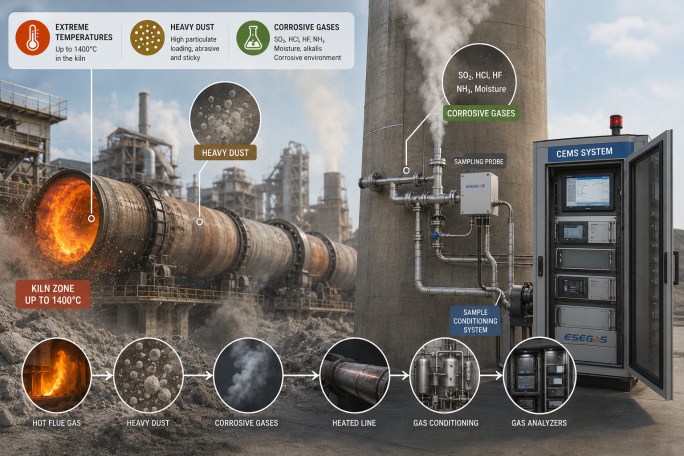
Cement production creates one of the harshest environments for continuous emissions monitoring. High temperatures, heavy particulate loading, moisture, and corrosive gases act together, placing constant stress on sampling systems and gas analyzers. Therefore, standard gas monitoring systems often struggle to maintain stable performance.
Most cement plants continuously monitor NOx, SO₂, CO, CO₂, and O₂ to meet environmental regulations and improve combustion efficiency. However, monitoring these gases is far more difficult than measuring them in typical industrial stacks. Several process conditions affect CEMS performance at the same time.
First, extreme temperatures place continuous thermal stress on sampling probes and accessories. Although gas is cooled before analysis, temperatures inside the kiln can exceed 1,400°C, requiring durable materials and effective probe cooling.
Second, high dust concentrations can clog probes, filters, and sampling lines. Without automatic back-purge systems and efficient filtration, sample flow becomes unstable, leading to inaccurate readings and increased maintenance.
Third, corrosive gases and moisture create additional risks. Compounds such as SO₂ and HCl may react with condensed water, causing corrosion or changing the gas composition before it reaches the analyzer. Heated sampling lines and reliable gas conditioning are therefore essential for accurate measurements.
Finally, cement kilns rarely operate under steady conditions. Alternative fuels, varying raw materials, and changing production rates continuously alter gas composition. Consequently, a CEMS must provide both fast response and long-term stability despite constant process fluctuations.
These challenges explain why selecting a cement kiln CEMS involves much more than choosing an gas analyzer. The next step is to compare the main CEMS architectures and determine which design performs best in demanding cement plant applications.
Which Type of CEMS Performs Best in Cement Kiln Applications?
Every cement plant has different process objectives. However, for most kiln emission monitoring applications, buyers usually choose between extractive CEMS, in-situ CEMS, and cross-stack CEMS.
| CEMS Type | Advantages | Limitations | Best Applications |
|---|---|---|---|
| Extractive CEMS | High measurement accuracy, supports multiple gas analyzer technologies, flexible gas measurement | Requires sample conditioning and regular maintenance | Environmental compliance, multi-gas monitoring |
| In-situ CEMS | Fast response, no sample transport delay, fewer sample handling components | Optical windows and probes require cleaning in dusty environments | Combustion optimization, process control |
| Cross-stack CEMS | Simple installation, minimal sampling hardware | Limited gas selection, affected by stack alignment and optical interference | Opacity and selected gas monitoring |
For most cement plants, extractive CEMS remains the preferred solution for regulatory emissions monitoring. It supports simultaneous measurement of gases such as NOx, SO₂, CO, CO₂, and O₂ using multiple gas analyzer technologies within one integrated system. In addition, gas analyzers operate inside a climate-controlled cabinet instead of directly in the hot exhaust stream, improving long-term stability and simplifying maintenance.
That said, extractive systems are not perfect. Gas must travel from the stack to the gas analyzer through heated sampling lines and a conditioning system. This transport process introduces a small response delay compared with direct in-situ measurement. For combustion optimization where operators need immediate feedback, response time may become a deciding factor. This is where in-situ CEMS offers an advantage.
Because the sensor measures gas directly inside the process, it eliminates sample transport and conditioning delays. Operators receive near real-time oxygen or CO measurements, allowing faster adjustment of combustion air and fuel flow. Several cement plants use in-situ gas analyzers to optimize kiln efficiency while reducing excess oxygen and fuel consumption. However, cement kilns produce extremely high dust concentrations.
Optical windows and sensing probes can gradually become coated with raw meal and clinker dust. As a result, modern in-situ systems often incorporate water cooling, automatic probe rotation, or pneumatic cleaning mechanisms to maintain measurement reliability.
For continuous regulatory reporting, extractive CEMS generally provides the broadest measurement capability. For rapid combustion control, in-situ gas analyzers often complement the extractive system by supplying faster process feedback. In many large cement plants, these two approaches work together instead of competing with each other.
Which CEMS Components Matter Most in Harsh Cement Kiln Applications?
Choosing the right measurement principle is only the beginning. The long-term reliability of a cement kiln CEMS depends on how well every component handles heat, dust, moisture, and corrosive gases. A complete system performs only as well as its weakest component.
High-Temperature Sampling Probe
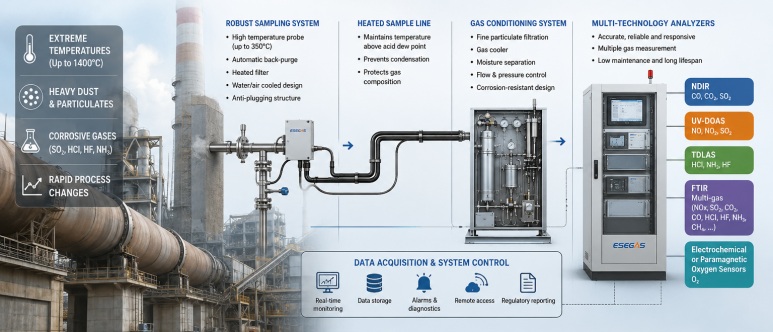
Everything starts at the sampling point. The probe must continuously collect representative flue gas while resisting temperatures, abrasive dust, and corrosive compounds. If dust blocks the probe entrance, measurement accuracy quickly deteriorates regardless of gas analyzer quality.
For this reason, cement kiln sampling probes commonly include:
- High-temperature alloy construction
- Automatic back-purge systems
- Heated filters
- Water or air cooling
- Anti-plugging probe geometry
Some advanced probe designs also include automatic cleaning mechanisms that periodically remove deposits without stopping the monitoring system. These features significantly reduce maintenance frequency in high-dust applications.
Heated Sampling Line
Once extracted, the gas sample must travel safely to the gas analyzer. This may sound simple, but it is one of the most critical stages of the entire CEMS. If the sample temperature falls below its dew point, water condenses inside the tubing. Acid gases such as HCl and SO₂ may dissolve into the condensate, changing the gas composition before measurement. Corrosion and salt deposits can also develop inside the sampling system.
Therefore, cement CEMS normally use heated sample lines to keep the gas above the acid dew point throughout transport. Maintaining a stable sample temperature helps preserve gas composition and improves analytical accuracy.
Gas Conditioning System
Even after careful extraction, the sample is rarely ready for gas analysis. A gas conditioning system removes unwanted contaminants while protecting sensitive gas analyzers from moisture and dust. Typical components include fine particulate filters, gas coolers, moisture separators. condensate pumps, flow controllers, and pressure regulation devices.
The objective is straightforward: deliver a clean, stable, representative gas sample without changing the concentration of target gases. A poorly designed conditioning system often causes more measurement problems than the gas analyzer itself.
Gas Analyzer Technologies
No single sensing technology can accurately measure every gas emitted from a cement kiln. Therefore, modern CEMS combine multiple gas analyzer technologies, with each one selected for the gases it measures most effectively.
| Gas Analyzer Technology | Typical Gases | Why It Is Used |
|---|---|---|
| NDIR | CO, CO₂ | Stable, selective, proven for combustion gases |
| UV-DOAS | NO, NO₂, SO₂ | Excellent sensitivity for nitrogen and sulfur oxides |
| TDLAS | NH₃, HCl, HF | Fast response with high selectivity in demanding processes |
| FTIR | CO, CO₂, NO, NO₂, SO₂, HCl, HF, NH₃, CH₄, N₂O and other gases | Simultaneous multi-component analysis with excellent flexibility for applications requiring broad gas coverage |
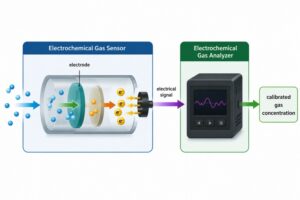
| Electrochemical or Paramagnetic Oxygen Sensors | O₂ | Continuous oxygen measurement for combustion optimization and process control |
When plants need to monitor a larger number of gas components simultaneously, FTIR becomes an attractive option. A single FTIR gas analyzer can measure multiple pollutants at the same time, making it well suited for applications where emission regulations require broad gas coverage or where process conditions frequently change. However, FTIR systems generally require more sophisticated spectral analysis and careful sample conditioning to maintain measurement accuracy.
For oxygen measurement, electrochemical sensors provide a cost-effective solution for many standard applications, while paramagnetic oxygen analyzers offer higher long-term stability, faster response, and excellent accuracy without consuming the measured oxygen. The choice depends on the required measurement range, maintenance strategy, and overall system design.
Rather than relying on a single gas analyzer, modern cement kiln CEMS typically integrate several technologies into one platform. By combining the strengths of each measurement principle, the system delivers accurate, reliable monitoring across multiple pollutants while maintaining high availability under harsh kiln operating conditions.
How Does ESEGAS Design CEMS for Harsh Cement Kiln Applications?
Selecting the right gas analyzer is only one part of a successful CEMS project. Just as importantly, the entire system must remain stable despite heat, dust, moisture, and changing process conditions. That is the design philosophy behind ESEGAS CEMS.
Instead of relying on a single measurement principle, ESEGAS integrates multiple gas analyzer technologies into one customized CEMS platform, allowing customers to select the most suitable configuration for their application. Depending on monitoring requirements, the system can combine NDIR for CO and CO₂, UV-DOAS for NOx and SO₂, TDLAS for HCl or NH₃, FTIR for simultaneous multi-component gas analysis, and electrochemical or paramagnetic oxygen sensors for continuous O₂ measurement. Multi-technology CEMS are widely adopted because they leverage the strengths of different analytical methods while providing comprehensive emissions monitoring.
Just as important is the sampling system. ESEGAS designs high-temperature sampling probes with automatic back-purge to reduce dust blockage in cement kiln applications. Heated sample lines help prevent condensation, while the gas conditioning unit removes moisture and particulate matter before the sample reaches the gas analyzers. Together, these components protect the instruments and preserve the integrity of the gas sample. Similar extractive CEMS architectures are widely recognized as the preferred approach for multi-gas monitoring in demanding industrial environments.
To reduce maintenance, ESEGAS also supports automatic zero and span calibration, continuous system diagnostics, and remote communication through industrial protocols such as Modbus. Operators can monitor gas analyzer status, identify faults quickly, and minimize unplanned downtime. This combination of reliable hardware and intelligent diagnostics helps cement plants maintain stable emissions data while lowering operating costs.
Conclusion
There is no single CEMS that fits every cement plant. However, the most reliable solution is one engineered specifically for harsh kiln conditions. A complete system with robust sampling, effective gas conditioning, and the right combination of analyzer technologies will deliver more accurate data, higher availability, and lower lifetime maintenance costs.
FAQs
What type of CEMS is most commonly used in cement plants?
Most cement plants use extractive CEMS because it supports simultaneous measurement of multiple pollutants, provides high analytical accuracy, and protects analyzers from harsh process conditions through sample conditioning.
Which gases should a cement kiln CEMS monitor?
A typical cement kiln CEMS monitors NOx, SO₂, CO, CO₂, and O₂. Depending on local regulations and process requirements, it may also measure HCl, HF, NH₃, and particulate matter (dust).
Why is dust a major challenge for CEMS in cement kilns?
Cement kiln exhaust contains high concentrations of abrasive fine particles that can clog sampling probes, block filters, and reduce sample flow. Automatic back-purge systems, heated filters, and efficient gas conditioning help maintain reliable operation.
Which gas analyzer technologies are best for cement kiln CEMS?
Most modern extractive CEMS combine several technologies. NDIR is commonly used for CO, CO₂, and SO₂; UV-DOAS for NOx; TDLAS for HCl or NH₃; FTIR for simultaneous multi-component gas analysis; and Electrochemical or Paramagenetic sensors for oxygen measurement. Using multiple technologies improves both measurement accuracy and system flexibility.
How can a well-designed CEMS reduce operating costs?
A properly engineered CEMS minimizes unplanned maintenance, improves gas analyzer availability, reduces spare-part consumption, supports stable regulatory compliance, and provides reliable process data that helps optimize combustion efficiency and fuel usage.