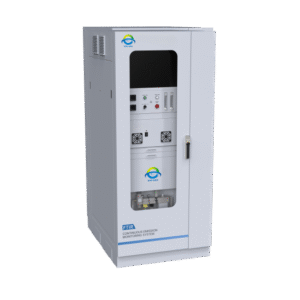
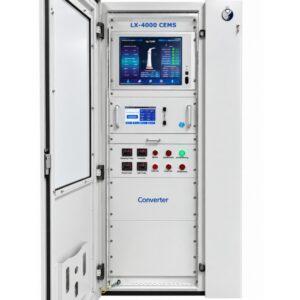
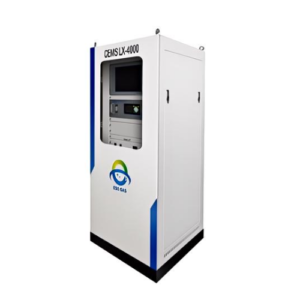
VOC Analyzer for Industrial Exhaust & Emission Monitoring
Introduction
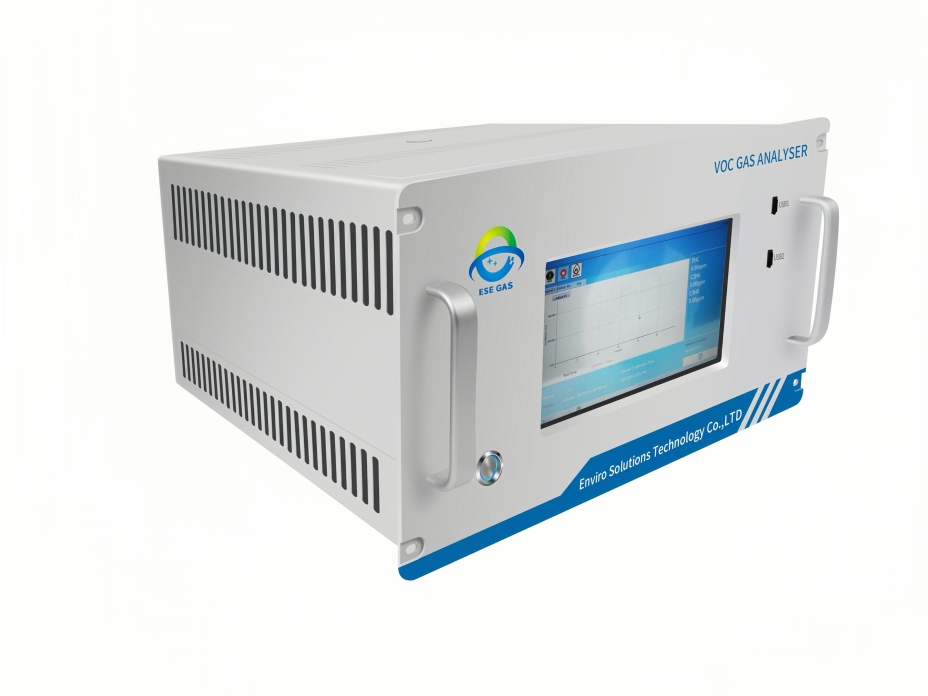
Monitor volatile organic compounds in industrial gas streams with measurement technology and system configurations selected for the required VOC reporting method.
Measured Gas: Total hydrocarbons | Methane | Nonmethane hydrocarbons | Benzene series | other volatile organic compounds
Technology: FID
Applications: Petrochemical processes, chemical manufacturing, industrial exhaust and emission control systems.
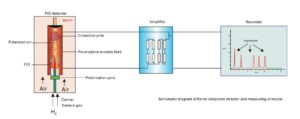
1) The Hydrogen FID (Flame lonization Director) in VOC analyzer
When volatile organic compound (VOC) burn in a hydrogen flame, high temperatures ionize the gas molecules. This process releases free electrons, which an electric field gradient efficiently directs toward a electrode collector. As electrons accumulate, they generate a measurable ionization current. Since the current strength directly correlates with VOC concentration, analysts use this linear relationship to quantify trace gas components in environmental monitoring and industrial safety applications.
FID-detection-principle
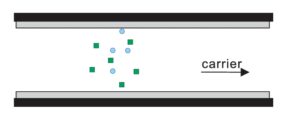
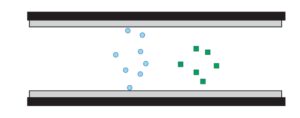
2) Chromatographic Column Separation Process in VOC analyzer
The carrier gas propels the sample mixture toward the chromatographic column’s right end. As the multicomponent gas flows through the column, the stationary phase selectively adsorbs its molecules. Since each gas component interacts uniquely with the stationary phase, their migration rates diverge significantly. This retention time variation enables precise component separation at the column outlet.
Specification
Measurement principle
Gas Chromatography Principle (GC-FID)
Detector
Flame ionization detector (FID)
Measured components
VOCs (total hydrocarbons, Methane, Nonmethane hydrocarbons, Benzene series and other volatile organic compounds)
Measuring range
0-500ppm (Optional)
Limit of detection
Total hydrocarbons 0.8 mg/m³
Repeatability
RSD≤2%
Measurement deviation
≤2%F.S.
Analysis cycle
120S~180S
Data output
RS232/RS485
Rated power
800W, 220VAC/50Hz
Injection mode
Sample injection via 14-port valve
Injection volume
Sample loop 0.5mL
Chromatographic column
3m PQ, 1.5m PQ, 0.6 mTHC column.
FID temperature
180℃
Valve box temperature
50℃~150℃
Column temperature
80℃~120℃
Hydrogen flow rate
45 ml/min
Air flow rate
400 ml/min
Applications
VOC (Volatile Organic Compound) analyzer play a critical role in atmospheric chemistry, acting as key precursors to ozone formation and secondary organic aerosols. Governments now prioritize VOC management, listing them as the fifth major pollutant after COD, ammonia-nitrogen, SO₂, and NOx. Consequently, reducing industrial VOC emissions has become vital for global air quality improvement.
Plastic products manufacturing
Etroleum refining and petrochemistry
Pharmaceutical manufacturing
Vehicle surface coating
Rubber products manufacturing
Printing Industry
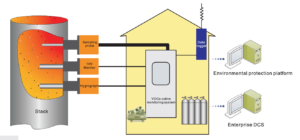
VOC Analyzer in Monitoring System Structure
The VOC (Volatile Organic Compound) analyzer integrates into an online monitoring system for precise industrial emissions control. The system has four key subsystems:
Gaseous pollutant monitoring subsystem uses a sampling probe with a ceramic filter to extract dust-free gas samples.
The flue gas monitoring subsystem employs a TPF-integrated monitor to analyze stacks’ temperature, oxygen, humidity, and flow velocity, while a hygrograph ensures accurate gas moisture measurement.
Calibration and assistant subsystem maintain system accuracy through automated checks.
Control and data collection subsystem houses a centralized control cabinet with an IPC, heating modules, and a high-temperature pump for real-time data processing.
VOCs Online Monitoring System structure
To enhance reliability, an air compressor provides gas for regular pipeline blowback, minimizing condensation risks in heat-traced sampling lines. This VOC analyzer integrates into an online monitoring system supports VOCs emission reduction and aligns with strict environmental compliance standards.
Q&As
Still having questions? Please just contact us directly!
Principle
1) The Hydrogen FID (Flame lonization Director) in VOC analyzer
When volatile organic compound (VOC) burn in a hydrogen flame, high temperatures ionize the gas molecules. This process releases free electrons, which an electric field gradient efficiently directs toward a electrode collector. As electrons accumulate, they generate a measurable ionization current. Since the current strength directly correlates with VOC concentration, analysts use this linear relationship to quantify trace gas components in environmental monitoring and industrial safety applications.
FID-detection-principle
2) Chromatographic Column Separation Process in VOC analyzer
The carrier gas propels the sample mixture toward the chromatographic column’s right end. As the multicomponent gas flows through the column, the stationary phase selectively adsorbs its molecules. Since each gas component interacts uniquely with the stationary phase, their migration rates diverge significantly. This retention time variation enables precise component separation at the column outlet.
Specification
Measurement principle
Gas Chromatography Principle (GC-FID)
Detector
Flame ionization detector (FID)
Measured components
VOCs (total hydrocarbons, Methane, Nonmethane hydrocarbons, Benzene series and other volatile organic compounds)