

Introduction
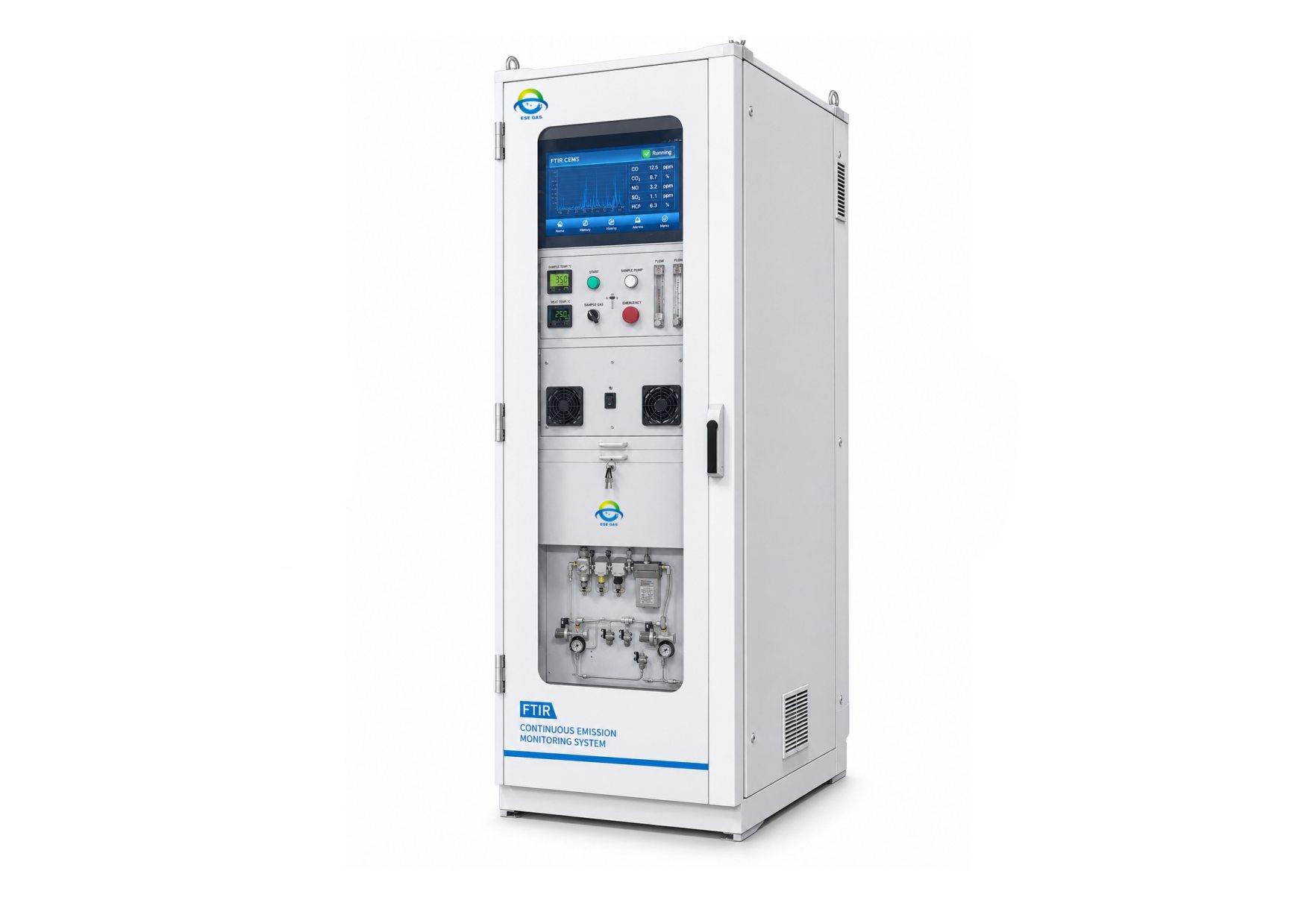
The ESEGAS FTIR Continuous Emission Monitoring System (FTIR CEMS) is designed for simultaneous and continuous measurement of multiple gaseous pollutants in complex industrial emissions. Based on Fourier Transform Infrared Spectroscopy (FTIR), it can monitor 10 gases and other configurable gas components in one system. Its full-process heated sampling design maintains the sampling probe and gas transportation lines at approximately 180°C to minimize condensation and prevent sample loss, particularly for water-soluble gases such as NH₃, HCl, and HF. It is suitable for waste incineration, power generation, chemical manufacturing, and industrial emission compliance monitoring.
Measured Gas: SO₂ | NO | NO₂ | CO | CO₂ | HCl | HF | NH₃ | N₂O | H₂O | O2 depending on configuration.
Technology: FTIR
The ESEGAS FTIR CEMS uses Fourier Transform Infrared (FTIR) spectroscopy to continuously and simultaneously measure multiple gas components in industrial flue gas. The measurement principle is based on the absorption of infrared radiation by gas molecules. Each gas molecule absorbs infrared energy at specific frequencies, causing changes in its molecular vibrational state. These characteristic absorption features allow the FTIR gas analyzer to identify and quantify different gases.
| Gas Analyzer | |
|---|---|
| Measuring Principle | FTIR |
| Gas Temperature | Up to 180°C |
| Operating Temperature Range | 15-35°C |
| Purge and Zero gas | Nitrogen (99.999% or higher than recommended) |
| Warm-up Time | 2 hours |
| Sample Gas Pressure | Ambient |
| Sample Gas Flow rate | 2-3L/min recommended |
| Sample Gas Filtration | Minimum 2μm particulate filtration |
| Gas Fittings | Sample in: 6mm Swagelok, stainless steel; Sample out: 8 mm Swagelok, stainless steel; Interferometer purge: 6mm Swagelok stainless steel; |
| Output Port | Ethernet port |
| Communication Protocols | MODBUS |
| Power Requirements | 220VAC±10% Peak 2500W/Average 150W |
| Weight | 25Kg |
| Physical Dimensions | 435mm(L)x175mm(H)x435(W) |
| Performance | |
| Zero Drift | <2%@24 hours |
| Span Drift | <2%@24 hours |
| Response Time | Typically<100s@3L/min |
| Linearity | ±1%F.S. |
| Repeatability | Not more than 1% |
| Accuracy | <2%FS |
Our FTIR CEMS is engineered for complex industrial emissions and process control. By employing full-process high-temperature heating (maintaining sampling probes and gas paths at 180°C), the system effectively eliminates the risk of sample condensation. This ensures the integrity of soluble gases and delivers industry-leading measurement accuracy.
Multi-Component Measurement: SO2, NO, NO2, N2O, CO, CO2, NH3, HCl, HF, H2O, CH4 (customizable to your specific needs).

The FTIR CEMS system employs full-process high-temperature heating (sampling probes, heated to 180°C) for pollutant measurement. It can measure multiple pollutants including SO2, NO, NO2, N2O, CO, CO2, NH3, HCl, HF, H2O, CH4, and H2O (customers can select according to their needs). The continuous heating minimizes pollutant loss during condensation, thereby enhancing measurement accuracy which is special design for the waste-energy application !
Features:
An FTIR Continuous Emission Monitoring System is designed to continuously measure multiple gaseous pollutants in industrial exhaust gases using Fourier Transform Infrared Spectroscopy.
An infrared source sends broadband infrared radiation through a Michelson interferometer and the gas sample. The resulting interferogram is processed using a Fourier Transform to obtain an infrared spectrum. Gas concentrations are calculated from characteristic absorption features.
Depending on the optical configuration and calibration library, FTIR CEMS can measure SO₂, NO, NO₂, CO, CO₂, NH₃, HCl, HF, N₂O, CH₄, H₂O, and other infrared-active gases.
Heated sampling helps prevent water condensation and sample loss during gas transportation. It is particularly important for water-soluble components such as NH₃, HCl, and HF.
Conventional CEMS may combine different analyzers using separate measurement technologies for individual gases. FTIR CEMS uses infrared spectroscopy to measure multiple infrared-active components within one analytical platform, depending on the configuration.
FTIR CEMS is suitable for waste incineration, power generation, cement production, chemical manufacturing, and other industries requiring simultaneous monitoring of multiple gaseous pollutants.
The ESEGAS FTIR CEMS uses Fourier Transform Infrared (FTIR) spectroscopy to continuously and simultaneously measure multiple gas components in industrial flue gas. The measurement principle is based on the absorption of infrared radiation by gas molecules. Each gas molecule absorbs infrared energy at specific frequencies, causing changes in its molecular vibrational state. These characteristic absorption features allow the FTIR gas analyzer to identify and quantify different gases.
| Gas Analyzer | |
|---|---|
| Measuring Principle | FTIR |
| Gas Temperature | Up to 180°C |
| Operating Temperature Range | 15-35°C |
| Purge and Zero gas | Nitrogen (99.999% or higher than recommended) |
| Warm-up Time | 2 hours |
| Sample Gas Pressure | Ambient |
| Sample Gas Flow rate | 2-3L/min recommended |
| Sample Gas Filtration | Minimum 2μm particulate filtration |
| Gas Fittings | Sample in: 6mm Swagelok, stainless steel; Sample out: 8 mm Swagelok, stainless steel; Interferometer purge: 6mm Swagelok stainless steel; |
| Output Port | Ethernet port |
| Communication Protocols | MODBUS |
| Power Requirements | 220VAC±10% Peak 2500W/Average 150W |
| Weight | 25Kg |
| Physical Dimensions | 435mm(L)x175mm(H)x435(W) |
| Performance | |
| Zero Drift | <2%@24 hours |
| Span Drift | <2%@24 hours |
| Response Time | Typically<100s@3L/min |
| Linearity | ±1%F.S. |
| Repeatability | Not more than 1% |
| Accuracy | <2%FS |
We will contact you within 1 working day, please pay attention to the email with the suffix “[email protected]” .