
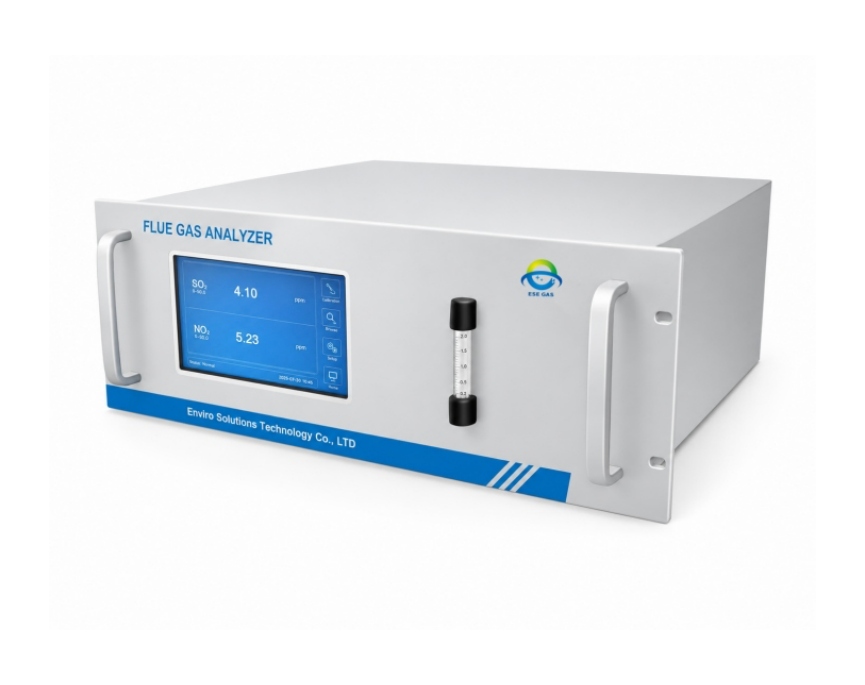
Introduction
Accurate measurement of SO₂, NO, NO₂, and CO in ppm, plus CO₂ and O₂ in %, for flue gases from steel plants, power plants, cement plants, waste incineration, and industrial combustion processes, with CEMS integration.
Measured Gas: SO₂ | NO | NO₂ | CO | CO₂ | O₂ | H₂S | NH₃
Technologies: UV-DOAS +NDIR
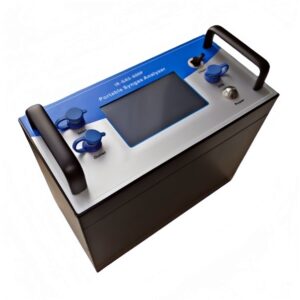
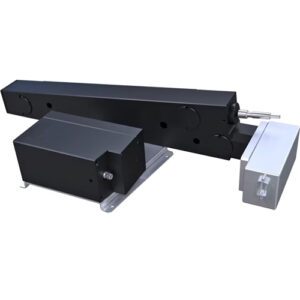
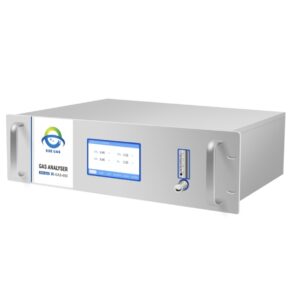
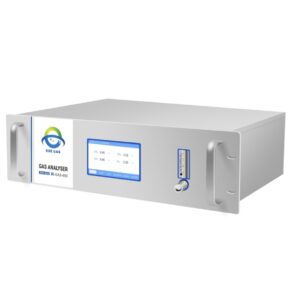
Configurations: Online Model | Portable Model | CEMS
Want to know more about maintenance, calibration, and operation, watch our videos.
| Parameter | Description |
|---|---|
| Measuring Principle | Ultraviolet Differential optical absorption spectrum(UV-DOAS) |
| Measuring Gas | SO2, NOx: UV-DOAS, CO/CO2: NDIR, O2: EC Sensor/Paramagnetic |
| Measuring Range | SO2 , NOx: 0-100/500/1000/3000ppm, CO: 0-1000ppm , O2: 0~25%(Other ranges can be customized) |
| Linearity Error | ≤2% F.S. |
| Zero Drift | ≤1% F.S. |
| Span Drift | ≤1% F.S. |
| Repeatability | ≤0.5% F.S. |
| Preheating Time | 60min |
| Response Time | ≤60s(T90) |
| Flow of Sample Gas | 1L/min~1.5L/min |
| Display Window | 7-inch HD touch screen with resolution power of 800×480 |
| Communication Interface | RS232, RS485(Supporting Modbus Agreement), 1-way light opening input, 4-way relay output, 5-way 4-20mA analog output, 3-way 4-20mA analog input (be customized) |
| Power Supply | AC110V~240V, 50Hz, ≤250W |
| Operation Temperature | 5℃~45℃ |
| Operation Humidity | <90%RH |
| Overall Size | 482.6mm(19″) * 177mm(4U) * 454mm; 482.6mm(19) * 177mm(4U) * 562.5mm with CO measurement |
| Whole Machine Weight | ≤12kg |
Flue gas analyzers are specialized instruments used to measure and analyze the composition of gases emitted from combustion processes, particularly those generated by boilers, furnaces, and other industrial heating systems. These analyzers are designed to assess the efficiency of combustion, monitor pollutant emissions, and optimize the performance of combustion equipment.
The importance of flue gas analyzers can be summarized as follows:
Flue gas analyzers employ various measurement techniques, including infrared spectroscopy, electrochemical sensors, zirconia sensors, and laser-based techniques, depending on the specific gases and parameters being analyzed.
In summary, flue gas analyzers are essential tools for evaluating combustion efficiency, monitoring pollutant emissions, ensuring regulatory compliance, optimizing equipment performance, and enhancing safety in combustion processes. They provide real-time and accurate measurements, enabling operators to make informed decisions, reduce emissions, and improve the overall efficiency and environmental performance of combustion systems.
1. How many gas components can be measured in one flue gas analyzer unit?
Normally, one unit can simultaneously measure SO₂, NOx, CO, CO₂, and O₂.
However, if a very low measurement range is required (for example, 0–100 ppm), the system may need to be divided into two separate units to ensure accuracy and stability.
2. What measurement technologies are used in the flue gas analyzer?
3. Can I purchase only the flue gas analyzer without accessories?
Yes, the flue gas analyzer can be purchased separately.
However, please ensure that the sample gas entering the analyzer is clean and dry.
If gas conditioning is required, we can also supply a complete gas conditioning system together with the analyzer.
4. How is the flue gas analyzer installed?
The flue gas analyzer does not require complex installation. Only basic connections are needed:
5. What is the lowest measurement range available?
6. What output signals are available for the flue gas analyzer?
The analyzer supports:
7. Can I purchase only the gas sensor for the flue gas analyzer?
Yes, gas sensors can be purchased separately.
Please note that a Minimum Order Quantity (MOQ) applies.
8. Can the flue gas analyzer be used to measure H₂S?
Yes, H₂S can be measured using UV-DOAS, ECD, or TDLAS technologies.
The appropriate technology depends on the background gas composition:
9. What kind of after-sales service do you provide?
We provide operation and maintenance video guides, demonstrating step-by-step procedures to help customers with daily operation and basic troubleshooting.
10.Do you support OEM services for the flue gas analyzer?
Yes, OEM services are available after signing an official OEM agreement.
11. What is the delivery time for the flue gas analyzer?
The standard delivery time is 1–2 weeks after receipt of the purchase order (PO).
The flue gas analyzer measures SO₂, NO, NO₂, and other gases using ultraviolet differential optical absorption spectroscopy (UV-DOAS). Based on the Beer–Lambert law, it uses UV absorption spectroscopy for gas concentration analysis.
| Parameter | Description |
|---|---|
| Measuring Principle | Ultraviolet Differential optical absorption spectrum(UV-DOAS) |
| Measuring Gas | SO2, NOx: UV-DOAS, CO/CO2: NDIR, O2: EC Sensor/Paramagnetic |
| Measuring Range | SO2 , NOx: 0-100/500/1000/3000ppm, CO: 0-1000ppm , O2: 0~25%(Other ranges can be customized) |
| Linearity Error | ≤2% F.S. |
| Zero Drift | ≤1% F.S. |
| Span Drift | ≤1% F.S. |
| Repeatability | ≤0.5% F.S. |
| Preheating Time | 60min |
| Response Time | ≤60s(T90) |
| Flow of Sample Gas | 1L/min~1.5L/min |
| Display Window | 7-inch HD touch screen with resolution power of 800×480 |
| Communication Interface | RS232, RS485(Supporting Modbus Agreement),
1-way light opening input, 4-way relay output, 5-way 4-20mA analog output, 3-way 4-20mA analog input (be customized) |
| Power Supply | AC110V~240V, 50Hz, ≤250W |
| Operation Temperature | 5℃~45℃ |
| Operation Humidity | <90%RH |
| Overall Size | 482.6mm(19″) * 177mm(4U) * 454mm;
482.6mm(19) * 177mm(4U) * 562.5mm with CO measurement |
| Whole Machine Weight | ≤12kg |
We will contact you within 1 working day, please pay attention to the email with the suffix “[email protected]” .