



Battery safety testing can record temperature, heat release and flame propagation, yet those parameters do not fully explain what happens inside a failing cell or enclosure. If the released gases are not characterised, laboratories may struggle to evaluate toxicity, flammability, ventilation needs and the timing of critical events. Multi-component gas data helps connect the physical failure to its chemical consequences.
FTIR improves battery thermal runaway testing by continuously measuring multiple infrared-active gases and linking their concentration profiles to temperature, pressure and propagation events. However, FTIR cannot measure every important component, so it should be combined with hydrogen, oxygen, flow and other appropriate measurements rather than used as a standalone compliance solution.
The value of the analyzer therefore depends on more than the instrument itself. Sampling temperature, material compatibility, response time, calibration and synchronisation with the test timeline all affect whether the gas results accurately describe the event.
Why Is Gas Measurement Becoming More Important in UL 9540A Testing?
A test may show whether fire spreads without fully explaining the gases that accumulated beforehand. This missing information can make it difficult to evaluate ventilation, ignition and deflagration scenarios.
Recent UL 9540A updates have increased attention on measurement topics including total hydrocarbons and hydrogen. Gas data can help laboratories examine:
- The timing of cell venting.
- Changes before and during thermal runaway propagation.
- Accumulation of flammable components.
- Toxic and corrosive gas hazards.
- Differences between cell chemistries and states of charge.
- The effect of module, unit and enclosure design.
Gas analysis supports the test, but it does not replace the prescribed procedure or automatically establish product compliance.
Which Battery Gases Can FTIR Measure?
Assuming one analyzer can measure every released component creates a serious blind spot. Some important gases absorb infrared radiation strongly, while others cannot be measured reliably by FTIR.
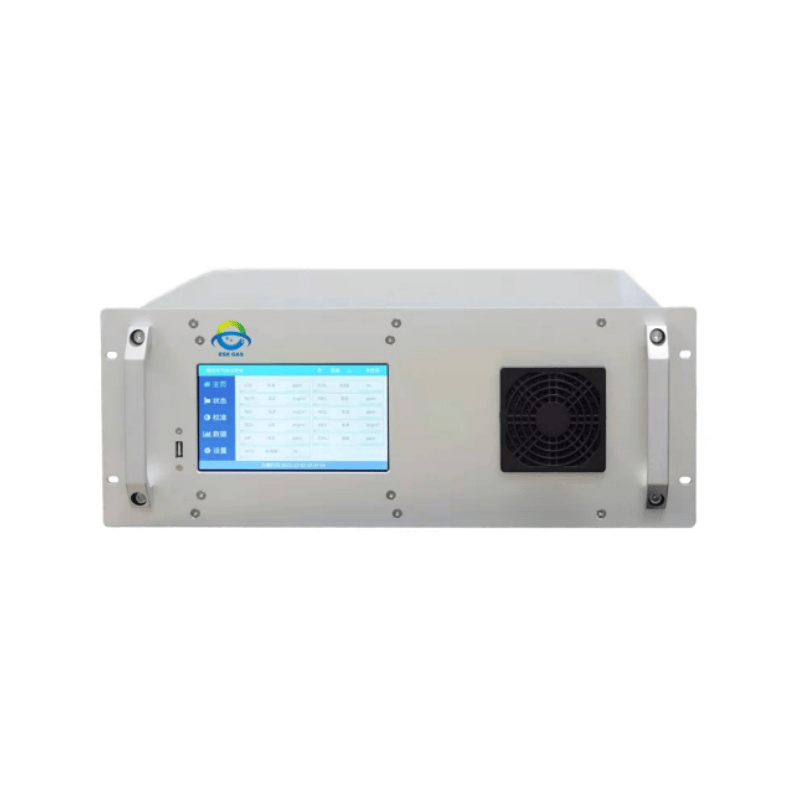
Depending on calibration and the available spectral library, lithium-ion battery off-gas analysis with FTIR may cover components such as:
- CO and CO₂.
- CH₄ and selected hydrocarbons.
- HF and HCl.
- Electrolyte-related vapours.
- Selected VOCs.
- Water vapour and other infrared-active compounds.
Hydrogen, oxygen and nitrogen do not have suitable infrared absorption behaviour for conventional FTIR measurement. Hydrogen may require a thermal-conductivity or dedicated sensor, while oxygen normally requires a paramagnetic, zirconia or electrochemical method.
For flammability assessment, total hydrocarbons may also require a dedicated method depending on the test specification and reporting objective.
How Should the Sampling System Be Designed?
Connecting an ordinary tube directly to a fire-test enclosure can produce delayed or biased results. Hot gases may cool and condense, corrosive compounds may react with unsuitable materials, and particles can contaminate the optical cell.
A reliable hot-wet gas sampling system should consider:
- Sampling location: Position the inlet where it represents the gas stream without exposing it to direct flame or excessive debris.
- Heated transport: Maintain sufficient line temperature to limit condensation of water and electrolyte vapours.
- Material compatibility: Select tubing, seals and filters that tolerate HF and other corrosive components.
- Particulate control: Protect the analyzer without removing target compounds through excessive filtration or adsorption.
- Dilution: Use controlled dilution when concentrations or temperatures exceed the analytical range.
- Response time: Minimise unnecessary line length and dead volume.
- Safe discharge: Route sampled gas to an appropriate treatment or exhaust system.
Before testing, the complete path should be checked using representative gases rather than validating only the analyzer.
How Can Gas Data Support Fire and Explosion Risk Assessment?
Concentration profiles alone do not show whether a hazardous mixture formed throughout an enclosure. Without flow, oxygen and spatial information, the data may be technically accurate but easy to misinterpret.
Vent gas composition can support risk assessment by helping laboratories:
- Identify when flammable components begin to accumulate.
- Compare gas release with pressure and temperature changes.
- Estimate the potential toxicity of battery fire effluent.
- Evaluate whether ventilation reduces accumulation.
- Provide inputs for dispersion or deflagration models.
- Compare different cell chemistries, states of charge and failure triggers.
HF gas monitoring is particularly relevant to corrosive and toxic exposure assessment, while CO, CH₄, hydrogen and hydrocarbon data support combustion-risk analysis. The final interpretation should use the complete test context rather than a single concentration threshold.
How Should Laboratories Validate FTIR Results?
Complex spectra can produce convincing numbers even when the calibration model or sampling conditions are unsuitable. Formal quality controls are therefore essential before the data is used in engineering decisions.
A validation plan should include:
- Background spectra under the actual test environment.
- Gas-specific calibration or verified analytical methods.
- Checks for water-vapour and spectral cross-interference.
- Span selection for both early venting and peak release.
- Recovery testing through the complete sample line.
- Blank and baseline tests.
- Synchronised timestamps across gas, temperature, pressure and video data.
- Documentation of detection limits, uncertainty and data gaps.
- Independent confirmation of selected compounds where necessary.
At ESEGAS, we recommend defining the target gas list, expected concentration range, moisture, temperature and test geometry before configuring an FTIR system.
What Should Laboratories Confirm Before Selecting an Analyzer?
Choosing an instrument from a general gas list may result in missing compounds, saturated readings or an unsuitable sampling system. A short application review can prevent these problems before the test program begins.
The laboratory should confirm:
- Applicable UL 9540A edition and project requirements.
- Cell chemistry and state of charge.
- Target compounds and supplementary sensors.
- Expected minimum and maximum concentrations.
- Sampling temperature and moisture.
- Required response time.
- Optical library and calibration coverage.
- Enclosure flow and dilution conditions.
- Data-interface and time-synchronisation needs.
- Safe handling of the extracted sample.
FTIR provides valuable continuous, multi-component information during battery safety testing, but its strongest use is as part of an integrated measurement package. At ESEGAS, we combine the appropriate FTIR configuration with suitable sampling and complementary gas measurements so laboratories can obtain more complete, interpretable and defensible thermal-runaway data.