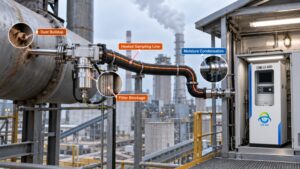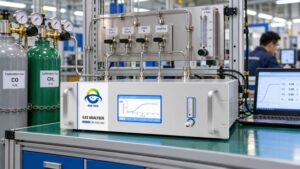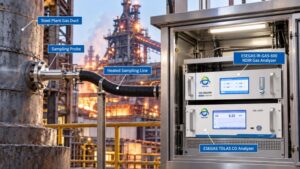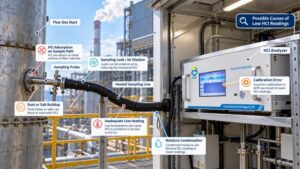




A Continuous Emissions Monitoring System (CEMS) may suddenly report low sample flow, unstable gas concentrations, or a sampling fault. In many cases, the problem begins inside the sampling probe or gas transport line rather than the gas analyzer.
Industrial flue gas often contains moisture, dust, acid gases, and condensable compounds. As the sample travels from the stack to the gas analyzer, changing temperatures and accumulated contaminants can disrupt gas flow. These problems are especially common in demanding applications such as cement production, waste incineration, steelmaking, and coal-fired power generation.
CEMS sampling lines become blocked mainly because of particulate accumulation, moisture condensation, salt deposits, or inadequate sample transport conditions. Condensation occurs when the gas or a local surface falls below the relevant dew point. Poor heating, damaged insulation, ineffective filtration, and faulty condensate drainage can make these problems worse.
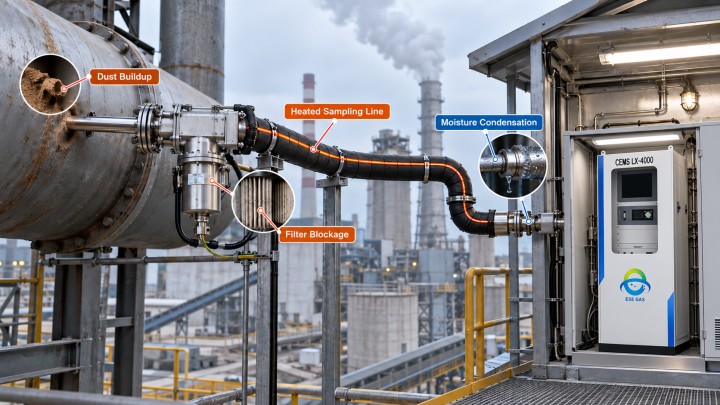
The most effective solution is to identify where the blockage or condensation begins, then correct the underlying sampling or conditioning problem.
What Causes CEMS Sampling Lines to Become Blocked?
Blockage occurs when contaminants accumulate inside a sampling component and restrict gas flow. The obstruction may develop inside the sampling probe, heated filter, transport tubing, valve, or gas conditioning unit.
The following table summarizes the main causes and their typical symptoms.
| Cause | How it affects the sampling line | Typical symptoms |
|---|---|---|
| Dust accumulation | Particulates collect in probes, filters, and tubing | Reduced flow, increasing vacuum |
| Moisture condensation | Liquid water accumulates inside cooler sections | Water alarms, unstable readings |
| Salt formation | Condensable compounds form solid deposits | Gradual restriction, frequent filter clogging |
| Heater failure | Cold spots promote condensation | Problems after shutdown or cold weather |
| Poor condensate drainage | Liquid water backs up from the cooler | Pump faults, moisture breakthrough |
| Inadequate back-purging | Deposits remain inside the probe or filter | Recurring blockage |
| Poor tubing installation | Low points retain liquid and contaminants | Repeated local blockage |
These causes are related. For example, condensation can wet dust particles, creating deposits that become harder to remove.
1. How Does Dust Accumulation Block CEMS Sampling Lines?
Dust accumulation is one of the most common reasons for reduced sample flow in industrial CEMS.
Flue gas from cement kilns, steel plants, boilers, and waste incinerators can carry substantial particulate matter. When these particles reach a sampling probe, they may accumulate around the inlet and filter surfaces.
As deposits increase, the effective flow area becomes smaller. The sampling pump must then work against greater resistance. Eventually, the flowmeter may indicate insufficient sample flow, triggering an alarm. Common contributing factors include:
- High particulate loading at the sampling point
- Damaged or overloaded probe filters
- Insufficient automatic back-purge frequency
- Inadequate purge-gas pressure or flow
- Deposits inside valves and tubing connections
Practical solution: Inspect the probe and filter first. Verify the back-purge system, then check downstream sampling components for accumulated deposits.
2. Why Does Moisture Condensation Occur Inside Heated Sampling Lines?
Condensation develops when the temperature of the gas or a contacted surface falls below the relevant dew point.
Industrial flue gas contains water vapor released during fuel combustion and industrial processes. Although the original gas may be hot, it can lose heat during extraction and transport. A heated sampling line should maintain adequate temperature throughout the transport path. However, a single cold spot can allow moisture to condense.
Typical causes include damaged heating elements, poor insulation, loose temperature sensors, and unheated connectors. For example, a heated line controller may display 150°C while an exposed connector operates at a much lower temperature. If that connector falls below the water dew point, liquid moisture can accumulate locally.
For acid-containing flue gas, the relevant condensation conditions may be more complicated. Sulfuric acid condensation can occur above the water dew point, depending on gas composition.
Practical solution: Verify temperatures along the entire sampling path, including the probe outlet, fittings, valves, and analyzer-side connections.
3. How Do Salt Deposits Cause Sampling-Line Blockage?
Salt formation can create persistent restrictions even when the sampling line contains little visible liquid water.
In waste incineration and NOx control applications, flue gas may contain ammonia and hydrogen chloride. Under suitable conditions, these gases can form ammonium chloride:

Solid deposits can accumulate inside cooler components, filters, and narrow passages. Consequently, operators may observe recurring blockage despite regular dust-filter replacement. These deposits can also change the composition of the sampled gas.
Practical solution: Evaluate ammonia slip, HCl concentration, sample temperature, and the possibility of ammonium salt formation. Maintain temperatures appropriate for the gas composition and validated sampling design.
4. Why Can Poor Condensate Drainage Block a CEMS System?
In a cold-dry CEMS, a sample gas cooler intentionally removes water vapor through controlled condensation. The resulting liquid must drain continuously. If the condensate trap or peristaltic pump fails, water may accumulate inside the cooler and associated tubing. Eventually, liquid can restrict flow or reach downstream filters, pumps, and gas analyzers. ESEGAS’s maintenance guidance identifies condensate-pump inspection as an essential part of reliable CEMS operation.
Practical solution: Inspect the cooler drain, condensate tubing, and peristaltic pump. Replace worn pump tubing and verify proper drainage without allowing unwanted ambient air into the sample path.
Why Does Condensation Cause Incorrect CEMS Gas Readings?
Condensation affects more than sample flow. It can also change the gas composition before measurement. Water-soluble components, including HCl, NH₃, and SO₂, may dissolve into condensed moisture. As a result, the gas analyzer can receive a sample containing less of the target gas than the stack actually contains.
This creates a negative measurement bias, even when the gas analyzer itself operates correctly. For example, a CEMS measuring HCl in waste incineration flue gas may report unexpectedly low concentrations if moisture condenses inside an unheated section. Meanwhile, condensation can promote corrosion, contamination, and further blockages.
The EPA’s published CEMS technical guidance identifies absorption into condensate, adsorption onto sampling surfaces, and particulate fouling as potential sources of measurement error. Therefore, eliminating condensation is essential for both measurement reliability and component protection.
What Is the Difference Between Water Dew Point and Acid Dew Point?
The water dew point is the temperature at which water vapor begins to condense under specified gas conditions. The acid dew point describes condensation behavior involving acid-forming compounds. Sulfuric acid dew-point behavior is especially relevant to sulfur-containing flue gas.
These temperatures are not necessarily the same. For example, keeping a sampling line above the water dew point does not automatically prevent every form of acid condensation.
Engineers should determine the relevant condensation limits from the actual gas composition and measurement requirements. A universal heating temperature cannot be recommended for every CEMS installation.
How Can Engineers Identify the Location of a CEMS Blockage?
The fastest troubleshooting method is to examine the sampling path in the direction of gas flow. Start at the probe and continue through the filter, heated transport line, conditioning unit, sampling pump, and analyzer inlet. Pressure, flow, and temperature measurements can help distinguish restrictions from condensation or leakage.
What Do Common CEMS Fault Symptoms Indicate?
| Observed symptom | Likely cause | First inspection point |
|---|---|---|
| Sample flow gradually decreases | Dust buildup or filter fouling | Probe filter |
| Sample flow suddenly drops | Severe blockage, pump failure, or closed valve | Sampling pump and valves |
| Vacuum increases while flow decreases | Upstream restriction | Probe and sampling line |
| Moisture alarm activates | Cooler malfunction or condensate accumulation | Gas cooler and drain |
| Readings become unusually low | Condensation, absorption, or air leakage | Heated line and fittings |
| Problems occur after cold weather | Heater failure or damaged insulation | Exposed line sections |
| Blockage returns after cleaning | Persistent dust loading or salt formation | Probe, purge system, gas chemistry |
A reduced flow reading does not always indicate blockage. Pump failure or leakage can produce similar symptoms. Therefore, engineers should compare flow measurements with system pressure and vacuum trends.
How Can Plants Prevent Condensation and Blockage in CEMS Sampling Lines?
Preventive design combines effective filtration, temperature control, condensate management, and routine inspections. The right approach depends on whether the CEMS uses hot-wet or cold-dry sample conditioning.
How Do Heated Sampling Lines Prevent Condensation?
A heated sampling line maintains gas temperature above the required condensation threshold during transport. For effective protection, engineers should verify more than the controller setpoint. They should also examine insulation, heater continuity, temperature-sensor placement, exposed fittings, and line routing. A line operating normally in summer may develop condensation problems during winter if insulation is inadequate.
Engineering recommendation: Specify heating based on the relevant dew points, process composition, and analyzer requirements. Monitor temperature at vulnerable locations and investigate unexpected differences.
How Does Automatic Back-Purging Reduce Blockage?
Automatic back-purging uses a controlled flow of purge gas to dislodge deposits from the sampling probe or filter. It is particularly useful in high-dust applications, such as cement kilns and coal-fired boilers.
However, back-purging cannot compensate for an incorrectly selected filter or severely contaminated sampling path. Purge pressure, duration, frequency, and gas quality should match the equipment design. Regular verification also helps identify damaged valves, blocked purge passages, and insufficient purge-gas supply.
How Does a Sample Gas Cooler Protect Downstream Gas Analyzers?
In cold-dry CEMS, the sample gas cooler lowers gas temperature under controlled conditions to remove moisture. A condensate pump then removes the collected liquid. This arrangement protects analyzers that require dry samples. However, the cooling process may also remove certain water-soluble gases.
Therefore, engineers must confirm that the conditioning method preserves the target components within the measurement requirements. For measurements involving HCl, NH₃, and certain other soluble gases, a heated hot-wet approach may be more appropriate.
Which CEMS Sampling Solutions Does ESEGAS Provide?
ESEGAS supplies continuous emissions monitoring systems and gas sampling components for industrial applications. Its solutions include heated sampling probes, sample transport, gas conditioning equipment, and gas analyzer integration. The selection depends on flue gas temperature, moisture content, dust loading, target pollutants, and monitoring requirements.
How Does the ESEGAS Gas Sampling Probe Reduce Blockage?
The ESEGAS Gas Sampling Probe combines electrical heating, particulate filtration, and automatic back-purging. Its design addresses two common failure mechanisms: dust accumulation and premature condensation.
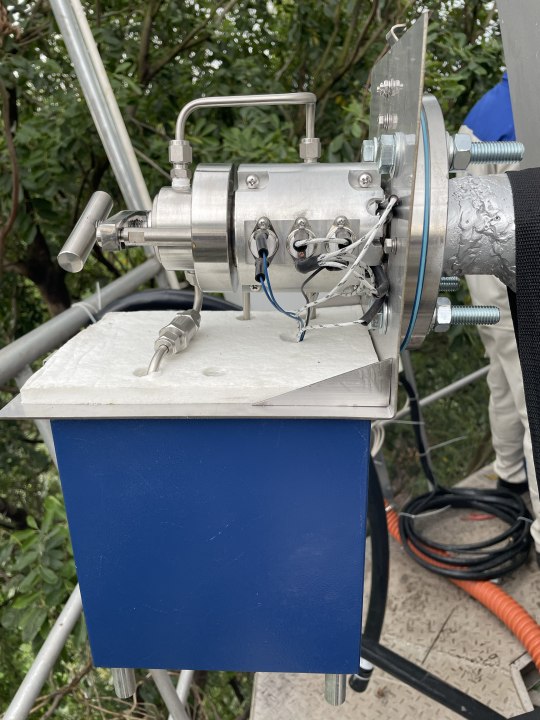
The published configuration includes:
| Parameter | ESEGAS specification |
|---|---|
| Probe temperature control | 150°C ±10°C |
| Filtration | 2 μm ceramic microfilter |
| Cleaning | PLC-controlled automatic back-purge |
| Installation | Flange-mounted sampling assembly |
| Applications | CEMS, cement, steel, power generation, waste incineration |
How Can ESEGAS Gas Conditioning Components Prevent Moisture Problems?
ESEGAS offers gas conditioning accessories, including Bühler sample gas coolers, filters, pumps, and condensate-removal components. For example, its available accessories include the RC1.1, RC1.2+, and TC-Standard sample gas coolers, alongside CPsingle and CPdouble peristaltic pumps. These components support different functions:
- Sample gas coolers: Remove moisture under controlled conditions for suitable cold-dry applications.
- Peristaltic pumps: Drain condensate while helping maintain sample-system integrity.
- Gas filters: Reduce particulate contamination before it reaches sensitive analyzer components.
- Sampling pumps: Maintain the required sample flow through the conditioning system.
Correct component selection depends on gas compatibility, required flow, condensate loading, and the pollutants being measured.
When Should Plants Choose ESEGAS Hot-Wet or Cold-Dry CEMS?
The ESEGAS Continuous Emissions Monitoring System can be configured using hot-wet or cold-dry sampling approaches.
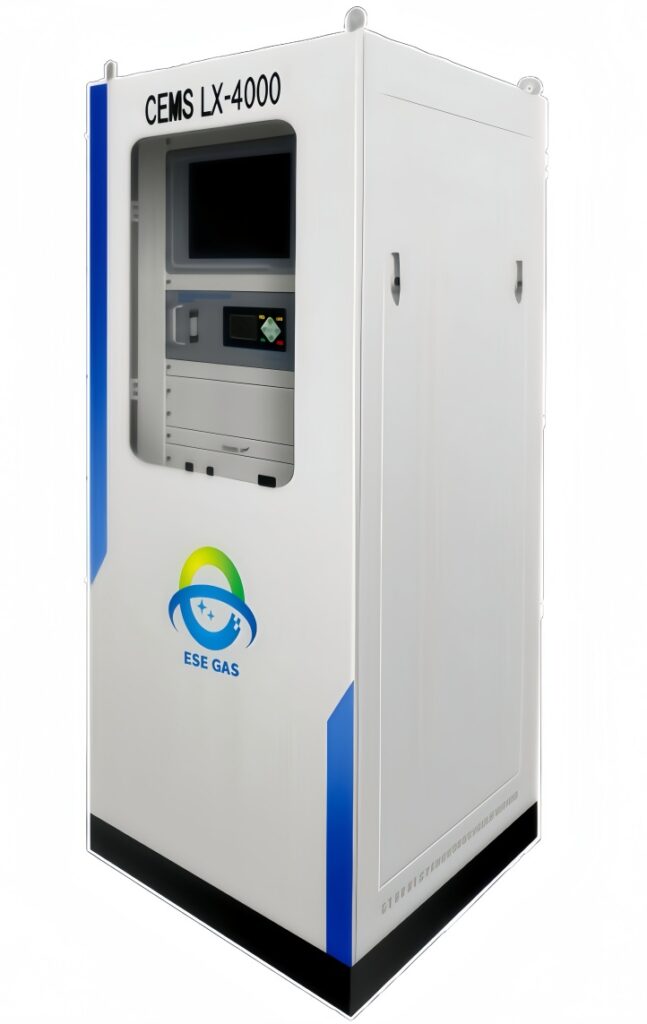
| Consideration | Hot-Wet CEMS | Cold-Dry CEMS |
|---|---|---|
| Sampling principle | Maintain the gas in a heated condition | Remove moisture through controlled conditioning |
| Main moisture-control method | Prevent condensation along the heated measurement path | Condense and drain water at the intended conditioning stage |
| Main advantage | Helps preserve soluble gas components | Provides a conditioned sample for dry-gas analyzers |
| Main maintenance concern | Heater integrity and heated-path deposits | Cooler performance and condensate drainage |
| Suitable applications | Moisture-sensitive multi-gas analysis | Compatible conventional extractive gas monitoring |
A hot-wet system is not automatically free from blockage. Dust and salt deposits can still affect heated components. Similarly, cold-dry CEMS can perform reliably when the conditioning method is compatible with the target gases.
For facilities monitoring several reactive gases, the ESEGAS FTIR CEMS is another relevant option within an appropriately configured heated extractive system.
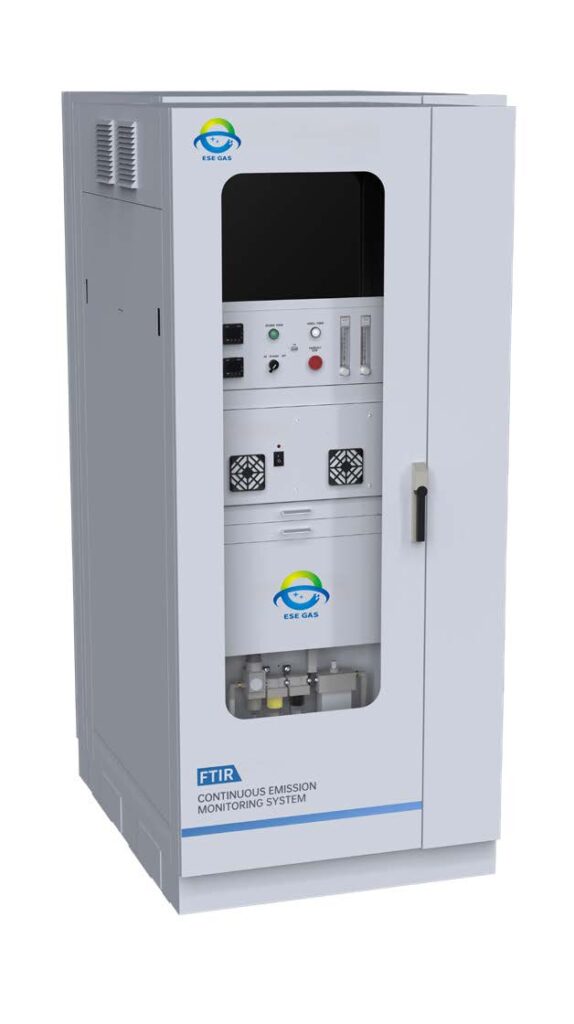
The final solution should preserve sample integrity and meet the specified measurement requirements.
Frequently Asked Questions About CEMS Sampling-Line Blockage
Can a CEMS sampling line become blocked even when heating works normally?
Yes. Dust accumulation, ammonium salts, filter fouling, and mechanical restrictions can block a line even without water condensation. Heating alone cannot remove particulate matter or prevent every chemical deposit.
What temperature should a CEMS heated sampling line maintain?
There is no universal setting. The required temperature depends on the gas composition, water and acid dew points, target pollutants, and analyzer configuration. Follow the validated sampling-system design.
Why does a CEMS frequently report low sample flow?
Common causes include clogged filters, blocked probes, pump faults, closed valves, and restricted tubing. Compare sample flow with vacuum and pressure measurements to identify the likely source.
Can condensation make SO₂ or HCl readings artificially low?
Yes. SO₂ and HCl can dissolve into condensed water. This reduces their gas-phase concentration before the sample reaches the analyzer, potentially producing falsely low measurements.
Does automatic back-purging completely prevent CEMS blockage?
No. Back-purging reduces certain particulate deposits, but it cannot correct poor heating, failed condensate drainage, incompatible materials, or every form of salt buildup.
Conclusion
CEMS sampling-line blockage and condensation usually result from problems within the sampling and conditioning system. Dust accumulation, cold spots, salt formation, and condensate drainage failures can restrict gas flow and alter pollutant concentrations. Therefore, effective prevention requires correct filtration, reliable heating, appropriate gas conditioning, and regular inspections.
Engineers should monitor the complete measurement path rather than focusing only on the gas analyzer. ESEGAS provides heated sampling probes, gas conditioning components, and configurable CEMS solutions for demanding industrial applications.
Need to reduce recurring CEMS blockage or condensation? Contact ESEGAS to discuss sampling-system design, gas conditioning, and maintenance requirements for your plant.