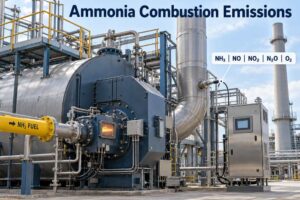




Ammonia contains no carbon, but that does not make its exhaust automatically clean or easy to interpret. Poor combustion, inappropriate staging or ineffective after-treatment can shift nitrogen between several gaseous products. If a project measures only one nitrogen oxide value, it may miss unreacted fuel or another climate-relevant component.
Ammonia combustion emissions monitoring should normally cover NH₃, NO, NO₂, N₂O and O₂. CO, CO₂, H₂, water vapour and other components should be added according to the co-fired fuel, combustion technology, after-treatment system and reporting objective. Concentration data should be combined with flow and operating information when mass emissions are required.
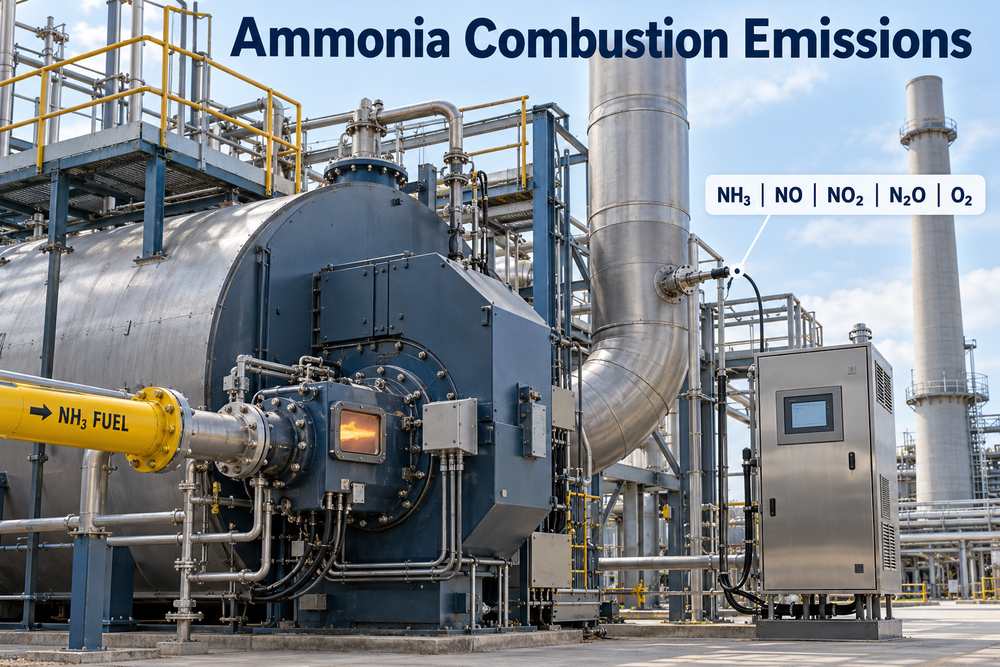
The final gas list differs between a research combustor, an industrial boiler and a power-generation turbine. Measurement points should therefore be mapped to specific questions: Is the fuel burning completely? Where are nitrogen compounds forming? Is the control system working? What is released at the final stack?
Why Must Several Nitrogen Compounds Be Measured Together?
Reducing one measured pollutant can appear successful while another nitrogen-containing emission rises. This creates a control problem that cannot be diagnosed from a single analyzer channel.
The main components include:
| Component | What it can indicate |
|---|---|
| NH₃ | Incomplete fuel conversion or reagent breakthrough |
| NO | Major nitrogen-oxide product under many combustion conditions |
| NO₂ | Oxidation conditions and total NOₓ composition |
| N₂O | Incomplete conversion pathways and greenhouse-gas impact |
| O₂ | Excess air, staging and sample dilution |
| H₂O | Combustion product and sampling basis |
| H₂ | Fuel blending, cracking or incomplete conversion where relevant |
| CO and CO₂ | Carbon-containing pilot or co-fired fuel behaviour |
Unburned ammonia can increase when flame stability deteriorates or when reaction time and temperature are inadequate. At the same time, fuel-bound NOx may form from nitrogen already present in the ammonia rather than only from atmospheric nitrogen.
Nitrous oxide formation should be evaluated separately from NO and NO₂. A measurement labelled “NOₓ” does not automatically include N₂O, and the technologies used for the two measurements may be different.
How Does the Fuel Configuration Affect the Gas List?
Treating every ammonia project as pure-ammonia combustion can leave important carbon-containing or hydrogen-related components unmeasured.
Possible configurations include:
- Pure ammonia firing.
- Ammonia–hydrogen blends.
- Ammonia cracked immediately before combustion.
- Ammonia–natural gas co-firing.
- Ammonia–coal co-firing.
- Ammonia used with another pilot fuel.
The ammonia co-firing ratio should be recorded with gas data because it affects flame behaviour, exhaust composition and the contribution from the second fuel.
Where natural gas, coal or another carbonaceous fuel is present, CO and CO₂ help assess combustion and carbon emissions. Where hydrogen is added or generated through partial cracking, H₂ measurement may support fuel control and safety analysis.
Fuel flow, composition, heating value and auxiliary-fuel use should be synchronised with the emissions record.
Where Should Measurements Be Taken?
A final-stack analyzer can show what is released but may not reveal where the nitrogen chemistry changed. Measurements around the combustion and treatment stages provide stronger diagnostic information.
Potential locations include:
- Fuel supply: Confirms ammonia concentration, blend composition and flow where required.
- Combustor or furnace outlet: Characterises primary combustion products.
- Boiler or heat-recovery outlet: Shows the effect of cooling and secondary reactions.
- DeNOx inlet: Establishes the untreated load entering the control system.
- DeNOx outlet: Evaluates treated gas and reagent breakthrough.
- Final stack: Provides the atmospheric release measurement.
- Bypass and startup vents: Identifies gas not routed through normal treatment.
- Equipment areas: Uses separate safety detectors for possible NH₃ or H₂ leaks.
For an ammonia-fired gas turbine, the sampling arrangement must also account for high exhaust flow, rapid load changes and any heat-recovery or after-treatment equipment downstream.
Process analyzers and area safety detectors have different ranges and responsibilities. They may exchange alarms, but neither should be assumed to replace the other.
Which Analytical Technologies Are Suitable?
NH₃, NO, NO₂, N₂O and O₂ do not all respond optimally to one measurement principle. Multi-technology systems may therefore be required.
Possible approaches include:
- FTIR: Measures multiple configured infrared-active gases, including possible NH₃, N₂O, water vapour, CO and CO₂ channels.
- UV-DOAS: Suitable for configured nitrogen-oxide or ammonia measurements where the gas matrix has been validated.
- Chemiluminescence: Commonly used for NO and total NOₓ measurement with the appropriate converter configuration.
- TDLAS: Provides selective NH₃ measurement at suitable ranges and sample conditions.
- Paramagnetic, zirconia or electrochemical analysis: Options for O₂.
- NDIR: Suitable for CO and CO₂ where carbon-containing fuels are used.
- Gas chromatography or mass spectrometry: Supports research, detailed composition and method confirmation.
- Flow measurement: Converts concentration into release rate.
A hot-wet FTIR system can retain water vapour and reactive components in the sample, but its calibration model must account for spectral overlap and the expected concentration range. It should not be assumed to meet a compliance method merely because it can display the required compounds.
At ESEGAS, we can configure FTIR, UV, laser, infrared and oxygen channels around the actual combustion system. The final selection requires confirmation of gas ranges, moisture, pressure, interference and validation requirements.
How Should the Sample System Handle NH₃ and Moisture?
Cooling a wet sample can dissolve or adsorb ammonia before it reaches the analyzer. NH₃ may also react on contaminated or unsuitable surfaces, creating a delayed and biased result.
The sample system should consider:
- Heated extraction where condensation must be avoided.
- A controlled and documented sample temperature.
- Materials suitable for wet ammonia-containing exhaust.
- Short tubing and limited dead volume.
- Filtration that does not retain the target gas.
- Stable pressure and sample flow.
- Safe disposal of the analyzed stream.
- Calibration through the normal sample path.
- Recovery testing at low and elevated NH₃ concentrations.
- Purging after calibration or high-concentration exposure.
If the sample is dried, the project should demonstrate how NH₃ and other soluble components are preserved or corrected. If it is measured wet, concentration, flow and reference-condition calculations must use compatible bases.
How Should After-Treatment Performance Be Assessed?
A low outlet NOₓ value may result from successful treatment, dilution or a change in combustor load. At the same time, excessive reagent addition can increase ammonia at the outlet.
For post-combustion DeNOx assessment, operators may need:
- Inlet and outlet NO and NO₂.
- Inlet and outlet NH₃.
- N₂O where the process or catalyst may affect it.
- Corresponding gas flow.
- O₂ and moisture.
- Catalyst temperature.
- Reagent flow.
- Pressure differential.
- Bypass and operating status.
Performance should be evaluated using corresponding mass quantities when flow changes significantly. Concentration reduction alone can overstate removal if dilution occurs between the measurement points.
The monitoring system should also distinguish ammonia used as fuel from ammonia injected as a treatment reagent. Without separate flow records, it may be impossible to identify the cause of the final NH₃ signal.
How Should Load Changes and Startup Be Covered?
A stable full-load test may not represent the operating periods with the greatest emissions risk. Ignition, warm-up, fuel switching and rapid load movement can change flame stability and treatment temperature.
A combustor load transition assessment should record:
- Fuel and blend flows.
- Burner or combustor load.
- O₂ and air staging.
- Ignition and pilot status.
- NH₃, NO, NO₂ and N₂O trends.
- After-treatment inlet temperature.
- Reagent injection.
- Analyzer response time.
- Startup, shutdown and trip events.
The measurement range must cover normal operation without saturating during an abnormal event. This may require multiple ranges, separate high- and low-level channels or documented dilution.
Time delay through the sample line should be measured so that gas peaks can be connected to the correct control-system event.
How Should Emissions Be Reported and Validated?
Concentration data cannot by itself compare two systems with different exhaust flows, loads or fuel mixtures.
Depending on the project, emissions may be expressed as:
- Mass per unit time.
- Mass per unit electricity or useful heat.
- Mass per unit fuel energy input.
- Concentration corrected to a defined oxygen level.
- Total mass over a test or operating period.
- Conversion or removal efficiency across a control device.
The selected basis, correction equations and data exclusions should be documented. Quality controls should include zero and span verification, multipoint checks where appropriate, interference testing, complete-path response tests, flow verification and independent reference measurements.
Raw analyzer readings, calculated values, validity flags, fuel data and maintenance records should be retained with synchronised timestamps.
Ammonia combustion can reduce direct carbon emissions at the burner while creating a demanding nitrogen-measurement problem. At ESEGAS, we recommend monitoring NH₃, NO, NO₂, N₂O and O₂ as a coordinated set, then adding fuel-specific components and flow information. This gives boiler, turbine and research projects a clearer basis for controlling combustion, evaluating after-treatment and documenting the final exhaust.