



NEWS UPDATE
The UK Environment Agency updated its guidance on continuous emissions monitoring on September 14, 2026. The update applies to England and clarifies how operators should select, install, calibrate, and maintain CEMS used for compliance monitoring.
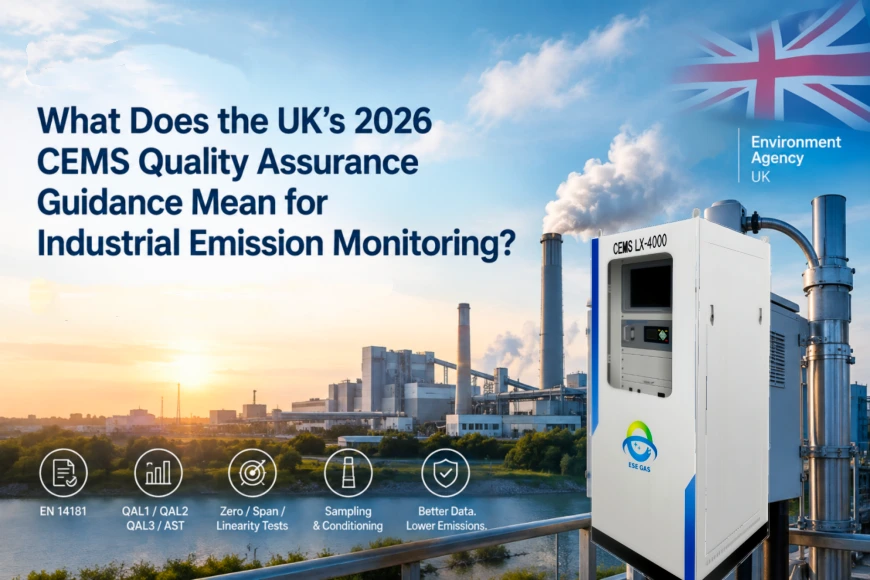
What Has Changed for CEMS?
The guidance places EN 14181 at the center of CEMS quality assurance. It covers QAL1, QAL2, QAL3, and the Annual Surveillance Test (AST).
For new CEMS, operators must select equipment with suitable certification ranges. The system must also support zero, span, and linearity tests after installation.
The guidance uses an ELV multiplier approach when assessing measurement ranges. For waste incineration, the lowest certified range should not exceed 1.5 times the daily average emission limit value. For large combustion plants and other processes, the multiplier is generally 2.5.
This point matters when selecting an gas analyzer. A wide measurement range may look flexible, but it may not provide the required performance near a low emission limit.
Why Do Sampling Systems Matter?
CEMS performance does not depend on the analyzer alone. For extractive CEMS, the sampling system can directly affect measurement quality. Sampling lines, heated valves, manifolds, dryers, and other components must maintain the required performance.
The Environment Agency allows some flexibility in sampling-system design. However, alternative components need evidence that they meet the required performance specifications.
That makes gas sampling and conditioning an important part of CEMS engineering. Poor sample transport can introduce moisture effects, condensation, leaks, or measurement delays before the gas even reaches the analyzer.
QAL3 Brings More Attention to Daily Performance
The guidance also emphasizes ongoing quality control. Under QAL3, operators regularly track zero and span performance. Control charts help identify measurement drift and determine when corrective action may be necessary.
The guidance recommends considering factors such as ambient temperature, stack pressure, voltage effects, cross-sensitivity, and detection limits when assessing analyzer performance.
In practical terms, CEMS maintenance is not just about repairing an analyzer after a failure. Operators need reliable data to understand how the system behaves over time.
What Does This Mean for CEMS Selection?
The 2026 guidance reinforces a simple engineering principle: CEMS should be designed around the application, not selected only by analyzer specifications.
Engineers need to consider the target gases, emission limits, measurement range, stack conditions, sampling location, gas temperature, moisture, calibration requirements, and long-term maintenance.
ESEGAS sees the same principle in CEMS projects. A complete monitoring system needs the analyzer, sampling probe, heated sampling line, gas conditioning unit, calibration system, flow measurement, and data handling to work together.
For extractive applications, ESEGAS can configure gas analysis systems around different measurement technologies, including NDIR, UV-DOAS, TDLAS, FTIR, zirconia, and electrochemical sensing. The final configuration depends on the gases, concentration range, process conditions, and monitoring requirements.
ESEGAS Technical Perspective
The UK’s updated guidance highlights a broader trend in industrial emission monitoring: CEMS performance increasingly depends on the complete measurement chain.
Gas analyzer selection is only the starting point. Sampling, conditioning, calibration, verification, and long-term quality control all influence the final measurement result.
For industrial plants planning a new CEMS or upgrading an existing system, these requirements should be considered during system design rather than after installation.