



Biogas and syngas may both be combustible process gases, but their compositions, origins, contaminants, and monitoring goals are different. Choosing the right analyzer therefore starts with the gas itself, not the analyzer name.
A biogas analyzer typically measures CH₄, CO₂, H₂S, and sometimes O₂, while a syngas analyzer commonly measures CO, H₂, CO₂, CH₄, and O₂. The correct configuration depends on gas composition, process conditions, measurement range, and application.
That difference becomes important when engineers specify an online gas analyzer. A unit designed around methane and carbon dioxide may not provide the hydrogen or carbon monoxide measurement required for syngas. Likewise, a syngas analyzer may need a different configuration when H₂S, condensation, or biogas upgrading becomes the main concern.
What Is a Biogas Analyzer Used to Measure?
A biogas analyzer continuously measures the composition of gas produced by processes such as anaerobic digestion, landfill gas recovery, and biogas upgrading.
According to the U.S. EPA, biogas from anaerobic digestion typically contains 50–75% methane, along with CO₂, H₂S, water vapor, and trace gases. Its exact composition varies with feedstock and process conditions. For this reason, a typical biogas monitoring system focuses on several key parameters:
| Gas | Why is it measured? |
|---|---|
| CH₄ | Indicates methane concentration and energy content |
| CO₂ | Helps evaluate gas quality and upgrading performance |
| H₂S | Supports corrosion control, equipment protection, and safety monitoring |
| O₂ | Helps identify air ingress where required |
| H₂ | Application-dependent and not always a primary biogas parameter |
| H₂O | Important for sampling and gas-conditioning design |
The measurement goal also changes with the application. For example, an anaerobic digester may need continuous CH₄ and CO₂ monitoring to track gas production. A biogas upgrading system may place greater emphasis on CO₂ removal and final biomethane quality. Therefore, “biogas analyzer” describes an application, not one fixed analyzer configuration.
ISO 20675:2018 covers biogas production, conditioning, upgrading, and utilization and remains a current standard after its 2025 review. It also recognizes applications including wastewater treatment, waste plants, landfill sites, and food and beverage facilities. That broad application range explains why engineers should define the gas composition before selecting the analyzer.
What Is a Syngas Analyzer Used to Measure?
A syngas analyzer measures the composition of synthesis gas generated by processes such as coal gasification, biomass gasification, reforming, and other thermochemical conversion processes.
Syngas has a different chemical profile from raw biogas. The U.S. Department of Energy describes synthesis gas from gasification as a mixture primarily containing hydrogen, carbon monoxide, and CO₂, with smaller amounts of gases such as methane.
Consequently, a syngas analyzer often needs to measure: CO, H₂, CO₂, CH₄, and O₂. Other hydrocarbons when required by the process. The reason is straightforward: these gases provide information about the gasification or reforming process itself. For example, CO and H₂ are often central to syngas composition. CH₄ can provide useful information about gasification or reforming performance, while CO₂ helps engineers understand carbon conversion and downstream process conditions. This makes syngas analysis more than a simple fuel-gas measurement.
Why Are Biogas and Syngas Different Analyzer Applications?
The main difference is how the gas is produced and what information the plant needs from it. Biogas normally comes from biological decomposition. Syngas usually comes from thermochemical conversion. That difference changes the gas matrix and, in turn, changes the analyzer configuration.
Biogas
Organic feedstock → Anaerobic digestion → Biogas → CH₄ + CO₂ + H₂S + H₂O
The analyzer therefore focuses on gas quality, methane concentration, contaminants, and process performance.
Syngas
Coal/biomass/other feedstock → Gasification or reforming → Syngas → CO + H₂ + CO₂ + CH₄ + other gases
Here, the analyzer often needs to characterize the combustible gas mixture and support process control.
The important point is that neither gas has one universal composition. Feedstock, reactor design, operating temperature, pressure, air or oxygen supply, steam addition, and downstream treatment can all change the measured gas concentrations. Therefore, engineers should select an gas analyzer from the actual gas composition and process conditions.
A multi-gas analyzer may be technically capable of measuring gases from both applications. However, the measurement ranges, detector selection, sampling system, and gas conditioning may need to change.
What Is the Difference Between a Biogas Analyzer and a Syngas Analyzer in Practice?
The easiest way to understand the difference is to look at the measurement job rather than the product name.
| Selection Factor | Biogas Analyzer | Syngas Analyzer |
|---|---|---|
| Main process | Anaerobic digestion / biogas recovery | Gasification / reforming |
| Main gases | CH₄, CO₂ | CO, H₂, CO₂, CH₄ |
| H₂S importance | Often high | Process-dependent |
| H₂ importance | Usually application-dependent | Often high |
| Moisture | Important | Important |
| Dust | Application-dependent | Often important in raw syngas |
| Tar | Usually less dominant | Can be significant |
| Typical technology | NDIR + application-specific sensors | NDIR + TCD + O₂ sensing |
| Main purpose | Gas quality and process monitoring | Syngas composition and process monitoring |
| Sampling design | Moisture/H₂S management | Dust/tar/moisture management |
The table does not mean that every plant follows exactly the same pattern. Instead, it provides a starting point for selecting the analyzer architecture.
How Does ESEGAS Configure Gas Analyzers for Syngas and Biogas Applications?
ESEGAS configures gas analyzers according to the gas composition, measurement range, and operating conditions of each application. Instead of using one fixed sensor configuration, ESEGAS combines different sensing technologies to match the characteristics of biogas and syngas.
How Does ESEGAS Configure a Biogas Analyzer?
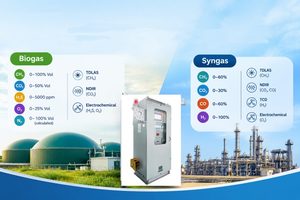
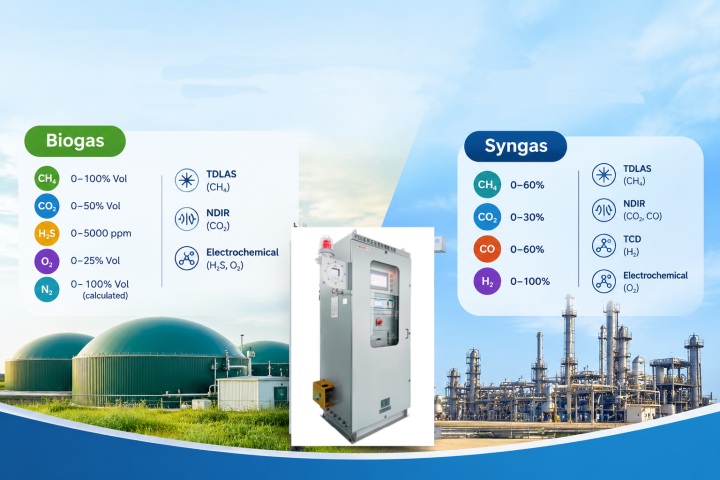
For biogas monitoring, ESEGAS combines CH₄-TDLAS laser sensing, CO₂-NDIR infrared sensing, and electrochemical detection for H₂S and O₂, supported by digital signal processing for stable multi-gas measurement.
A typical configuration measures:
CH₄: 0–100% Vol
CO₂: 0–50% Vol
H₂S: 0–5000 ppm
O₂: 0–25% Vol
N₂: 0–100% Vol, calculated
This configuration is suitable for monitoring key biogas components and contaminants. CH₄ and CO₂ indicate gas composition, while H₂S helps monitor corrosive contaminants and O₂ can indicate air ingress.
How Does ESEGAS Configure a Syngas Analyzer?
Syngas typically contains a wider range of combustible gases, so ESEGAS combines multiple detection technologies:
CH₄: TDLAS laser sensor
CO₂ / CO: NDIR infrared sensor
H₂: MEMS-based TCD sensor
O₂: Electrochemical sensor
A typical measurement configuration includes:
CH₄: 0–60%
CO₂: 0–30%
CO: 0–60%
H₂: 0–100%
This multi-technology design allows the analyzer to measure the major components of syngas while matching each gas with an appropriate detection principle.
Biogas and syngas have different gas matrices, so their analyzer configurations should not be treated as interchangeable. ESEGAS selects the sensing technology and measurement range according to the target gases and actual process requirements. The measuring ranges above are for reference only. ESEGAS can customize measurement ranges according to the user’s actual application requirements.
Conclusion
A biogas analyzer and a syngas analyzer serve different measurement needs because their gas matrices and processes differ. Biogas monitoring usually emphasizes CH₄, CO₂, and H₂S, while syngas monitoring often requires CO, H₂, CO₂, CH₄, and O₂. The right solution depends on the complete gas composition and sampling conditions.