



A geothermal plant may maintain steady steam flow and electrical output while changes in reservoir chemistry, air leakage, or gas-removal performance develop in the background. If these changes are not measured, corrosion, odour complaints, treatment problems, and environmental releases may be recognised only after they have become operational issues. Gas analysis gives operators a direct view of the volatile components moving through the steam cycle.
Geothermal plants should generally prioritise H₂S, CO₂ and CH₄ in non-condensable streams. Oxygen can indicate air ingress, while hydrogen, nitrogen, ammonia, mercury or SO₂ may be relevant at particular resources or treatment stages. The final gas list must reflect the reservoir, power-cycle design, abatement process, permit and monitoring objective.

Not every geothermal facility releases gas through the same path. Flash-steam, dry-steam and binary configurations have different separation and containment arrangements, so measurements should be designed around the actual flow diagram rather than copied from another power plant.
Where Do Non-Condensable Components Enter the Process?
When geothermal fluid is depressurised or steam is condensed, dissolved or entrained gases may separate from the water. Geothermal non-condensable gases can then accumulate in condensers, reduce vacuum performance or pass into a treatment, reinjection or discharge system.
Common components can include:
| Component | Possible significance |
|---|---|
| H₂S | Environmental, odour, corrosion, treatment and occupational concern |
| CO₂ | Major component at many resources and relevant to greenhouse-gas accounting |
| CH₄ | Resource characterisation and greenhouse-gas assessment |
| N₂ | Reservoir or air-ingress information |
| O₂ | Air leakage, dilution and equipment-condition indication |
| H₂ | Resource chemistry and selected process or safety applications |
| Water vapour | Sampling basis, condensation and mass-flow correction |
| Other trace components | Selected according to site chemistry and permit requirements |
Composition is site-specific and may change as wells, steam fields or operating conditions change. Periodic laboratory speciation is useful for defining the permanent analyzer channels.
Which Gases Matter for Environmental Monitoring?
Measuring only H₂S can address a major local concern but leave the plant without the information needed for greenhouse-gas reporting or treatment diagnostics. The monitoring scope should be linked to each environmental question.
Possible priorities include:
- H₂S: Track untreated and final releases where required.
- CO₂: Quantify direct carbon-dioxide emissions from separated gas.
- CH₄: Determine whether the resource produces a material methane component.
- SO₂: Monitor where an oxidation or combustion stage can convert sulfur compounds into SO₂.
- Ammonia or mercury: Evaluate only where resource characterisation or permit conditions show relevance.
- Gas flow: Combine with concentration when a mass-emission rate is needed.
A measured H₂S concentration at the treatment inlet should not be reported as a stack result. Sampling location and gas routing must remain explicit in every data record.
Where Should Geothermal Gas Samples Be Taken?
One convenient sample point cannot describe the reservoir, vacuum system, treatment efficiency and atmospheric release simultaneously. Condensation, air leakage and chemical treatment can substantially change composition between locations.
A layered plan may include:
- Production-well or steam-field sampling: Characterises differences between wells and supports reservoir studies.
- Steam separator outlet: Evaluates gas entering the steam cycle.
- Condenser extraction line: Supports condenser off-gas monitoring and vacuum-system control.
- Ejector or vacuum-pump discharge: Shows gas actually transferred to treatment or release.
- Abatement inlet and outlet: Supports performance assessment.
- Reinjection line: Confirms the composition and quantity returned underground where applicable.
- Final release point: Provides data for permit or inventory calculations.
- Plant boundary or community locations: Evaluates ambient impact.
- Occupied and enclosed areas: Provides independent safety alarms.
Steam ejector gas analysis should be time-aligned with unit load, condenser pressure, well selection and treatment status. Without this context, a changing concentration may be mistaken for changing total emissions.
Which Technologies Are Suitable for the Main Components?
Using an instrument designed for dry combustion gas on a wet geothermal stream can create unstable readings and excessive maintenance. The measurement principle and sample interface must be selected together.
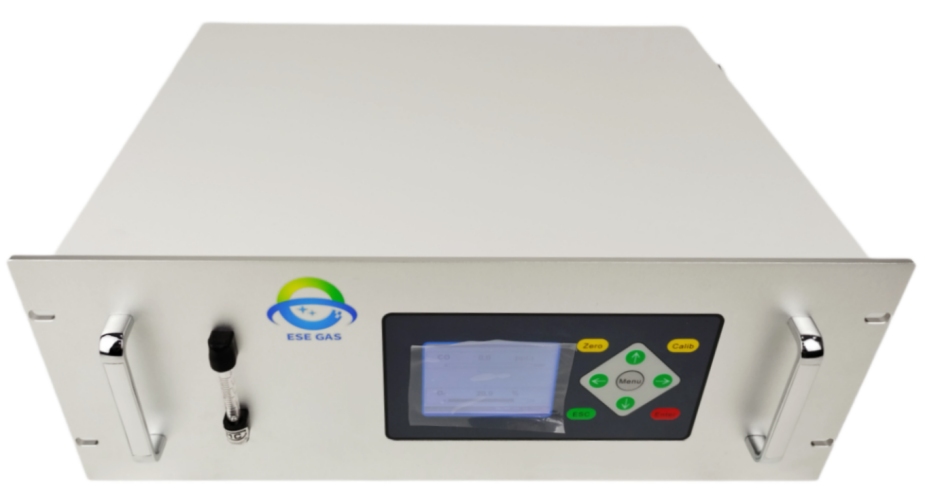
Possible analytical channels include:
- UV-DOAS: Can measure H₂S in a validated gas matrix and range.
- NDIR: Commonly applied to CO₂ and CH₄.
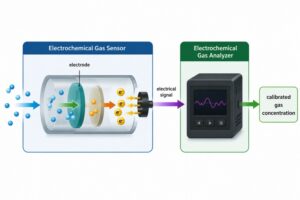
- Paramagnetic, zirconia or electrochemical analysis: Options for oxygen, depending on conditions.
- Thermal-conductivity analysis: Can measure hydrogen or bulk binary mixtures where the background composition is sufficiently defined.
- Gas chromatography: Useful for detailed composition and periodic confirmation.
- Specialised mercury methods: Needed if mercury is included in the monitoring plan.
- Flow measurement: Required when concentration must be converted into total release.
At ESEGAS, we can combine UV and infrared measurement channels around the required gas list. We first confirm the expected concentration, water content, pressure, sulfur load and interfering components because a nominal gas capability does not prove suitability in a geothermal matrix.
How Should a Wet Geothermal Sample Be Conditioned?
Cooling the gas without understanding its chemistry can remove H₂S with condensate and produce an apparently low result. Allowing uncontrolled condensation can also corrode components, block filters and change the analyzer response.
Wet-sample conditioning should consider:
- Heated transport where condensation must be avoided.
- A controlled knockout or cooler where a dry-basis measurement is appropriate.
- Materials compatible with wet H₂S and other resource components.
- Short sample lines and limited dead volume.
- Representative filtration.
- Stable pressure and flow.
- Condensate collection and safe disposal.
- Leak checks to prevent air dilution.
- Calibration-gas delivery through the sample path.
- Recovery testing for soluble or reactive target gases.
Hot-wet measurement may preserve soluble components but requires analyzers and wetted parts designed for the full moisture load. Cold-dry measurement may simplify analysis, yet the plant must quantify moisture and demonstrate that the target gas is not lost before detection.
How Can Abatement Performance Be Measured Correctly?
Comparing two concentrations can overstate performance if air enters between the inlet and outlet or if the total gas flow changes. An H2S abatement system should therefore be assessed using comparable gas quantities.
The evaluation should record:
- Inlet H₂S concentration and flow.
- Outlet H₂S concentration and flow.
- Temperature, pressure and moisture basis.
- Unit load and selected wells.
- Treatment reagent or process status.
- Bypass and maintenance periods.
- Any sulfur-containing transformation products.
- Instrument validity and calibration status.
Where required, the H₂S mass emission rate can be calculated by combining concentration with the corresponding dry or wet gas flow under defined reference conditions. Removal performance should be based on inlet and outlet mass flow rather than concentration reduction alone.
If geothermal gas reinjection is used, operators should distinguish gas directed underground from gas released through vents, treatment equipment or emergency routes.
How Can Gas Trends Improve Plant Operation?
Collecting results only for a periodic report misses valuable diagnostic information. Gas composition can help explain changes in vacuum equipment, corrosion, chemical consumption and steam-field behaviour.
Operators may use trends to:
- Detect air entering the condenser or extraction system.
- Compare wells and steam-field groups.
- Identify increasing sulfur load before treatment performance declines.
- Optimise reagent use.
- Investigate odour events.
- Track changes after well work or production adjustments.
- Evaluate gas-extraction capacity.
- Compare measured releases with electrical generation.
- Plan maintenance for ejectors, pumps and treatment equipment.
A rising oxygen result with falling concentrations of other gases may indicate dilution rather than a real reduction in gas production. Multichannel analysis provides a stronger interpretation than one isolated H₂S reading.
Why Must Source, Ambient and Safety Monitoring Remain Separate?
An analyzer at the final vent cannot show the concentration a worker might encounter beside a leaking flange. Likewise, an area alarm does not provide a representative mass-emission result for an exhaust stream.
The three monitoring layers have different duties:
| Layer | Main question | Typical system |
|---|---|---|
| Process or source monitoring | What is moving through the equipment or release point? | Extractive or in-situ process analyzer |
| Ambient monitoring | What concentration reaches a location outside the source? | Stationary or mobile ambient monitor |
| Safety detection | Is an immediate hazardous condition developing? | Fixed or portable alarm detector |
The systems can exchange data, but they should retain independent ranges, alarm logic, maintenance procedures and availability requirements.
How Should Data Quality Be Maintained?
High humidity, sulfur exposure and changing pressure can make a geothermal analyzer appear stable while its response gradually changes. Routine quality checks must cover both the sensor and the sampling path.
We recommend documenting:
- Zero and span checks.
- Calibration standards and their traceability.
- Response and recovery time.
- Sample-line leak and recovery tests.
- Moisture and reference-condition corrections.
- Flow-instrument verification.
- Preventive cleaning intervals.
- Treatment of invalid or missing data.
- Time synchronisation with plant operating records.
- Independent laboratory confirmation.
- Raw-data and maintenance-record retention.
The system should also identify whether a sample represents normal production, startup, shutdown, treatment bypass or an abnormal well condition.
Geothermal non-condensable gas monitoring should connect resource chemistry with power-plant operation, emissions control and safety. At ESEGAS, we recommend separating these objectives, mapping every relevant gas route and then selecting H₂S, CO₂, CH₄, O₂ and supplementary channels for the actual resource. A correctly conditioned, flow-linked and quality-controlled system gives operators data they can use for both environmental reporting and day-to-day plant decisions.