



A HCl analyzer may display unexpectedly low readings even when the industrial process appears stable. This issue frequently concerns engineers monitoring hydrogen chloride emissions from waste-to-energy plants, cement kilns, and chemical processing facilities.
For example, a HCl analyzer may report lower HCl concentrations than a reference measurement. The analyzer may also respond slowly to calibration gas or show unusually stable readings during process changes. These symptoms do not necessarily indicate a faulty sensor. Instead, hydrogen chloride can disappear from the sampled gas before reaching the measurement cell.
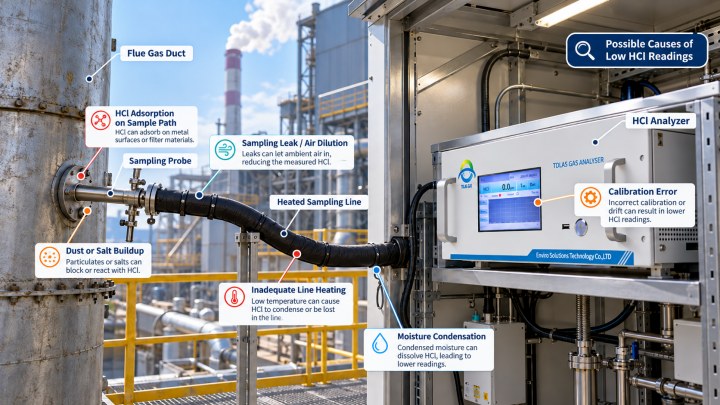
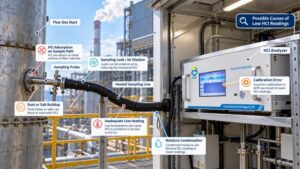
A HCl analyzer usually shows falsely low readings because of moisture condensation, HCl adsorption, sampling leaks, or inadequate sample heating. Incorrect calibration, gas interference, and measurement-basis differences can also explain discrepancies. Therefore, engineers should examine the complete sampling and measurement system before replacing or recalibrating the analyzer.
Why Is Hydrogen Chloride Difficult to Measure Accurately?
Hydrogen chloride (HCl) is highly water-soluble, corrosive, and reactive with certain substances. These properties make HCl monitoring more challenging than measuring relatively stable gases such as CO or CO₂. In industrial flue gas, HCl often coexists with water vapor, dust, ammonia, and other combustion products. Consequently, sampling conditions can change the amount of gaseous HCl that reaches the gas analyzer.
Three characteristics deserve particular attention.
- High water solubility: HCl readily dissolves in condensed water, reducing its concentration in the gas phase.
- Surface interactions: HCl may adsorb onto sampling surfaces or react with deposited materials.
- Sensitivity to sample conditioning: Temperature, residence time, gas composition, and sampling materials can affect HCl recovery.
The U.S. EPA identifies water vapor and sampling-system condensation as critical concerns in Method 321. The method requires operators to prevent condensation throughout the sampling path.
Therefore, accurate HCl measurement depends on more than the gas analyzer’s specifications. It requires a sampling system that preserves the target gas from the stack to the measurement cell.
What Are the Main Causes of Low HCl Analyzer Readings?
Several problems can produce similar symptoms, but their causes differ. The following comparison helps engineers identify the most likely failure points.
| Potential cause | Why HCl readings become low | Typical warning sign |
|---|---|---|
| Moisture condensation | HCl dissolves into liquid water | Readings fall after cooling or startup |
| Surface adsorption | HCl temporarily attaches to sampling surfaces | Slow response or delayed stabilization |
| Sampling leakage | Ambient air dilutes the extracted gas | Low HCl with abnormal O₂ readings |
| Inadequate heating | Cold spots promote condensation and deposition | Readings change with heater operation |
| Dust or salt buildup | Deposits capture HCl or restrict sample flow | Reduced flow and slow response |
| Calibration problems | Incorrect span, offset, or response factor | Direct span check fails |
| Spectral interference | Other gases affect optical interpretation | Disagreement changes with gas composition |
| Wet/dry basis mismatch | Values use different water-vapor corrections | Consistent proportional difference |
The table provides diagnostic clues rather than definitive conclusions. Multiple problems may occur simultaneously.
1. How Does Moisture Condensation Cause Low HCl Readings?
Moisture condensation removes gaseous HCl from the sample stream because HCl dissolves readily in water. When hot flue gas enters a cooler sampling section, water vapor may condense. The resulting liquid absorbs HCl, leaving less gas-phase HCl available for measurement.
Consider a waste incineration stack containing water vapor and HCl. If an unheated fitting creates a cold spot, liquid water may accumulate inside the sampling line. The downstream gas analyzer can then report less HCl than the stack actually contains.
EPA Method 321 specifically warns against condensation inside probes, sampling lines, and analytical instruments. It also explains that sampling conditions strongly influence HCl measurement bias.
Practical solution: Inspect the complete sampling path, including probe connections, filters, valves, heated lines, and analyzer inlets. Maintain appropriate temperatures above the relevant condensation thresholds, following the validated system design.
2. Why Does HCl Adsorption Reduce Measurement Accuracy?
HCl adsorption occurs when hydrogen chloride interacts with surfaces inside the sampling system. This can reduce the amount reaching the measurement cell.
Potential problem areas include sampling probes, filters, tubing, valves, connectors, and accumulated deposits. For example, a newly installed sampling line may initially produce a lower HCl reading. As exposed surfaces become conditioned, the reading may gradually stabilize.
Adsorption can also cause delayed recovery following a concentration change. Consequently, a system may take longer to reach its final reading than the analyzer’s stated response time suggests.
EN 16429:2021 documents HCl adsorption and desorption effects in certain sampling materials. It also highlights the need to consider stabilization time during system checks.
Practical solution: Select compatible sampling materials, minimize unnecessary tubing length, and maintain clean sampling surfaces. Evaluate HCl recovery across the complete sampling path rather than checking the analyzer alone.
3. Can Sampling System Leaks Produce Falsely Low HCl Concentrations?
Yes. Air leakage can dilute the extracted sample, especially when the sampling pump creates negative pressure. Suppose the stack gas contains 20 ppm HCl, but ambient air enters through a loose fitting. The gas analyzer receives a mixture containing less HCl per unit volume.
In a simplified example, 10% dilution with HCl-free air would reduce 20 ppm to approximately 18 ppm. This assumes no chemical losses and consistent measurement conditions. However, real systems may exhibit both dilution and HCl adsorption.
Practical solution: Perform leak checks according to the manufacturer’s procedure. Inspect fittings, valve connections, seals, filters, and pump connections.
Additionally, compare oxygen readings when appropriate. Air leakage may increase the measured O₂ concentration while reducing HCl.
4. Why Is Sampling Temperature Critical for HCl Measurement?
Sampling temperature affects condensation, surface reactions, and the transport of gaseous HCl. For heated extractive systems, engineers must maintain a suitable temperature throughout the gas-contacting path. Heating only the main sampling line may not prevent condensation inside unheated valves or connectors.
EN 16429:2021 discusses heated sampling configurations and identifies typical component temperatures between 175°C and 200°C for preventing salt formation under relevant conditions. This is not a universal setting for every HCl analyzer. The correct temperature depends on the gas composition, moisture content, acid dew point, analyzer design, and operating conditions.
Practical solution: Verify actual temperatures at vulnerable locations, not just the controller’s setpoint. Use the temperature requirements specified for the installed measurement system.
5. Can Dust and Ammonia Interfere With HCl Measurements?
Yes. Dust deposits and reactions involving ammonia can contribute to sampling losses. In flue gas containing HCl and NH₃, ammonium chloride formation may occur under suitable conditions:
- NH3(g) + HCl(g) ↔ NH4Cl(s)
This reaction can produce deposits inside the sampling path when temperature and gas composition favor salt formation. Consequently, HCl may be removed from the gas phase before measurement. Deposits can also increase flow resistance and create further sampling problems.
This issue deserves attention in facilities that use ammonia-based NOx reduction, such as selective catalytic reduction or selective non-catalytic reduction systems.
Practical solution: Evaluate ammonia slip, sampling temperatures, filter conditions, and the possibility of ammonium salt deposits. Avoid introducing cold spots where these deposits may accumulate.
How Can Engineers Determine Whether the HCl Analyzer or Sampling System Is Responsible?
The most useful diagnostic approach compares the analyzer’s direct response with its response through the complete sampling system.
Start with a certified HCl calibration gas that matches the instrument’s requirements. Then compare the reading at the analyzer inlet against the reading obtained through the sampling probe and line.
Simplified HCl diagnostic sequence
- Direct gas analyzer span check: Introduce suitable HCl calibration gas directly at the gas analyzer inlet. If Direct check passes, investigate sampling losses. If Direct check fails, Investigate analyzer calibration, optics, and settings.
- Full sampling-system check: Introduce HCl calibration gas upstream, as close to the probe inlet as practicable.
- Compare recovery and response: Check temperature, leaks, flow, adsorption, and stabilization time when recovery is poor. A useful screening calculation is: Recovery(%)= C(Measured)/C(Reference) * 100. For example, suppose a certified 20 ppm HCl gas produces a stabilized downstream reading of 16 ppm. Recovery=16/20 * 100= 80%. This hypothetical result indicates a 20% difference. However, a valid full-system recovery assessment must account for test-gas delivery, dilution, uncertainty, and the applicable protocol.
In particular, EPA Method 321 uses HCl analyte spiking to evaluate the integrity of sample transport. This provides an established approach for investigating sampling losses.
For regulatory testing, engineers should apply the relevant acceptance criteria rather than treating any illustrative recovery figure as a pass/fail threshold.
How Do TDLAS and FTIR HCl Analyzers Compare?
Both Tunable Diode Laser Absorption Spectroscopy (TDLAS) and Fourier Transform Infrared Spectroscopy (FTIR) can measure hydrogen chloride in industrial emissions. However, their optical designs and measurement capabilities differ.
TDLAS uses a laser tuned to selected molecular absorption features of HCl. Meanwhile, FTIR measures infrared absorption across a broader spectral region, allowing simultaneous analysis of multiple gases.
| Comparison | TDLAS HCl Analyzer | FTIR HCl Analyzer |
|---|---|---|
| Measuring principle | Tunable laser absorption | Broadband infrared spectroscopy |
| Main advantage | Selective HCl measurement | Multi-component gas analysis |
| Gas measurement | Targeted gases, depending on configuration | HCl, HF, SO₂, NOx and other gases |
| Sampling arrangement | In-situ or extractive, depending on model | Commonly heated extractive |
| Main considerations | Optical conditions, calibration, pressure, temperature | Spectral interference, calibration, sampling losses |
| Typical application | Dedicated HCl process or emission monitoring | Multi-pollutant CEMS |
Neither technology automatically eliminates HCl measurement errors. An extractive TDLAS gas analyzer can still suffer from condensation or adsorption. Similarly, an FTIR gas analyzer may show low readings when its sampling system fails to preserve gaseous HCl. Therefore, engineers should select the measurement technology together with the sampling configuration.
How Can ESEGAS HCl Analyzers Improve Measurement Reliability?
ESEGAS improves HCl measurement reliability through selective laser spectroscopy, heated sampling systems, and multi-gas FTIR analysis. These technologies help reduce spectral interference, prevent condensation-related losses, and support accurate hydrogen chloride monitoring.
However, choosing the right gas analyzer depends on the sampling conditions, HCl concentration, and monitoring requirements.
How Do ESEGAS Online TDLAS HCl Analyzers Improve Measurement Accuracy?
The ESEGAS ESE-LASER-200 Online TDLAS HCl Analyzer uses Tunable Diode Laser Absorption Spectroscopy (TDLAS) for continuous hydrogen chloride measurement. Its selective optical measurement reduces interference from other gas components. Additionally, specialized coatings help minimize HCl adsorption on internal surfaces. The HCl analyzer offers:
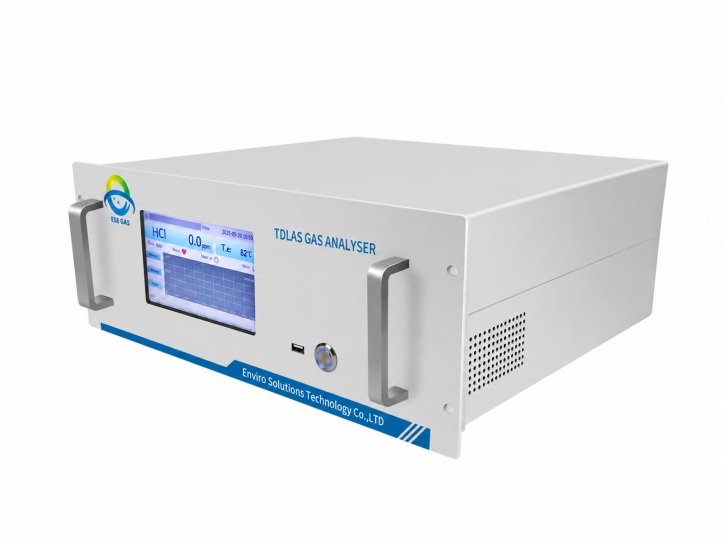
- HCl measurement ranges of 0–20 ppm and 0–200 ppm.
- Measurement accuracy of ≤±1% FS.
- Resolution of 0.1 ppm.
- T90 response time of ≤30 seconds.
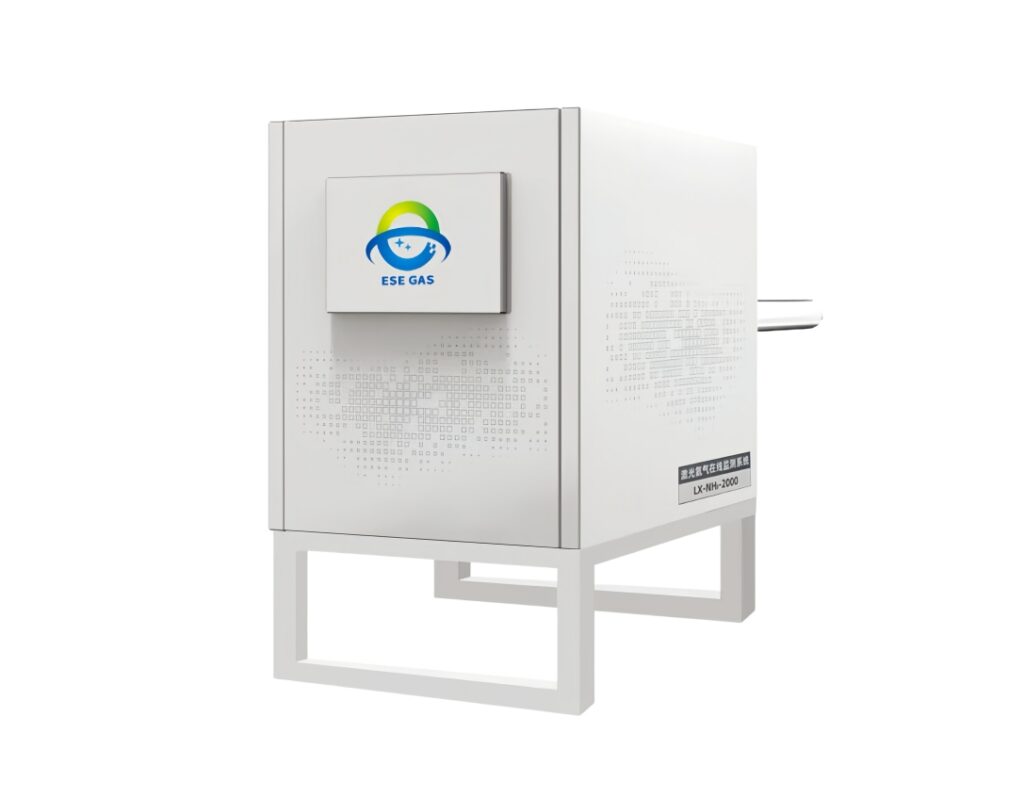
For continuous industrial monitoring, the ESEGAS LX-2000 Online TDLAS Gas Monitoring System supports continuous HCl detection in demanding environments. Its laser-based technology provides selective measurement and rapid response, making it suitable for waste incineration, cement production, and power generation.
How Does a Heated TDLAS HCl System Reduce Sampling Losses?
Condensation is a major reason HCl analyzers report unexpectedly low concentrations. When flue gas cools below its dew point, HCl can dissolve into condensed moisture before reaching the analyzer.
The ESEGAS ESE-LASER-200WM Wall-Mounted TDLAS HCl Analysis System addresses this challenge through high-temperature extractive sampling. Its integrated sampling, transmission, pretreatment, and analysis units help maintain sample integrity.
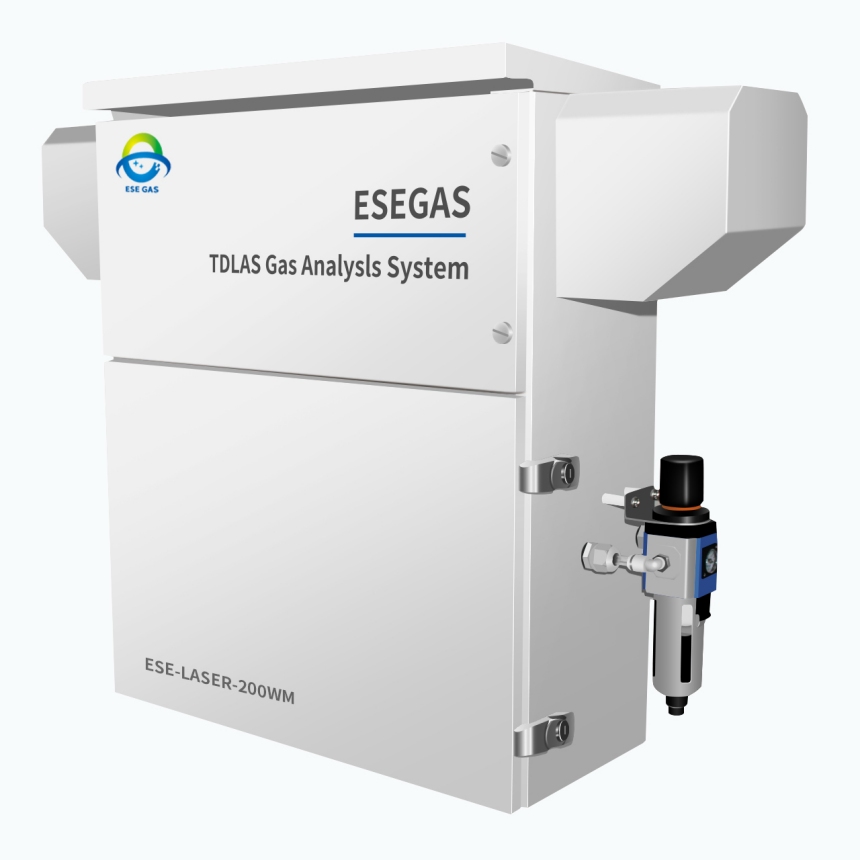
The system supports configurable HCl ranges of 0–50 ppm, 0–100 ppm, and 0–500 ppm. Furthermore, its TDLAS measurement technology reduces spectral interference. For continuous HCl monitoring, suitable temperature control and heated sampling lines help minimize condensation-related measurement losses.
How Can Portable HCl Analyzers Help Troubleshoot Low Readings?
Portable gas analyzers allow engineers to investigate unexpected differences between actual process conditions and installed monitoring results. The ESEGAS ESE-LASER-200P Portable TDLAS HCl Analyzer supports selective HCl measurement during field inspections, commissioning, and troubleshooting. Its heated extractive sampling configuration helps reduce moisture-related sampling losses.
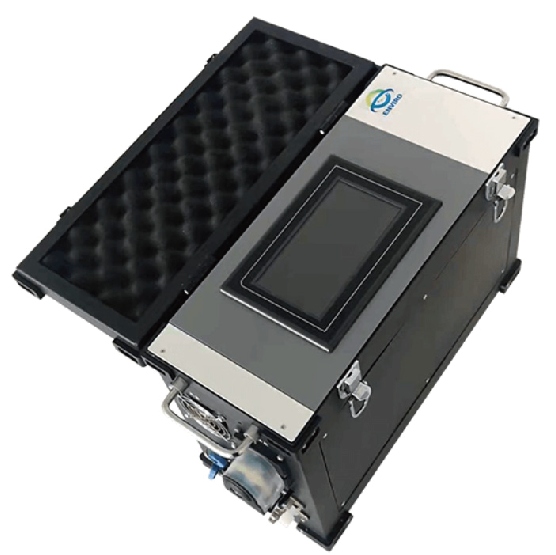
Meanwhile, the ESEGAS ESE-FTIR-100P Portable FTIR Gas Analyzer measures HCl alongside SO₂, NOx, HF, CO₂, and H₂O. By comparing portable measurements with fixed analyzer readings, engineers can identify potential sampling problems, calibration deviations, or process-related concentration changes.
However, meaningful comparisons require equivalent sampling conditions, measurement units, and reference corrections.
How Does the ESEGAS ESE-FT600 FTIR Analyzer Support Reliable Multi-Gas Monitoring?
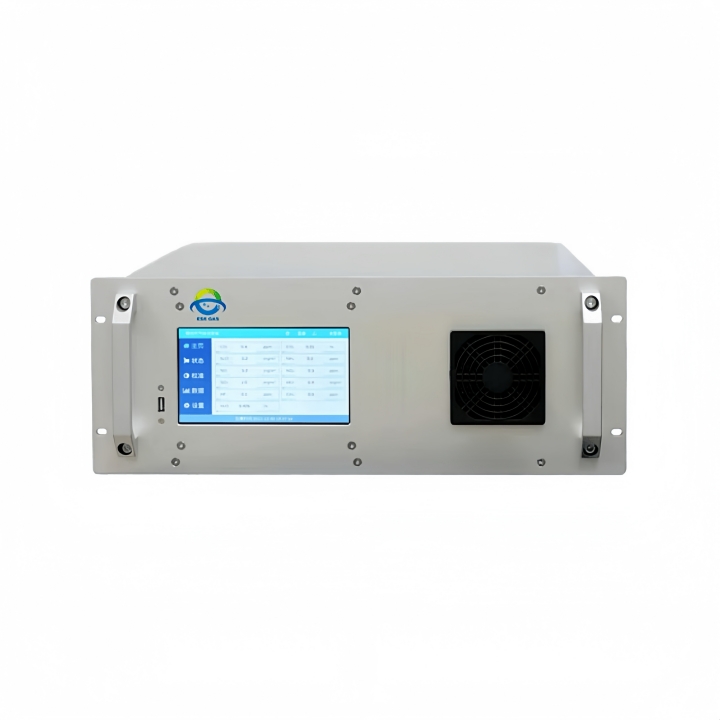
The ESEGAS ESE-FT600 Online FTIR Gas Analyzer provides continuous multi-component measurement for complex industrial flue gas. It simultaneously analyzes HCl, HF, SO₂, NOx, CO, CO₂, H₂O, and other configurable components. Its high-temperature sample handling helps prevent condensation. Additionally, FTIR spectral analysis supports gas identification and reduces selected spectral interferences. This makes the analyzer suitable for waste-to-energy plants, cement kilns, and industrial emission monitoring systems.
However, FTIR technology cannot recover HCl already lost through condensation or adsorption. Proper sample heating, leak checks, and calibration remain essential.
Ultimately, reliable HCl measurement depends on both analyzer performance and sample integrity. ESEGAS provides online and portable TDLAS and FTIR solutions for different industrial monitoring needs.
Frequently Asked Questions About Low HCl Gas Analyzer Readings
Can an HCl gas analyzer show zero even when HCl is present?
Yes. Condensation, severe adsorption, sampling blockage, or analyzer faults may produce near-zero readings. However, genuinely low process concentrations are also possible. Engineers should verify sample delivery and calibration before drawing conclusions.
Why does an HCl analyzer respond slowly to calibration gas?
Slow response can result from adsorption, long sampling lines, low flow, or contaminated surfaces. The analyzer’s optical response time may differ significantly from the complete system response time.
Should an HCl sample be cooled before analysis?
Not without validating the conditioning method. Conventional cooling can condense water and remove gaseous HCl. Heated extractive systems usually preserve the sample gas to avoid uncontrolled condensation.
Can an HCl analyzer pass calibration but still report incorrect stack concentrations?
Yes. Direct calibration confirms instrument response under specified conditions. It does not necessarily reveal losses inside upstream sampling components. Full-path calibration or validated analyte-spiking procedures can identify additional problems.
Is TDLAS always more accurate than FTIR for HCl monitoring?
No. Both technologies can deliver accurate HCl measurements when properly configured. Their performance depends on the measurement range, interference control, gas conditions, calibration, and sampling-system integrity.
Conclusion
Unexpectedly low HCl readings of HCl analyzer often originate outside the measurement cell. Moisture condensation, adsorption, sampling leaks, and inadequate temperature control can remove HCl before detection.
Additionally, calibration errors and inconsistent wet/dry corrections may create misleading results. Therefore, effective troubleshooting should begin with the complete measurement path. Engineers should verify calibration response, sample transport, operating temperatures, and HCl recovery before adjusting analyzer settings.
For industrial emission monitoring, ESEGAS provides TDLAS and FTIR-based solutions that can be configured around specific gas measurement requirements. Contact ESEGAS to discuss HCl gas analyzer selection, heated sampling systems, customized HCl analysis system, CEMS integration, or troubleshooting requirements for your industrial application.