



Natural gas leaving a TEG dehydrator still shows unstable moisture readings? Choosing the wrong moisture analyzer can lead to off-spec gas, hydrate formation, costly downtime, and unnecessary maintenance.
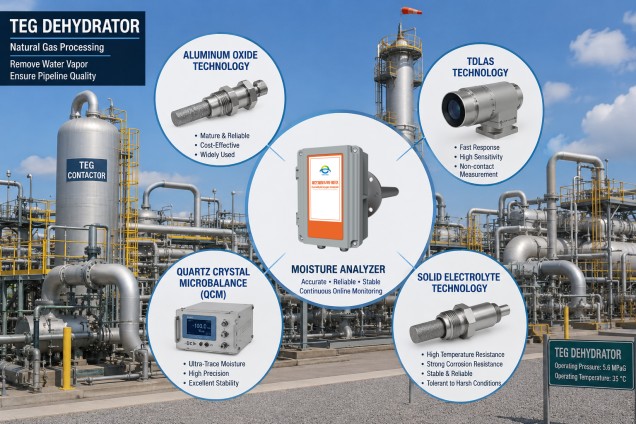
The best moisture analyzer depends on your moisture range, gas composition, process conditions, and maintenance goals. Aluminum oxide, TDLAS, quartz crystal microbalance (QCM), and solid electrolyte technologies each offer unique advantages. Matching the technology to your application delivers the most reliable results.
However, technology alone does not guarantee accurate measurement. Sample quality, operating environment, and long-term stability all influence gas analyzer performance. Let’s examine what really matters when selecting a moisture analyzer for natural gas TEG dehydration systems.
Why Is a Moisture Analyzer Important After a Natural Gas TEG Dehydrator?
The primary job of a TEG dehydration unit is to remove water vapor before natural gas enters pipelines or downstream processing. If moisture remains too high, several problems can occur:
- Hydrate formation blocks valves and pipelines.
- Water accelerates corrosion, especially when CO₂ or H₂S is present.
- Gas may fail pipeline moisture specifications.
- Compressors and processing equipment experience increased wear.
For many transmission pipelines, water content must remain below strict contractual limits. Even small measurement errors can result in expensive off-spec gas or unnecessary glycol circulation.
Reliable online moisture monitoring helps operators maintain stable dehydration performance while minimizing operating costs.
What Challenges Does a Moisture Analyzer Face in TEG Dehydration Systems?
Although TEG dehydration is a mature process, moisture measurement remains challenging.
Glycol Carryover
Small glycol droplets frequently enter the sampling system. Over time, they contaminate sensors, foul optical components, and reduce measurement accuracy.
High Pressure
Natural gas often exits dehydration units at pressures exceeding several MPa. A proper pressure reduction system is essential for stable measurements.
Sour Gas
Many natural gas streams contain CO₂ and H₂S. These corrosive gases shorten sensor life if the analyzer lacks adequate corrosion resistance.
Variable Operating Conditions
Changes in flow, temperature, and pressure continuously affect moisture equilibrium. The analyzer must respond quickly while maintaining long-term stability.
Because of these challenges, the sampling system is just as important as the moisture analyzer itself.
Which Moisture Analyzer Technology Is Best for Natural Gas?
Different measurement principles serve different operating conditions.
| Technology | Advantages | Limitations | Applications |
|---|---|---|---|
| Aluminum Oxide Moisture Analyzer | -Proven industrial technology -Competitive cost -Good accuracy for pipeline monitoring -Simple maintenance | -Sensitive to contamination -Requires periodic calibration -Response may slow after exposure to liquid water | Best suited for clean natural gas streams with stable operating conditions. |
| TDLAS Moisture Analyzer | -Very fast response -Excellent repeatability -High sensitivity -Suitable for continuous online monitoring | -Higher initial investment -Requires excellent sample conditioning -Heated sample lines are often recommended -Optical components can still be affected by glycol contamination if the sampling system is inadequate | TDLAS performs exceptionally well when fast process control is required and the sample system is properly engineered. |
| Quartz Crystal Microbalance (QCM) | -Excellent trace moisture sensitivity -High measurement precision -Suitable for ultra-dry gas applications | -Sensitive to contamination -Requires very clean sample gas -Higher maintenance requirements | QCM is commonly selected for semiconductor, specialty gas, and ultra-high purity applications rather than standard natural gas processing. |
Solid Electrolyte Moisture Analyzer
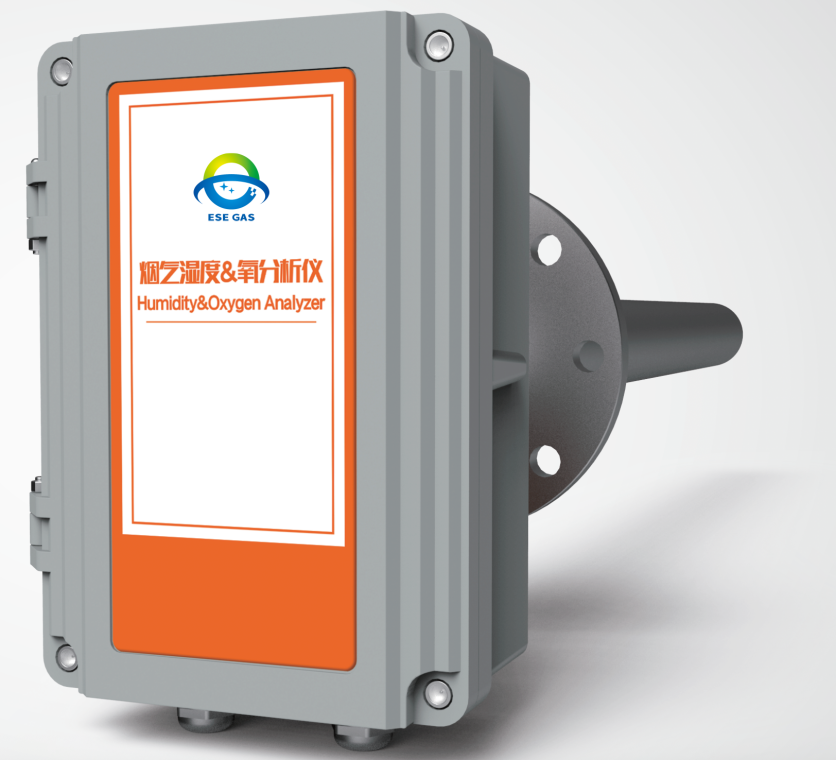
Solid electrolyte technology continues to gain popularity in harsh industrial environments. The moisture analyzer adopts third-generation solid electrolyte humidity and oxygen measurement technology. Unlike conventional moisture analyzers, it is designed for continuous online operation under demanding process conditions.
Key advantages include:
- Fast response time
- Excellent measurement stability
- High-temperature resistance
- Strong corrosion resistance
- Reliable performance in high-humidity environments
- Better tolerance to VOC interference than many conventional moisture analyzers
- Simultaneous humidity and oxygen measurement for selected applications
These characteristics make it particularly suitable for natural gas processing, refinery gas, chemical plants, and other challenging industrial applications. Not every natural gas application requires laser technology. If your process includes corrosive gases, variable temperatures, high humidity, or VOC interference, a solid electrolyte analyzer may provide a better balance between reliability and maintenance.
For TEG dehydration units operating in harsh industrial environments, the ESEGAS moisture analyzer ESE-HO-1000 offers dependable long-term monitoring without relying on complex optical components. For many operators, lower maintenance and stable performance throughout the gas analyzer’s service life outweigh the benefits of ultra-fast laser measurements.
What Should You Evaluate Before Buying a Moisture Analyzer?
Selecting a moisture analyzer should involve more than comparing accuracy specifications.
Consider the following factors:
- Measurement range
- Accuracy and repeatability
- Response time (T90)
- Long-term stability
- Calibration interval
- Corrosion resistance
- Sample conditioning requirements
- Operating temperature and pressure
- Digital communication protocols such as Modbus or 4–20 mA
- Total cost of ownership
Looking beyond the purchase price often leads to lower operating costs over the analyzer’s lifetime.
Which Moisture Analyzer Is the Best Choice for Your Natural Gas Process?
If you need ultra-fast response, TDLAS is an excellent option. For ultra-low trace moisture, QCM remains a leading technology. Aluminum oxide continues to provide dependable performance in many standard applications.
However, when harsh process conditions, corrosion resistance, and long-term stability are the top priorities, third-generation solid electrolyte technology offers a compelling alternative.