


Hydrogen production may appear straightforward: generate hydrogen, separate it, purify it, and deliver it to the next process. In practice, however, producing hydrogen at the required purity while keeping the process safe and efficient is much more demanding. Oxygen crossover, residual moisture, unconverted methane, carbon monoxide, carbon dioxide, and changing process conditions can all affect hydrogen quality and plant performance. Without reliable gas measurement, operators may not know whether a deviation is developing until product quality deteriorates or process safety is affected. This is why selecting the right gas analysis equipment is a critical part of hydrogen production.
Hydrogen production typically requires hydrogen analyzers, oxygen analyzers, moisture analyzers, and, depending on the production method, analyzers for CO, CO₂, CH₄, and other process gases. Electrolysis plants mainly monitor H₂, O₂, and moisture, while steam methane reforming and gasification plants generally require multi-component analysis of H₂, CO, CO₂, CH₄, and related gases for process control, safety, and hydrogen purity verification.
Knowing which gases need to be measured is only the first step. The more important engineering question is where each analyzer should be installed, what measuring range is required, and which measurement principle is suitable for the gas composition at that point. At ESEGAS, we approach hydrogen analysis from the process itself, because the correct analyzer configuration depends on the production technology, measurement objective, gas background, and required accuracy.
Why Are Gas Analyzers Necessary in Hydrogen Production?
A hydrogen production plant can operate continuously while still experiencing changes in gas composition, separation efficiency, purity, or process safety. If these changes are not detected early, operators may face off-spec hydrogen, reduced process efficiency, or unsafe gas mixtures. Proper gas analysis provides continuous information that helps identify these problems before they affect plant performance.
In hydrogen plants, Gas Analyzers are generally used for three major purposes: process control, product quality verification, and safety monitoring. These functions often overlap, which is why one analyzer is rarely sufficient for an entire production facility.
For process control, gas analyzers can help operators evaluate reaction efficiency, conversion rates, separation performance, and purification conditions. In steam methane reforming, for example, measurements of H₂, CO, CO₂, and CH₄ can indicate whether reforming and shift reactions are operating as expected.
For quality control, analyzers verify hydrogen purity and detect impurities that may affect downstream applications. Depending on the end use, these may include oxygen, moisture, carbon monoxide, carbon dioxide, methane, or nitrogen.
For safety monitoring, gas analysis becomes particularly important in processes where hydrogen and oxygen may come into contact. Continuous measurement can identify abnormal crossover or contamination before concentrations move into an unsafe operating range.
Which Gas Analyzers Are Required for Water Electrolysis Hydrogen Production?
Water electrolysis is often considered a clean and relatively simple route to hydrogen production, but gas monitoring remains essential. Electrolyzers produce hydrogen and oxygen simultaneously, and membrane performance, pressure differences, operating load, and gas separation efficiency can influence crossover between the two streams.
The most important Gas Analyzers in an electrolysis hydrogen plant usually include hydrogen analyzers, oxygen analyzers, and moisture analyzers.
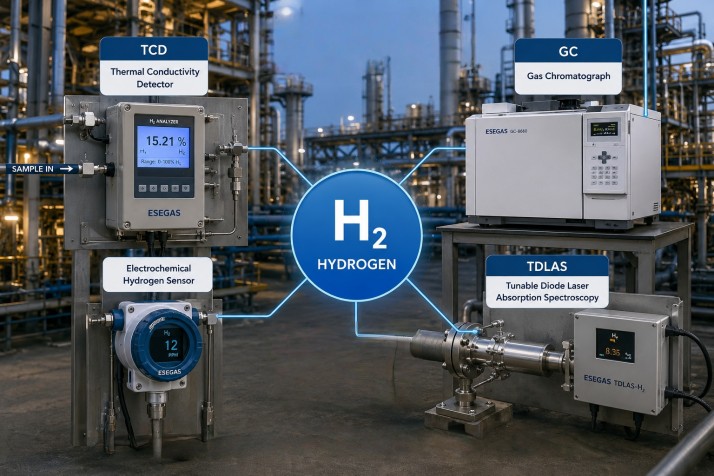
Hydrogen Analyzer
A hydrogen analyzer is used to measure H₂ concentration or hydrogen purity at selected points in the process. Depending on the application, it may be installed downstream of gas separation equipment, purification equipment, or before final hydrogen delivery.
For higher-concentration hydrogen streams, thermal conductivity measurement is commonly suitable because hydrogen has a significantly different thermal conductivity compared with many background gases.
At ESEGAS, we can configure hydrogen analyzers according to the expected hydrogen range, background gas, pressure, temperature, and process conditions rather than treating every hydrogen measurement as the same application.
Oxygen Analyzer
Oxygen measurement is especially important on the hydrogen side of an electrolyzer. Even a small change in oxygen concentration may indicate gas crossover, separator performance deterioration, membrane problems, or unstable operating conditions.
An oxygen analyzer may therefore be used to monitor:
- O₂ in the hydrogen stream
- oxygen content after gas separation
- oxygen concentration before hydrogen purification
- final product oxygen impurity
The required detection range depends on whether the measurement is for process monitoring, safety control, or final product quality.
Hydrogen-in-Oxygen Analyzer
The oxygen stream must also be monitored because hydrogen may cross into the oxygen side.
This measurement is different from measuring oxygen in hydrogen. In one case, the analyzer detects O₂ in an H₂-rich background; in the other, it detects H₂ in an O₂-rich background. These different gas matrices can require different analyzer configurations and calibration strategies.
Monitoring both directions of crossover gives operators a clearer understanding of electrolyzer separation performance.
Moisture Analyzer
Hydrogen leaving an electrolyzer usually contains water vapor that must be reduced during downstream drying and purification.
A moisture analyzer can be installed after the dryer or purification unit to verify:
- residual moisture concentration
- dryer performance
- hydrogen quality stability
- final product compliance
For hydrogen supplied to sensitive downstream processes, moisture measurement may be just as important as the overall hydrogen purity reading.
Which Gas Analyzers Are Needed in Steam Methane Reforming Hydrogen Production?
Steam methane reforming produces a much more complex gas mixture than electrolysis. Hydrogen is generated together with carbon monoxide, carbon dioxide, residual methane, steam, and other process components. As a result, measuring hydrogen alone cannot provide enough information for effective process control.
In SMR plants, multi-component Gas Analyzers are often required because operators need to understand how gas composition changes through the reformer, shift reactor, and hydrogen purification system.
Reformer Outlet Analysis
At the reformer outlet, typical target gases include:
- H₂
- CO
- CO₂
- CH₄
These measurements help assess reforming efficiency and identify changes in methane conversion.
If methane concentration increases unexpectedly, it may indicate incomplete reforming or changing process conditions. At the same time, CO and CO₂ concentrations provide additional information about the reaction balance.
Water-Gas Shift Outlet Analysis
After reforming, the gas normally enters one or more water-gas shift stages. In this section, carbon monoxide reacts with steam to generate additional hydrogen and carbon dioxide.
Typical measurements include:
- CO
- CO₂
- H₂
The residual CO concentration is particularly important because it indicates shift conversion performance.
PSA Inlet and Outlet Analysis
Pressure swing adsorption is widely used to purify hydrogen after reforming and shift conversion.
At the PSA inlet, multi-component gas analysis can provide information about the gas mixture entering the purification stage.
At the PSA outlet, the measurement objective changes. The priority becomes hydrogen purity and breakthrough of residual impurities such as:
- CO
- CO₂
- CH₄
Continuous monitoring can help identify adsorbent deterioration, cycle performance changes, or abnormal purification conditions.
Which Gas Analyzers Are Required for Coal or Biomass Gasification?
Gasification produces synthesis gas containing hydrogen, carbon monoxide, carbon dioxide, methane, and other components. The gas composition may vary significantly depending on feedstock, gasifier operating conditions, temperature, oxidant supply, and downstream treatment.
This makes multi-component Gas Analyzers particularly valuable in gasification-based hydrogen production.
Typical target components include:
- H₂
- CO
- CO₂
- CH₄
- O₂
Instead of relying on a single hydrogen reading, operators can use the full syngas composition to evaluate gasification efficiency, conversion behavior, downstream shift performance, and purification requirements.
At ESEGAS, we generally recommend evaluating the complete gas matrix before selecting the analyzer. For complex syngas applications, different measuring principles may be combined within one analysis system so that several gases can be monitored simultaneously.
Which Impurities Should Be Monitored in Produced Hydrogen?
A high hydrogen concentration does not automatically mean the gas meets the requirements of its final application. Small concentrations of specific impurities can affect fuel cells, catalysts, compression equipment, storage systems, or downstream chemical processes.
The required impurity measurements therefore depend on how the hydrogen will be used.
| Impurity | Why It Should Be Monitored | Common Source |
| O₂ | Safety and product purity | Electrolysis crossover, air ingress |
| H₂O | Product quality and downstream protection | Electrolysis, wet process gas, drying stage |
| CO | Purity and catalyst protection | SMR, gasification |
| CO₂ | Purity and process control | SMR, gasification |
| CH₄ | Reforming efficiency and purity | Steam methane reforming |
| N₂ | Hydrogen purity | Air ingress or feed contamination |
This is why hydrogen quality should not be evaluated only by one overall purity value. A hydrogen stream may appear highly pure while still containing a small concentration of an impurity that matters to the downstream application.
Selecting the correct Gas Analyzers therefore requires both concentration measurement and impurity-specific analysis.
What Measurement Technologies Are Used for Hydrogen Production Gas Analysis?
Different gases interact with measurement technologies in different ways. For this reason, there is no single sensing principle that is ideal for every hydrogen production application.
At ESEGAS, analyzer configuration is based on the target gas, concentration range, background gas, potential interference, response time, and process conditions.
Thermal Conductivity Measurement
Thermal conductivity technology is widely used for hydrogen concentration measurement because hydrogen has a high thermal conductivity compared with many other gases.
It can be suitable for:
- hydrogen purity measurement
- high-percentage H₂ analysis
- process hydrogen monitoring
- selected binary or quasi-binary gas mixtures
However, the background gas must be carefully evaluated because changes in other gas components can influence the measurement result.
NDIR Measurement
Non-dispersive infrared technology is commonly applied to infrared-active gases such as:
- CO
- CO₂
- CH₄
This makes NDIR particularly useful in SMR, shift conversion, syngas, and gasification applications.
A multi-component process analyzer may combine NDIR channels for CO, CO₂, and CH₄ with another measurement principle for H₂ or O₂.
Oxygen Measurement Technologies
Oxygen can be measured using several technologies depending on the application.
These may include:
- paramagnetic measurement
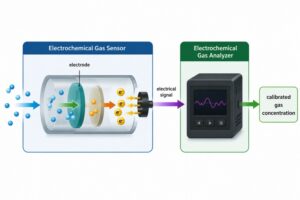
- electrochemical sensors
- zirconia-based measurement
The correct technology depends on the oxygen range, background gas, operating conditions, required response speed, and whether the measurement is for process control or trace oxygen detection.
TDLAS Measurement
Tunable diode laser absorption spectroscopy can be useful for selected fast-response and low-concentration gas measurements.
Depending on the application, TDLAS may be used for:
- moisture measurement
- selected trace gas analysis
- in-situ or extractive process monitoring
Its fast response can make it attractive for dynamic hydrogen production processes.
Where Should Gas Analyzers Be Installed in a Hydrogen Plant?
Even the correct analyzer technology will not provide useful information if the measurement point is poorly selected. Gas analyzer location should therefore be determined together with the process objective.
A simplified hydrogen production flow may look like this:
Feed or water → reaction or electrolysis → gas separation → purification → drying → final hydrogen product
Typical analyzer locations include:
- Electrolyzer hydrogen outlet
- Electrolyzer oxygen outlet
- Reformer outlet
- Water-gas shift outlet
- PSA inlet
- PSA outlet
- Dryer outlet
- Final hydrogen product line
Each measuring point serves a different purpose.
For example, an analyzer installed immediately after an electrolyzer may focus on crossover and process safety, while an analyzer installed after the final dryer may focus on hydrogen quality and moisture specification.
When designing Gas Analyzers for these applications, sample conditioning is also important. Pressure, temperature, condensate, particles, flow rate, and corrosive components can all affect analyzer reliability.
Should You Use a Single-Gas or Multi-Component Gas Analyzer?
Hydrogen plants often require both dedicated single-gas analyzers and multi-component systems. The best choice depends on the measurement objective rather than on the number of gases alone.
| Single-Gas Analyzer | Multi-Component Gas Analyzer |
| Focused on one critical component | Measures several process gases |
| Suitable for dedicated safety or purity points | Suitable for complex process streams |
| Simple measurement objective | Provides broader process information |
| Often used for O₂, H₂, or moisture | Often used for H₂, CO, CO₂, and CH₄ combinations |
For electrolysis plants, dedicated analyzers may be appropriate for critical oxygen-in-hydrogen and hydrogen-in-oxygen measurements.
For SMR and gasification plants, multi-component Gas Analyzers often provide greater value because several gases must be interpreted together to understand process performance.
In many projects, the most effective solution is a combination of both approaches.
How Do You Choose the Right Gas Analyzer for Hydrogen Production?
Choosing an analyzer only by gas name can lead to measurement errors or unnecessary system cost. A hydrogen analyzer suitable for one process stream may not perform correctly in another because the background gas, concentration range, humidity, pressure, and interference gases are different.
At ESEGAS, we recommend evaluating the following factors before selecting Gas Analyzers for a hydrogen production project:
- Hydrogen production method
Electrolysis, SMR, gasification, and other hydrogen processes generate different gas compositions. - Target gas components
Determine whether the application requires H₂, O₂, CO, CO₂, CH₄, moisture, or several components at once. - Measurement range
Percentage-level process measurement and trace impurity detection require different analyzer configurations. - Background gas composition
The matrix gas can affect the suitability and accuracy of the selected measuring principle. - Sample pressure and temperature
These conditions determine whether sample conditioning, pressure reduction, cooling, or heating is required. - Required response time
Safety-related measurements and fast-changing process streams may require quicker analyzer response. - Measurement objective
Process optimization, safety monitoring, and final quality verification often require different measurement strategies.
By reviewing these conditions before instrument selection, we can configure a more reliable and application-specific gas analysis system.
What Gas Analyzer Solutions Can ESEGAS Provide for Hydrogen Production?
Hydrogen production rarely has a one-size-fits-all gas analysis requirement. An electrolyzer, reformer, gasifier, PSA unit, and final hydrogen product line may all require different measuring ranges and different analyzer technologies.
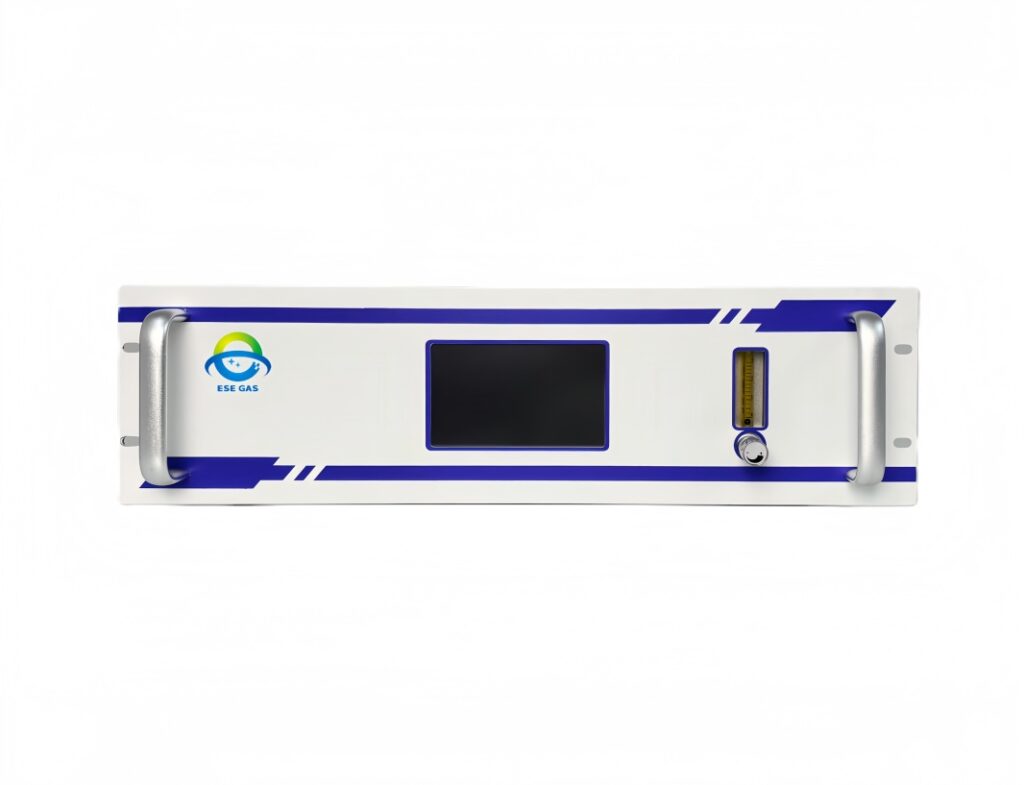
At ESEGAS, we provide gas analysis solutions that can be configured for applications such as:
- hydrogen concentration and purity measurement
- oxygen monitoring
- H₂/O₂ crossover analysis
- CO, CO₂, and CH₄ process analysis
- multi-component process gas analysis
- syngas analysis
- moisture and selected trace gas monitoring
- customized sample conditioning systems
Our approach starts with the actual process conditions rather than selecting an instrument model first. We evaluate the target gases, concentration ranges, background gas composition, pressure, temperature, measurement point, and required response time before recommending a suitable solution.
This is particularly important for Gas Analyzers used in hydrogen production, because the same target component can require a completely different measurement configuration depending on where it is measured.
Conclusion
Hydrogen production does not require one universal gas analyzer. The correct analysis system depends on the production process, measurement point, gas composition, and final hydrogen quality requirements.
Electrolysis plants typically require H₂, O₂, and moisture monitoring, especially for crossover control and final hydrogen quality. Steam methane reforming plants generally need H₂, CO, CO₂, and CH₄ analysis throughout reforming, shift conversion, and purification. Gasification-based hydrogen plants benefit from multi-component syngas analysis, while final hydrogen product lines may require dedicated impurity and moisture monitoring.
At ESEGAS, we select and configure Gas Analyzers according to real process conditions rather than applying one standard solution to every hydrogen plant. By matching the analyzer technology to the production method, measurement range, gas matrix, and application objective, we help hydrogen producers achieve more reliable process control, safer operation, and consistent hydrogen quality.