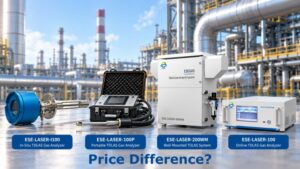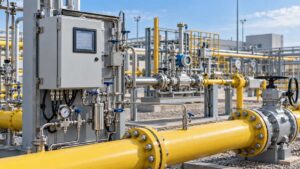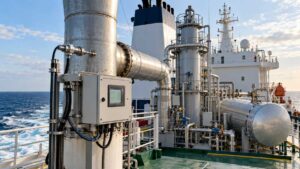




Industrial gas monitoring becomes difficult when the process gas is hot, wet, dusty, corrosive, or changing quickly. In these conditions, delayed readings or unstable measurements can affect combustion control, emission compliance, product quality, and plant safety. That is why many industrial users are moving toward laser-based gas analysis: a TDLS analyzer helps operators capture target gas concentrations faster and more selectively, so they can make process decisions with greater confidence.
A TDLS analyzer is a gas analyzer that uses Tunable Diode Laser Absorption Spectroscopy to measure the concentration of a specific gas by detecting how that gas absorbs laser light at a selected wavelength. It is commonly used for continuous, real-time monitoring of gases such as NH₃, HCl, HF, CH₄, CO, CO₂, O₂, and H₂O in industrial process control and environmental emission monitoring.ESEGAS TDL laser gas analyzers are based on TDLAS technology and are designed for rapid, non-contact, continuous online measurement of target gases. (Gas Analyzer Manufacturers)

Knowing what a TDLS analyzer is only answers the first question. To choose the right system, users also need to understand how the technology works, which gases it can measure, where it performs best, and how it compares with other gas analyzer technologies such as NDIR, FTIR, UV-DOAS, and electrochemical sensors. At ESEGAS, we look at the full measurement environment, not only the analyzer itself, because reliable gas analysis depends on the correct match between technology, sampling method, process conditions, and application goals.
How Does a TDLS Analyzer Work?
A plant may already know that it needs continuous gas monitoring, but the real challenge is obtaining data that is fast, selective, and stable under industrial conditions. When the gas stream contains moisture, dust, corrosive components, or rapidly changing concentrations, weak measurement selectivity can lead to uncertainty. A TDLS analyzer solves this problem by focusing on the unique absorption behavior of the target gas molecule.
A TDLS analyzer uses a tunable diode laser that emits light at a very narrow wavelength range. This wavelength is selected according to the absorption line of the target gas. When the laser beam passes through the gas sample, the target gas absorbs part of the light. The analyzer then measures the reduction in light intensity and calculates the gas concentration.
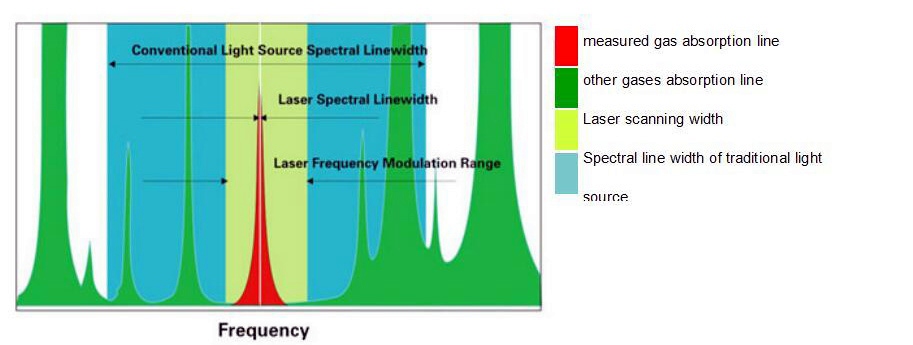
In simple terms, the process includes:
- The laser is tuned to a specific wavelength.
- The laser beam passes through the process gas or sample cell.
- The target gas absorbs light at its characteristic absorption line.
- A detector measures the remaining light intensity.
- The system calculates gas concentration in real time.
This is why a TDLS analyzer is often valued in industrial applications where fast response and high selectivity are required. ESEGAS TDLAS systems are designed to monitor gas concentrations in real time and can be applied in industrial, environmental, and research settings. (Gas Analyzer Manufacturers)
Which Gases Can a TDLS Analyzer Measure?
Selecting the wrong gas analysis technology can lead to poor accuracy, unstable readings, and unnecessary maintenance. Some gases are better suited to infrared, ultraviolet, electrochemical, or FTIR methods, while others are ideal for laser absorption measurement. A TDLS analyzer is especially useful when the target gas has a suitable absorption line and the process requires continuous, selective monitoring.
Common gases measured by TDLS analyzer systems include:
| Target Gas | Typical Industrial Relevance |
| NH₃ | Ammonia slip monitoring in SCR/SNCR denitrification |
| HCl | Waste incineration, coal combustion, chemical process monitoring |
| HF | Fluorine-related processes, stack gas monitoring, laboratory applications |
| CH₄ | Combustion control, process safety, gas quality monitoring |
| CO | Combustion efficiency, explosion prevention, process control |
| CO₂ | Combustion optimization and process gas analysis |
| O₂ | Safety monitoring, combustion control, oxygen enrichment or deficiency detection |
| H₂O | Moisture monitoring and process condition compensation |
ESEGAS TDL laser gas analyzers can measure gases including NH₃, HCl, HF, CH₄, CO, CO₂, and O₂, depending on the application and configuration. (Gas Analyzer Manufacturers) For projects requiring ammonia monitoring, our TDLAS technology can directly measure NH₃ concentration across a wide range from percent level to ppb level, with HCl, HF, CH₄, and C₂H₂ also available as optional measurement gases. (Gas Analyzer Manufacturers)
Why Is a TDLS Analyzer Suitable for Harsh Industrial Conditions?
Industrial gas streams are rarely clean and stable. High temperature, high humidity, corrosive acid gases, dust loading, pressure changes, and rapid concentration fluctuations can all make gas measurement difficult. If the analyzer cannot respond quickly or distinguish the target gas clearly, operators may receive delayed or misleading data. A TDLS analyzer is designed to reduce these risks by using laser-based selective absorption.
The main advantages include:
Fast response
A TDLS analyzer can provide real-time or near-real-time measurement, making it suitable for process control applications where gas concentration changes quickly.
High selectivity
Because the laser targets a specific absorption wavelength, the analyzer can focus on the target gas and reduce interference from other components in the gas mixture.
Non-contact measurement potential
Depending on the installation design, TDLS technology can support non-contact optical measurement, which is useful for hot or corrosive process gases.
Continuous online monitoring
For industrial plants, continuous measurement is more valuable than occasional sampling. A TDLS analyzer helps operators track process changes as they happen.
Lower maintenance in suitable applications
When correctly selected and installed, laser-based gas analysis can reduce contact between sensitive components and aggressive process gases, helping improve long-term operation.
This makes TDLS analyzer technology especially useful in applications such as waste incineration, power generation, cement production, steelmaking, chemical processing, ultra-high-purity gas monitoring, and environmental emission control.
What Is the Difference Between an In-Situ TDLS Analyzer and an Extractive TDLS Analyzer?
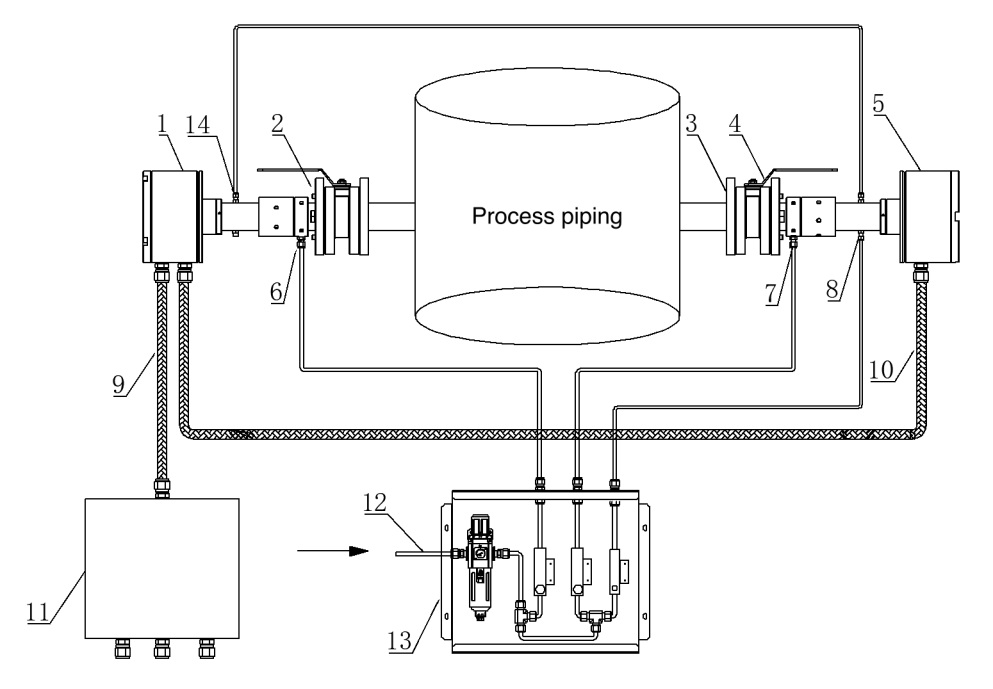
Many gas monitoring problems are not caused by the analyzer technology itself, but by choosing the wrong installation method. A measurement point with high dust, vibration, limited optical path, or strong corrosion may require a different configuration from a clean and stable process line. That is why we evaluate whether an in-situ or extractive TDLS analyzer is more suitable before recommending a system.
| Type | Measurement Method | Best For | Key Consideration |
| In-situ TDLS analyzer | Measures directly across the process path | Fast response, high-temperature gas, direct process control | Requires suitable installation position and optical path |
| Extractive TDLS analyzer | Extracts sample gas into a controlled measurement system | Wet, corrosive, dusty, or complex gas streams | Requires proper sampling, heating, filtration, and pretreatment |
| System-integrated TDLS analyzer | Combines analyzer, sampling, pretreatment, control, and data output | Turnkey industrial gas analysis projects | Must be designed according to real site conditions |
At ESEGAS, we do not treat the TDLS analyzer as an isolated instrument. We consider the sample gas, installation point, temperature, pressure, moisture, particulate level, corrosive components, and communication requirements. For complex applications, the complete gas analysis system may include sampling units, transfer lines, pretreatment components, control units, and the analyzer module.
How Does a TDLS Analyzer Compare with NDIR, UV-DOAS, FTIR, and Electrochemical Analyzers?
Gas analyzer selection can become confusing because every technology has strengths and limits. Choosing only by price, range, or brand can lead to problems later. A TDLS analyzer is powerful for selective laser-based measurement of specific gases, but it should still be compared with other technologies according to the application.
| Technology | Main Strength | Typical Use |
| TDLS / TDLAS | Fast, selective measurement of target gases | NH₃, HCl, HF, CH₄, CO, CO₂, O₂ |
| NDIR | Reliable infrared absorption measurement | CO, CO₂, CH₄ and other IR-active gases |
| UV-DOAS | Multi-component UV absorption measurement | SO₂, NOx, O₃ and other UV-absorbing gases |
| FTIR | Simultaneous multi-gas infrared measurement | Emission monitoring, research, complex gas mixtures |
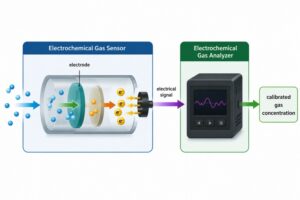
| Electrochemical | Compact and cost-effective detection | Safety monitoring or simple gas detection points |
For example, ESEGAS offers FTIR gas analyzers for simultaneous detection of multiple gas components including SO₂, NOx, CH₄, HCl, HF, CO, CO₂, O₂, and H₂O, with additional gases available upon request. (Gas Analyzer Manufacturers) We also provide UV-DOAS gas analysis solutions for applications where ultraviolet absorption is more suitable. (Gas Analyzer Manufacturers)
In practice, the best choice depends on the target gas, required response time, detection limit, gas matrix, humidity, dust, corrosion, and whether the customer needs single-gas precision or multi-gas coverage.
Where Can a TDLS Analyzer Be Used in Industrial Applications?
A gas analyzer only creates value when it is installed at the right measurement point and connected to the right process decision. Without proper application matching, even a high-performance analyzer may not help the plant improve control, safety, or compliance. A TDLS analyzer is especially useful where fast and selective measurement of one target gas is required.
Typical applications include:
Ammonia slip monitoring
In SCR and SNCR denitrification systems, NH₃ measurement helps operators control ammonia injection and reduce excess ammonia slip.
HCl and HF monitoring
In waste incineration, coal-fired power plants, chemical processes, and laboratory combustion research, acid gas monitoring is important for emission control and process evaluation.
Combustion optimization
CO, CO₂, O₂, and CH₄ monitoring can support combustion efficiency, fuel control, and process safety.
Steelmaking and converter gas monitoring
Fast oxygen or combustible gas measurement can help reduce explosion risk and improve process control in steel plants.
Ultra-high-purity gas monitoring
For semiconductor, photonics, and high-tech industries, TDLAS technology can support real-time trace impurity detection in high-purity gas streams. ESEGAS TDLAS gas analysis systems are used for real-time impurity monitoring in ultra-pure gas applications. (Gas Analyzer Manufacturers)
Environmental emission monitoring
A TDLS analyzer can be integrated into continuous emission monitoring systems when the target gas and process conditions match the measurement principle.
How Should You Choose the Right TDLS Analyzer?
A common mistake is to choose a TDLS analyzer only by the gas name. In real industrial projects, the same gas may require different ranges, optical paths, sampling systems, materials, heating methods, and calibration strategies. If these details are ignored, the analyzer may not perform as expected on site.
When selecting a TDLS analyzer, we recommend evaluating the following factors:
- Target gas
Confirm whether the target gas is suitable for TDLS/TDLAS measurement. - Measurement range
Decide whether the application requires percent, ppm, ppb, or trace-level detection. - Process conditions
Review temperature, pressure, humidity, dust, flow rate, and gas composition. - Corrosive components
For gases such as HCl, HF, or NH₃, material compatibility and sample handling are critical. - Installation type
Choose between in-situ, extractive, or system-integrated measurement. - Response time requirement
Fast process control needs faster response than general environmental reporting. - Signal output and integration
Confirm whether the analyzer needs to connect with DCS, PLC, SCADA, CEMS, or local data acquisition systems. - Maintenance strategy
Consider calibration, optical alignment, sample conditioning, filter replacement, and long-term service access.
At ESEGAS, our goal is not simply to supply a TDLS analyzer, but to provide a measurement solution that fits the real application. We work with users to understand the gas, process, site conditions, and control objectives before recommending the most suitable configuration.
Why Choose ESEGAS for TDLS Gas Analysis?
When customers choose a TDLS analyzer, they are not only purchasing an instrument. They are choosing the reliability of their gas data, the stability of their process control, and the confidence of their environmental or safety decisions. A gas analyzer must work in the real world, not only under ideal laboratory conditions.
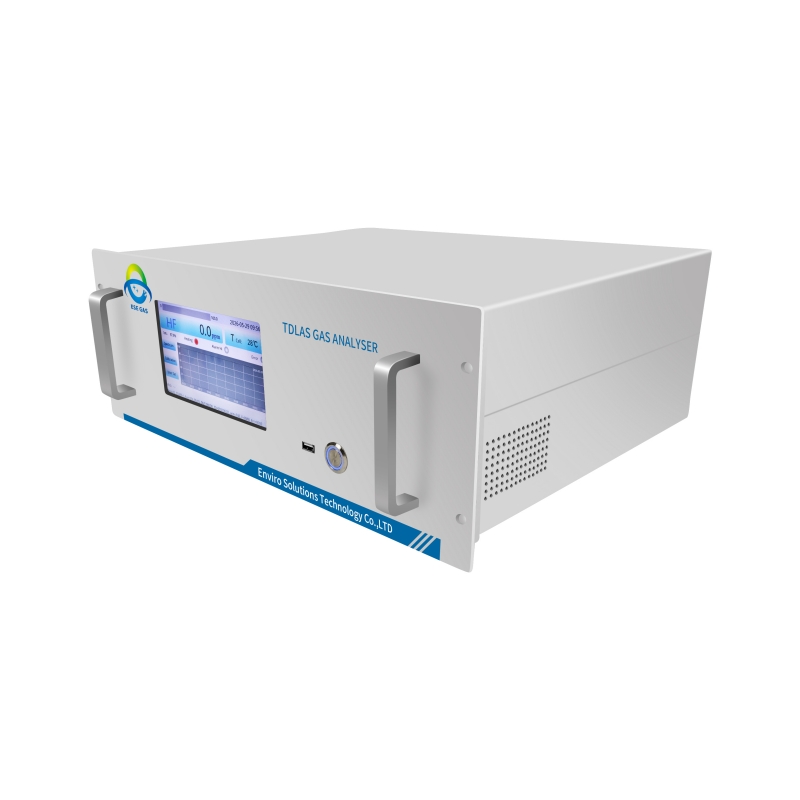
At ESEGAS, we focus on industrial gas analysis solutions based on application needs. Our TDLS/TDLAS gas analyzer systems are developed for demanding gas monitoring tasks involving gases such as NH₃, HCl, HF, CH₄, CO, CO₂, and O₂. We also provide other gas analyzer technologies, including FTIR, UV-DOAS, and NDIR, so we can recommend the most appropriate method instead of forcing one technology into every application.
Our approach includes:
- Understanding the target gas and measurement purpose
- Evaluating process conditions and installation challenges
- Selecting the right gas analysis technology
- Designing sampling and pretreatment systems when needed
- Supporting integration with plant control or monitoring systems
- Helping users improve long-term measurement stability
This application-driven method allows us to support industries such as power generation, waste incineration, cement, steel, chemical processing, laboratory research, semiconductor manufacturing, and environmental monitoring.
Conclusion
A TDLS analyzer is a powerful solution for fast, selective, and continuous industrial gas monitoring. By using tunable diode laser absorption spectroscopy, it measures target gases according to their specific light absorption characteristics, making it suitable for applications that require real-time process insight and reliable gas concentration data.
For gases such as NH₃, HCl, HF, CH₄, CO, CO₂, O₂, and H₂O, the right TDLS analyzer can help improve process control, reduce operational risk, support emission compliance, and strengthen plant safety. At ESEGAS, we help customers move beyond instrument selection and build complete gas analysis solutions based on real site conditions, target gases, and long-term monitoring goals.