


Water quality problems rarely announce themselves early. A sudden increase in organic pollution, ammonia nitrogen, phosphorus, or chlorine residue may remain unnoticed until discharge limits are exceeded, treatment efficiency drops, or environmental risk becomes difficult to control. For operators who still rely heavily on manual sampling, this delay can create pressure, uncertainty, and unnecessary operational cost. At ESEGAS, we believe that continuous online monitoring is not only a testing method, but also a practical way to help water treatment plants, industrial discharge points, and environmental monitoring stations respond faster and manage water quality with greater confidence.
A water quality online monitor helps users continuously track key water parameters in real time, such as COD, ammonia nitrogen, total phosphorus, total nitrogen, permanganate index, nitrate nitrogen, nitrite nitrogen, phosphate, sulfide, residual chlorine, and total chlorine. By providing automatic measurement, data storage, alarm functions, and remote communication, it supports more stable water treatment, earlier pollution detection, and more reliable compliance management.
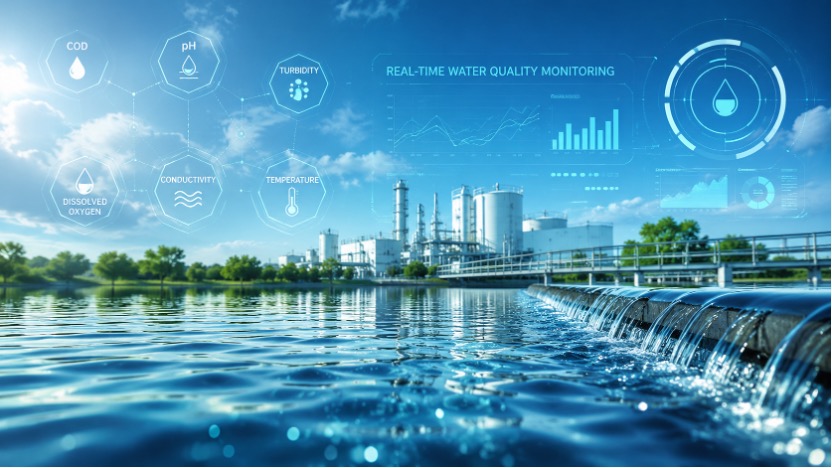
Knowing that online monitoring is important is only the first step. In real projects, users also need to understand which parameters matter, how the instrument works, where it can be applied, and what kind of technical design makes long-term operation more stable. This is why ESEGAS developed solutions such as the ESE-COD-3000, a practical online analyzer platform designed for continuous water quality monitoring in demanding field conditions.
What Is a Water Quality Online Monitor?
When water quality changes faster than manual testing can respond, operators may lose the best time to adjust treatment processes. This is especially risky for wastewater discharge, surface water monitoring, and industrial process water, where pollutant levels may fluctuate within hours. A Water Quality Online Monitorsolves this problem by automatically sampling, analyzing, displaying, storing, and transmitting water quality data without waiting for repeated manual laboratory testing.
The ESE-COD-3000 Water Quality Online Monitor is designed for real-time monitoring of municipal domestic sewage, pollution source discharge water, surface water, groundwater, and other water quality applications. Based on a photoelectric signal detection module, it can be configured for multiple monitoring parameters, including COD, ammonia nitrogen, total phosphorus, total nitrogen, permanganate index, nitrate nitrogen, nitrite nitrogen, phosphate, sulfide, residual chlorine, and total chlorine.
Instead of offering only a single reading, the ESE-COD-3000 supports continuous operation with automatic analysis modes such as hourly, interval, manual, and remote measurement. This allows users to build a more complete picture of water quality trends and react quickly when abnormal values appear.
How Does the ESE-COD-3000 Measure COD and Other Water Quality Parameters?
Many users know they need COD or nutrient monitoring, but they may not know whether the measurement principle is suitable for long-term field operation. Inaccurate or unstable measurement can lead to wrong process decisions, excessive chemical dosing, or missed pollution events. That is why the analytical method inside a Water Quality Online Monitor matters as much as the monitoring result itself.
For COD monitoring, the ESE-COD-3000 adopts the potassium dichromate spectrophotometry method. A quantitative water sample is mixed with potassium dichromate, silver sulfate solution, and concentrated sulfuric acid, then heated in the digestion tank. During digestion, chromium ions change state as organic compounds are oxidized, and the instrument calculates COD through colorimetric conversion.
For other parameters, the ESE-COD-3000 series uses different photometric and spectrophotometric methods according to the target substance:
| Monitoring Parameter | Measurement Principle | Typical Value for Water Management |
| COD | Potassium dichromate spectrophotometry | Evaluates organic pollution level |
| Ammonia Nitrogen | Salicylic acid spectrophotometry | Supports wastewater treatment and nutrient pollution control |
| Total Phosphorus | Molybdate spectrophotometry | Helps control eutrophication-related discharge |
| Total Nitrogen | Photometric method after digestion | Supports nitrogen pollution monitoring |
| Heavy Metals | Reagent-based photometric methods | Measures ions such as lead, cadmium, chromium, copper, nickel, and fluoride |
This technical structure allows ESEGAS to provide a Water Quality Online Monitor solution that is not limited to one simple parameter, but can support broader online water quality management needs.
Which Technical Specifications Make the ESE-COD-3000 Suitable for Online Monitoring?
A monitor may perform well in a laboratory but still fail to meet field requirements if its range, accuracy, data output, or maintenance cycle cannot match real operating conditions. For users managing wastewater discharge or environmental monitoring stations, unstable operation can create data gaps and reduce trust in the monitoring system. The ESE-COD-3000 is designed to help address these practical concerns.
For COD monitoring, the ESE-COD-3000 offers analysis ranges of 0–200 mg/L, 0–1000 mg/L, and 0–5000 mg/L, with customizable options. Its COD detection limit is 3 mg/L, resolution is less than 1.0 mg/L, and the measurement error is less than ±5% for standard solution and less than ±10% for water samples.
The instrument also supports:
- Fault alarms, including liquid shortage alarm, self-check alarm, fault alarm, and over-limit alarm
- Data communication, including 4–20 mA analog output, RS232 or RS485 interface, and RJ45
- MODBUS protocol, allowing remote reading of operating status and related data
- Data storage of about 20,000 groups, with USB export support
- A maintenance cycle of more than 30 days
- A 7-inch LCD display with 1024×600 resolution
- Operating environment of 5–40°C, humidity below 90% without condensation
These specifications make the ESE-COD-3000 Water Quality Online Monitor suitable for users who need continuous data, remote communication, and stable on-site operation.
Where Can a Water Quality Online Monitor Be Used?
Water quality risks are not limited to one industry. Municipal wastewater plants, industrial parks, environmental stations, and water resource management projects all face different monitoring pressures. Without online data, it is difficult to know whether water quality changes are temporary fluctuations or signs of a deeper treatment or discharge problem.
The ESE-COD-3000 Water Quality Online Monitor can be applied in a wide range of water monitoring scenarios, including:
- Municipal domestic sewage monitoring
- Industrial wastewater discharge monitoring
- Pollution source discharge water monitoring
- Surface water monitoring
- Groundwater monitoring
- Environmental water quality stations
- Process water control in industrial facilities
In municipal wastewater treatment, it can help operators understand COD, ammonia nitrogen, total phosphorus, and total nitrogen trends. In industrial discharge applications, it supports continuous supervision of outlet water quality. In surface water and groundwater projects, it helps build long-term environmental data records for better pollution source evaluation.
How Does the ESE-COD-3000 Improve Daily Operation and Maintenance?
Even when users understand the value of online monitoring, they may still worry about maintenance workload, reagent handling, data export, and instrument stability. If an analyzer requires too much manual intervention, the benefit of automation becomes weaker. For ESEGAS, a reliable Water Quality Online Monitor must be accurate, stable, and practical for daily operation.
The ESE-COD-3000 is designed with several features that support long-term use. Its main components use imported brands to help ensure accuracy, stability, and reliability. The infrared metering unit supports precise quantitative measurement, while positive and negative pressure flow technology helps improve durability because the peristaltic pump tube does not pass liquid directly.
The instrument also uses a dedicated LED light source with a high signal-to-noise ratio, together with dual photocell detection to reduce the influence of temperature drift. For users who need integration into existing automation systems, the RS232/RS485 interface and standard MODBUS protocol make it easier to remotely read operating status and measurement data.
From an operation perspective, the ESE-COD-3000 supports interval, manual, and remote calibration. Combined with fault alarms and data storage, it helps operators reduce blind spots and maintain a clearer view of instrument status.
What Should Users Consider Before Choosing a Water Quality Online Monitor?
Selecting the wrong monitor can lead to mismatched measurement ranges, unnecessary maintenance, poor integration, or unreliable data. This is especially true when water quality varies significantly between municipal sewage, industrial wastewater, surface water, and groundwater. A good selection process should begin with the actual monitoring purpose, not only the product name.
Before choosing a Water Quality Online Monitor, ESEGAS recommends evaluating the following factors:
| Selection Factor | Why It Matters |
| Monitoring parameters | Determines whether the system can measure COD, ammonia nitrogen, phosphorus, nitrogen, chlorine, or other target indicators |
| Measurement range | Ensures the analyzer matches expected concentration levels |
| Detection limit and resolution | Affects sensitivity to low-level changes |
| Measurement method | Influences reliability, accuracy, and suitability for the application |
| Communication interface | Supports integration with PLC, data logger, SCADA, or remote platforms |
| Alarm functions | Helps operators respond to liquid shortage, faults, or over-limit events |
| Maintenance cycle | Reduces workload and improves data continuity |
| Installation environment | Ensures stable operation under temperature, humidity, and site conditions |
| Technical support | Helps with installation, commissioning, training, and long-term use |
For example, if the project focuses on organic pollution, COD range and digestion performance are important. If the site is a municipal wastewater plant, ammonia nitrogen, total phosphorus, and total nitrogen may also be required. If the project needs remote supervision, RS485, MODBUS, 4–20 mA, and data storage functions should be considered from the beginning.
Why Choose ESEGAS for Water Quality Online Monitoring?
Water monitoring projects require more than an instrument. Users need a solution that fits the water source, monitoring parameter, site conditions, communication requirements, and maintenance capacity. Without professional matching, even a capable analyzer may not deliver its full value in real operation.
At ESEGAS, we focus on practical online monitoring solutions for water quality and environmental applications. With the ESE-COD-3000 Water Quality Online Monitor, we help users monitor important indicators such as COD, ammonia nitrogen, total phosphorus, total nitrogen, residual chlorine, total chlorine, and other configurable parameters.
Our goal is to provide instruments that support reliable measurement, easier operation, and better data management. From product selection to installation guidance and after-sales support, we work with users to make online monitoring more stable and more useful in daily water quality management.
Conclusion
A Water Quality Online Monitor is more than a testing device. It is an important tool for real-time water quality control, pollution source supervision, wastewater treatment optimization, and environmental compliance management. The ESE-COD-3000 reflects ESEGAS’s practical approach to online monitoring: accurate measurement principles, configurable parameters, automatic analysis, reliable communication, data storage, alarm functions, and long-term operation support. For users who need smarter and more dependable water quality management, ESEGAS is ready to provide a solution built for real working conditions.