



Choosing a gas analyzer should be straightforward. Yet many buyers get stuck when they see both RS485 in gas analyzer and Modbus in gas analyzer listed on the specification sheet. Selecting the wrong communication option can lead to integration problems, delayed commissioning, and unexpected engineering costs.
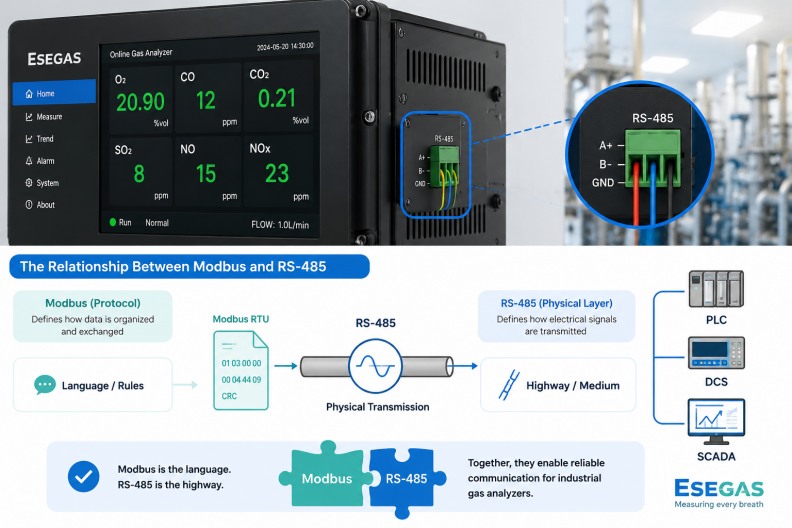
RS485 in gas analyzer refers to the physical communication interface, while Modbus in gas analyzer refers to the communication protocol. RS485 carries the data, and Modbus defines how the data is organized and exchanged. In most industrial gas analyzers, Modbus RTU operates over an RS485 interface.
However, knowing the definition is only the beginning. To select the right gas analyzer for your PLC, DCS, or SCADA system, you need to understand how these technologies work together in real industrial environments.
Why Do Buyers Often Confuse RS485 in Gas Analyzer and Modbus in Gas Analyzer?
The confusion usually starts with product specifications. A gas analyzer datasheet may include: RS485 Communication, Modbus RTU, RS485 + Modbus, and RS232 / RS485 Optional. At first glance, they appear to be competing communication methods. In reality, they belong to different layers of the communication system.
Think of it this way: RS485 is the highway. Modbus is the traffic rule. A highway allows vehicles to travel. Traffic rules ensure every vehicle knows where to go and how to behave. Likewise, RS485 provides the electrical pathway for data transmission, while Modbus determines how devices exchange information. Once this distinction becomes clear, selecting the right communication option becomes much easier.
What Is RS485 in Gas Analyzer Communication?
RS485 is an industrial serial communication standard that defines how electrical signals travel between devices. Unlike office networks, industrial facilities contain:
- Large motors
- Variable-frequency drives
- High-voltage equipment
- Long cable runs
- Strong electromagnetic interference
As a result, communication systems must remain reliable even in harsh environments. RS485 was designed specifically for these conditions. It uses differential signaling, which significantly improves noise immunity and communication stability.
Key Benefits of RS485 in Gas Analyzer Applications
| Feature | Benefit |
|---|---|
| Differential signaling | Strong resistance to electrical noise |
| Long transmission distance | Up to approximately 1200 m under typical conditions |
| Multi-device networking | Multiple instruments can share one communication bus |
| Low wiring cost | Reduces installation expenses |
| Industrial reliability | Stable operation in harsh environments |
For this reason, RS485 has become one of the most widely used interfaces in:
- Continuous Emission Monitoring Systems (CEMS)
- Process gas analyzers
- Oxygen analyzers
- Multi-gas monitoring systems
- Environmental monitoring stations
Importantly, RS485 only defines how data travels, and it does not define what the data means. That is where Modbus enters the picture.
What Is Modbus in Gas Analyzer Communication?
Modbus is an industrial communication protocol developed for exchanging process data between automation devices. While RS485 handles signal transmission, Modbus defines device addresses, data registers, read and write commands, message formats, and error-checking methods.
In simple terms, Modbus creates a common language that allows equipment from different manufacturers to communicate reliably.
How Modbus Works in a Gas Analyzer?
Suppose a gas analyzer measures gas concentration (CO, CO₂, O₂, and CH₄). The gas analyzer stores these values in predefined Modbus registers.
When a PLC requests data, Modbus specifies:
- Which register contains the value.
- How the request should be formatted.
- How the analyzer should respond.
- How communication errors are detected.
As a result, the control system can automatically retrieve real-time process data without requiring custom software development. This standardization explains why Modbus remains one of the most common protocols in industrial automation today.
How Do RS485 and Modbus Work Together in a Gas Analyzer?
This is the point many buyers overlook. In most industrial gas analyzers, RS485 and Modbus are not alternatives. They work together. The communication process typically follows this sequence:
- The gas analyzer measures gas concentration.
- Measurement values are stored in Modbus registers.
- Modbus organizes the communication message.
- RS485 transmits the message through the communication cable.
- The PLC, DCS, or SCADA system receives the data.
In other words, Modbus defines the language. RS485 delivers the message. This combination—Modbus RTU over RS485—has become the standard communication architecture for industrial instrumentation.
RS485 in Gas Analyzer vs Modbus in Gas Analyzer: What Are the Main Differences?
The easiest way to understand the distinction is through direct comparison.
| Parameter | RS485 in Gas Analyzer | Modbus in Gas Analyzer |
|---|---|---|
| Type | Physical interface | Communication protocol |
| Purpose | Signal transmission | Data exchange |
| Defines wiring | Yes | No |
| Defines commands | No | Yes |
| Defines registers | No | Yes |
| Defines electrical signals | Yes | No |
| Supports industrial automation | Yes | Yes |
| Usually used together | Yes | Yes |
Therefore, when a buyer asks: “Should I choose RS485 or Modbus?” the more accurate question is: “Does the gas analyzer support Modbus communication through an RS485 interface?” In most industrial projects, the answer should be yes.
Which Communication Option Should You Choose for Your Gas Analyzer?
The right choice depends largely on the automation system already installed at your facility.
| Preferred Solution | Conditions |
|---|---|
| Choose RS485 with Modbus RTU for most industrial applications | use PLC systems |
| use DCS platforms | |
| operate SCADA software | |
| need long-distance communication | |
| want multi-vendor compatibility | |
| expect future system expansion |
When Might RS485 Be Used Without Modbus?
Some specialized equipment uses proprietary communication protocols over an RS485 interface.
Although technically possible, this approach often creates integration challenges because each device requires custom software drivers and dedicated engineering support.
Consequently, most modern plants prefer Modbus RTU because it simplifies commissioning and maintenance.
How Does Modbus RTU over RS485 Benefit Industrial Gas Monitoring?
Consider a typical power plant or cement kiln. The facility may operate: SO₂ analyzers, NOx analyzers, CO analyzers, O₂ analyzers, and dust monitors. Instead of running separate communication networks, engineers can connect multiple instruments to a shared RS485 communication bus.
The SCADA system then polls each gas analyzer using Modbus RTU and retrieves: gas concentrations, alarm status, calibration information, diagnostic data, and instrument health indicators.
This architecture delivers several benefits: reduced wiring complexity, lower installation costs, faster commissioning, easier troubleshooting, and improved scalability. As facilities continue adopting Industry 4.0 practices, reliable digital communication has become just as important as measurement accuracy itself.
What Communication Configuration Does ESEGAS Recommend?
For most process monitoring and emission monitoring applications, ESEGAS recommends:
Standard Industrial Configuration
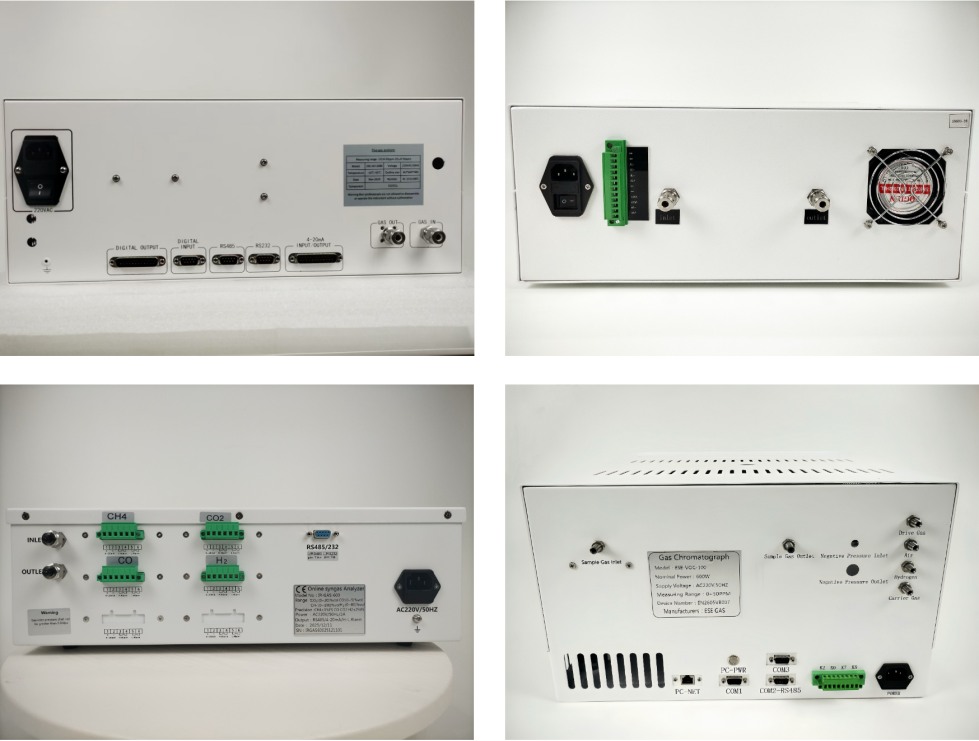
- RS485 Communication Interface
- Modbus RTU Protocol
- PLC/DCS/SCADA Integration Support
- Long-Distance Industrial Networking
This configuration is widely used across industries such as:
- Power generation
- Cement manufacturing
- Steel production
- Petrochemicals
- Waste incineration
- Chemical processing
- Environmental monitoring
Whether monitoring CO, CO₂, CH₄, H₂, O₂, NOx, SO₂, HCl, HF, VOCs, or other process gases, Modbus RTU over RS485 provides a stable and proven communication solution for industrial automation systems.
Conclusion
RS485 in gas analyzer and Modbus in gas analyzer serve different purposes but work best together. RS485 provides the physical communication pathway, while Modbus defines how measurement data is exchanged. For most industrial gas monitoring applications, Modbus RTU over RS485 remains the most reliable, compatible, and cost-effective communication solution. If you are evaluating a new gas analyzer project, the ESEGAS team can help you select the optimal communication architecture for seamless integration with your control system.
FAQs:
1. What is the difference between RS485 in Gas Analyzer and Modbus in Gas Analyzer?
RS485 in Gas Analyzer is a physical communication interface that transmits electrical signals between devices. Modbus in gas analyzer is a communication protocol that defines how data is organized, requested, and exchanged. In most industrial gas analyzers, Modbus RTU operates over an RS485 interface.
2. Is Modbus the same as RS485?
No. RS485 and Modbus are different technologies that work together. RS485 defines the physical layer and wiring, while Modbus defines the communication rules and data structure. A common analogy is that RS485 is the highway, and Modbus is the traffic language used on that highway.
3. Can a gas analyzer use RS485 without Modbus?
Yes. A gas analyzer can use RS485 with proprietary communication protocols. However, most industrial facilities prefer Modbus RTU over RS485 because it simplifies integration with PLCs, DCS systems, and SCADA platforms.
4. Why do most industrial gas analyzers use Modbus RTU over RS485?
Modbus RTU over RS485 provides:
- Long-distance communication
- Strong anti-interference capability
- Multi-device networking
- Easy PLC and SCADA integration
- Lower installation costs
These advantages make it one of the most widely adopted communication methods in industrial automation.
5. What control systems support Modbus in Gas Analyzer applications?
Most modern automation systems support Modbus communication, including:
- PLC systems
- DCS systems
- SCADA software
- Industrial HMIs
- Data acquisition systems
This broad compatibility is one reason Modbus remains a standard protocol in process industries.
6. How far can RS485 communication transmit gas analyzer data?
Under typical industrial conditions, RS485 communication can support transmission distances up to approximately 1,200 meters (4,000 feet) while maintaining reliable performance. Actual distance depends on baud rate, cable quality, and installation practices.
7. Can multiple gas analyzers share the same RS485 network?
Yes. RS485 supports multi-drop communication, allowing multiple gas analyzers and field devices to communicate on a single bus. Each device is assigned a unique Modbus address, enabling the PLC or SCADA system to identify and retrieve data from individual instruments.
8. What information can a PLC read through Modbus from a gas analyzer?
A PLC can typically access:
- Gas concentration values
- Analyzer status
- Alarm signals
- Calibration status
- Diagnostic information
- System fault codes
The specific data available depends on the analyzer’s Modbus register map.
9. What is Modbus RTU in a gas analyzer?
Modbus RTU is the serial version of the Modbus protocol. It uses binary data transmission and is commonly implemented over RS485 communication networks. Modbus RTU is known for its reliability, simplicity, and widespread industrial adoption.
10. How do I know if my gas analyzer supports Modbus RTU over RS485?
Check the analyzer specification sheet for terms such as:
- RS485 Communication
- Modbus RTU
- Modbus RS485
- Serial Communication Protocol
You can also review the Modbus register map provided by the manufacturer. If a register map is available, the analyzer typically supports Modbus communication.
11. What are the common causes of Modbus RTU communication failures?
Common issues include:
- Incorrect slave address settings
- Mismatched baud rates
- Wrong parity configuration
- Reversed A/B wiring
- Missing termination resistors
- Communication parameter mismatches
Many “Modbus problems” are actually RS485 wiring issues rather than protocol errors.
12. Does ESEGAS support Modbus RTU over RS485?
Yes. ESEGAS online gas analyzers can be configured with RS485 communication and Modbus RTU protocol, allowing seamless integration with PLC, DCS, SCADA, and industrial monitoring systems for real-time process control and emissions monitoring.