


Industrial fluid welding is unforgiving. A small change in shielding gas composition, residual gas concentration, moisture, carbon dioxide, carbon monoxide, or hydrocarbon contamination can lead to porosity, oxidation, weak weld seams, leakage risks, and costly rework. The problem becomes more serious when manufacturers rely only on flow meters or manual inspection, because gas instability may already have affected the weld before the issue is discovered. At ESEGAS, we believe that stable welding quality starts with reliable gas data, and an infrared gas analyzer helps manufacturers see what is happening inside the process before defects become expensive failures.
An infrared gas analyzer improves industrial fluid welding processes by continuously measuring key gas concentrations, helping manufacturers control shielding gas quality, identify process contamination, reduce weld defects, improve workshop safety, and maintain stable welding conditions. In fluid-related welding applications, it is especially useful for monitoring infrared-active gases such as CO₂, CO, CH₄, hydrocarbons, and other process gases that may affect weld quality or safety.
For industrial fluid equipment such as pipelines, pressure vessels, storage tanks, valves, heat exchangers, and fluid transfer systems, welding is not only a joining process. It is a quality-critical operation that directly affects sealing performance, corrosion resistance, mechanical strength, and long-term reliability. That is why gas analysis should not be treated as a secondary inspection step. It should be part of process control. Below, we explain how ESEGAS infrared gas analysis technology supports industrial fluid welding from gas monitoring to quality assurance and safety management.
Why Does Gas Monitoring Matter in Industrial Fluid Welding?
Industrial fluid welding often involves components that must withstand pressure, temperature changes, corrosive media, or continuous fluid flow. When gas conditions are unstable, defects may not be visible immediately, but they can appear later as leakage, corrosion points, weak joints, or failed pressure tests. This creates a painful cycle: weld, inspect, repair, and test again. A well-configured infrared gas analyzer helps break this cycle by giving manufacturers real-time insight into the gas environment around the welding process.
Gas monitoring matters because welding quality depends on more than current, voltage, heat input, and operator skill. The gas environment also plays a critical role.
In industrial fluid welding, gas analysis helps manufacturers:
| Gas Control Need | Why It Matters in Welding |
| Shielding gas stability | Helps protect the molten weld pool from oxidation and contamination |
| CO₂ concentration control | Supports stable gas mixture control in certain welding and process environments |
| CO monitoring | Helps detect incomplete combustion, process gas leakage, or safety risks |
| CH₄ and hydrocarbon detection | Helps identify fuel gas leakage or process contamination |
| Moisture and residual gas awareness | Helps reduce weld defects related to contamination |
| Process gas trend tracking | Supports quality documentation and root-cause analysis |
For ESEGAS customers, the value of gas monitoring is not limited to detecting whether gas is present or absent. The real value is knowing whether the gas condition is stable enough to support repeatable welding quality.
What Gases Can an Infrared Gas Analyzer Measure During Welding?
Many welding operations focus heavily on gas flow rate, but flow rate alone does not prove that the gas composition is correct. A line may deliver the expected flow while still carrying the wrong gas mixture, contamination, or leakage from another process. This is where an infrared gas analyzer becomes valuable: it provides concentration data, not just flow information.
Infrared gas analysis is especially suitable for gases that absorb infrared radiation at characteristic wavelengths. In industrial fluid welding and related process environments, common monitoring targets include:
| Gas Component | Typical Relevance to Industrial Fluid Welding |
| CO₂ | Shielding gas mixture control, process gas monitoring, combustion-related analysis |
| CO | Safety monitoring, incomplete combustion detection, process abnormality identification |
| CH₄ | Fuel gas leakage detection, hydrocarbon contamination monitoring |
| CnHm / hydrocarbons | Process contamination, combustible gas monitoring, fuel-related process control |
| N₂O | Specialized process or environmental gas monitoring |
| O₂ | Important for residual oxygen control, usually measured with electrochemical, paramagnetic, or zirconia technology rather than standard NDIR alone |
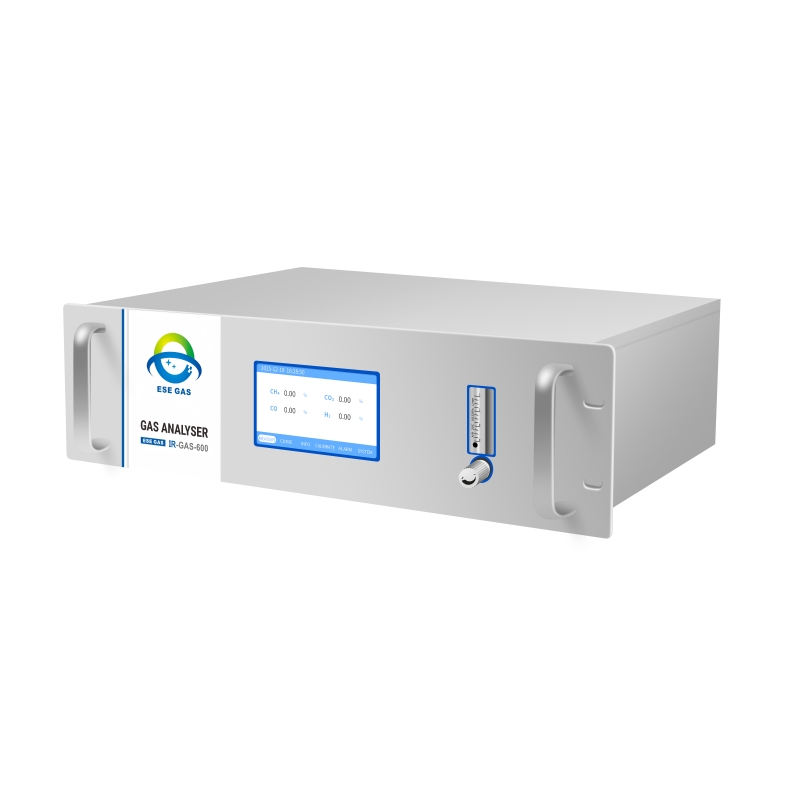
ESEGAS NDIR Gas Analyzer IR-GAS-600 is designed for industrial gas analysis and can measure gases such as CO, CO₂, CH₄, N₂O, and O₂ depending on configuration. The product page also describes infrared detection for CO, CO₂, and CH₄, with optional oxygen measurement by electrochemical or paramagnetic sensor. (Gas Analyzer Manufacturers)
This is important because welding applications often need more than one gas value. For example, a manufacturer may need CO₂ and CH₄ monitoring for fuel-related process safety, CO detection for workshop risk control, and O₂ monitoring for purge or residual oxygen verification. ESEGAS can support this through integrated gas analysis solutions rather than treating every gas as a separate isolated measurement.
How Does Infrared Gas Analysis Support Weld Quality Control?
Weld defects rarely come from one single cause. They are usually the result of several process variables drifting at the same time: gas purity, gas mixture ratio, material surface condition, heat input, humidity, and environmental exposure. Without gas concentration data, it becomes difficult to prove whether a defect was caused by gas instability or by another process factor. An infrared gas analyzer gives quality teams a reliable data layer for process control and troubleshooting.
In industrial fluid welding, infrared gas analysis supports quality control in several ways.
First, it helps verify gas consistency. If the process requires a stable CO₂-containing gas mixture, continuous measurement can confirm whether the concentration remains within the expected range.
Second, it helps identify contamination before it causes visible defects. Hydrocarbon, CO, or abnormal CO₂ readings may indicate leakage, combustion problems, or unwanted gas mixing in the process area.
Third, it supports repeatability. Welding quality improves when the same gas conditions can be maintained from one batch to the next.
Fourth, it improves traceability. When gas concentration data is recorded together with welding parameters, manufacturers gain stronger evidence for quality audits, customer documentation, and internal process improvement.
For fluid equipment manufacturers, this is especially valuable because weld failure can affect sealing reliability. A stable welding gas environment helps reduce the risk of porosity, oxidation, incomplete protection, and inconsistent weld bead quality.
Why Is Infrared Technology Suitable for Industrial Welding Environments?
Industrial welding workshops are not ideal laboratory environments. They may involve high temperature zones, dust, metal fumes, vibration, humidity, long production hours, and changing process loads. A gas analyzer used in this environment must offer stable measurement, fast response, and the ability to integrate with sampling and conditioning systems. This is why infrared gas analyzer technology is widely used in industrial process monitoring.
Infrared technology is suitable for welding-related gas monitoring because it offers several practical advantages:
- Non-consumptive measurement principle
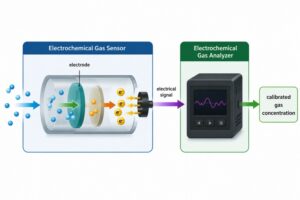
NDIR technology measures gas concentration based on infrared absorption. The ESEGAS product description explains that gases such as CO, CO₂, CH₄, C₃H₈, and other molecular species can be detected by measuring their infrared absorption spectra, with concentration related to absorption intensity according to Lambert–Beer’s law. (Gas Analyzer Manufacturers) - Good suitability for CO₂, CO, and CH₄
These gases are highly relevant in many industrial process and welding-related environments, especially where shielding gases, fuel gases, combustion gases, or hydrocarbons are present. - Fast response for process control
Gas concentration changes can be detected quickly enough to support alarms, trend monitoring, and process adjustment. - Stable performance for continuous monitoring
Compared with occasional manual checks, continuous infrared gas analysis helps manufacturers understand process trends over time. - Flexible integration with sample conditioning
In complex welding sites, gas samples may require filtration, drying, pressure regulation, or temperature control before analysis. ESEGAS can configure gas analysis systems according to actual site conditions.
Where Can ESEGAS Infrared Gas Analyzers Be Used in Fluid Welding Applications?
Not every industrial fluid welding process has the same gas monitoring requirement. A pipeline welding station, a pressure vessel workshop, and a heat exchanger production line may all need different gas sampling points, target gases, response times, and analyzer configurations. The risk of using a generic analyzer without process understanding is that the data may be technically correct but not useful for production control.
ESEGAS infrared gas analyzer solutions can be applied in multiple fluid welding scenarios, including:
- Pipeline welding and purge gas monitoring
Used to monitor process gases around pipe welding, especially where gas composition stability affects weld protection and internal surface quality. - Pressure vessel welding
Helps support quality control in welds that must pass pressure, leakage, and safety inspections. - Heat exchanger manufacturing
Supports consistent welding conditions for tube sheets, fluid channels, and sealed joints. - Valve and fluid control equipment welding
Helps improve process stability where small weld defects may affect sealing performance. - Storage tank and fluid container fabrication
Supports gas environment monitoring during welding, repair, or process-related heating operations. - Automated welding production lines
Can be integrated into online gas monitoring systems to provide continuous gas concentration data for process control.
In these applications, ESEGAS does not view the infrared gas analyzer as a stand-alone instrument only. We see it as part of a complete gas monitoring solution that may include sampling probes, filters, gas conditioning units, calibration systems, signal outputs, alarms, and integration with plant control systems.
How Can an Infrared Gas Analyzer Improve Safety in Welding Workshops?
Welding quality is important, but safety cannot be separated from quality. In industrial fluid welding environments, gases such as CO, CH₄, hydrocarbons, and combustion-related byproducts may create risks for operators and equipment. If these gases accumulate unnoticed, the result may be toxic exposure, fire risk, explosion risk, or unsafe working conditions. An infrared gas analyzer helps manufacturers detect abnormal gas conditions before they become serious safety events.
Safety improvement comes from continuous visibility.
For example, CO monitoring can help identify incomplete combustion or hazardous gas accumulation. CH₄ and hydrocarbon monitoring can help detect leakage from fuel gas lines or process gas systems. CO₂ monitoring can help identify abnormal gas release or ventilation issues in confined or semi-confined welding areas.
When connected to alarms or control systems, an infrared gas analyzer can support:
- Early warning for unsafe gas concentration
- Ventilation system activation
- Process shutdown or interlock logic
- Leakage investigation
- Worker exposure risk reduction
- Safety documentation and compliance support
For ESEGAS, safety monitoring is not only about meeting a specification. It is about helping industrial users build a more predictable and controllable welding environment.
How Should Manufacturers Choose the Right Infrared Gas Analyzer?
Choosing the wrong analyzer can create a false sense of control. The instrument may be installed, but if the gas range, sampling method, response time, or sensor configuration does not match the welding process, the data may be delayed, unstable, or incomplete. For industrial fluid welding, the right infrared gas analyzer should be selected according to real process conditions.
Manufacturers should consider the following factors before selecting a gas analyzer:
| Selection Factor | What to Confirm |
| Target gases | CO₂, CO, CH₄, hydrocarbons, O₂, N₂O, or other process gases |
| Measuring range | ppm-level, percentage-level, or multi-range requirement |
| Sampling method | In-situ, extractive, portable, or online system configuration |
| Process conditions | Temperature, humidity, dust, pressure, flow rate, and corrosive components |
| Response time | Whether the analyzer must support real-time control or periodic monitoring |
| Output signals | Analog output, digital communication, alarm relay, or PLC/DCS integration |
| Maintenance needs | Calibration interval, filter replacement, sensor stability, and service access |
| System integration | Whether gas conditioning, alarms, cabinets, or automation interfaces are required |
The ESEGAS NDIR Gas Analyzer IR-GAS-600 is available for environmental monitoring, industrial emission gas analysis, and process gas analysis. Its product specifications include infrared detector measurement for CO, CO₂, CH₄, and hydrocarbon components, with additional detector options for gases such as H₂ and O₂ depending on configuration. (Gas Analyzer Manufacturers)
For industrial fluid welding users, this means ESEGAS can help configure a gas analysis solution based on the actual welding process, target gases, installation environment, and quality control requirements.
Why Choose ESEGAS for Industrial Fluid Welding Gas Analysis?
A welding workshop needs more than a sensor. It needs a gas analysis partner that understands industrial process conditions, gas measurement principles, and application-specific system design. If the analyzer is not matched with the sampling system, or if the selected gas range does not match the process, even a high-quality instrument may fail to deliver useful data.
At ESEGAS, we provide gas analysis solutions for industrial applications where accuracy, stability, and long-term reliability matter. For industrial fluid welding processes, our value comes from combining instrument technology with application engineering.
Our support can include:
- Target gas and measuring range selection
- Infrared gas analyzer configuration
- Multi-component gas analysis design
- Sampling and gas conditioning system planning
- Online monitoring system integration
- Alarm and signal output configuration
- Application guidance for welding-related process control
By introducing the ESEGAS infrared gas analyzer into industrial fluid welding workflows, manufacturers can move from reactive defect inspection to proactive process monitoring.
Conclusion
An infrared gas analyzer plays an important role in improving industrial fluid welding processes. It helps manufacturers monitor key gas concentrations, control shielding and process gas conditions, detect contamination, reduce weld defects, improve safety, and strengthen quality traceability. For pipelines, pressure vessels, valves, heat exchangers, tanks, and other fluid-related equipment, stable gas monitoring can directly support better weld reliability and lower production risk.
At ESEGAS, we design gas analysis solutions to help industrial users understand and control their process environment. With the ESEGAS NDIR Gas Analyzer IR-GAS-600 and customized gas monitoring systems, we help manufacturers build safer, more stable, and more traceable welding processes for demanding industrial fluid applications.