



Choosing a gas analyzer should never be a guess. In many industrial applications, one wrong selection can lead to unstable readings, slow response, frequent maintenance, compliance pressure, or even unsafe process decisions. The challenge is that different gases behave differently, and different measurement technologies are designed for different working conditions. At ESEGAS, we help customers avoid these risks by matching the analyzer technology to the gas, concentration range, sample condition, and real operating environment.
The main types of gas analyzers include NDIR gas analyzers, electrochemical gas analyzers, paramagnetic oxygen analyzers, zirconia oxygen analyzers, chemiluminescence analyzers, flame ionization detectors, thermal conductivity analyzers, FTIR gas analyzers, and gas chromatographs. The right gas analyzer depends on the target gas, measurement range, accuracy requirement, response time, sample temperature, humidity, pressure, interference gases, and whether the application is continuous monitoring, process control, emission measurement, or laboratory analysis.
Knowing the analyzer type is only the first step. The more important question is why one technology works well in one application but performs poorly in another. Below, we explain the major gas analyzer technologies from an industrial gas analysis perspective, so you can make a more reliable decision before investing in a system.
What Is an NDIR Gas Analyzer Best Used For?
Many users choose NDIR technology because it is stable, widely used, and suitable for continuous measurement. However, if the sample gas contains high moisture, dust, corrosive components, or strong interference gases, a simple analyzer configuration may not be enough. That is why we always evaluate the full gas condition before recommending an NDIR solution.
NDIR stands for Non-Dispersive Infrared. This type of analyzer measures gas concentration based on the absorption of infrared light by specific gas molecules. Different gases absorb infrared energy at different wavelengths, allowing the analyzer to identify and quantify the target gas.
NDIR gas analyzers are commonly used for:
| Target Gas | Typical Application |
| CO₂ | Combustion control, biogas, process monitoring |
| CO | Boiler emissions, furnace gas, safety-related process analysis |
| CH₄ | Natural gas, biogas, landfill gas, industrial process gas |
| SO₂ | Flue gas, stack emission monitoring, sulfur-related processes |
| NO or N₂O | Selected emission and process applications |
The main advantages of NDIR technology are long-term stability, non-contact optical measurement, and suitability for continuous gas monitoring. For many industrial sites, it provides a strong balance between performance, reliability, and maintenance cost.
At ESEGAS, we often recommend NDIR gas analyzers for applications such as CEMS, boiler flue gas monitoring, combustion optimization, process control, biogas analysis, and industrial emission measurement. Among the different types of gas analyzers, NDIR is one of the most practical choices when the target gas is infrared-active and the project requires stable online monitoring.
When Should You Choose an Electrochemical Gas Analyzer?
Electrochemical gas analyzers are attractive because they are compact, cost-effective, and easy to use. But this convenience can become a problem if the analyzer is used in a harsh industrial environment without considering sensor lifetime, cross-interference, or sample conditioning. A low initial cost may turn into frequent replacement and unstable measurement if the application is not suitable.
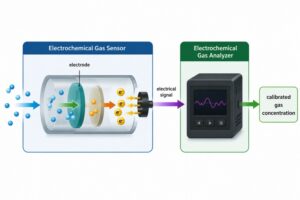
An electrochemical gas analyzer uses a sensor in which the target gas reacts at an electrode and generates an electrical signal. The signal is proportional to the concentration of the gas.
Electrochemical sensors are commonly used for:
- Oxygen, or O₂
- Carbon monoxide, or CO
- Nitric oxide, or NO
- Nitrogen dioxide, or NO₂
- Sulfur dioxide, or SO₂
- Hydrogen sulfide, or H₂S
- Chlorine, ammonia, and other toxic gases in selected applications
Their main strengths include fast response, small size, low power consumption, and relatively low cost. They are often used in portable gas detectors, safety monitoring devices, confined space detection, and simple environmental checks.
However, electrochemical sensors also have limitations. Sensor lifetime is finite, and performance can be affected by temperature, humidity, pressure, poisoning compounds, and cross-sensitive gases. For continuous emission monitoring or demanding process control, we usually evaluate whether electrochemical technology can meet the required stability and maintenance expectations.
When comparing different types of gas analyzers, electrochemical analyzers are best viewed as practical solutions for portable, safety, or lower-cost detection applications rather than universal replacements for industrial online gas analysis systems.
How Do Paramagnetic and Zirconia Oxygen Analyzers Differ?
Oxygen measurement may seem simple, but choosing the wrong oxygen analyzer can affect combustion efficiency, safety control, nitrogen blanketing, and emission calculations. In many projects, the question is not only “Do we need to measure O₂?” but also “Which oxygen measurement principle is suitable for this process?”
A paramagnetic oxygen analyzer measures oxygen based on its magnetic properties. Oxygen is strongly paramagnetic compared with most other gases, which allows the analyzer to detect its concentration with high selectivity and stability.
A zirconia oxygen analyzer uses a zirconium oxide sensing element, usually operating at high temperature, to measure the oxygen partial pressure difference between the sample gas and a reference gas.
Here is a practical comparison:
| Oxygen Analyzer Type | Best For | Main Advantage | Key Consideration |
| Paramagnetic O₂ analyzer | Process gas, laboratory gas, industrial oxygen monitoring | Stable and selective oxygen measurement | Requires clean and properly conditioned sample gas |
| Zirconia O₂ analyzer | Combustion gas, boiler flue gas, furnace gas, kiln gas | Excellent for high-temperature combustion control | Not suitable for every reducing or combustible gas condition |
| Electrochemical O₂ analyzer | Portable detection, simple oxygen monitoring | Compact and economical | Sensor aging and replacement must be considered |
At ESEGAS, we help customers choose oxygen analyzer technology based on gas composition, temperature, humidity, installation method, response time, and required accuracy. For combustion applications, zirconia can be a strong choice. For process gas analysis where precision and stability are critical, paramagnetic oxygen measurement is often more suitable.
What Are CLD and FID Gas Analyzers Used For?
In emission testing and engine exhaust analysis, NOx and hydrocarbons are often key regulated components. Basic sensor technologies may not provide the sensitivity, response speed, or measurement confidence required for these applications. This is where CLD and FID technologies become important.
A CLD gas analyzer, or chemiluminescence detector, is mainly used for NO, NO₂, and total NOx measurement. It works by detecting light produced during a chemical reaction involving nitric oxide. CLD is widely used where accurate NOx measurement is required.
An FID gas analyzer, or flame ionization detector, is mainly used for total hydrocarbon, THC, and VOC measurement. It detects ions formed when organic compounds are burned in a hydrogen flame.
Common applications include:
- Engine exhaust emission testing
- Vehicle and marine emission measurement
- Industrial stack gas monitoring
- VOC monitoring
- Combustion research
- Environmental compliance testing
CLD and FID analyzers offer high sensitivity and strong performance in professional emission applications. However, they are more complex than many other types of gas analyzers. They may require auxiliary gases, stable sample handling, regular calibration, and careful maintenance.
At ESEGAS, we do not treat CLD or FID as standalone instruments only. For demanding emission projects, we consider the complete system, including sampling probe, heated line, filtration, moisture handling, calibration gas, gas flow control, and data output. This system-level approach helps ensure that the analyzer performs reliably in real operating conditions.
What Is a Thermal Conductivity Gas Analyzer Used For?
Some gases do not absorb infrared light strongly and cannot be easily measured by common optical methods. In these cases, users may struggle to find a simple and stable measurement method. A thermal conductivity gas analyzer can be useful when the target gas has a significantly different thermal conductivity from the background gas.
A thermal conductivity detector, often called TCD, measures the difference in heat transfer between gases. Because different gases conduct heat differently, the analyzer can estimate concentration based on thermal conductivity changes.
TCD analyzers are often used for:
- Hydrogen measurement
- Helium measurement
- Argon or nitrogen balance gas analysis
- Binary gas mixture monitoring
- Industrial process gas applications
The main advantage of TCD technology is that it can measure gases that are not suitable for NDIR or electrochemical methods. It is also relatively stable when the gas mixture is simple and the background composition is known.
The limitation is selectivity. If the sample gas contains multiple components with changing concentrations, thermal conductivity measurement may become less accurate. That is why we carefully check the gas background before recommending a TCD solution.
When Do You Need FTIR Gas Analysis?
When a process contains multiple gas components, choosing one analyzer for each gas can make the system complex and expensive. At the same time, using a single simple sensor may not provide enough information. For complex gas mixtures, FTIR can be a powerful solution.
FTIR stands for Fourier Transform Infrared. It measures the infrared absorption spectrum of the gas and uses that spectrum to identify and quantify multiple components at the same time.
FTIR gas analyzers are commonly used for:
- Multi-component emission monitoring
- Waste incineration flue gas analysis
- Chemical process gas analysis
- Research and development
- Semiconductor and specialty gas applications
- Complex industrial exhaust gas monitoring
The main advantage of FTIR is multi-gas capability. It can measure several infrared-active gases simultaneously, which makes it valuable in applications where the gas composition is complicated.
However, FTIR systems are usually more expensive and require stronger technical support than basic single-gas analyzers. Sample conditioning, spectral interpretation, calibration, and maintenance are all important. At ESEGAS, we recommend FTIR when the application truly benefits from multi-component analysis, not simply because it is a more advanced technology.
What Role Does Gas Chromatography Play in Gas Analysis?
Some industrial gases are too complex to analyze accurately with direct-reading sensors. When different gas compounds need to be separated before measurement, gas chromatography becomes one of the most reliable methods. Without separation, similar compounds may overlap and cause incorrect readings.
A gas chromatograph, or GC, separates a gas mixture into individual components before detection. This makes it especially useful for detailed composition analysis.
GC systems are commonly used for:
- Natural gas composition analysis
- Refinery and petrochemical gas analysis
- High-purity gas quality control
- Laboratory gas analysis
- Complex hydrocarbon mixture analysis
- Specialty gas production and verification
Compared with many other types of gas analyzers, GC provides strong selectivity and detailed component separation. It is suitable when users need accurate composition data rather than only one or two target gas readings.
The trade-off is speed and complexity. GC analysis is usually periodic rather than fully continuous in the same way as online NDIR or oxygen analyzers. It also requires proper column selection, carrier gas, calibration, and maintenance. For this reason, we usually recommend GC for applications where detailed gas composition is more important than instant response.
How Should You Compare Different Types of Gas Analyzers?
Many gas analysis projects fail not because the analyzer technology is poor, but because the selection process is incomplete. If the target gas is considered without checking moisture, dust, pressure, temperature, corrosive components, installation conditions, and maintenance capability, even a high-quality analyzer may not perform correctly.
The best way to compare analyzer technologies is to look at both the measurement principle and the application environment.
| Analyzer Type | Typical Target Gases | Main Strength | Common Limitation | Typical Applications |
| NDIR gas analyzer | CO₂, CO, CH₄, SO₂ | Stable continuous measurement | Only suitable for infrared-active gases | CEMS, process control, combustion analysis |
| Electrochemical gas analyzer | O₂, CO, NO, NO₂, SO₂, H₂S | Compact and cost-effective | Sensor aging and cross-interference | Portable detection, safety monitoring |
| Paramagnetic oxygen analyzer | O₂ | Stable and selective oxygen measurement | Mainly for oxygen only | Process gas, laboratory gas, industrial oxygen monitoring |
| Zirconia oxygen analyzer | O₂ | Strong for combustion oxygen measurement | Application conditions must be suitable | Boiler, furnace, kiln, combustion control |
| CLD gas analyzer | NO, NO₂, NOx | High sensitivity for NOx | More complex system design | Emission testing, engine exhaust analysis |
| FID gas analyzer | THC, VOCs, hydrocarbons | Sensitive hydrocarbon detection | Requires fuel gas and careful maintenance | VOC monitoring, exhaust testing |
| Thermal conductivity analyzer | H₂, He, binary gas mixtures | Useful for gases not suited to IR methods | Limited selectivity in complex mixtures | Process gas, purity monitoring |
| FTIR gas analyzer | Multiple infrared-active gases | Multi-component analysis | Higher cost and technical complexity | Complex emissions, research, process analysis |
| Gas chromatograph | Complex gas mixtures | Strong separation and detailed composition | Slower cycle and more complex operation | Laboratory, natural gas, petrochemical analysis |
At ESEGAS, we usually recommend starting with these questions:
- What gas or gases need to be measured?
- What is the expected concentration range?
- Is the sample gas hot, wet, dusty, corrosive, or under pressure?
- Is the measurement continuous, portable, laboratory-based, or process-integrated?
- What response time is required?
- What accuracy and repeatability are needed?
- What maintenance level can the site support?
- Are there regulatory or reporting requirements?
These questions help narrow the selection from a broad list of types of gas analyzers to a practical, application-ready solution.
Which Gas Analyzer Type Is Right for Your Application?
There is no single gas analyzer that fits every project. A technology that works perfectly in a clean laboratory gas stream may fail in a wet flue gas duct. A compact sensor that works well for portable detection may not be stable enough for continuous emission monitoring. This is why application-based selection is essential.
At ESEGAS, we choose gas analyzer solutions by matching technology to real working conditions.
For continuous emission monitoring, we may recommend NDIR, UV, CLD, FID, zirconia O₂, or integrated multi-gas systems, depending on the required components.
For combustion control, oxygen measurement is often combined with CO, CO₂, or other flue gas measurements to improve efficiency and safety.
For process gas analysis, we focus on stability, sample conditioning, response time, and compatibility with the process environment.
For portable gas detection, electrochemical sensors may be suitable when the priority is mobility, fast response, and cost control.
For complex multi-component gas analysis, FTIR or GC may be considered when single-gas measurement cannot provide enough information.
The right choice depends not only on the analyzer itself, but also on the sampling system. In many industrial applications, the sampling probe, filter, heated line, condenser, pump, flow control, and calibration system are just as important as the analyzer module. A good analyzer with poor sample handling will still produce poor data.
Conclusion
The main types of gas analyzers include NDIR, electrochemical, paramagnetic, zirconia, CLD, FID, thermal conductivity, FTIR, and gas chromatography systems. Each technology has its own strengths, limits, and ideal applications. NDIR is strong for infrared-active gases and continuous monitoring. Electrochemical sensors are practical for portable and lower-cost detection. Paramagnetic and zirconia technologies are widely used for oxygen analysis. CLD and FID are important for professional emission testing. FTIR and GC are better suited for complex multi-component analysis.
At ESEGAS, we do more than help customers choose an analyzer name from a product list. We evaluate the gas composition, process condition, measurement goal, maintenance expectation, and system integration requirements to provide a reliable gas analysis solution. When the right technology is matched with the right sampling and conditioning system, gas analysis becomes more accurate, stable, and valuable for industrial decision-making.