



Industrial emission monitoring becomes far more difficult when flue gas contains moisture, acid gases, ammonia slip, nitrogen oxides, carbon compounds, and changing process conditions at the same time. If the sample cools down during extraction or transportation, water-soluble components such as HCl, HF, and NH₃ may be lost through condensation, causing inaccurate data and unreliable compliance decisions. At ESEGAS, we designed our FTIR CEMS to help industrial plants capture a more complete picture of emissions, especially in harsh applications where stable, real-time, multi-component gas analysis is essential.
FTIR CEMS improves industrial emission monitoring by using Fourier Transform Infrared spectroscopy, full-process heated sampling, and multi-gas analysis to continuously measure pollutants such as SO₂, NO, NO₂, N₂O, CO, CO₂, NH₃, HCl, HF, H₂O, and CH₄. ESEGAS FTIR CEMS maintains the sampling probe and gas path at 180°C to reduce condensation loss, protect water-soluble gas components, and deliver more accurate data for compliance monitoring, process control, and environmental research. (Gas Analyzer Manufacturers)
However, accurate emission monitoring is not only about installing an analyzer. It depends on how the sample is extracted, how the gas path is heated, how spectral interference is corrected, and how the system adapts to different industries. That is why understanding FTIR CEMS technology, its applications, and its configuration options can help plants choose a monitoring solution that is both technically reliable and practical for long-term operation.
What Is FTIR CEMS and Why Is It Important for Continuous Emission Monitoring?
When a plant relies on single-gas analyzers for a complex emission source, it may need multiple instruments, more maintenance, and separate data streams that do not always reflect the same process condition. This can make troubleshooting slow and compliance reporting more complicated. A properly configured FTIR CEMS solves this by measuring multiple gas components through one integrated online system.
FTIR CEMS stands for Fourier Transform Infrared Continuous Emission Monitoring System. It uses infrared absorption spectroscopy to identify and quantify different gas molecules based on their characteristic absorption features. In industrial emission monitoring, this approach is especially valuable because many regulated and process-related gases can be measured simultaneously.
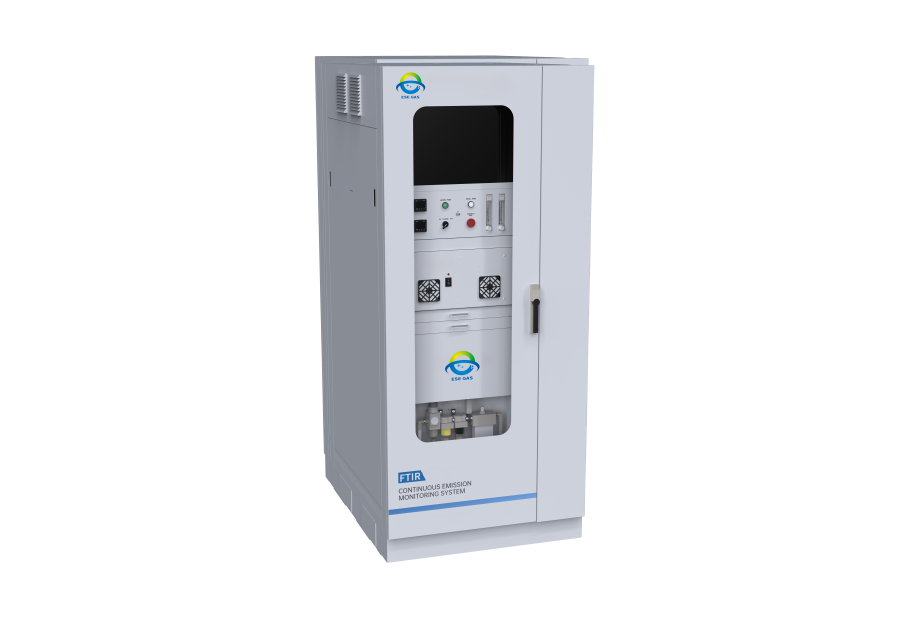
At ESEGAS, our FTIR CEMS is engineered for complex industrial emissions and process control. It is suitable for applications where real-time gas monitoring is required and where the target gases may include acid gases, nitrogen compounds, carbon oxides, hydrocarbons, moisture, and ammonia slip. The system can be customized according to the user’s monitoring requirements, making it suitable for both compliance-driven and process-optimization applications. (Gas Analyzer Manufacturers)
How Does ESEGAS FTIR CEMS Measure Multiple Pollutants at the Same Time?
In complex flue gas, different pollutants often appear together and may interfere with each other if the analyzer does not have sufficient spectral resolution or correction capability. This is a common challenge in waste incineration, power generation, chemical manufacturing, and other high-emission processes. FTIR CEMS addresses this issue by analyzing the complete infrared spectrum rather than focusing on only one narrow gas absorption point.
The measurement principle is based on the absorption of infrared radiation by sample gas molecules. An infrared source emits polychromatic radiation, which passes through a Michelson interferometer. The system converts the interferogram into an infrared spectrum through Fourier Transform signal processing, allowing the analyzer to calculate the concentration of multiple gases from their absorption characteristics.
ESEGAS FTIR CEMS combines this principle with high spectral resolution and advanced algorithms to reduce cross-interference between gas components. This is particularly important when measuring gases such as SO₂, NO, NO₂, N₂O, CO, CO₂, NH₃, HCl, HF, H₂O, and CH₄ in one system. Instead of treating each pollutant as an isolated measurement point, our system provides a broader and more accurate understanding of the gas composition. (Gas Analyzer Manufacturers)
Which Gases Can ESEGAS FTIR CEMS Monitor?
If an industrial site needs to monitor several pollutants at once, using separate analyzers for every gas can increase installation space, maintenance work, calibration complexity, and system cost. A multi-component FTIR CEMS provides a more integrated approach by allowing plants to configure the measured gases according to their process and regulatory needs.
ESEGAS FTIR CEMS can simultaneously monitor a wide range of gas components, including:
| Gas Category | Typical Components |
| Acid gases | HCl, HF, SO₂ |
| Nitrogen compounds | NO, NO₂, N₂O, NH₃ |
| Carbon compounds | CO, CO₂, CH₄ |
| Moisture | H₂O |
This multi-gas capability makes FTIR CEMS suitable for applications where pollutant behavior is interconnected. For example, ammonia slip monitoring can support denitrification control, HCl and HF monitoring can support acid gas treatment, and CO measurement can help indicate combustion efficiency. With configurable gas components, ESEGAS helps customers build a monitoring system that matches the real emission profile of their facility. (Gas Analyzer Manufacturers)
Where Is FTIR CEMS Commonly Applied?
Emission sources are not all the same. A system that works well in a dry and stable process may not perform reliably in a wet, corrosive, and high-dust flue gas environment. This is why choosing FTIR CEMS should always be connected to the real application conditions, not only the gas list on a specification sheet.

ESEGAS FTIR CEMS is suitable for industries that require continuous, real-time, multi-pollutant monitoring, including:
- Waste incineration and waste-to-energy plants
FTIR CEMS is highly suitable for waste-to-energy applications because these plants often need to monitor acid gases, NOx-related compounds, CO, CO₂, moisture, and ammonia slip under wet and variable flue gas conditions. - Power plants
In combustion-based power generation, FTIR CEMS can support emission compliance and process control by monitoring pollutants related to fuel combustion, denitrification, and flue gas treatment. - Chemical manufacturing
Chemical processes may release multiple gas components at the same time. FTIR CEMS helps plants track gas composition changes and improve process transparency. - Environmental research and testing
Research institutions and environmental monitoring projects often require flexible gas measurement. A configurable FTIR CEMS can support multi-component analysis for different test scenarios.
By applying FTIR CEMS in these industries, operators can move from single-parameter monitoring to a more complete understanding of emission behavior. (Gas Analyzer Manufacturers)
How Does FTIR CEMS Support Compliance and Process Optimization?
For many plants, emission monitoring is first seen as a compliance requirement. But when the data is accurate, stable, and available in real time, it can do much more than satisfy reporting obligations. Poor-quality data only tells operators that something may be wrong; high-quality FTIR CEMS data helps them understand where the problem may be coming from.
ESEGAS FTIR CEMS supports compliance and process optimization in several ways:
- Continuous emission tracking: Real-time measurement helps plants observe pollutant trends instead of relying only on periodic sampling.
- Multi-pollutant visibility: Operators can evaluate the relationship between combustion conditions, acid gas treatment, denitrification, and ammonia injection.
- Reduced sample loss: Heated sampling helps preserve water-soluble components, improving the credibility of measured values.
- Dry-basis conversion support: The system includes calculation software that can correct temperature and pressure and convert values to dry-basis standard conditions for environmental reporting.
- Full-process calibration: Calibration functionality supports long-term measurement reliability.
From our perspective, FTIR CEMS is not only a gas analyzer. It is a continuous monitoring solution that helps industrial users connect emission compliance, process control, and operational decision-making in one system. (Gas Analyzer Manufacturers)
What Makes ESEGAS FTIR CEMS Suitable for Harsh Industrial Environments?
Harsh industrial environments create multiple risks for gas analyzers: corrosion, moisture, particulate loading, temperature fluctuation, and long-term optical stability. If the system is not designed for these conditions, maintenance frequency increases and data reliability decreases. ESEGAS FTIR CEMS is built with these challenges in mind.
Key design features include:
- Field-oriented interferometer design
The FTIR CEMS analyzer uses an independently developed interferometer designed for field applications, supporting robust long-term operation. - Helium-neon laser wavelength stability
The interferometer section uses a helium-neon laser, which supports stable wavelength reference performance. - High-temperature gold-plated gas cell
The fully metallic, multi-reflective, high-temperature gold-plated gas cell is designed for corrosion resistance and reliable measurement of water-soluble components such as HCl and NH₃. - Optimized spectral resolution
The spectrometer resolution is optimized for target gases, helping improve detection accuracy and reduce interference. - Modular structure
The modular design includes the light source, spectrometer, core circuitry, and gas cell modules, supporting scalability and easier maintenance. - Two-stage filtration and heated SS316L sampling probe
The sample collection and transportation process uses two-stage filtration, while the flue gas sampling probe is made of SS316L and heated to 180°C to reduce corrosion and condensation risk.
These design details help FTIR CEMS maintain stable performance in demanding industrial environments where conventional sampling and gas conditioning methods may cause pollutant loss or maintenance issues. (Gas Analyzer Manufacturers)
How Should Industries Choose the Right FTIR CEMS Configuration?
Choosing the wrong configuration can lead to overspending, under-measurement, or unstable long-term operation. A plant may know that it needs FTIR CEMS, but the best system design depends on the gas matrix, sampling location, regulatory requirements, and process objectives. That is why configuration should always begin with the application, not only the analyzer model.
When helping customers configure an FTIR CEMS solution, ESEGAS usually considers:
| Selection Factor | Why It Matters |
| Target gas components | Determines spectral configuration, calibration strategy, and measurement range |
| Moisture level | Affects heated sampling requirements and water vapor correction |
| Acid gas concentration | Influences material selection and corrosion resistance |
| Dust and particulate load | Determines filtration and probe design |
| Sampling distance | Affects heated line design and response time |
| Compliance requirements | Defines reporting units, dry-basis conversion, calibration, and data output |
| Communication needs | Supports integration with plant control and data acquisition systems |
The ESEGAS FTIR CEMS specification includes recommended sample gas flow of 2–3 L/min, minimum 2 μm particulate filtration, MODBUS communication, Ethernet output, typical response time below 100 seconds at 3 L/min, and accuracy below 2% FS. These specifications help the system integrate into industrial monitoring projects where stable data output and long-term maintainability are important. (Gas Analyzer Manufacturers)
Conclusion: Why Choose ESEGAS FTIR CEMS for Industrial Emission Monitoring?
FTIR CEMS is valuable because it combines multi-component gas analysis, heated sample preservation, real-time monitoring, and flexible configuration in one continuous emission monitoring solution. For industries such as waste incineration, power generation, chemical manufacturing, and environmental research, this means more accurate pollutant data, better process visibility, and stronger confidence in compliance reporting.
At ESEGAS, we build FTIR CEMS for industrial users who need reliable measurement under complex flue gas conditions. With 180°C full-process heated sampling, configurable gas components, high-resolution FTIR analysis, corrosion-resistant design, and application-focused system integration, we help customers monitor emissions more accurately and manage their processes more intelligently.