



In hazardous industrial sites, gas is often the danger operators cannot see. A small leak of methane, hydrogen, VOCs, hydrogen sulfide, or carbon monoxide may spread before people notice it, and ordinary electrical equipment can become an ignition source if it is not designed for explosive atmospheres. That is why choosing the right gas analysis system is not only about measurement accuracy; it is about protecting people, equipment, production continuity, and compliance from the first day of installation.
An explosion-proof gas analyzer is an industrial gas analysis instrument designed to measure gas concentrations safely in hazardous areas where flammable gases, vapors, or dust may exist. It helps prevent ignition risks, supports continuous gas monitoring, and provides reliable concentration data for process safety, environmental compliance, and industrial control. ESEGAS develops gas analyzers and gas analysis systems for process gas and environmental emissions monitoring applications. (Gas Analyzer Manufacturers)
Knowing the definition is only the first step. For engineers, safety managers, and purchasing teams, the real question is how to choose a system that matches the hazardous area classification, gas composition, sampling condition, response time, communication protocol, and long-term maintenance needs. At ESEGAS, we look at an explosion-proof gas analysis project as a complete safety and process monitoring solution, not simply as a single instrument.
Why Do Hazardous Areas Need an Explosion-Proof Gas Analyzer?
When flammable gas appears in a refinery, petrochemical plant, LNG terminal, or chemical production area, the risk does not come only from the gas itself. The greater problem is that monitoring equipment must operate inside the same dangerous environment. If the analyzer, enclosure, cable entry, sampling system, or electrical interface is not suitable for hazardous locations, the device intended to improve safety may become part of the risk.
An Explosion-Proof Gas Analyzer is used to reduce that risk by allowing continuous gas measurement in classified areas where explosive gases or vapors may be present. These systems are especially important in:
| Hazardous Area | Typical Gas Components | Monitoring Purpose |
| Oil refineries | CH₄, H₂, H₂S, VOCs, CO | Leak detection, process safety, combustion control |
| Petrochemical plants | VOCs, C₂H₄, C₃H₈, NH₃, HCl | Process monitoring, toxic gas control, safety interlock |
| LNG and natural gas facilities | CH₄, CO₂, H₂S | Explosion prevention, gas quality monitoring |
| Steelmaking and metallurgy | CO, O₂, CO₂, H₂ | Converter gas safety, recovery optimization |
| Environmental monitoring systems | SO₂, NOx, CO, CO₂, VOCs | Emissions tracking and regulatory compliance |
In ESEGAS projects, we focus on both the measurement task and the operating environment. The analyzer must provide accurate concentration data, but it must also match the site’s safety requirements, installation method, sample gas condition, and control system architecture.
How Does an Explosion-Proof Gas Analyzer Work?
Many measurement problems begin when users focus only on the sensor and ignore the gas path. In real industrial environments, sample gas may be hot, wet, dusty, corrosive, pressurized, or unstable. Without proper sampling and conditioning, even a high-quality analyzer can suffer from drift, blockage, condensation, slow response, or shortened service life.
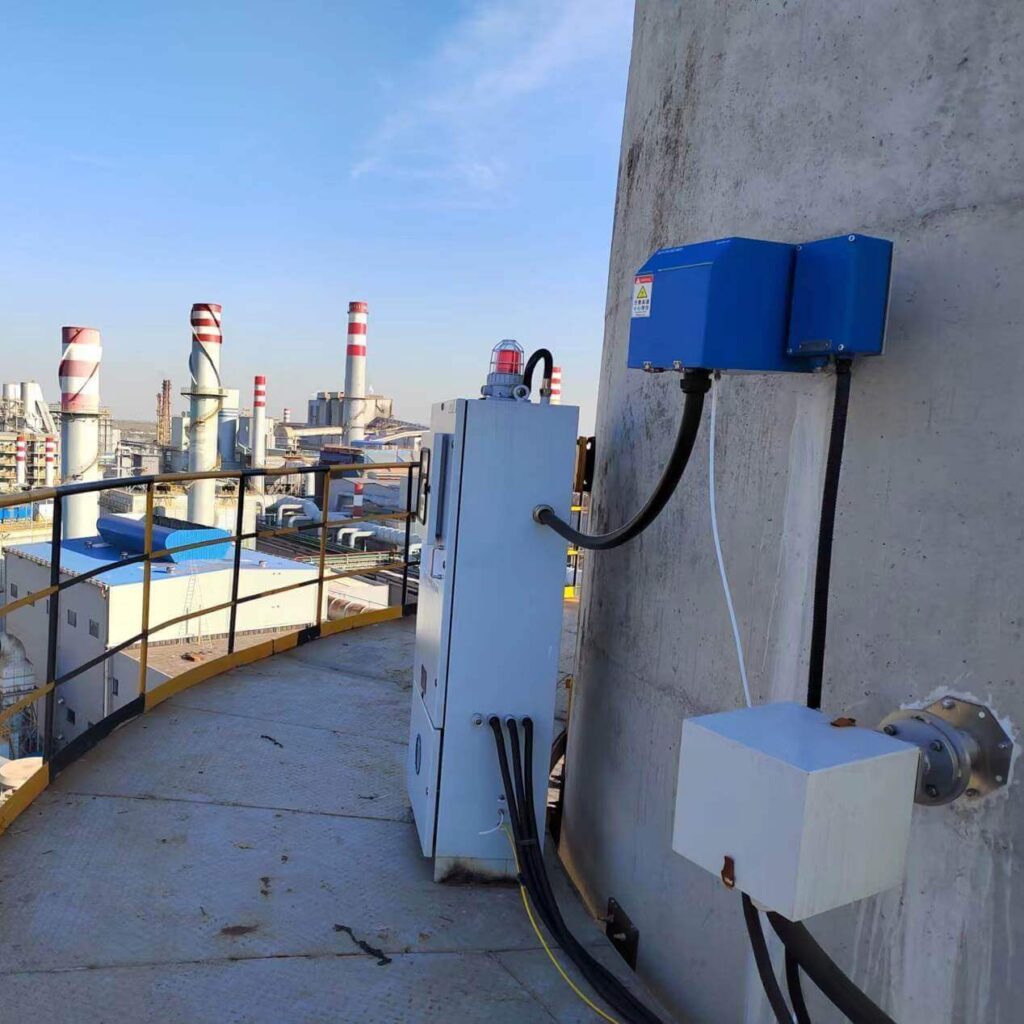
A typical Explosion-Proof Gas Analyzer works through four connected stages:
- Gas sampling
The system collects gas from the process, stack, pipeline, reactor, furnace, or confined area. Depending on the application, the design may use extractive sampling, in-situ measurement, heated sampling probes, or conditioned sampling lines. - Sample conditioning
Before gas reaches the measuring cell, it may need filtration, pressure control, flow regulation, cooling, heating, moisture removal, or corrosion protection. ESEGAS portable and process gas analyzer solutions can include components such as sampling probes, heated tubes, gas conditioning systems, and other sampling accessories. (Gas Analyzer Manufacturers) - Gas measurement
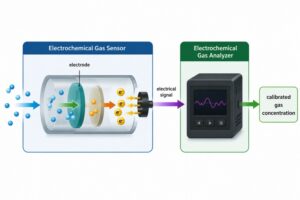
The analyzer detects the target gas using a suitable technology. Common methods include NDIR for CO, CO₂, CH₄ and other infrared-active gases; UV-DOAS for gases such as NO, NO₂, SO₂, NH₃, H₂S and others; FTIR for multi-gas analysis; TDLAS for fast and selective single-gas measurement; electrochemical sensors for certain toxic gases; and zirconia or paramagnetic methods for oxygen monitoring. ESEGAS product information shows support for technologies including FTIR, UV-DOAS, TDLAS, NDIR, and zirconia oxygen analysis across different gas analyzer categories. (Gas Analyzer Manufacturers) - Signal output and system integration
The concentration data can be transmitted to a PLC, DCS, alarm system, data acquisition platform, or plant safety system. For industrial users, the value of the analyzer is not only the display reading; it is the ability to support decisions, alarms, interlocks, trend analysis, and process optimization.
What Explosion-Proof Standards Should Be Considered?
A gas analyzer may be accurate in the laboratory but unsuitable for a hazardous area if the certification, enclosure, temperature class, or installation method does not match the site requirement. This is where many project risks begin: the equipment is selected for measurement performance first, and hazardous area compliance is checked too late.
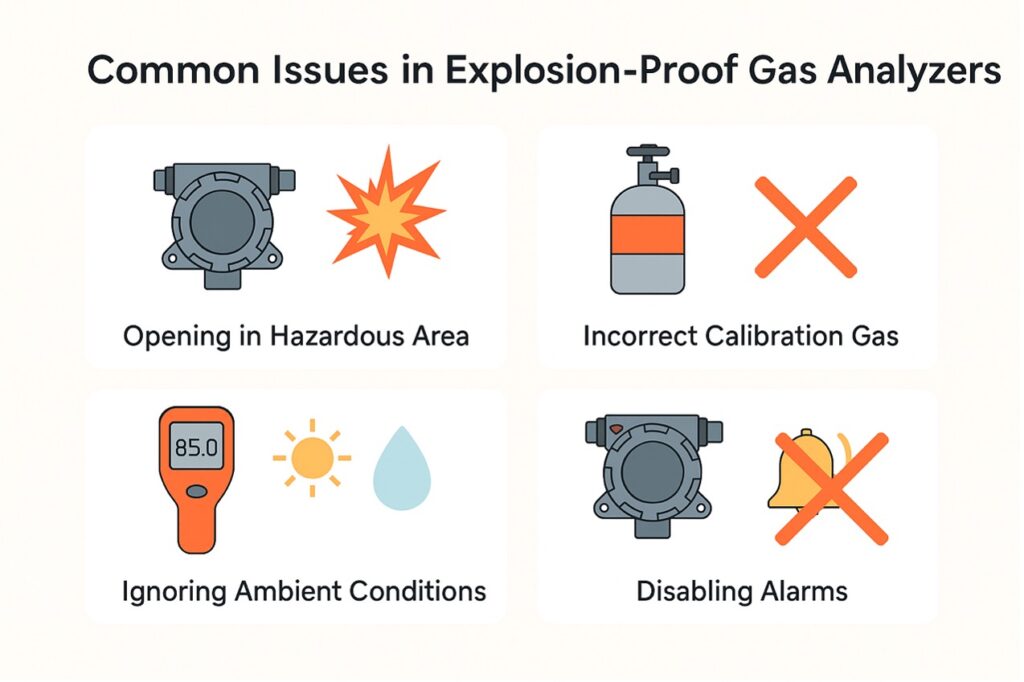
Before choosing an Explosion-Proof Gas Analyzer, users should confirm the required explosion-proof framework. Common references include ATEX for the European market, IECEx for international certification related to equipment used in explosive atmospheres, and Class/Division or Zone systems used in North American hazardous location practices. The ATEX Directive 2014/34/EU covers equipment and protective systems intended for use in potentially explosive atmospheres, while IECEx is an IEC certification system for equipment used in explosive atmospheres.
Key selection factors include:
- Hazardous area classification: Zone 1, Zone 2, Class I Division 1, Class I Division 2, or other site-specific classifications
- Gas group: Whether the environment contains gases such as hydrogen, acetylene, ethylene, propane, methane, or other flammable substances
- Temperature class: The maximum surface temperature allowed for the equipment
- Protection method: Flameproof enclosure, increased safety design, intrinsic safety, pressurized enclosure, or other approved methods
- Ingress protection and corrosion resistance: Especially important for outdoor, marine, chemical, and high-humidity environments
- Cable glands and wiring: Explosion-proof protection must continue through the complete electrical installation, not only the analyzer enclosure
At ESEGAS, we recommend confirming the hazardous area drawing, gas group, temperature class, certification target, installation position, and local regulatory expectations before finalizing the analyzer configuration.
How Should You Choose the Right Explosion-Proof Gas Analyzer?
The most common mistake is asking, “Which analyzer is best?” before defining the application. A better question is, “Which analyzer configuration fits this gas, this range, this process condition, and this hazardous area?” Without this step, users may face unstable readings, high maintenance frequency, slow response, or compliance problems after installation.
To select the right Explosion-Proof Gas Analyzer, we usually evaluate the following project details:
1. Target gas and concentration range
Different gases require different analysis methods. CO, CO₂, CH₄, H₂S, O₂, NOx, SO₂, NH₃, HCl, HF, VOCs, and moisture each have different absorption characteristics, interference risks, and measurement ranges. For example, NDIR is widely used for infrared-active gases such as CO, CO₂, and CH₄, while FTIR can support simultaneous multi-gas measurement in complex emissions. (Gas Analyzer Manufacturers)
2. Process condition
Temperature, pressure, dust, humidity, acid gas, tar, condensate, and vibration all affect system design. A clean and dry gas sample may need only basic conditioning, while a hot and corrosive sample may require heated probes, heated lines, special filters, cooling systems, and corrosion-resistant materials.
3. Response time
Safety monitoring often requires fast response, while emissions compliance may require stable long-term averaging. The analyzer should match the required reaction time of the process, alarm system, or control loop.
4. Installation method
Some applications are suitable for in-situ measurement, while others require extractive sampling. The best choice depends on gas temperature, dust load, access conditions, maintenance strategy, and measurement objective.
5. Communication and control integration
A modern gas analysis system should support plant-level data use. Users may need analog output, digital communication, Modbus, RS485, relay alarms, DCS connection, PLC integration, or remote diagnostics.
6. Maintenance strategy
A reliable analyzer should be easy to calibrate, inspect, and service. In hazardous locations, every maintenance activity may require extra safety procedures, so reducing unnecessary intervention is valuable.
At ESEGAS, we build gas analysis solutions around the real process rather than forcing one standard configuration into every site. This approach helps users balance safety, accuracy, stability, maintenance, and total cost of ownership.
Which Industries Commonly Use Explosion-Proof Gas Analyzers?
In many plants, dangerous gases are part of normal production. The challenge is that normal operation and abnormal leakage can look similar without continuous measurement data. When the monitoring system is not designed for the actual risk level, operators may lose the time window needed to respond before the situation escalates.
An Explosion-Proof Gas Analyzer is commonly used in industries such as:
- Petrochemical and refinery: monitoring combustible gases, hydrogen, sulfur compounds, VOCs, and process emissions
- LNG and natural gas: methane monitoring, gas quality analysis, leakage risk control, and process safety
- Chemical manufacturing: toxic, corrosive, and flammable gas analysis in reactors, pipelines, storage areas, and exhaust systems
- Steel and metallurgy: CO, O₂, CO₂, and combustible gas monitoring in converter gas recovery, furnace control, and safety systems
- Power generation and combustion: oxygen, CO, CO₂, NOx, and SO₂ analysis for combustion optimization and emissions control
- Environmental monitoring: continuous emissions monitoring for regulated pollutants and greenhouse gases
ESEGAS analyzer solutions are used across process gas analysis and environmental emissions monitoring, and our product portfolio covers multiple gas analysis technologies for different industrial requirements. (Gas Analyzer Manufacturers)
What Maintenance Does an Explosion-Proof Gas Analyzer Require?
Explosion-proof does not mean maintenance-free. In fact, hazardous area analyzers often work in some of the harshest environments in the plant. Heat, humidity, dust, corrosive gases, vibration, and contaminated sample gas can gradually affect sensors, filters, sampling lines, seals, and enclosures if the system is not maintained properly.
For an Explosion-Proof Gas Analyzer, maintenance should include both analytical performance checks and safety-related inspections:
| Maintenance Item | Why It Matters |
| Filter inspection and replacement | Prevents blockage, flow reduction, and sensor contamination |
| Sampling line inspection | Avoids leakage, condensation, plugging, and delayed response |
| Flow and pressure verification | Keeps measurement conditions stable |
| Zero and span calibration | Maintains measurement accuracy and traceability |
| Enclosure and seal inspection | Protects explosion-proof integrity |
| Cable gland and grounding check | Ensures safe electrical installation |
| Condensate and moisture control | Reduces corrosion and measurement drift |
| Maintenance log review | Helps identify recurring faults and plan preventive service |
ESEGAS maintenance guidance highlights that explosion-proof analyzers may operate in volatile environments such as oil refineries, petrochemical facilities, LNG terminals, and confined industrial spaces, where heat, humidity, dust, corrosive gases, and vibration can affect components over time. (Gas Analyzer Manufacturers)
Why Choose ESEGAS for Explosion-Proof Gas Analysis Solutions?
A hazardous area gas analysis project cannot be solved by choosing an analyzer model from a catalog alone. The real requirement is a complete system that combines measurement technology, explosion-proof protection, sample handling, site integration, calibration support, and long-term reliability.
At ESEGAS, we design and manufacture gas analyzers and gas analysis systems for industrial applications. As an ODM/OEM partner, we develop custom gas analysis systems for global industry users and provide solutions for environmental safety and industrial compliance. (Gas Analyzer Manufacturers)
When customers come to us for an Explosion-Proof Gas Analyzer, we help evaluate:
- The target gas and expected concentration range
- The hazardous area classification and certification requirement
- Sample gas temperature, humidity, pressure, dust, and corrosive components
- Required response time and measurement accuracy
- Sampling probe, heated line, filtration, and conditioning configuration
- Output signals and integration with PLC, DCS, or monitoring platforms
- Calibration, spare parts, maintenance, and long-term technical support
Our goal is not only to deliver an analyzer, but to help customers build a safer and more stable gas monitoring system for demanding industrial environments.
Conclusion
An explosion-proof gas analyzer is a critical instrument for hazardous areas where flammable, toxic, or corrosive gases may exist. It helps industrial users detect gas concentration safely, reduce explosion risk, support process control, and meet safety or environmental requirements. However, the right solution depends on more than the analyzer itself. It must match the gas composition, process condition, hazardous area classification, sampling system, communication needs, and maintenance strategy.
At ESEGAS, we approach every Explosion-Proof Gas Analyzer project from the perspective of complete system reliability. By combining gas analysis technology, explosion-proof design thinking, sampling expertise, and application engineering, we help customers create safer, smarter, and more dependable gas monitoring solutions for high-risk industrial sites.