



Unstable syngas composition and difficult sampling can undermine valuable gasification experiments. An online syngas analyzer provides continuous gas data for more reliable renewable energy research.
An online syngas analyzer continuously measures H2, CO, CO2, CH4, and O2 during gasification experiments. It helps university research institutes evaluate gasifier performance, compare operating conditions, and obtain consistent syngas composition data for renewable energy research.
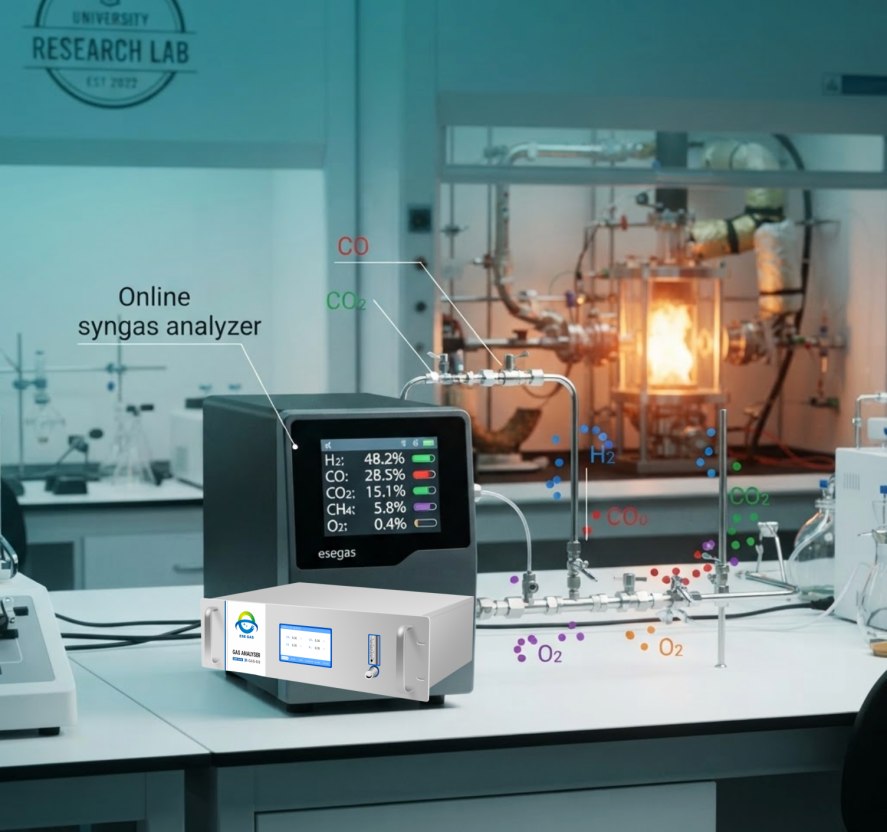
For university research institutes, syngas measurement involves more than placing an analyzer on a gas line. Gas composition can change with operating conditions, while moisture, dust, and tar can affect the sample before it reaches the analyzer. Therefore, researchers need a measurement system that delivers stable, representative data throughout the experiment.
What Makes Syngas Analysis Difficult in University Gasification Research?
Syngas analysis becomes challenging when a university gasification experiment changes from one operating condition to another. Temperature, feedstock moisture, and gasifying-agent flow can shift gas composition, while raw syngas may also contain moisture, dust, and tar.
| Challenge | Impact on Syngas Analysis |
|---|---|
| Changing composition | Results vary with operating conditions |
| Moisture | Condensation can alter the sample |
| Dust | Filters and sampling lines can clog |
| Tar | Deposits can contaminate the system |
| Air leakage | Can distort O₂ and other gas readings |
The syngas analyzer only measures the gas that reaches its cell. Therefore, poor sampling can affect good analyzer performance. Research systems commonly use heated sampling lines, particle filters, cooling, and controlled flow before gas reaches the analyzer.
Tar requires particular attention because it can condense as raw gas cools, causing fouling in sampling equipment. For this reason, a university research system should treat sampling, conditioning, and analysis as one measurement chain. Once the sample is stable and representative, researchers can focus on the next question: which gases should they measure?
Which Gases Should an Online Syngas Analyzer Measure for Renewable Energy Research?
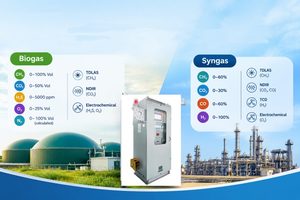
For most university gasification projects, the core syngas measurement should cover H2, CO, CO2, CH4. Researchers may also add O2 when they need to track air ingress, oxygen-blown gasification, or process safety. The right gas combination depends on the research objective, not simply on how many channels an analyzer can provide.
| Gas | Why Measure It? | Typical Research Focus |
|---|---|---|
| H₂ | Tracks hydrogen production | H₂ yield and syngas quality |
| CO | Indicates gasification reactions | Carbon conversion and process performance |
| CO₂ | Helps assess carbon conversion | Reaction behavior and gas balance |
| CH₄ | Shows methane formation | Reforming and H₂ production |
| O₂ | Detects oxygen in the gas stream | Air leakage and process safety |
H₂ is a key target in many renewable energy studies, particularly biomass gasification and hydrogen-rich syngas production. Researchers can use H₂ concentration to compare feedstocks, gasification conditions, and process modifications. Studies also show that temperature and steam input can significantly change the proportions of major syngas components, including H2, CO, CO2, CH4.
With the target gases defined, the next step is choosing the right measurement technology for each gas.
Which Gas Analyzer Technologies Are Suitable for Syngas Research?
No single gas-analysis technology is ideal for every syngas component. The best approach matches each gas with a suitable detection principle while keeping the overall system simple and stable. For university research, NDIR, TCD, electrochemical, paramagnetic, TDLAS, and FTIR each have a practical role.
| Technology | Typical Syngas Gases | Main Advantage |
|---|---|---|
| NDIR | CO, CO₂, CH₄ | Stable multi-gas measurement |
| TCD | H₂ | Suitable for hydrogen measurement |
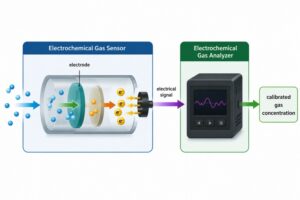
| Electrochemical | O₂ | Simple and cost-effective |
| Paramagnetic | O₂ | Long-term, low-maintenance O₂ measurement |
| TDLAS | Selected gases | High selectivity and fast response |
| FTIR | Multiple gases | Broad multi-component analysis |
Therefore, technology selection should follow the gas composition, concentration range, sampling conditions, and research objective.
How Can an Online Syngas Analyzer Support Different Renewable Energy Research Projects?
An online syngas analyzer can serve more than one experiment. By continuously tracking gas composition, a single analyzer platform can support biomass gasification, hydrogen production, waste conversion, and catalytic reforming research.
| Research Project | Key Gases | Main Purpose |
|---|---|---|
| Biomass gasification | H₂, CO, CO₂, CH₄ | Evaluate gasification performance |
| Waste gasification | H₂, CO, CO₂, CH₄, O₂ | Track process stability |
| Hydrogen research | H₂, CO, CO₂, CH₄ | Study H₂ yield and syngas quality |
| Catalytic reforming | H₂, CO, CO₂, CH₄ | Evaluate catalyst performance |
For this reason, an online syngas analyzer can become a common measurement platform across multiple renewable-energy projects, rather than a single-purpose laboratory instrument. From laboratory to real projects, online gas analyzers must adapt to a variety of operating environments and the specific gases that need to be monitored on-site.And it leads to the next question: how should ESEGAS design an online syngas analyzer around a university’s specific research process?
How Does ESEGAS Design an Online Syngas Analyzer for University Research?
A university research project rarely follows a fixed production recipe. Researchers may change the feedstock, gasification temperature, steam ratio, or catalyst from one test to the next. Therefore, ESEGAS designs the online syngas analyzer around the research process, rather than using one standard configuration for every laboratory.
First, ESEGAS identifies the gases that the research team needs to measure and their expected concentration ranges. It then reviews the gasifier, sampling point, temperature, pressure, moisture, dust, and tar conditions. This approach matters because online gas analysis has already been used in laboratory and pilot-scale biomass and refuse-derived-fuel gasification research.
For a typical university gasification project, ESEGAS can combine different detection principles in one syngas analyzer. An online syngas analyzer that combines NDIR for CH₄ measurement, TCD for H₂ measurement, and electrochemical or paramagnetic oxygen measurement for O₂.
The IR-GAS-600 online syngas analyzer supports simultaneous CO, CO₂, and CH₄ measurement using infrared detection, while H₂ can use compensated thermal conductivity detection and O₂ can use electrochemical or optional paramagnetic sensing.
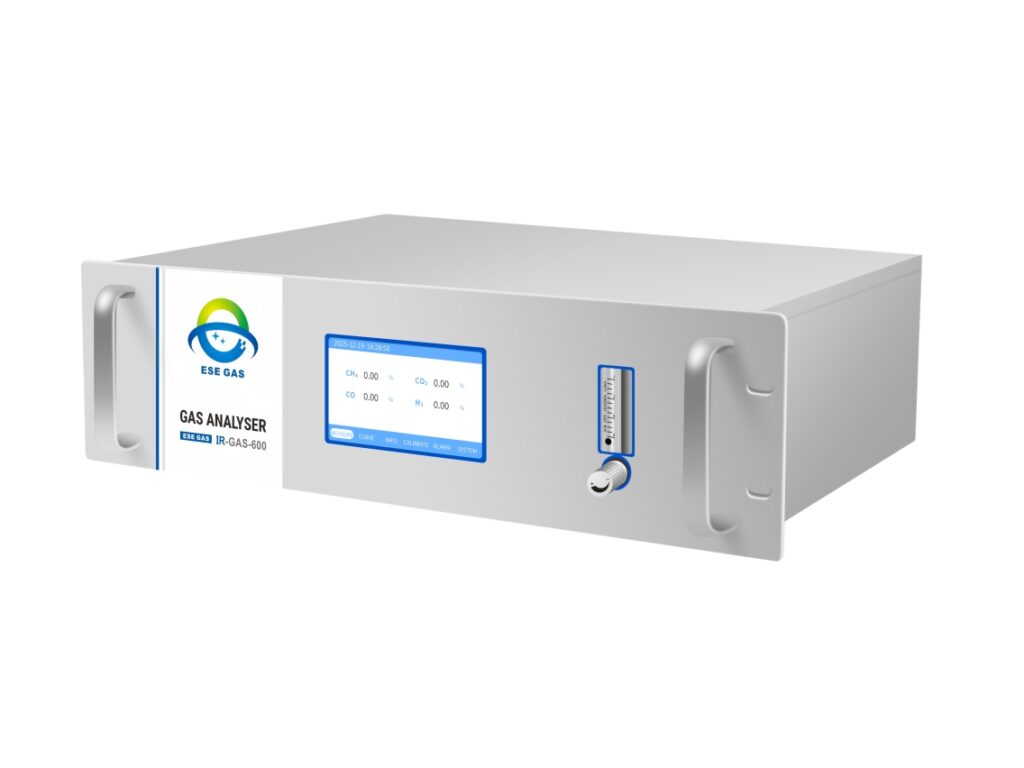
The syngas analyzer is only one part of the measurement chain. ESEGAS can configure the sampling system around actual gasification conditions, including filtration, heated sampling lines, cooling, condensate removal, flow control, and sample protection. This is especially important because raw syngas can contain particles and tar, while cooling can cause moisture and condensable compounds to separate from the gas stream. Research has therefore used heated probes, filtration, and controlled gas conditioning before analysis.
In practice, the design follows a simple principle:
Research objective → Target gases → Measurement technology → Sampling conditions → Complete online syngas analyzer system
This application-first approach allows the syngas analyzer to support different research stages while leaving room for future gas-channel expansion.
Conclusion
An online syngas analyzer gives university research teams continuous H₂, CO, CO₂, CH₄, and O₂ data for gasification studies, hydrogen research, and syngas optimization. ESEGAS combines suitable detection technologies with application-specific sampling systems to match each project. Contact ESEGAS to discuss your online syngas analyzer requirements.