



In modern industrial emission control, SCR (Selective Catalytic Reduction) systems have become one of the most effective technologies for reducing nitrogen oxide (NOx) emissions. However, maintaining the right ammonia injection level remains a major challenge. Too little ammonia reduces NOx removal efficiency, while excessive ammonia injection causes ammonia slip, leading to higher operating costs, potential equipment fouling, and environmental compliance risks. Without accurate monitoring, operators may struggle to find the ideal balance between emission reduction and ammonia consumption. An NH3 Analyzer provides a reliable solution by continuously measuring ammonia concentration at the SCR outlet, enabling precise ammonia injection control and minimizing ammonia slip.

An NH3 Analyzer controls ammonia slip in SCR systems by continuously monitoring residual ammonia concentration after the SCR reaction and providing real-time feedback to the control system. This measurement data allows operators or automatic control systems to adjust ammonia injection rates accurately, maintaining optimal NOx reduction performance while preventing excessive ammonia emissions.
Although ammonia slip may appear to be a simple measurement issue, it is actually closely related to SCR system efficiency, catalyst performance, and operational stability. Traditional SCR operation often relies on calculated ammonia injection models, but changing fuel characteristics, load fluctuations, and catalyst aging can make these calculations inaccurate. By introducing real-time gas analysis technology, ESEGAS helps industrial facilities achieve more precise SCR control and improve overall emission management.
Why Does Ammonia Slip Occur in SCR Systems?
Excess ammonia slip is one of the common operational challenges faced by SCR system operators. When ammonia injection does not match the actual NOx concentration and reaction conditions, unreacted ammonia passes through the catalyst layer and enters the downstream flue gas. This not only wastes ammonia resources but may also create operational problems in downstream equipment.
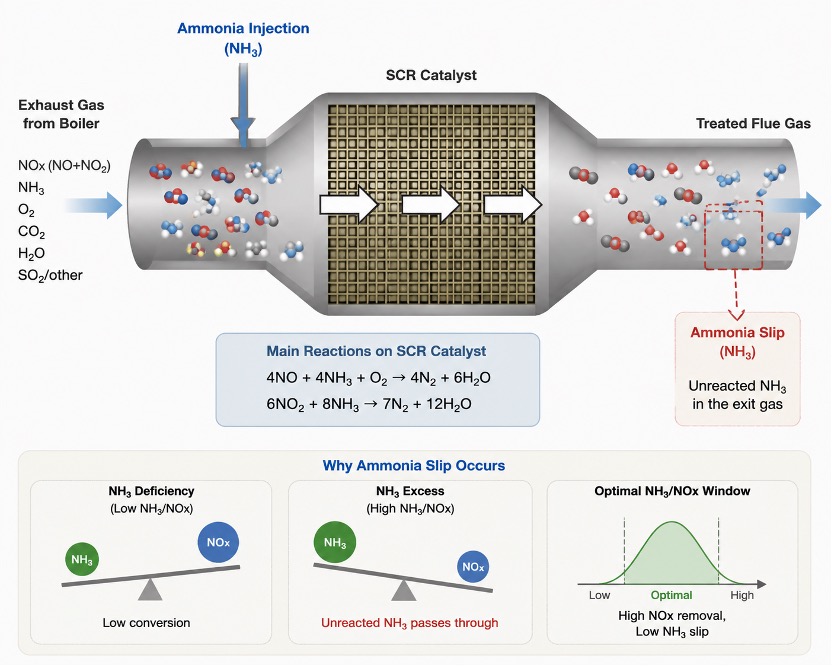
Several factors can contribute to ammonia slip in SCR applications:
1. Excessive Ammonia Injection
When the ammonia injection rate is higher than the amount required for the NOx reduction reaction, the additional ammonia cannot be fully consumed by the catalyst. As a result, excess NH3 remains in the flue gas and becomes ammonia slip.
2. Uneven Ammonia Distribution
A poor ammonia mixing system can cause uneven NH3 concentration across the catalyst surface. Some areas may receive excessive ammonia, while other areas may not receive enough, reducing overall SCR efficiency.
3. Catalyst Aging and Performance Reduction
SCR catalysts gradually lose activity due to long-term operation, contamination, and thermal stress. A catalyst with reduced activity requires more precise ammonia control to maintain NOx removal performance without increasing ammonia slip.
4. Rapid Changes in Operating Conditions
Industrial boilers, power plants, and waste incineration systems often experience changing loads. Without real-time ammonia monitoring, the ammonia injection system may react too slowly to these variations.
How Does an NH3 Analyzer Measure Ammonia Slip?
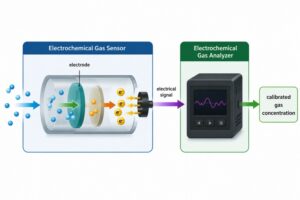
Accurate ammonia measurement is the foundation of effective SCR optimization. Many traditional control methods estimate ammonia requirements based on NOx concentration and operating models, but these methods cannot always reflect real-time conditions inside the flue gas system. An NH3 Analyzer provides direct measurement data, allowing operators to understand the actual ammonia slip level.
The measurement process typically includes three important steps:
| Measurement Stage | Function | Value for SCR Control |
| Gas Sampling | Collects flue gas from the SCR outlet | Provides actual operating data |
| NH3 Detection | Measures ammonia concentration in the gas stream | Identifies ammonia slip level |
| Data Feedback | Sends measurement results to the control system | Enables injection adjustment |
At ESEGAS, we understand that industrial gas measurement requires both accuracy and reliability. Our gas analysis solutions are designed to provide stable measurement performance in demanding environments, helping users obtain dependable ammonia concentration data for SCR optimization.
An advanced NH3 Analyzer allows operators to move from indirect estimation to direct monitoring. Instead of increasing ammonia injection based on assumptions, the system can respond according to actual ammonia levels measured in the flue gas.
How Does an NH3 Analyzer Optimize SCR Ammonia Injection Control?
Maintaining the correct ammonia injection rate is essential for achieving the best balance between NOx reduction and ammonia consumption. Over-injection increases ammonia slip, while under-injection reduces emission control efficiency. This creates a narrow operating window where accurate measurement becomes critical.
Without real-time ammonia monitoring, SCR systems may experience unstable operation, unnecessary chemical consumption, and increased maintenance requirements. ESEGAS helps customers overcome these challenges by providing accurate gas analysis technology that supports closed-loop SCR control.
The optimization process works as follows:
- Continuous ammonia monitoring
The NH3 Analyzer measures ammonia concentration at the SCR outlet and provides continuous operational feedback. - Comparison with target values
The control system compares measured ammonia levels with the desired operating range. - Adjustment of ammonia injection
Based on measurement results, the ammonia injection system increases or decreases ammonia supply. - Maintaining optimal SCR performance
The system achieves high NOx removal efficiency while keeping ammonia slip at a controlled level.
This feedback-based approach improves process stability and reduces dependence on manual adjustments. By integrating reliable gas analysis into SCR systems, ESEGAS enables industrial users to achieve smarter and more efficient emission control.
What Are the Benefits of Using an NH3 Analyzer in SCR Systems?
For industries operating SCR systems, controlling ammonia slip is not only an environmental requirement but also an important factor affecting operational costs and equipment reliability. Accurate ammonia measurement provides valuable insights that help operators improve the entire emission control process.
The key benefits include:
| Benefit | Impact on SCR Operation |
| Reduced ammonia slip | Helps maintain emission compliance and minimize environmental impact |
| Lower ammonia consumption | Reduces chemical usage and operating expenses |
| Improved catalyst utilization | Supports longer catalyst service life |
| More stable NOx reduction | Maintains consistent emission performance |
| Better process visibility | Provides real-time information for operational decisions |
By using an NH3 Analyzer, operators can identify ammonia-related issues earlier and make adjustments before they develop into larger operational problems. This proactive approach is especially valuable for large-scale industrial facilities where even small efficiency improvements can create significant long-term benefits.
Why Choose ESEGAS NH3 Analyzer for SCR Applications?
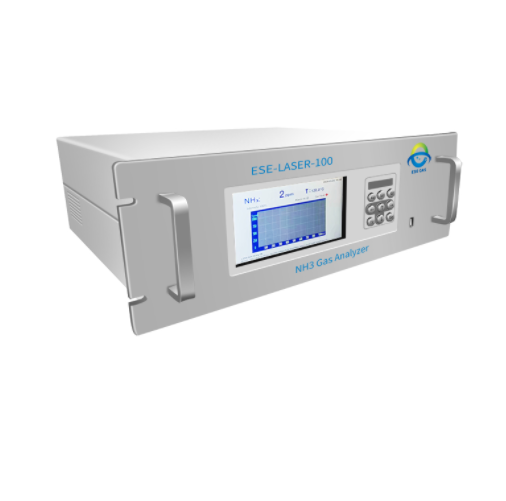
Industrial customers need more than basic ammonia measurement; they need a reliable gas analysis solution that can operate continuously in challenging environments. At ESEGAS, we focus on developing advanced gas analyzer technologies that support accurate measurement, efficient operation, and emission optimization.
Our NH3 Analyzer solutions are designed to help SCR system operators achieve:
- High measurement accuracy for reliable ammonia slip monitoring
- Fast response performance for timely process adjustments
- Stable operation in harsh industrial conditions
- Easy integration with existing SCR control systems
- Improved emission management and operational efficiency
With extensive experience in gas analysis technology, ESEGAS provides solutions that help industries optimize their environmental control systems. By delivering accurate ammonia measurement and dependable performance, our analyzers support customers in achieving cleaner, more efficient, and more sustainable industrial operations.
Conclusion
An NH3 Analyzer plays a critical role in controlling ammonia slip in SCR systems by providing real-time ammonia concentration measurement and enabling precise injection control. Through accurate monitoring, industrial operators can maintain high NOx reduction efficiency, reduce ammonia waste, protect downstream equipment, and improve overall system reliability.
At ESEGAS, we believe that effective emission control starts with accurate measurement. Our gas analyzer solutions help industries achieve smarter SCR operation by transforming ammonia monitoring from a reactive process into a precise, data-driven control strategy.