



In industrial production, oxygen is often invisible but never insignificant. When the oxygen level in a process gas stream is too high, it may cause oxidation, combustion instability, product contamination, or safety risks. When it is too low, combustion efficiency can drop, reactions may become incomplete, and operators may lose control of critical process conditions. At ESEGAS, we see the O2 analyzer not simply as a measuring instrument, but as a practical tool that helps plants turn oxygen data into safer operation, better process control, and more stable production performance.
An O2 analyzer is used in process analysis to continuously measure oxygen concentration in industrial gases. It helps operators monitor combustion efficiency, control process atmosphere, detect air leakage, protect product quality, and support safety and emission management. In ESEGAS process gas analysis solutions, O2 measurement can be integrated with multi-gas analysis systems to provide real-time data for industrial process control.
Although the basic function of an O2 analyzer is to measure oxygen concentration, its value depends heavily on where and how it is used. In a boiler, oxygen data may help optimize the air-to-fuel ratio. In a chemical reactor, it may help prevent unsafe oxygen ingress. In a high-purity gas process, even trace oxygen can affect product quality. That is why process analysis requires more than a sensor—it requires the right measurement principle, sampling design, installation method, and system integration.
Why Is O2 Measurement Important in Process Analysis?
When oxygen concentration is not monitored continuously, process changes can remain hidden until they become expensive problems. A small amount of air leakage may reduce product purity. Excess oxygen in flue gas may waste fuel. Insufficient oxygen in combustion may increase CO formation. With an ESEGAS O2 analyzer, operators can identify these risks earlier and respond before they affect safety, efficiency, or product quality.
In process analysis, oxygen measurement is important because it provides a direct indication of process condition. The O2 analyzer helps plants understand whether the process atmosphere is oxidizing, reducing, inert, or combustion-balanced.
Key values of O2 measurement include:
| Process Need | Role of the O2 Analyzer | Operational Value |
| Combustion control | Measures residual oxygen in flue gas | Improves fuel efficiency and combustion stability |
| Process safety | Detects oxygen ingress in inert or flammable environments | Reduces explosion and oxidation risks |
| Quality control | Monitors oxygen contamination in process gas | Helps maintain stable product quality |
| Emission control | Supports exhaust gas and combustion optimization | Helps reduce unnecessary emissions |
| Leak detection | Identifies air entering closed systems | Enables earlier maintenance action |
For many industrial users, oxygen is one of the first indicators of whether a process is under control. This is why ESEGAS designs O2 analyzer solutions not only for measurement accuracy, but also for long-term stability in real plant conditions.
Where Is an O2 Analyzer Commonly Used in Industrial Processes?
Many plants only begin to focus on oxygen after they notice higher fuel consumption, unstable product quality, or abnormal emissions. In reality, oxygen often gives an early warning before these issues become obvious. By installing an O2 analyzer at the right process point, operators can monitor critical gas conditions continuously instead of depending only on delayed laboratory results or manual inspection.
Common applications of an O2 analyzer in process analysis include:
Combustion Systems
In boilers, furnaces, kilns, heaters, and incinerators, the O2 analyzer measures residual oxygen in flue gas. This helps operators adjust the air-to-fuel ratio. Too much excess air carries heat away and reduces efficiency. Too little oxygen may cause incomplete combustion and increase CO formation.
Chemical and Petrochemical Processes
In reactors, pipelines, and process vessels, oxygen ingress can affect reaction stability, catalyst life, or product quality. An ESEGAS O2 analyzer can help detect air leakage and support safer process control.
Inert Gas Protection
In tank blanketing, nitrogen purging, and inert atmosphere systems, oxygen concentration must often be kept below a specific safety limit. Continuous O2 measurement helps confirm that the inert atmosphere remains effective.
High-Purity Gas and Specialty Gas Applications
In some processes, even low levels of oxygen contamination can damage product quality. A suitable O2 analyzer helps monitor trace or low-level oxygen to protect gas purity and downstream production.
Environmental and Emission Monitoring
Oxygen data is also useful in exhaust gas analysis. It helps evaluate combustion conditions and can support emission correction, process optimization, and environmental management.
How Does an O2 Analyzer Improve Combustion Control?
Combustion looks simple from the outside, but small changes in air supply, fuel quality, burner condition, or draft pressure can quickly affect efficiency. Without continuous oxygen data, operators may only discover the problem after fuel costs rise, flame stability drops, or emissions become abnormal. An O2 analyzer gives the plant a real-time signal that helps keep combustion closer to the ideal operating range.
In combustion control, the O2 analyzer measures the oxygen remaining after combustion. This residual oxygen reflects whether the system is running with too much, too little, or appropriate excess air.
An ESEGAS O2 analyzer can help combustion processes by:
- Optimizing the air-to-fuel ratio
Oxygen data helps operators adjust air supply and fuel input more accurately. - Reducing fuel waste
Excess air absorbs heat and sends it out through the stack. Better oxygen control helps reduce unnecessary heat loss. - Lowering incomplete combustion risk
When oxygen is insufficient, combustion may produce more CO and unburned fuel components. O2 monitoring helps prevent this condition. - Improving process stability
Stable oxygen measurement supports stable furnace temperature, boiler load, and burner performance. - Supporting automatic control
The O2 analyzer can provide signals to DCS, PLC, or SCADA systems for continuous process adjustment.
For industries using boilers, thermal oxidizers, kilns, or furnaces, oxygen analysis is often one of the most practical ways to improve both energy efficiency and operational reliability.
How Does O2 Analysis Support Process Safety?
In many industrial processes, oxygen is not just a measurement parameter—it is a safety boundary. If oxygen enters a flammable or inerted system unexpectedly, the risk of explosion, oxidation, or uncontrolled reaction may increase. When operators cannot see oxygen changes in real time, they may lose the opportunity to act early. A reliable O2 analyzer helps make this invisible risk measurable and manageable.
O2 analysis supports process safety in several ways:
Monitoring Inert Atmospheres
In nitrogen blanketing, purge gas systems, and storage tanks, the O2 analyzer confirms whether oxygen remains below the required level. This is especially important when handling flammable vapors, reactive chemicals, or oxidation-sensitive materials.
Detecting Air Leakage
Air ingress can occur through seals, valves, flanges, or sampling points. Continuous oxygen measurement helps detect leakage earlier than periodic manual sampling.
Supporting Start-Up and Shutdown Safety
During process start-up, shutdown, or maintenance, oxygen concentration may change quickly. An O2 analyzer helps operators confirm whether the gas environment is safe before the next operating step.
Enabling Alarm and Interlock Functions
When integrated into a control system, the O2 analyzer can trigger alarms or safety actions if oxygen concentration exceeds the set limit.
At ESEGAS, we pay close attention to sampling system design, gas conditioning, response time, and alarm reliability because safety applications require more than a correct reading—they require dependable performance when conditions change.
Which O2 Analyzer Technology Is Suitable for Process Gas Analysis?
Choosing the wrong oxygen measurement technology can create serious problems. A sensor that works well in clean gas may fail in wet, dusty, corrosive, or high-temperature gas. A measurement range suitable for percent-level oxygen may not be suitable for trace oxygen. The right O2 analyzer must match the process gas composition, operating condition, required accuracy, and maintenance expectations.
Several oxygen measurement technologies are commonly used in process analysis:
| Technology | Typical Application | Main Advantage | Key Consideration |
| Zirconia oxygen analysis | Combustion flue gas, high-temperature processes | Fast response and suitable for hot gas measurement | Requires suitable temperature and gas condition |
| Paramagnetic oxygen analysis | Percent-level O2 in process gas | Stable and selective for oxygen | Best for clean and properly conditioned gas |
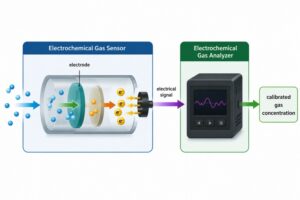
| Electrochemical oxygen analysis | Portable or selected online applications | Cost-effective and practical | Sensor life depends on gas condition |
| TDLAS oxygen analysis | Fast, non-contact, or difficult process conditions | Rapid response and low maintenance potential | Requires proper optical path and application design |
| Trace oxygen analysis | High-purity gas and specialty gas | Detects very low oxygen concentration | Requires careful sampling and leak-free design |
ESEGAS selects O2 analyzer technology based on the actual application, not only the gas name. We evaluate the process temperature, pressure, moisture, dust, corrosive components, background gases, response time, and installation environment. This helps us provide a solution that performs reliably in daily operation.
What Should You Consider When Choosing an O2 Analyzer?
Many oxygen measurement problems are not caused by the analyzer itself, but by incorrect selection, poor sample handling, or unsuitable installation. If the sample gas contains moisture, acid gas, dust, or condensable components, the oxygen reading may become unstable. If the response time is too slow, operators may miss critical process changes. Selecting an O2 analyzer therefore requires a complete view of the process, not only a measurement range.
Before choosing an O2 analyzer for process analysis, we recommend considering the following factors:
1. Measurement Range
Different applications require different oxygen ranges. Combustion control may measure percent-level oxygen, while high-purity gas applications may require ppm or trace oxygen measurement.
2. Gas Composition
The presence of CO, CO2, CH4, H2, acid gases, solvents, moisture, or dust can affect technology selection and sample conditioning design.
3. Installation Method
An O2 analyzer may be installed as an in-situ system, extractive system, online cabinet system, or portable analyzer. The best choice depends on the process condition and maintenance requirements.
4. Response Time
Safety and combustion control applications often require fast response. Quality control applications may prioritize stability and accuracy.
5. Sample Conditioning
For extractive systems, filters, coolers, pumps, valves, and moisture removal devices may be required to protect the analyzer and maintain measurement reliability.
6. Signal Integration
The analyzer should provide suitable output signals such as 4–20 mA, relay alarm, Modbus, or other communication protocols for plant control systems.
7. Maintenance and Calibration
A good O2 analyzer solution should be easy to maintain, calibrate, and verify. This reduces downtime and supports long-term measurement confidence.
At ESEGAS, we help users evaluate these factors before recommending an analyzer. Our goal is to provide a practical process analysis solution that fits the real operating environment.
How Does ESEGAS Build Reliable O2 Process Analysis Solutions?
A plant usually does not need only an oxygen sensor. It needs a complete measurement solution that can handle real gas conditions, deliver stable data, and connect smoothly with the control system. Without proper system design, even a high-quality O2 analyzer may provide unreliable results. That is why ESEGAS approaches oxygen analysis from the complete application, not from the instrument alone.
Our O2 process analysis solutions may include:
- O2 analyzer selection based on process requirements
- Gas sampling and pretreatment system design
- Multi-gas measurement integration with CO, CO2, CH4, H2, NOx, SO2, or other gases
- Online monitoring cabinet configuration
- Portable or fixed installation options
- Alarm, data output, and control system integration
- Technical support for commissioning and long-term operation
ESEGAS process gas analysis systems are designed for applications such as combustion control, chemical processing, emission monitoring, inert gas protection, industrial safety, and quality control. By combining suitable analyzer technology with application-specific engineering, we help users obtain oxygen data that is accurate, stable, and useful for real process decisions.
How Can an O2 Analyzer Improve Long-Term Process Performance?
Some plants treat oxygen analysis as a compliance or safety requirement only. However, when oxygen data is used actively, it can become a long-term performance improvement tool. Without continuous O2 monitoring, operators may rely on experience or delayed lab results. With a properly selected O2 analyzer, the process becomes more visible, measurable, and controllable.
Over time, an O2 analyzer can help plants:
- Reduce fuel consumption in combustion processes
- Improve product consistency
- Detect abnormal process changes earlier
- Reduce unplanned shutdowns
- Support preventive maintenance
- Strengthen safety management
- Improve emission control strategies
- Provide historical data for process optimization
For ESEGAS, the real value of oxygen analysis is not limited to one reading on a screen. Its value appears when reliable oxygen data supports better decisions every day.
Conclusion
An O2 analyzer plays an essential role in process analysis by continuously measuring oxygen concentration and helping operators control safety, efficiency, product quality, and emissions. From combustion systems and chemical processes to inert gas protection and high-purity gas monitoring, oxygen measurement provides critical insight into process conditions.
At ESEGAS, we provide O2 analyzer solutions that are built around real industrial applications. By combining suitable measurement technology, sampling system design, multi-gas analysis capability, and control system integration, we help plants transform oxygen data into practical process value. For any industry that depends on stable gas composition, a reliable O2 analyzer is not just an instrument—it is a foundation for safer, cleaner, and more efficient operation.