



Volatile Organic Compounds (VOCs) are organic chemicals with low boiling points that easily vaporize into air. Because they can react in sunlight to form smog and ground-level ozone, many regions set strict limits on VOC emissions to protect air quality and public health. VOCs also include toxic substances like benzene or formaldehyde that can irritate lungs or affect long-term health.
Common industrial sources include solvent use, coatings, fuel handling, printing, and chemical processing. In these environments, uncontrolled VOC emissions can quickly accumulate, making reliable monitoring essential for safety and regulation compliance.

When engineers and safety leaders research a VOC analyzer or an online VOC monitoring system, they seek clear answers that affect operational decisions:
- Accuracy: “Can this VOC analyzer measure the compounds I care about at the levels I need?”
- Reliability: “Will it operate continuously online and integrate with our plant control system?”
- Technology fit: “Which detection method works best for my specific emissions?”
- Comparison: “What truly sets one product apart from another in terms of performance and cost?”
These questions show that buyers are focused on getting dependable real-time data, not just basic measurements.
A well-chosen VOC analyzer and online VOC monitoring system does more than log numbers. It provides continuous, real-time data that helps teams spot emission spikes early, satisfy environmental permit requirements, and protect workers from harmful exposure. Continuous monitoring also supports automated alarms and control actions, reducing the need for manual checks and lowering risk.
In regulated industries, this ongoing insight helps facilities maintain compliance, avoid fines, and improve operational visibility — making VOC monitoring a strategic tool, not just a compliance box to tick.
What Detection Principles Do VOC Analyzers and Online VOC Monitoring Systems Use?
A. How VOC Analyzer Technologies Differ and What They Offer
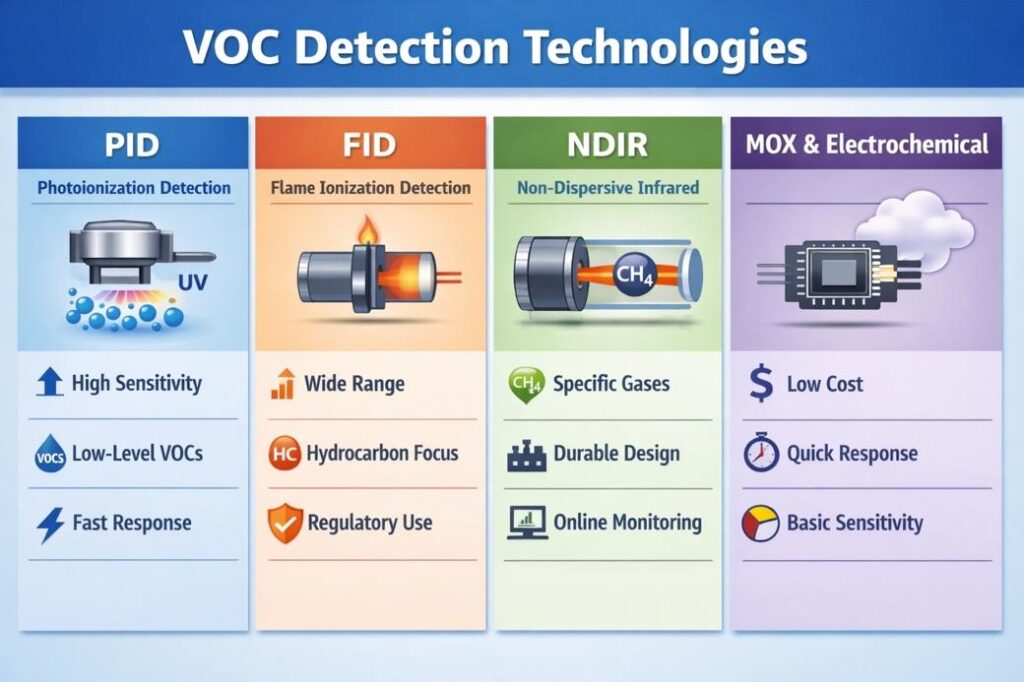
When selecting a VOC analyzer, it helps to understand the detection technologies and what each method delivers. One common technology is Photoionization Detection (PID). PID uses an ultraviolet lamp to ionize volatile organic compounds and then measures the resulting electrical signal. It offers high sensitivity and fast response, making it well suited for low-level total VOC detection in air quality and workplace safety applications.
Another widely used technology is Flame Ionization Detection (FID). FID burns sample gas in a hydrogen flame and measures ions formed during combustion. It produces a strong, consistent signal for hydrocarbons across a wide range, making it ideal for regulatory VOC emissions monitoring.
Non-Dispersive Infrared (NDIR) detection measures specific gases by how they absorb infrared light. This technology is rugged and reliable in continuous industrial environments and is often used in online systems for targeted VOCs like methane.
Lower-cost options such as metal oxide (MOX) and electrochemical sensors change resistance or current when VOCs interact with their surfaces. These sensors respond quickly and have low energy use, but they can struggle to distinguish complex mixtures and may need environmental compensation.
Overall, these detection approaches each influence how a VOC analyzer performs in real-world monitoring.
B. What an Online VOC Monitoring System Really Means in Practice
An online VOC monitoring system does more than take occasional readings — it continuously samples air and delivers real-time data. Instead of snapshot measurements, these systems draw a consistent air stream through sensors so operators see changes in VOC concentrations as they occur.
These systems typically integrate with plant control infrastructure such as Distributed Control Systems (DCS) or Supervisory Control and Data Acquisition (SCADA) networks. That means data can feed directly into automation platforms, trigger alarms, and support compliance reporting.
In practice, online systems support automatic calibration, environmental compensation (for temperature and humidity), and long-term data storage. These capabilities make them reliable tools for industrial emissions tracking, safety monitoring, and environmental reporting — far beyond what handheld tests can provide.
How Does a VOC Analyzer and Online VOC Monitoring System Support Continuous Operation and Automation?
24/7 Online VOC Monitoring and Why It Matters
For many industrial sites, round-the-clock VOC tracking isn’t optional — it’s essential. A true online VOC monitoring system collects air samples continuously, showing real-time trends instead of occasional snapshots. This constant visibility lets teams spot emission spikes the moment they happen, rather than discovering them hours or days later. Most systems deliver data automatically to plant dashboards or environmental reporting tools via network links, improving situational awareness and operational response.
Automated Calibration and Zeroing Simplify Long-Term Use
Manual calibration can be labor-intensive and inconsistent. Modern VOC analyzers automate calibration and zero-point checks using built-in software routines and compensation algorithms. These functions adjust sensor parameters based on environmental changes like temperature or humidity, helping ensure reliable measurements without manual intervention. By maintaining baseline accuracy automatically, systems reduce drift and downtime.
What Features Industrial Buyers Should Look For
To support reliable 24/7 operation and automation, buyers should evaluate several practical features:
- Auto-cleaning or pre-conditioning filters: These help keep sample paths clear of dust and particulates that might affect readings, especially in industrial air environments.
- Software-assisted calibration: Advanced algorithms can schedule and execute calibration events, correcting sensor drift with minimal human work.
- Self-diagnostic health monitoring: Smart systems monitor their own components and flag maintenance needs before performance degrades.
- Remote access and alarm notifications: Connectivity options like Ethernet, RS232 or wireless links let teams access data and alerts from control rooms or mobile devices, enabling faster responses.
These elements not only make monitoring more reliable — they also reduce the total cost of ownership by lowering manual labor and helping avoid compliance breaches.
Remote Reporting Enhances Safety and Compliance
In addition to automation, remote status reporting is key. Many online VOC monitoring systems can transmit data to a central server or environmental platform where software can generate charts, logs, and compliance reports. This capability supports regulatory reporting and gives environmental teams a clear historical record of emissions performance over time.
By combining continuous sampling with automated calibration and smart connectivity, a VOC analyzer integrated into an online VOC monitoring system delivers a proactive, reliable tool for industrial air quality, safety, and compliance.
How Does an ESEGAS VOC Analyzer Fit Into an Online VOC Monitoring System?
A. Measurement Range and Technology Used by ESEGAS VOC Analyzer
When evaluating a VOC analyzer that integrates into an online VOC monitoring system, range and analytical method matter a lot. ESEGAS’s solution covers a wide span of volatile organic compounds: NMHC and total hydrocarbons (HC) can be monitored from 0 up to 1000 ppm, and benzene-series VOCs can be tracked up to 10 ppm — all of which can be customized for specific site needs. These ranges make the analyzer suitable for both moderate and trace emissions scenarios. The system uses Gas Chromatography coupled with Flame Ionization Detection (GC-FID), a proven technology for quantifying VOCs with high sensitivity and repeatability across complex mixtures.
B. How the Online VOC Monitoring System Is Structured for Reliability
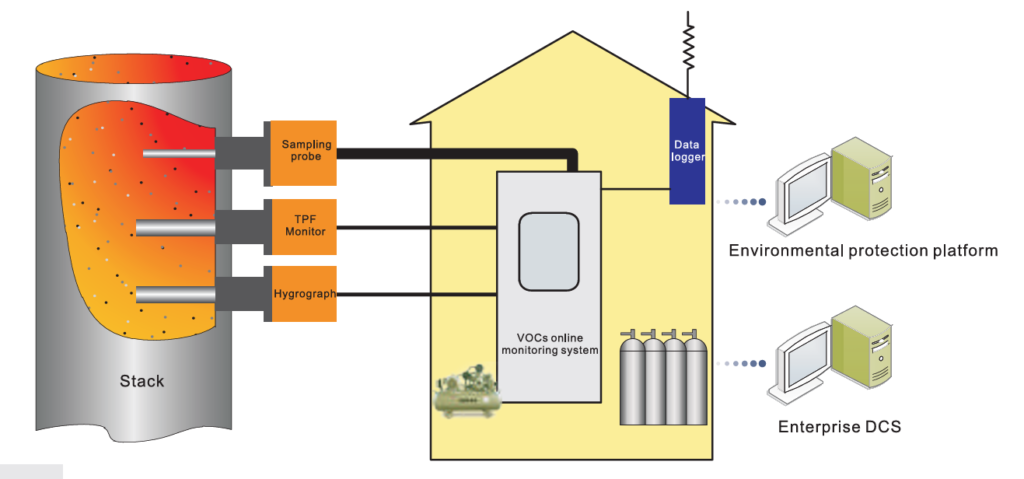
(ESEGAS Online VOC Monitoring System)
A well-engineered online VOC monitoring system goes beyond a single detector — it combines several subsystems to ensure accuracy, continuity, and robustness in industrial environments. First, a gaseous pollutant monitoring subsystem uses a sampling probe with a ceramic filter to deliver clean, dust-free gas to the analyzer. Meanwhile, a flue gas monitoring subsystem measures stack temperature, oxygen, humidity, and gas flow velocity using a TPF-integrated monitor and hygrograph. A calibration and assistant subsystem performs periodic automated checks to maintain analytical precision over time. Centralized real-time processing takes place in a control cabinet with an IPC, heating modules, and a high-temperature pump. To further enhance reliability, an air compressor supports regular pipeline blowback, which reduces condensation risks in the heat-traced sample lines. This system architecture supports continuous VOC emission reduction and compliance with strict environmental standards.
C. The Detection Principles Behind ESEGAS’s VOC Analyzer
The core of this VOC analyzer lies in two complementary analytical principles.
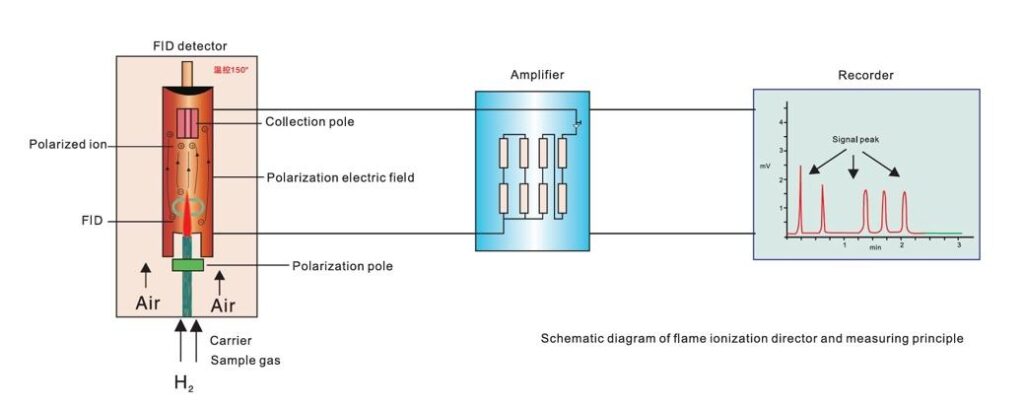
1) Hydrogen Flame Ionization Detection (FID) — When VOCs enter a hydrogen flame, the high temperature breaks their molecular bonds and generates free electrons. An electrical field draws these electrons toward a collector, generating an ionization current. The magnitude of this current is proportional to VOC concentration, allowing precise quantification of hydrocarbons. This linear response makes FID ideal for trace-level VOC monitoring in emissions and safety applications.
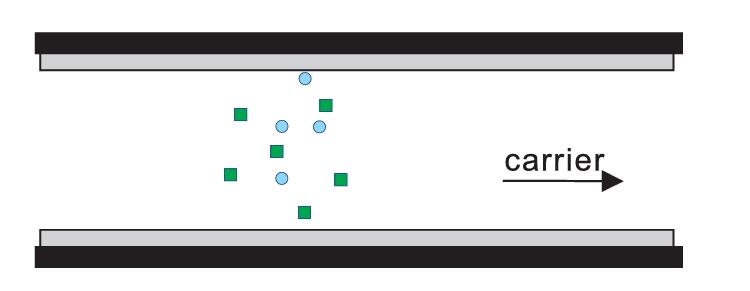
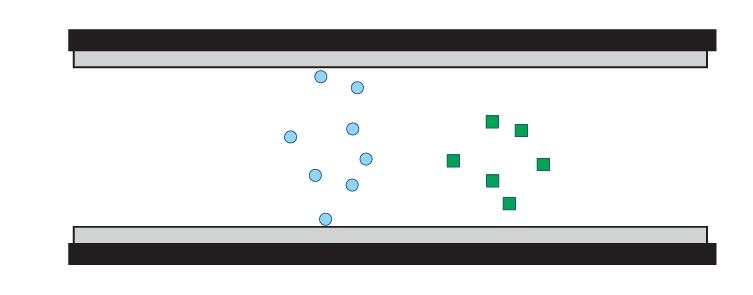
2) Chromatographic Separation — Before detection, the sample passes through a gas chromatographic column carried by an inert gas. Inside the column, each VOC interacts differently with the stationary phase, causing compounds to migrate at different speeds. This retention time difference separates individual components, so the detector measures each VOC specifically rather than as a blended signal. This process enables detailed chemical speciation even in complex industrial emissions.
Together, these principles allow ESEGAS’s VOC analyzer to deliver high-resolution, accurate, and continuous data when integrated into a real-time online VOC monitoring system — supporting regulatory compliance, operational insight, and environmental responsibility.
Conclusion
As you decide on a VOC analyzer and online VOC monitoring system, focus on more than just sensitivity. A strong monitoring solution combines accurate measurement with real world reliability and practical functionality. Moreover, choose systems that deliver dependable long term performance. Look for analyzers and monitoring systems with built in reliability features such as automated calibration, self diagnostic checks, and environmental compensation. These features reduce maintenance burdens, prevent false readings, and keep data trustworthy over months and years of continuous operation.
In summary, choose a VOC analyzer and online VOC monitoring system based on four core criteria: measurement accuracy, operational resilience, data integrity, and integration flexibility. Prioritizing these factors gives you a monitoring solution that supports both regulatory demands and better business outcomes. Let’s build together for your VOC analyzer and online VOC monitoring system!
FAQs:
1. What is a VOC analyzer and why is it essential for online VOC monitoring systems?
A VOC analyzer measures volatile organic compounds (VOCs) in air or emissions to assess air quality and compliance. In online VOC monitoring systems, it provides continuous real time data rather than periodic spot checks, helping facilities detect emission changes instantly and meet regulatory standards.
2. What are the most common technologies used in VOC analyzers?
VOC analyzers use several detection principles:
- PID (Photoionization Detection) — high sensitivity for many VOCs.
- FID (Flame Ionization Detection) — strong response to hydrocarbons and suitable for regulatory monitoring.
- NDIR (Non Dispersive Infrared) — good for targeted gas species in rugged environments.
- MOX & electrochemical sensors — lower cost, fast response, but less selective for complex mixtures.
Each method suits different applications depending on sensitivity needs and target VOC types.
3. What monitoring range should a VOC analyzer support?
A good VOC analyzer should cover the concentration levels expected in your application. Industrial online systems often measure from low ppb up to several ppm or higher, and customizable ranges help match specific regulatory or safety limits. This ensures accurate tracking from trace emissions to higher leak levels.
4. Why is continuous online VOC monitoring better than spot testing?
Continuous monitoring avoids gaps between periodic tests. An online VOC monitoring system samples air constantly and reports data in real time. This enables faster response to emission spikes, supports automated reporting, and integrates with plant control systems for operational insight and compliance.
5. What features improve reliability in a VOC analyzer setup?
Look for features that support robust long term operation:
- Automated calibration and zeroing
- Self diagnostic health checks
- Auto cleaning/sample pre conditioning
- Remote access and alarms
These help reduce maintenance, prevent data drift, and ensure continuous accurate readings.
6. Can VOC analyzers differentiate between different VOC species?
Yes. Advanced systems using gas chromatography (GC) and mass spectrometry (MS) or specific detectors like FID can separate and quantify individual VOC components. This is useful when you need compound specific information, not just total VOC levels.
7. What industries benefit most from online VOC monitoring systems?
Online VOC monitoring systems serve many sectors, including petrochemical, chemical manufacturing, painting/coating operations, printing, and semiconductor production. These industries produce complex VOC emissions that require continuous tracking for environmental and safety compliance.