


What Is a Gas Analyzer?
A gas analyzer is an industrial instrument that measures gas concentration in real time to support safety, process control, and environmental compliance. It does more than detect gas presence because it provides continuous, quantitative data that operators can act on immediately.
In modern plants, invisible gases create real risks, including explosions, poisoning, and process instability, so reliable monitoring becomes essential rather than optional. Industries rely on gas analyzers to maintain stable combustion, control emissions, and improve product quality, which means the right analyzer directly affects efficiency, compliance, and profitability.
If you are searching for a gas analyzer, you are not just buying equipment, you are solving a safety or process problem that affects your entire operation. Most users search for gas analyzers when something goes wrong or when regulations tighten, but the real goal usually goes deeper than that. You may want to prevent gas leaks, stabilize combustion, reduce emissions, or improve energy efficiency, and all these needs point to one thing, which is accurate and reliable gas measurement.
In practice, users look for solutions that deliver fast response, low maintenance, and stable performance in harsh environments, because downtime and false readings cost more than the analyzer itself. This is why selecting the right technology matters more than selecting the cheapest device.
What Is the Difference Between a Gas Analyzer and a Gas Detector?
Many people confuse gas analyzers with gas detectors, but they serve different roles in industrial systems.
A gas detector focuses on safety alerts, while a gas analyzer focuses on process control and data accuracy. A detector tells you something is wrong, while an analyzer tells you how to fix it and prevent it from happening again.
| Aspect | Gas Analyzer | Gas Detector |
| Function | Continuous measurement | Alarm detection |
| Output | Quantitative data | Threshold alarm |
| Purpose | Optimization | Safety |
For industrial users, this difference directly impacts operational efficiency and long-term cost.
How Does a Gas Analyzer Work?
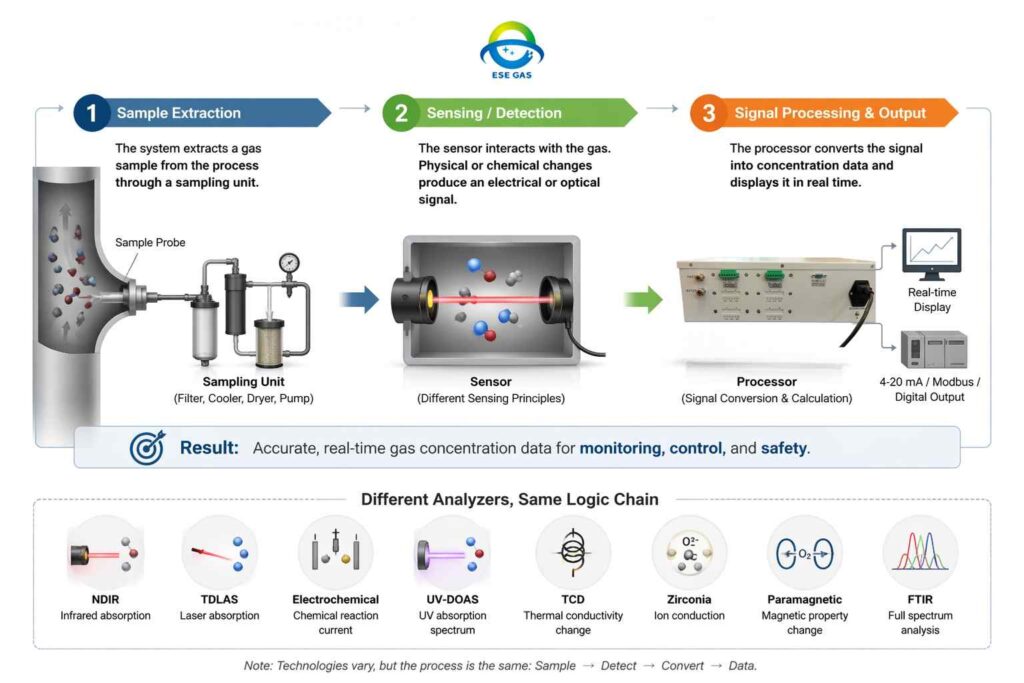
A gas analyzer follows a clear process, but the technology behind it determines accuracy and performance.
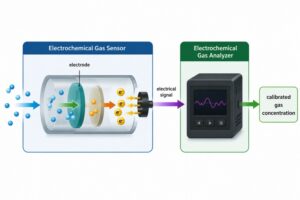
First, the system extracts a gas sample through a sampling unit, then a sensor interacts with the gas and generates a signal, and finally, the processor converts that signal into readable concentration data. Different analyzers use different sensing principles, but they all follow this same logic chain, which ensures consistent measurement output.
At the core, the analyzer converts physical or chemical changes into electrical or optical signals that operators can interpret in real time. This conversion process is what makes industrial automation and control possible.
What Types of Technologies Are Used in Gas Analyzers?
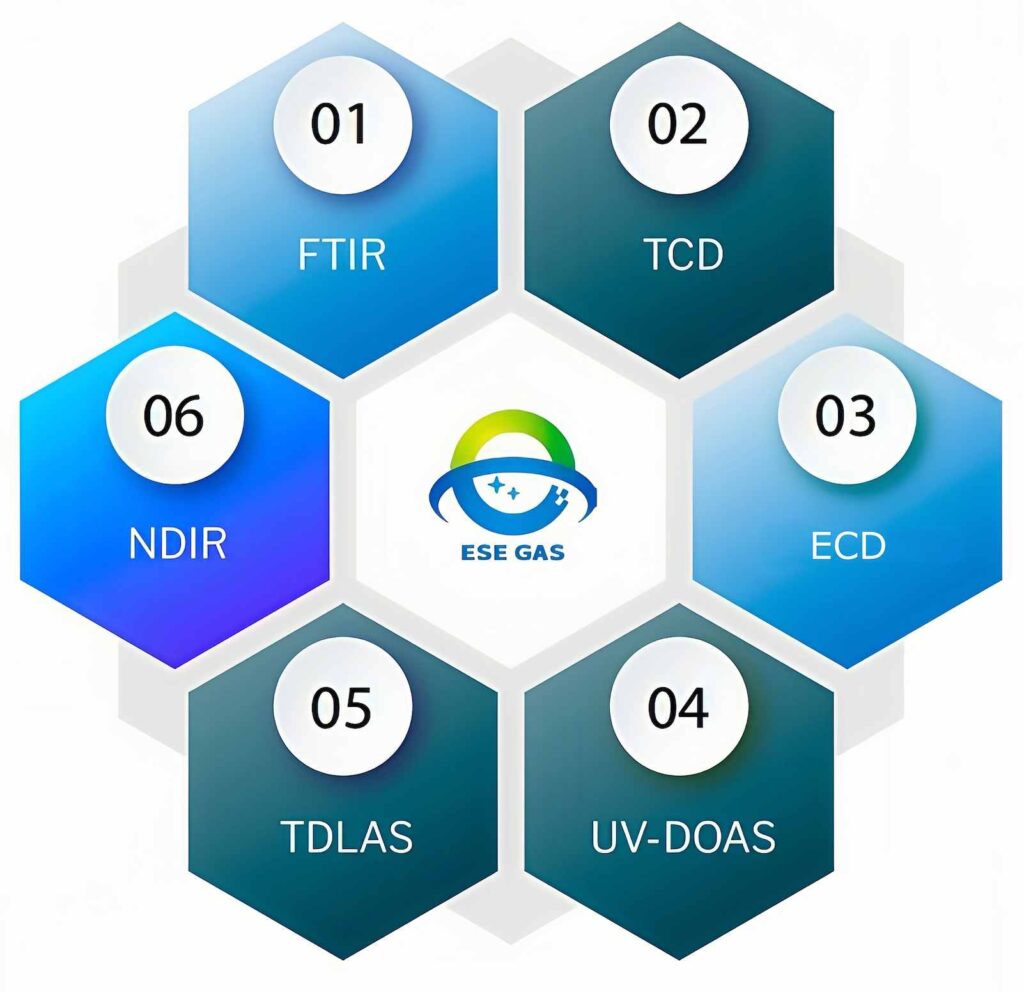
Different gas analyzer technologies exist because industrial conditions vary widely, and no single method can handle every gas, environment, or accuracy requirement. Each technology works best for specific gases, operating ranges, and process conditions, so understanding their strengths helps you avoid costly mismatches.
Below is a clear breakdown of the most widely used technologies in modern industrial gas analysis.
1. NDIR (Non-Dispersive Infrared)
NDIR analyzers measure gas concentration by detecting how gases absorb infrared light at specific wavelengths. They work best for gases with strong infrared absorption, such as CO and CO₂, which makes them a standard choice for combustion monitoring and emission control.
NDIR sensors offer high stability and simple structure, so they require relatively low maintenance and perform reliably over long periods. However, they may experience cross-interference when gases share similar absorption bands, which requires proper calibration and compensation.
2. TDLAS (Tunable Diode Laser Absorption Spectroscopy)
TDLAS uses a laser tuned to a specific gas absorption line, which allows highly selective and precise measurement. It can monitor gases such as NH₃, HCl, HF, O₂, H₂S, CO, CO₂, and CH₄, but typically one analyzer measures one gas due to its narrow spectral focus.
This technology delivers ultra-fast response and high accuracy, even in high dust, high humidity, or high temperature environments. It also avoids direct contact with the gas in many in-situ designs, which improves durability and reduces maintenance.
3. Electrochemical Gas Analyzer
Electrochemical analyzers generate a signal through chemical reactions between the gas and sensor electrodes. They are widely used for toxic gases and oxygen measurement because they provide good sensitivity at relatively low cost.
These analyzers are compact and cost-effective, which makes them suitable for safety monitoring and portable applications. However, the sensor has a limited lifespan and requires regular calibration and replacement, especially in demanding environments.
4. UV-DOAS (Ultraviolet Differential Optical Absorption Spectroscopy)
UV-DOAS analyzes gas concentration by measuring ultraviolet light absorption across multiple wavelengths. It provides strong selectivity and can separate overlapping gas spectra, which improves accuracy in complex gas mixtures.
This technology is widely used in emission monitoring systems because it can measure multiple gases simultaneously with high sensitivity. It also performs well at low concentration levels, making it suitable for regulatory compliance applications.
5. TCD (Thermal Conductivity Detector)
TCD measures gas concentration based on differences in thermal conductivity between gases.
It is especially effective for detecting hydrogen, which has significantly higher thermal conductivity than most gases.
TCD analyzers are simple, durable, and capable of measuring multiple gases when combined with reference gas systems. However, their accuracy depends on stable reference conditions, and they are less selective than optical methods.
6. Zirconia and Paramagnetic Oxygen Analyzers
Both technologies are dedicated to oxygen measurement, but they operate under different principles and suit different environments.
Zirconia analyzers use a high-temperature solid electrolyte to generate a signal based on oxygen concentration, which makes them ideal for combustion processes. Paramagnetic analyzers rely on the magnetic properties of oxygen to measure concentration, and they provide high accuracy in clean gas streams. Zirconia sensors perform well in high-temperature flue gas, while paramagnetic analyzers suit stable and conditioned environments.
7. FTIR (Fourier Transform Infrared Spectroscopy)
FTIR gas analyzers measure gas concentration by scanning the entire infrared spectrum and analyzing how different gases absorb energy at multiple wavelengths simultaneously. Unlike NDIR, which targets a single wavelength, FTIR captures a full spectral “fingerprint” of the gas mixture, which allows it to identify and quantify many components in one measurement. Each gas has a unique absorption pattern, so the system compares the measured spectrum with reference libraries and calculates concentrations using advanced algorithms. This capability makes FTIR one of the most powerful tools for analyzing complex gas mixtures, especially when multiple unknown or interfering gases are present.
FTIR gas analyzers can measure dozens of gases at once, including CO, CO₂, NOx, SO₂, NH₃, HCl, CH₄, and various VOCs, which makes them highly suitable for continuous emission monitoring and research applications. However, FTIR-based gas analyzers are typically more complex and require well-designed sampling systems to control moisture, temperature, and contamination, which directly affect measurement accuracy.
Choosing the right gas analyzer technology depends on how many gases you need to measure and how complex your process conditions are.
Where Are Gas Analyzers Used in Real Industrial Scenarios?
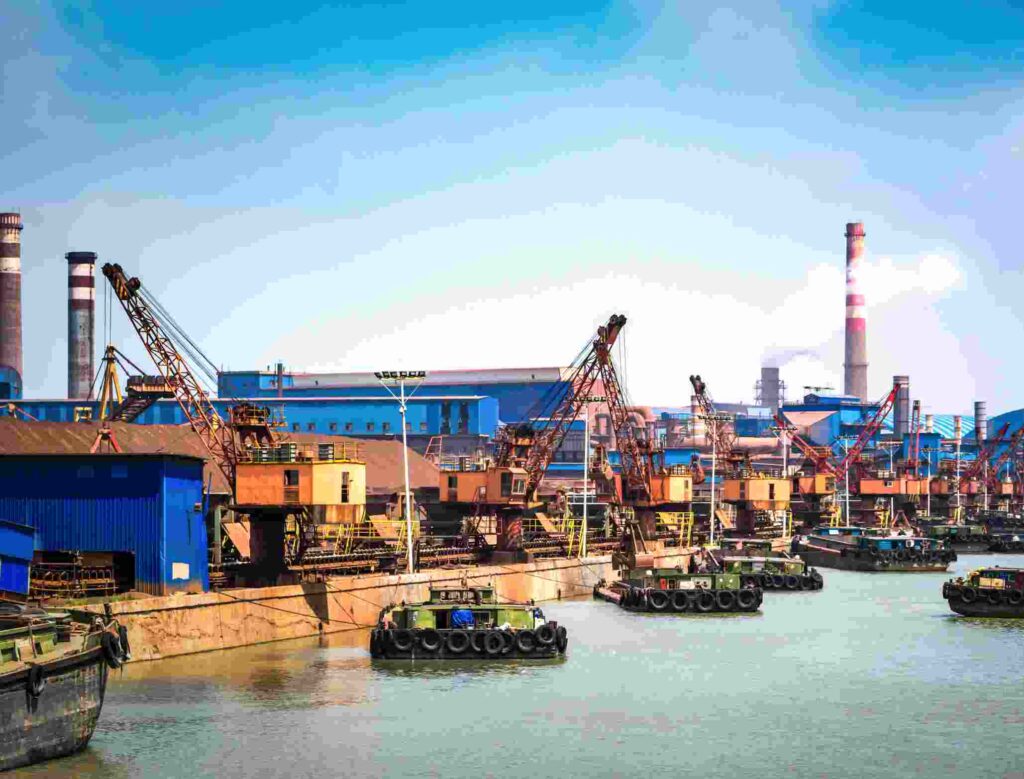
Gas analyzers support a wide range of industries, and each application highlights a different value.
- In oil and gas, they monitor pipelines and detect leaks to prevent catastrophic failures.
- In power plants, they optimize combustion by balancing oxygen and fuel levels, which improves efficiency and reduces emissions.
- In steel and cement industries, they control kiln processes and reduce energy consumption.
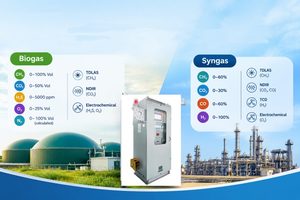
- In biogas plants, they measure methane and carbon dioxide to improve yield and stability.
- In environmental monitoring, they ensure compliance with emission standards and support air quality management.
Across all these industries, the goal stays the same, which is turning gas data into actionable decisions.
How Do You Choose the Right Gas Analyzer for Your Application?
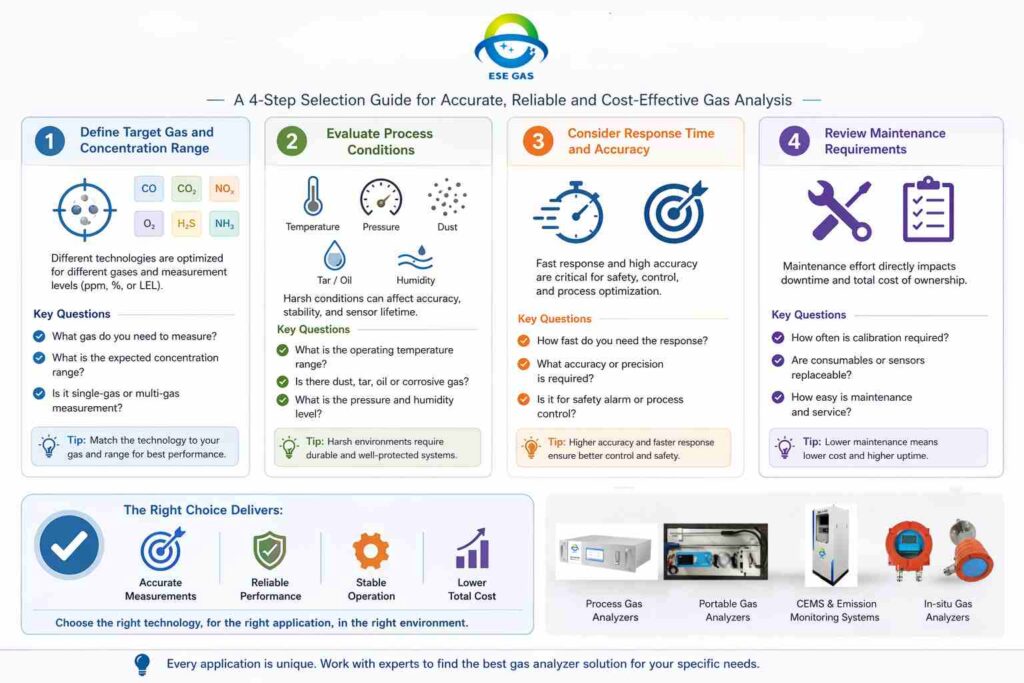
Selecting a gas analyzer requires a structured approach, because wrong choices lead to inaccurate data and high maintenance costs.
First, define your target gas and concentration range, because different technologies suit different measurement levels.
Next, evaluate process conditions such as temperature, pressure, dust, tar, oil, and humidity, since harsh environments require robust solutions.
Then, consider response time and accuracy, especially for critical safety or control applications.
Finally, review maintenance requirements, because frequent calibration increases operational cost.
Many users overlook cross-sensitivity and environmental interference, but these factors often cause measurement errors in real applications. A good selection process focuses on long-term performance rather than initial cost.
Why Does ESEGAS Have the Capability to Deliver Reliable Gas Analysis Solutions?

Reliability in gas analysis does not come from a single product, but from the combination of engineering, manufacturing, and service. At ESEGAS Official Website, we build that reliability into every stage, from design to delivery and long-term operation.
First, we rely on a strong technical team that includes experienced sales engineers and dedicated R&D specialists, and this close collaboration ensures that every solution matches real industrial needs instead of theoretical specifications. We also support OEM and ODM projects, which allows us to customize gas analyzers based on specific process conditions, industry standards, and customer requirements.
Second, we design our systems for easy installation and fast deployment, because downtime directly impacts production. For example, our online TDLAS gas monitoring systems can be mounted directly on the stack, which enables real-time ammonia (NH₃) monitoring in SCR processes without complex sampling systems. This in-situ design reduces maintenance while improving response time and measurement reliability.
Third, continuous innovation drives our product performance. We operate a dedicated R&D laboratory and testing base, where we develop new sensing technologies and improve system stability under real industrial conditions. This ongoing investment ensures that our solutions keep pace with stricter emission standards and more demanding process environments.
Fourth, we focus on fast and reliable delivery. We maintain sufficient inventory to support urgent projects, and typical lead times are around two weeks for standard analyzers and about twenty days for complete systems. This speed helps customers respond quickly to operational or regulatory requirements.
Finally, our service extends beyond product delivery. Our engineering team supports on-site installation, calibration, and maintenance, and we also provide hands-on training at your facility to ensure your team can operate the system confidently and efficiently.
In practice, this full-cycle support turns a gas analyzer into a long-term, stable solution rather than just a piece of equipment.
What Gas Analyzer Solutions Does ESEGAS Offer for Different Industrial Needs?
ESEGAS provides a complete portfolio designed to meet diverse industrial applications, from single-point detection to complex multi-gas monitoring systems. Each product line focuses on solving specific operational challenges while maintaining high accuracy and reliability.
Multi-gas analyzers and single-gas analyzers
ESEGAS offers both integrated multi-gas systems and dedicated single-gas analyzers, depending on your process requirements.
For example, our six-gas analyzer can simultaneously measure CH₄, CO₂, CO, CnHm, O₂, and H₂ within one system. We achieve this by integrating multiple sensing technologies into a single platform, including NDIR for CO₂ and CO, TDLAS for CH₄ and hydrocarbons, electrochemical or paramagnetic sensors for O₂, and TCD for hydrogen. This hybrid design allows each gas to be measured with the most suitable technology, which improves accuracy and reduces cross-interference.
For applications that require ultra-low detection limits, we also provide trace gas analyzers, such as trace H₂ analyzers, which support high-purity and specialty gas processes.
Portable gas analyzers for on-site diagnostics
Portable gas analyzers give engineers the flexibility to perform real-time measurements directly at the site. They are ideal for troubleshooting, temporary testing, and maintenance checks, especially in large or complex facilities. With fast response and easy operation, portable units help reduce downtime by allowing quick diagnosis of process issues.
CEMS and AQMS systems for environmental compliance
ESEGAS supports environmental and process monitoring with integrated system solutions.
- In carbon capture applications, our analyzers measure CO₂ concentration and purity to ensure efficient capture and process optimization.
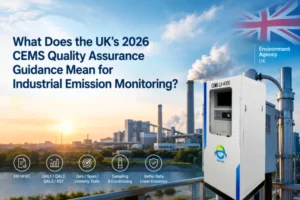
- For emission monitoring, our Continuous Emission Monitoring Systems (CEMS) solutions track key pollutants such as SO₂, NOx, CO, and CO₂ to meet regulatory requirements.
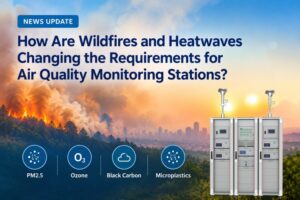
- Ambient Air Quality Monitoring Systems (AQMS) provide continuous ambient air monitoring, which helps industries and governments manage air quality effectively.
Mercury and VOCs monitoring solutions
For advanced environmental and industrial applications, ESEGAS also offers specialized systems for mercury (Hg) and volatile organic compounds (VOCs). They are critical for environmental protection and regulatory compliance.
- Mercury monitoring systems are widely used in power plants and waste incineration processes, where strict emission limits apply.
- VOC monitoring systems support industries such as petrochemical, coating, and semiconductor manufacturing, where organic emissions must be controlled precisely.
Choosing a gas analyzer is not only about selecting a product, but about selecting a partner who can support your system over its full lifecycle. ESEGAS combines technology, engineering, and service to deliver solutions that remain accurate, stable, and easy to maintain over time. If your goal is to improve process control, ensure compliance, and reduce operational risk, the right solution starts with the right expertise.
Conclusion
If your current gas analyzers or systems struggles with accuracy, response time, or maintenance cost, it may be time to upgrade your approach.
Start by reviewing your process conditions and identifying where measurement gaps affect performance.Then work with experienced engineers who understand both gas analysis technology and real industrial challenges. A well-designed solution will not only measure gases, but also improve efficiency, reduce risk, and support long-term compliance.
FAQs:
Question: What is a gas analyzer used for in industry?
Answer: A gas analyzer measures the concentration of gases in real time to support safety, process control, and environmental compliance. It helps operators optimize combustion, detect harmful gases, and ensure stable production conditions.
Question: How does a gas analyzer work?
Answer: A gas analyzer collects a gas sample, detects it using a sensor, and converts the signal into concentration data. The system compares the signal with calibrated reference values to produce accurate measurements.
Question: What is the difference between a gas analyzer and a gas detector?
Answer: A gas analyzer provides continuous and precise concentration data, while a gas detector mainly triggers alarms when gas levels exceed a threshold. Analyzers support process optimization, while detectors focus on safety alerts.
Question: Which gas analyzer technology is the most accurate?
Answer: TDLAS technology offers the highest accuracy and fastest response for single-gas measurement in harsh environments. FTIR provides high accuracy for multi-gas analysis, especially in complex gas mixtures.
Question: How do I choose the right gas analyzer for my application?
Answer: Start by identifying the target gas and concentration range, then evaluate process conditions such as temperature, dust, and humidity. Finally, consider accuracy, response time, and maintenance requirements before selecting the technology.
Question: Can one gas analyzer measure multiple gases at the same time?
Answer: Yes, multi-gas analyzers like FTIR and intergrated sensors can measure several gases simultaneously. These gas analyzers are widely used in emission monitoring and complex industrial processes.
Question: Why is sample conditioning important in gas analysis?
Answer: Sample conditioning removes dust, moisture, and contaminants before measurement, which protects sensors and improves accuracy. It is essential in high-temperature or high-humidity environments.