



A continuous emission monitoring system (CEMS) does more than measure flue gas. It directly affects compliance, reporting accuracy, and operational safety. Under ultra-low emission regulations, small measurement errors can lead to penalties or failed audits. The real challenge is not installing a CEMS, but selecting the right measurement technology. UV and infrared methods both rely on optical absorption, yet they behave very differently in real conditions. Their strengths only become clear when applied to actual flue gas environments. In practice, the choice is a balance between sensitivity, stability, and resistance to interference. Understanding this balance is the key to building a reliable monitoring system.
What Is the Difference Between UV and IR Measurement Principles in CEMS?
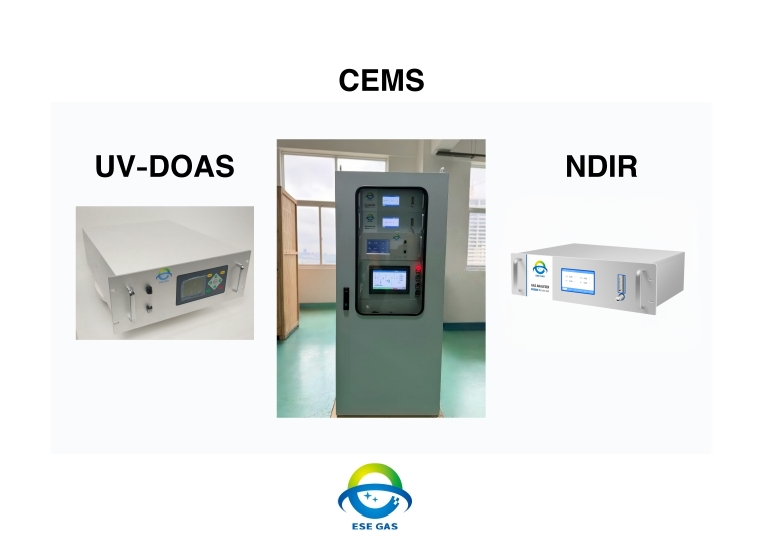
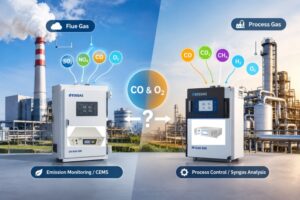
Both UV and IR technologies rely on the same fundamental principle: gas molecules absorb light at specific wavelengths, and the degree of absorption is proportional to their concentration. However, the key difference lies in the wavelength range used. Infrared spectroscopy is based on molecular vibrational absorption, making it particularly effective for gases such as CO₂, CO, and CH₄. In contrast, ultraviolet spectroscopy relies on electronic transitions, which are more suitable for gases like SO₂ and NO₂. This distinction explains why UV and IR technologies are not interchangeable but complementary.
Infrared (NDIR) Technology: Stability and Practicality
Non-dispersive infrared (NDIR) technology is one of the most widely used methods in CEMS applications. It operates by directing infrared light through a gas sample and measuring the absorbed wavelengths to determine gas concentration.
The primary advantage of NDIR lies in its maturity and robustness. It provides stable long-term performance and is particularly good for monitoring gases such as CO, CO₂, and CH₄. In addition, its relatively simple structure and lower operational cost make it a practical choice for many standard applications.
However, NDIR faces significant challenges in complex flue gas environments. Water vapor, which strongly absorbs infrared radiation, can interfere with measurements and cause spectral overlap. As a result, most IR-based systems require gas conditioning units to remove moisture before analysis. While this improves accuracy, it also introduces additional complexity and maintenance requirements.
More importantly, the condensation process used to remove moisture can lead to the loss of water-soluble gases such as SO₂, potentially introducing secondary measurement errors. This limitation becomes particularly problematic when monitoring low-concentration pollutants under strict emission standards.
UV-DOAS Technology: Precision in Complex Conditions
Ultraviolet differential optical absorption spectroscopy (UV-DOAS) offers a more targeted approach for measuring certain pollutants. It uses ultraviolet light to detect gas concentrations based on their unique absorption spectra. Unlike IR systems, water vapor and carbon dioxide interference can not largely affect UV analyzers, which simplifies sample handling and improves measurement reliability.
A key strength of UV-DOAS lies in its differential algorithm, which separates rapidly changing gas absorption features from slowly varying background signals caused by dust and moisture. This capability allows the system to maintain high accuracy even in challenging environments.
In practical applications, UV-DOAS demonstrates excellent sensitivity at low concentrations, often reaching detection limits at the mg/m³ level. This makes it particularly suitable for ultra-low emission monitoring, where requires precise measurement of SO₂ and NOx.
Despite these advantages, UV systems are generally more complex and may require periodic optical maintenance to ensure consistent performance. Nevertheless, in demanding industrial scenarios, their superior anti-interference capability often outweighs these considerations.
Comparing UV and IR in Real Applications
The difference between UV and IR technologies becomes most evident when applied to real industrial conditions. Infrared systems perform well in relatively clean and stable environments where gas concentrations remain within their optimal measurement range. In contrast, ultraviolet systems excel in situations involving high humidity, dust, and low pollutant concentrations.
Rather than viewing these technologies as competitors, it is more accurate to consider them as complementary tools. Each has its own strengths, and the optimal choice depends on how well the technology matches the specific application.
How to Select the Right CEMS Technology?
Selecting the appropriate analyzer requires a systematic evaluation of several key factors. The first consideration is the type of gas to be measured. UV technology is generally preferred for SO₂ and NOx, while IR is more suitable for CO and CO₂.
The concentration range is equally important. When pollutant levels fall below 100 ppm, IR systems often struggle to maintain accuracy, whereas UV analyzers continue to provide stable and reliable results. This makes UV technology the preferred option for ultra-low emission monitoring.
Process conditions also play a decisive role. In high-moisture environments, such as those found after wet flue gas desulfurization systems, UV analyzers offer clear advantages because they are not affected by water vapor. On the other hand, in dry and relatively clean gas streams, IR systems can provide a cost-effective and stable solution.
Maintenance capability should not be overlooked. IR systems typically require less frequent maintenance but depend heavily on the performance of the gas conditioning unit. UV systems, while more resistant to interference, may require periodic optical cleaning to maintain accuracy.
Finally, regulatory requirements must be considered. As emission standards become more stringent, especially for SO₂ and NOx, UV technology is increasingly favored due to its superior low-level detection capability.
Conclusion
The choice between UV and IR technologies in a continuous emission monitoring system is not a matter of superiority but of suitability. Infrared systems offer simplicity, stability, and cost efficiency in controlled environments, while ultraviolet systems provide superior accuracy and resistance to interference in complex conditions.
As industrial processes and environmental regulations continue to evolve, the most effective approach is often a combination of both technologies. Ultimately, the success of a CEMS depends on how well the selected solution aligns with the specific gas composition, process conditions, and compliance requirements of the application.
If you have any questions, contact with us please!
FAQs:
1.What Is a Continuous Emission Monitoring System (CEMS)?
A continuous emission monitoring system (CEMS) is an industrial solution. It can measure pollutant concentrations in flue gas continuously. Power plants, cement kilns, steel mills, and waste incineration facilities widely deploy CEMS.
CEMS typically monitors:
- SO₂, NOx, CO, CO₂
- HCl, NH₃, HF
- Moisture and particulate matter
A typical CEMS includes:
- Sampling probe
- Gas conditioning system
- Gas analyzer (UV or IR)
- Data acquisition system
2.What is the difference between UV and IR in CEMS?
UV measures gases using ultraviolet absorption and is better for low concentrations, while IR uses infrared absorption and can measure gases like CO₂ and CO.
3.Which technology is better for SO₂ and NOx?
UV-DOAS is generally superior due to higher sensitivity and lower interference.
4.Why does IR struggle in high humidity?
Water vapor absorbs infrared light, causing spectral overlap and measurement errors.
5.Can UV measure CO or CO₂?
No, these gases are IR-active and require infrared-based measurement.
6.Is hybrid CEMS the future?
Yes—combining UV and IR is increasingly common for complex industrial applications.