



When a gas measurement project starts to feel urgent, many teams compare price tags, delivery times, and brand names first. That is understandable—but it is also where costly mistakes begin. In industrial safety, emissions compliance, and process control, the bigger risk is not buying the wrong supplier; it is choosing the wrong measurement principle for the gas, range, and field conditions. When the principle does not match the application, readings can drift, cross-interference can increase, maintenance becomes heavier, and critical decisions may end up based on unstable data. At ESEGAS, we see again and again that better analyzer selection starts with one question: does the sensing principle truly fit the job?

The right choice among the main gas analyzer principles depends on your target gas, measurement range, required accuracy, response speed, and site conditions. In most industrial applications, NDIR is a strong choice for infrared-active gases such as CO, CO₂, and CH₄; paramagnetic analysis is often preferred for accurate oxygen measurement; electrochemical sensing is widely used for toxic-gas monitoring where sensitivity and cost matter; and TDLAS is especially valuable for fast, selective measurement in demanding industrial environments. (Gas Analyzer Manufacturers)
That direct answer is useful, but it still leaves the real selection problem unsolved. In practice, engineers do not choose from labels alone—they choose under pressure from process requirements, installation limits, interference risks, and long-term maintenance expectations. That is exactly where a principle-based approach becomes more valuable than a feature list. Below, we explain how each of the four major Gas Analyzer Principles works, where it performs best, and how we at ESEGAS naturally match each principle with suitable analyzer solutions.
What makes NDIR a practical choice for many gas analysis applications?
Many plants need continuous, dependable measurement for gases like CO, CO₂, and CH₄, yet they cannot afford frequent recalibration or unstable output. That is where selection often goes wrong: a system may look capable on paper, but once background conditions shift or long-term operation begins, the data quality no longer supports process decisions. In applications that require stable monitoring of infrared-active gases, one of the most practical Gas Analyzer Principles is NDIR because it is built around the absorption behavior of the gas itself rather than a consumable sensor element. (Gas Analyzer Manufacturers)
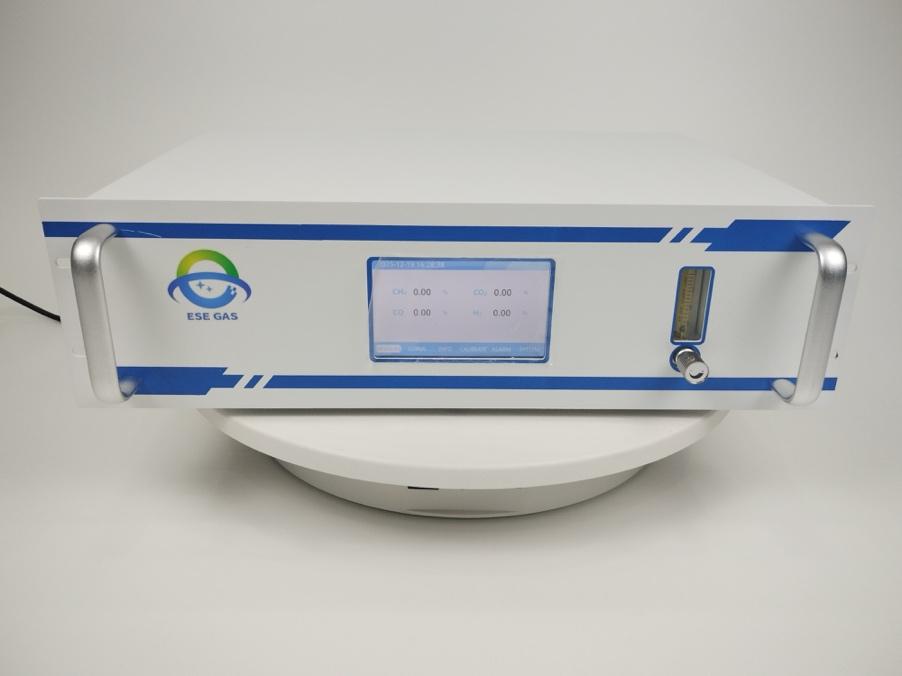
NDIR, or non-dispersive infrared, measures gases by sending infrared radiation through the sample and detecting how much energy is absorbed at characteristic wavelengths. ESEGAS notes that this method is well suited to gases such as CO, CO₂, CH₄, and even C₃H₈, because their molecular structures produce identifiable infrared absorption spectra. On our product pages, we also highlight flexible span configuration from ppm to percentage levels, making NDIR suitable for both lower-range monitoring and broader industrial process applications. For users who need a practical product example, our IR-GAS-600 NDIR Gas Analyzer is designed for stable measurement of CO, CO₂, and CH₄, while the broader Process Gas Analyzer IR-GAS-600 platform can integrate NDIR with other sensing technologies depending on application needs. That makes NDIR a strong ESEGAS recommendation for emissions monitoring, greenhouse projects, process gas analysis, and other applications where reliability and continuous measurement matter. (Gas Analyzer Manufacturers)
Why is paramagnetic analysis often preferred for oxygen measurement?
Oxygen analysis looks simple until the process starts demanding more than a basic reading. In many industrial environments, oxygen data is tied directly to combustion efficiency, product quality, inerting safety, or gas purity control. When that happens, low-cost measurement alone is not enough. A technology that appears acceptable for intermittent checking may not deliver the long-term stability needed for continuous process decisions. Among the main Gas Analyzer Principles, paramagnetic analysis stands out because oxygen itself has a unique magnetic property that can be measured with high selectivity. (Gas Analyzer Manufacturers)
Paramagnetic oxygen analyzers work by using the fact that O₂ is attracted to a magnetic field, unlike most common gases. According to ESEGAS product and technical pages, this physical measurement approach offers high precision, good stability, and minimal sensor wear compared with consumable electrochemical cells. We position paramagnetic oxygen analysis as the better choice when users need higher accuracy and stable readings across varying temperature and pressure conditions. On the ESEGAS side, our Oxygen (O₂) Gas Analyzer IR-GAS-600 can be supplied in paramagnetic configurations for higher-accuracy applications, and our oxygen-analysis guidance also explains why paramagnetic technology is often favored in combustion, gas purification, and safety systems. For customers in metallurgy, air separation, semiconductor processing, and other oxygen-critical operations, paramagnetic analysis is often the most dependable route when precision matters more than minimum upfront cost. (Gas Analyzer Manufacturers)
When is electrochemical technology the better option?
Not every project needs a premium high-stability analyzer cabinet. In many toxic-gas monitoring tasks, the real challenge is to get sensitive, responsive detection in a practical package and within a realistic budget. That is especially true when the measurement objective is personnel safety, area monitoring, or targeted toxic-gas detection rather than high-end process optimization. In those cases, one of the more cost-effective Gas Analyzer Principles is electrochemical sensing, provided the user clearly understands sensor life, replacement planning, and possible cross-sensitivity. The source material you shared also points out that electrochemical sensors are commonly used for toxic gases and may require scheduled replacement over time. (Gas Analyzer Manufacturers)
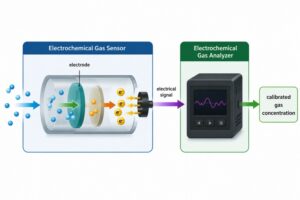
Electrochemical analyzers detect gas through reactions at the sensor electrode, generating an electrical signal proportional to concentration. ESEGAS explains on its oxygen analyzer page that electrochemical-based analyzers can offer high accuracy, fast response, low power consumption, and long life span for suitable applications, especially where intermittent or continuous monitoring is needed without the higher cost of a paramagnetic system. In practical terms, electrochemical technology is often the better choice for toxic and safety-related monitoring where compactness, responsiveness, and affordability all matter. Within the ESEGAS portfolio, electrochemical configurations are available through our Oxygen Gas Analyzer IR-GAS-600 offering, while the Process Gas Analyzer IR-GAS-600 platform also incorporates electrochemical sensing as part of mixed-technology solutions. For buyers comparing Gas Analyzer Principles from an application-first perspective, electrochemical technology is usually strongest when the gas target is specific, the budget is controlled, and maintenance intervals are already part of the operating plan. (Gas Analyzer Manufacturers)
Why does TDLAS stand out in harsh industrial environments?
Some gas measurements fail not because the target gas is unusual, but because the site is unforgiving. High dust loading, elevated temperature, process fluctuations, long sampling paths, and strong cross-interference can quickly expose the limits of conventional methods. When response must be fast and selectivity must remain high under difficult operating conditions, the wrong analyzer principle can turn into a maintenance burden instead of a control tool. That is why, among advanced Gas Analyzer Principles, TDLAS receives so much attention in demanding industrial environments. (Gas Analyzer Manufacturers)
TDLAS, or Tunable Diode Laser Absorption Spectroscopy, uses a laser tuned to a specific absorption line of the target gas and measures attenuation with high selectivity. ESEGAS describes this technology as suitable for rapid, non-contact, continuous online measurement and lists gases such as NH₃, HCl, HF, CH₄, CO, CO₂, and O₂ among supported applications. Because the laser targets a narrow spectral feature, TDLAS is especially useful where cross-interference must be minimized and response time is critical. In our portfolio, the TDL Laser Gas Analyzer category and the TDL Gas Analysis System ESE-LASER-200WMare natural solutions for these scenarios, while our technical content also references the ESE-LASER-U50design for stable, reliable TDLAS measurement. For applications such as ammonia slip monitoring, acid-gas measurement, pipeline leak detection, and other harsh industrial processes, TDLAS is often the most strategic choice when process visibility cannot be compromised. (Gas Analyzer Manufacturers)
How can you quickly choose the right gas analyzer principle for your application?
Many selection mistakes happen because teams ask which technology is “best” before they define what the measurement must survive, prove, and deliver. A faster and more reliable method is to screen the application through a few decision points first, then match the technology accordingly. At ESEGAS, we recommend evaluating Gas Analyzer Principles through the actual task: target gas, range and accuracy, environmental conditions, and whether the analyzer is intended for safety alarming or process control. Your source document reaches the same conclusion and summarizes four key questions before final selection. (Gas Analyzer Manufacturers)
A practical selection guide looks like this:
| Application need | Recommended principle | Typical ESEGAS direction |
| CO, CO₂, CH₄, and other infrared-active gases | NDIR | IR-GAS-600 NDIR Gas Analyzer |
| High-accuracy oxygen measurement with strong long-term stability | Paramagnetic | O₂ Gas Analyzer IR-GAS-600 |
| Cost-sensitive toxic-gas or targeted safety monitoring | Electrochemical | Electrochemical configurations in IR-GAS-600 / process analyzer solutions |
| Fast, selective measurement in harsh or interference-prone environments | TDLAS | TDL Laser Gas Analyzer / ESE-LASER-200WM |
Before making a final decision, we suggest confirming four points clearly: what gas you need to measure, what range and precision are truly required, what the site environment looks like, and whether the measurement serves safety response or process optimization. Once those answers are clear, the “best” technology usually becomes much easier to identify.
Conclusion

The four main gas analyzer principles are not competing in a simple ranking—they solve different measurement problems. NDIR is highly practical for many infrared-active gases, paramagnetic analysis remains a leading option for precise oxygen monitoring, electrochemical sensing is valuable when sensitivity and cost must be balanced, and TDLAS excels when industrial conditions become severe and selectivity matters most. From the ESEGAS perspective, good analyzer selection is never just about choosing an instrument; it is about matching the right principle, the right structure, and the right product platform to the real process. That is how gas analysis becomes more than a specification sheet—it becomes a dependable part of safe, efficient industrial operation. (Gas Analyzer Manufacturers)