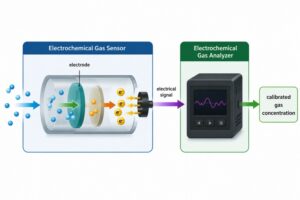




The IR-GAS-600 NDIR gas analyzer measures CO, CO₂, CH₄, CnHm, H₂, and O₂ in a single integrated unit. Its CO and CO₂ channels use Non-Dispersive Infrared (NDIR) technology. This approach ensures high measurement accuracy, long-term stability, automatic temperature compensation, and reliable performance in demanding industrial environments.
NDIR gas analyzer works by detecting infrared absorption at specific wavelengths. Each gas molecule absorbs infrared light based on its unique vibrational and rotational frequencies. The gas analyzer calculates gas concentration by measuring changes in infrared intensity after absorption. This method provides high precision and long-term stability in process gas monitoring.
Why Does Cross-Interference Occur in CO and CO₂ Measurement?
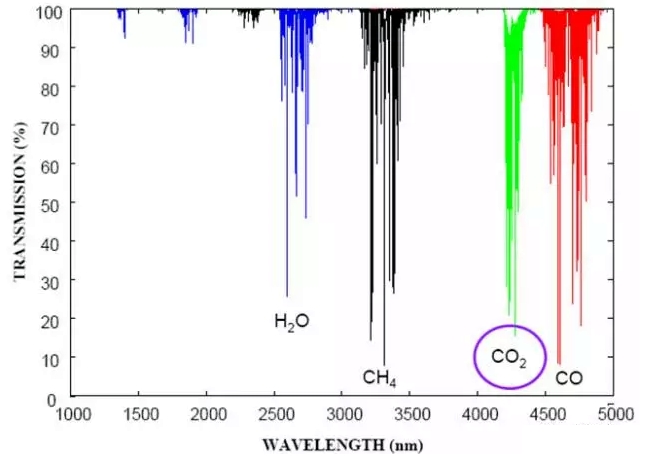
Different gas molecules often have multiple infrared absorption peaks. These peaks may overlap with those of other gases. When overlap occurs, the sensor responds not only to the target gas but also to interfering gases. This effect is known as cross-interference.
CO and CO₂ have absorption bands that lie very close to each other. As a result, their signals can overlap under certain conditions. In NDIR gas analyzer, background gases such as CO₂ can produce a response similar to CO, which leads to measurement errors.
The degree of interference depends on gas concentration, optical filter design, and sensor configuration. Engineers often describe this effect using a cross-interference coefficient, which defines how much one gas affects another’s reading.
Why Does Cross-Interference Become Severe in Mixed Gas (CO and CO₂) Conditions?
Let’s check some real test results first.
Single-gas CO Measurement
| Concentration of CO Calibration Gas (%vol) | Measuring CO Concentration (%vol) | Measuring CO₂ Concentration (%vol) |
| 0 | 0 | 0 |
| 9.9 | 9.75 | 0.03 |
| 29.7 | 29.59 | 0.07 |
| 39.6 | 39.64 | 0.1 |
Single-gas CO₂ Measurement
| Concentration of CO₂ Calibration Gas (%vol) | Measuring CO Concentration (%vol) | Measuring CO₂ Concentration (%vol) |
| 0 | 0 | 0 |
| 8.85 | 0 | 8.77 |
| 18.18 | 0 | 18.21 |
| 28.04 | 0 | 28.26 |
Measurement of CO and CO₂ Mixture (Uncorrected Data)
| Concentration of CO Calibration Gas (%vol) | Concentration of CO₂ Calibration Gas (%vol) | Measuring CO Concentration (%vol) | Measuring CO₂ Concentration (%vol) |
| 0 | 0 | 0 | 0 |
| 10.71 | 7.26 | 12.75 | 7.78 |
| 21.22 | 14.39 | 26.89 | 16.25 |
| 36.72 | 26.9 | 50.38 | 29.73 |
Test results show that CO and CO₂ do not interfere with each other during single-gas measurement. When only CO is present, the analyzer reports accurate CO values with negligible CO₂ response. The same applies when measuring pure CO₂. This happens because the analyzer isolates the dominant absorption signal when no competing gas exists. The optical filter and signal processing algorithm can clearly distinguish the target gas under these conditions.
The situation changes when CO and CO₂ coexist. Test data shows that both measured CO and CO₂ values become higher than their actual concentrations. This error becomes significant in multi-component gas environments such as blast furnace gas or syngas.
This phenomenon differs from typical cross-sensitivity. When CO and CO₂ absorb infrared radiation simultaneously, molecular interactions can slightly alter energy states. In rare cases, atomic-level interactions during molecular collisions may affect absorption behavior.
In practical terms, overlapping absorption bands combined with high gas concentrations amplify the interference effect. As a result, both channels produce positively biased readings, which reduces measurement reliability.
How Can Software Algorithms Eliminate CO and CO₂ Cross-Interference in NDIR Gas Analyzer?
To solve this issue, ESEGAS engineers simulate real process gas compositions and conduct extensive testing. They analyze large datasets to quantify interference patterns between CO and CO₂.
Based on this analysis, advanced compensation algorithms are developed. These algorithms apply correction factors in real time, adjusting measured values according to known interference behavior. The NDIR gas analyzer continuously calculates compensated concentrations using multi-variable models. This approach removes the influence of overlapping absorption and restores measurement accuracy.
After applying the correction algorithm, measurement accuracy improves significantly. The corrected real-time measurement data is shown in the table below:
| Component | Calibration gas concentration | Measuring concentration |
| CO | 35 | 34.95 |
| CO₂ | 25 | 24.88 |
CO/CO₂ mixture measurement (corrected data)
| Concentration of CO Calibration Gas (%vol) | Concentration of CO₂ Calibration Gas (%vol) | Measuring CO Concentration (%vol) | Measuring CO₂ Concentration (%vol) |
| 0 | 0 | 0 | 0 |
| 10.71 | 7.26 | 10.65 | 7.22 |
| 21.22 | 14.39 | 21.16 | 14.28 |
| 35 | 25 | 34.95 | 24.88 |
Test results show that both CO and CO₂ values closely match standard gas concentrations.
For example, when the standard gas contains 35% CO and 25% CO₂, the corrected readings align almost exactly with these values. Similar accuracy appears across different concentration ranges.
This confirms that algorithm-based compensation effectively eliminates cross-interference in mixed gas conditions. The analyzer maintains reliable performance even in complex industrial environments.
Why Is Cross-Interference Compensation Critical for Modern Gas Analysis?
In real industrial processes, gas mixtures rarely contain a single component. Multi-component gases are common in steel plants, chemical production, and energy systems. Without correction, CO and CO₂ readings can deviate significantly from true values.
Such errors affect combustion control, safety monitoring, and emission reporting. For example, inaccurate CO readings may lead to improper combustion tuning, while CO₂ errors may distort efficiency calculations.
Modern industrial processes demand precise gas monitoring under dynamic and multi-component conditions. Simple calibration cannot solve interference caused by overlapping infrared absorption.
Only a combination of advanced sensor design and intelligent algorithms can ensure accurate results. By eliminating CO and CO₂ cross-interference, NDIR intergrated gas analyzers become more reliable for process control, safety assurance, and environmental compliance.
FAQs:
Question: What causes CO and CO2 cross-interference in NDIR gas analyzers?
Answer: CO and CO2 cross-interference occurs because their infrared absorption bands are close or partially overlapping. When both gases are present, the sensor may respond to both signals, leading to measurement errors.
Question: Why is cross-interference not observed in single-gas measurement?
Answer: In single-gas measurement, only one dominant absorption signal exists. The NDIR analyzer can isolate this signal accurately without interference from other gases.
Question: How does cross-interference affect industrial gas analysis?
Answer: Cross-interference can cause both CO and CO2 readings to be higher than actual values in mixed gas environments. This leads to inaccurate process control, safety risks, and incorrect emission reporting.
Question: How can CO and CO2 cross-interference be eliminated?
Answer: Cross-interference can be eliminated using advanced compensation algorithms, optimized optical filters, and calibration based on real gas mixtures. These methods correct overlapping signals and improve measurement accuracy.
Question: Why is NDIR still widely used despite cross-interference?
Answer: NDIR technology offers high accuracy, stability, and fast response. With proper compensation and design, it remains one of the most reliable methods for multi-component gas analysis in industrial applications.