



In industrial combustion, a small error in oxygen measurement can quietly become a costly problem. Too much excess air wastes fuel and carries valuable heat out through the flue gas; too little oxygen may cause incomplete combustion, unstable flame conditions, higher CO risk, and potential safety concerns. For operators managing boilers, furnaces, kilns, incinerators, or process heaters, guessing the air-to-fuel ratio is no longer enough. At ESEGAS, we believe reliable oxygen data is the starting point for safer, cleaner, and more efficient combustion control.
A zirconia gas analyzer improves industrial combustion by providing fast, stable, and accurate oxygen measurement in flue gas or process gas. It uses a zirconium dioxide sensing cell to detect oxygen concentration, helping operators optimize the air-to-fuel ratio, reduce fuel waste, control emissions, and improve process safety in continuous industrial operation.
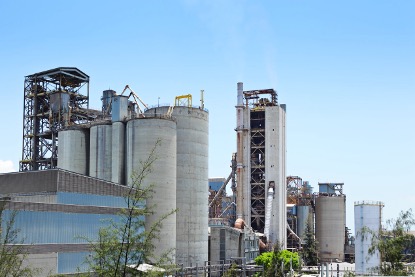
However, oxygen measurement is not only about receiving a number on a display. The real value comes from understanding how the measurement is generated, where the analyzer should be installed, what kind of industrial environment it can handle, and how the data can support better process decisions. That is why ESEGAS focuses not only on supplying gas analyzers, but also on helping industrial users choose oxygen analysis solutions that match their real operating conditions.
What Is a Zirconia Gas Analyzer?
Many industrial sites know they need to measure oxygen, but they may not always know which oxygen analysis technology fits their process. Choosing the wrong analyzer can lead to slow response, unstable readings, frequent maintenance, or poor performance in high-temperature combustion environments. A zirconia gas analyzer solves this problem by offering a proven oxygen measurement method designed for demanding industrial combustion and flue gas applications.
A zirconia gas analyzer is an industrial gas analysis instrument used mainly for measuring oxygen concentration in combustion gas, flue gas, or process gas. Its core sensing element is typically made from zirconium dioxide, a ceramic material that conducts oxygen ions at high temperature.
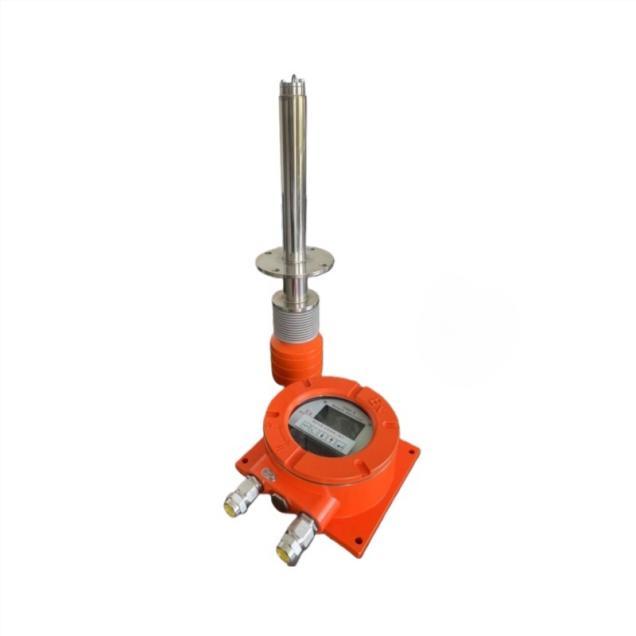
In practical industrial use, this analyzer is commonly applied in:
| Application Area | Why Oxygen Measurement Matters |
| Industrial boilers | Helps optimize combustion efficiency and reduce fuel waste |
| Furnaces and kilns | Supports stable heating conditions and product quality |
| Waste incineration | Helps maintain combustion stability and emission control |
| Power generation | Provides continuous flue gas oxygen data |
| Metallurgy and heat treatment | Supports controlled combustion atmosphere management |
| Petrochemical heating processes | Helps improve process safety and energy performance |
At ESEGAS, we position zirconia oxygen analysis as a practical solution for industries that need continuous, real-time oxygen monitoring in harsh combustion environments. For users who need dependable O₂ data directly from high-temperature flue gas or combustion systems, a zirconia gas analyzer can provide a strong balance of response speed, stability, and industrial durability.
How Does a Zirconia Gas Analyzer Work?
When oxygen readings are delayed or unstable, combustion control becomes reactive instead of proactive. Operators may adjust air dampers, fuel flow, or burner settings based on incomplete data, which can cause efficiency losses and process fluctuations. A zirconia gas analyzer helps solve this by using a high-temperature electrochemical measurement principle that responds quickly to oxygen changes in the gas stream.
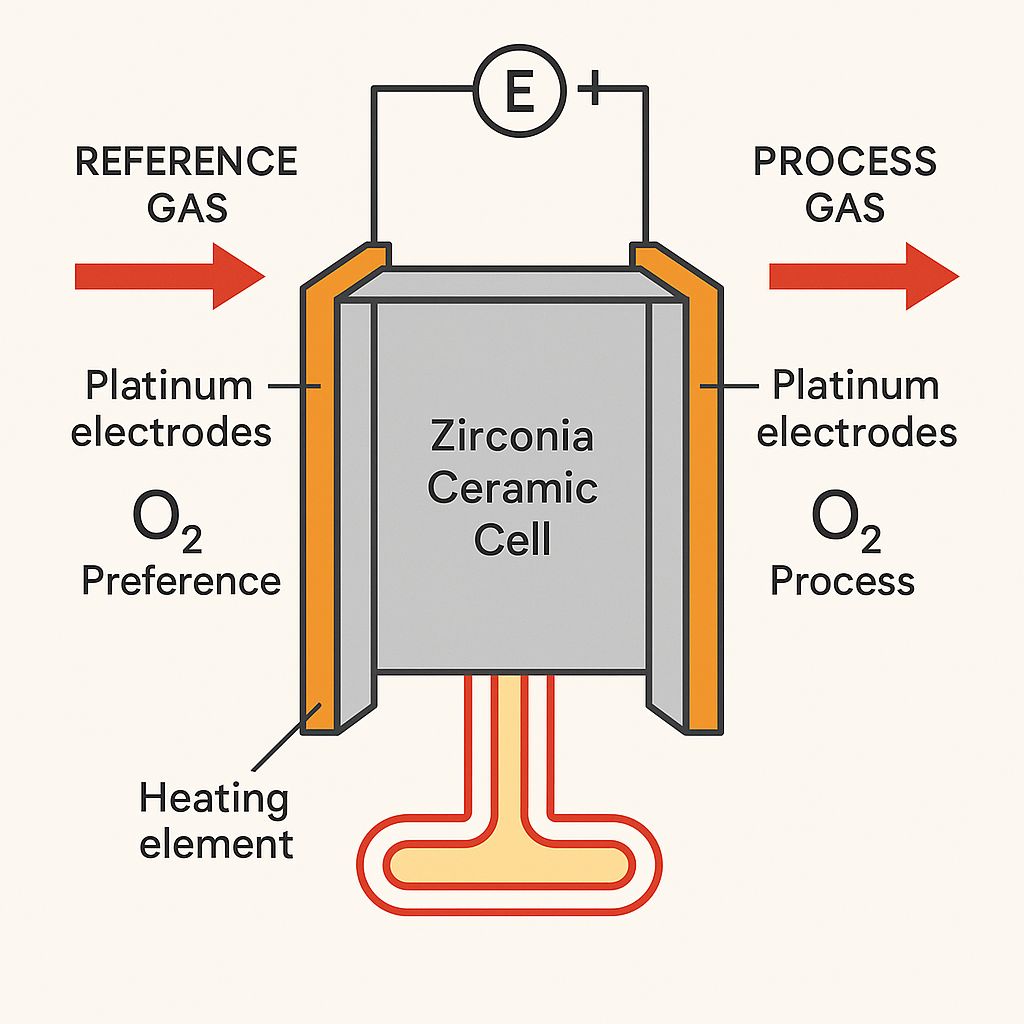
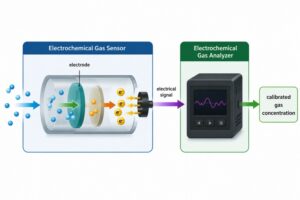
The working principle is based on the oxygen concentration difference between two sides of a zirconia sensing cell. One side is exposed to the sample gas, while the other side is usually exposed to a reference gas, often ambient air. When the zirconia cell is heated to its required operating temperature, oxygen ions can move through the ceramic material. This movement creates an electrical signal related to the oxygen concentration difference.
In simple terms, the analyzer converts oxygen activity into a measurable voltage signal. The instrument then processes this signal and displays the oxygen concentration value.
A typical zirconia oxygen measurement process includes:
- Sample gas contact
The gas from the combustion process reaches the zirconia sensing cell. - Reference oxygen comparison
The sensor compares oxygen levels between the sample gas side and the reference side. - Signal generation
The oxygen difference produces an electrical signal. - Data conversion
The analyzer converts the signal into an oxygen concentration value. - Output for control systems
The result can be displayed locally or transmitted to a control system for combustion optimization.
This measurement method is especially valuable in combustion control because oxygen levels can change quickly when fuel quality, air supply, load demand, or burner conditions change. With a properly selected zirconia gas analyzer, operators can see these changes in real time and respond with greater confidence.
Why Is Zirconia Technology Suitable for Combustion Control?
Combustion is a balance. If too much air enters the system, heat is lost through unnecessary excess oxygen. If too little air is supplied, combustion may become incomplete and unsafe. Without reliable oxygen data, operators may run the system conservatively, often using more excess air than necessary. A zirconia gas analyzer helps bring this balance under control by giving operators a clearer view of what is happening inside the flue gas.
Zirconia technology is suitable for combustion control because it provides fast oxygen response in high-temperature industrial environments. This allows operators to monitor whether the combustion process is running with too much, too little, or an appropriate level of oxygen.
The relationship between oxygen and combustion condition can be understood as follows:
| Oxygen Condition | Possible Result | Operational Impact |
| Too much oxygen | Excess air and heat loss | Higher fuel consumption, lower efficiency |
| Too little oxygen | Incomplete combustion | CO risk, unstable flame, safety concerns |
| Stable oxygen range | Balanced combustion | Better efficiency, safer operation, more stable emissions |
For many ESEGAS customers, the goal is not simply to measure O₂. The real goal is to use O₂ data to improve daily operation. A zirconia gas analyzer supports this by helping operators:
- Optimize the air-to-fuel ratio
- Reduce unnecessary excess air
- Improve thermal efficiency
- Support emission control
- Detect abnormal combustion conditions earlier
- Improve process stability in boilers, furnaces, and kilns
At ESEGAS, we often see oxygen measurement as a direct connection between instrumentation and plant performance. When the oxygen signal is accurate and stable, combustion decisions become more reliable.
Where Can a Zirconia Gas Analyzer Be Used?
Not every gas analyzer is suitable for hot, dusty, corrosive, or continuously operating industrial processes. If an analyzer is not matched to the site environment, the result may be frequent maintenance, unstable readings, or poor data quality. A zirconia gas analyzer is widely used because it is well suited for oxygen monitoring in many combustion-related applications.
Common application areas include:
Industrial Boilers
Boilers require stable combustion to produce steam efficiently. Oxygen monitoring helps operators reduce excess air while avoiding incomplete combustion. In boiler systems, zirconia oxygen analysis can help improve fuel use and support safer operation.
Industrial Furnaces
Furnaces used in steel, metallurgy, glass, ceramics, and heat treatment often require stable thermal conditions. A zirconia gas analyzer helps monitor oxygen levels in combustion gas, supporting consistent heating performance and better process control.
Cement and Ceramic Kilns
Kilns operate under demanding high-temperature conditions. Oxygen measurement helps maintain stable combustion and can support product quality, energy efficiency, and emission management.
Waste Incineration
Incineration processes require controlled oxygen levels to support complete combustion and reduce harmful byproducts. Continuous oxygen measurement helps operators maintain stable burning conditions.
Power Plants
In power generation, flue gas oxygen monitoring is important for boiler efficiency and emission control. Zirconia oxygen analyzers are commonly used to support combustion tuning and operational monitoring.
Chemical and Petrochemical Heating Systems
Process heaters and thermal systems in chemical plants require reliable combustion control. Oxygen data helps improve safety, energy performance, and process consistency.
For these applications, ESEGAS provides oxygen analysis solutions designed around real industrial needs, including installation conditions, gas characteristics, maintenance access, and signal integration with plant control systems.
What Are the Main Advantages of a Zirconia Gas Analyzer?
Industrial users do not choose an oxygen analyzer only because it can measure O₂. They need an instrument that can respond quickly, operate reliably, withstand demanding conditions, and provide useful data for process control. A zirconia gas analyzer offers several advantages that make it especially valuable in combustion monitoring.
Fast Response to Oxygen Changes
Combustion conditions can change rapidly when load, fuel composition, burner performance, or air supply changes. Zirconia sensing technology provides fast oxygen response, allowing operators to detect process changes sooner.
Suitable for High-Temperature Combustion Environments
Many oxygen measurement points are located near hot flue gas ducts, furnaces, or combustion chambers. Zirconia oxygen analyzers are widely used in these conditions because their sensing principle is suitable for high-temperature oxygen measurement.
Continuous Monitoring Capability
Industrial combustion systems often operate continuously. A zirconia gas analyzer can provide ongoing oxygen data, helping operators monitor process performance over time instead of relying only on occasional manual checks.
Support for Energy Efficiency
Excess oxygen usually means excess air. Excess air carries heat away from the process and reduces efficiency. By using accurate oxygen measurement, operators can reduce unnecessary air supply and improve fuel utilization.
Better Combustion Safety
Low oxygen levels may indicate incomplete combustion or unsafe operating conditions. Reliable oxygen monitoring helps operators identify risks earlier and take corrective action.
Useful for Emission Control
Stable combustion supports more predictable emissions. While oxygen measurement is only one part of emission control, it is an important foundation for managing combustion quality and reducing operating fluctuations.
At ESEGAS, we design our zirconia oxygen analysis solutions for industrial users who need practical, stable, and continuous oxygen data—not just laboratory-style measurement under ideal conditions.
How Should You Choose the Right Zirconia Gas Analyzer?
A poor analyzer selection can reduce the value of the entire measurement system. Even a high-quality instrument may perform badly if the measuring range, installation method, gas condition, or output signal does not match the application. Choosing the right zirconia gas analyzer requires looking at both the instrument and the process environment.
Before selecting an analyzer, industrial users should consider the following factors:
| Selection Factor | What to Check |
| Measurement range | Confirm the expected oxygen concentration range |
| Gas temperature | Check whether the installation point is suitable |
| Dust level | Consider filtration, probe design, and maintenance needs |
| Moisture condition | Understand whether the gas contains high humidity or condensation risk |
| Installation location | Choose a point with representative and stable gas flow |
| Response time | Match response speed with control requirements |
| Calibration needs | Confirm calibration method and maintenance frequency |
| Output signal | Ensure compatibility with PLC, DCS, or monitoring systems |
| Application type | Boiler, furnace, kiln, incinerator, or process heater |
A suitable analyzer should not only match the gas measurement requirement but also fit the site’s mechanical, electrical, and maintenance conditions. For example, a boiler flue gas application may require different installation considerations than a high-temperature furnace or a cement kiln.
ESEGAS supports customers by looking at the whole measurement challenge, including gas composition, temperature, dust, pressure, installation structure, and control system requirements. This helps ensure that the zirconia gas analyzer is not only technically correct, but also practical for long-term operation.
How Does ESEGAS Support Reliable Oxygen Measurement?
Many customers come to us because they need more than a single instrument. They need a reliable oxygen monitoring solution that can work under real plant conditions. If the analyzer is difficult to install, hard to maintain, or unstable in the actual gas environment, the measurement result will not support better control. At ESEGAS, we focus on building gas analysis solutions that serve real industrial operation.
Our approach to zirconia oxygen measurement is based on several priorities:
- Application matching
We help users select oxygen analysis solutions based on the actual process, not only the measurement range. - Stable industrial performance
We focus on reliable operation in combustion gas, flue gas, and process gas environments. - Practical installation support
We consider probe location, gas temperature, dust level, access for maintenance, and integration with existing systems. - Combustion optimization value
We aim to help users turn oxygen data into better combustion decisions. - Long-term usability
We understand that industrial instruments must be maintainable, stable, and suitable for continuous operation.
For applications such as boilers, industrial furnaces, kilns, and incineration systems, ESEGAS zirconia oxygen analysis solutions help operators monitor O₂ concentration with greater confidence. By delivering dependable oxygen data, we support better fuel efficiency, safer combustion, and more stable process control.
Why Does Oxygen Measurement Matter for Long-Term Industrial Performance?
Some plants treat oxygen measurement as a basic monitoring point, but in reality, it can strongly influence long-term operating costs and process reliability. When oxygen data is inaccurate or ignored, combustion systems may run with hidden inefficiencies for months or years. A zirconia gas analyzer helps make these hidden conditions visible.
Reliable oxygen measurement can support long-term performance in several ways:
- Lower fuel consumption
Better control of excess air can reduce wasted heat and improve energy use. - More stable production
Stable combustion supports more consistent temperature control in furnaces, kilns, and heaters. - Reduced operational risk
Oxygen trends can help identify abnormal combustion conditions before they become serious problems. - Improved maintenance planning
Changes in oxygen readings may reveal burner problems, air leakage, damper issues, or process instability. - Better environmental management
Combustion stability can help reduce emission fluctuations and support compliance strategies.
At ESEGAS, we see oxygen measurement as part of a broader industrial improvement strategy. A zirconia gas analyzer is not just a sensor; it is a tool that helps operators make informed decisions every day.
Conclusion
A zirconia gas analyzer plays an important role in industrial combustion by providing fast, stable, and accurate oxygen measurement in flue gas and process gas. With reliable O₂ data, operators can optimize the air-to-fuel ratio, reduce excess air, improve fuel efficiency, support emission control, and strengthen combustion safety.
At ESEGAS, we provide zirconia oxygen analysis solutions for demanding industrial environments where measurement stability and practical performance matter. Whether the application is a boiler, furnace, kiln, incinerator, or process heater, our goal is to help customers turn oxygen measurement into better process control, safer operation, and long-term energy savings.