




As greenhouse gas monitoring moves from research labs into industrial sites, carbon accounting projects, and environmental compliance systems, accuracy matters more than ever. A greenhouse gas analyzer must not only detect gases quickly, but also maintain stable and repeatable readings over long operating cycles.
To evaluate real measurement performance, ESEGAS conducted a full indication error and repeatability test on the tailored ESE-GH-2080 Greenhouse Gas Analyzer. The test focused on three critical greenhouse gases:
- CH₄ (Methane)
- CO₂ (Carbon Dioxide)
- CO (Carbon Monoxide)
The analyzer uses advanced NDIR (Non-Dispersive Infrared) technology and supports expansion with additional sensing technologies for more complex gas monitoring requirements.
What Does the Performance Testing of a Greenhouse Gas Analyzer Evaluate?
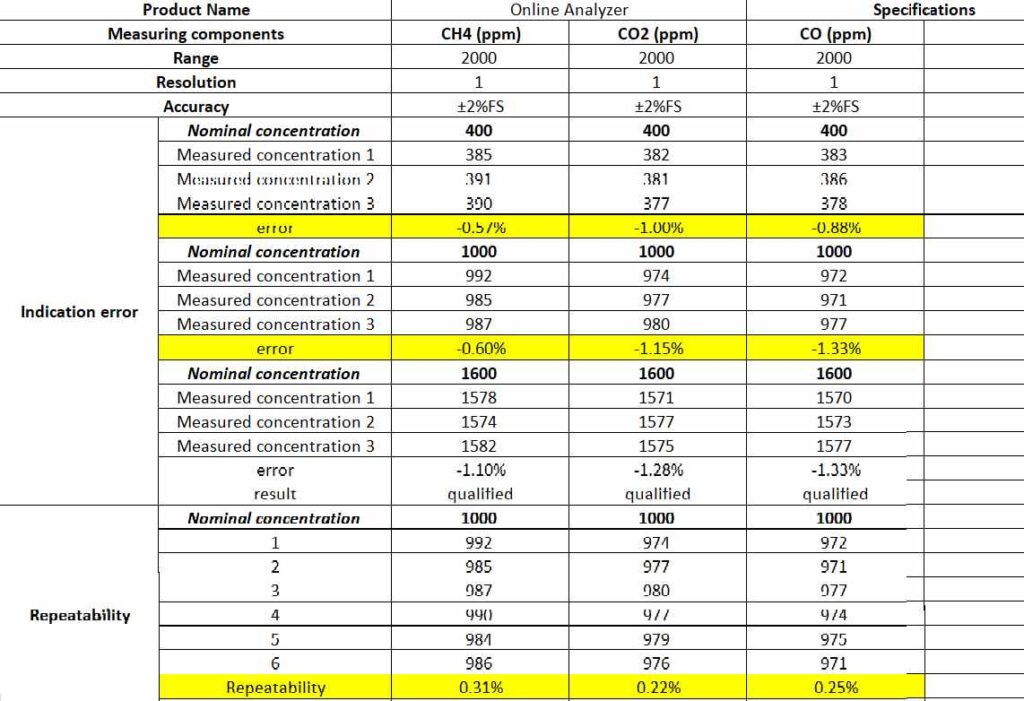
The laboratory’s testing focuses on two key performance indicators for greenhouse gas analyzers:
1. Indication Error
This test compares the measured value against the certified nominal gas concentration. It reflects the analyzer’s measurement accuracy.
2. Repeatability
This evaluates how stable the analyzer remains when measuring the same gas concentration multiple times under identical conditions.
For industrial greenhouse gas monitoring, both parameters are critical. A system may show correct readings once, but poor repeatability can still create unreliable long-term trend data.
Test Conditions and Configuration
The analyzer was configured with:
| Parameter | Value |
| Measurement Principle | NDIR |
| Target Gases | CH₄ / CO₂ / CO |
| Range | 0–2000 ppm |
| Resolution | 1 ppm |
| Specified Accuracy | ±2% FS |
The testing covered three concentration points:
- 400 ppm
- 1000 ppm
- 1600 ppm
These concentration levels simulate common greenhouse gas monitoring scenarios in industrial and environmental applications.
CH₄ Measurement
Methane (CH₄) Indication Error Results
| Nominal Value | Measured Values | Average Error |
| 400 ppm | 385 / 391 / 390 | -0.57% |
| 1000 ppm | 992 / 985 / 987 | -0.60% |
| 1600 ppm | 1578 / 1574 / 1582 | -1.10% |
Analysis
The methane channel showed very stable behavior across the entire measurement range.
Even at the higher concentration point of 1600 ppm, the indication error remained only -1.10%, well within the specified ±2% FS requirement.
The measurement trend also remained linear, which is important for greenhouse gas inventory calculations and long-term emissions analysis.
CO₂ Measurement
Carbon Dioxide (CO₂) Indication Error Results
| Nominal Value | Measured Values | Average Error |
| 400 ppm | 382 / 381 / 377 | -1.00% |
| 1000 ppm | 974 / 977 / 980 | -1.15% |
| 1600 ppm | 1571 / 1577 / 1575 | -1.28% |
Analysis
The CO₂ channel maintained excellent consistency throughout the test.
The maximum error remained below -1.3%, showing strong infrared signal stability and effective optical compensation performance.
For greenhouse gas monitoring systems, CO₂ is often the primary regulatory parameter. Stable CO₂ measurement directly improves:
- Carbon accounting reliability
- Emission reporting accuracy
- Long-term climate data consistency
CO Measurement
Carbon Monoxide (CO) Indication Error Results
| Nominal Value | Measured Values | Average Error |
| 400 ppm | 383 / 386 / 378 | -0.88% |
| 1000 ppm | 972 / 971 / 977 | -1.33% |
| 1600 ppm | 1570 / 1573 / 1577 | -1.33% |
Analysis
The CO channel also demonstrated strong analytical performance.
The error remained highly controlled across all concentration points, with the largest deviation measured at -1.33%.
This result confirms that the analyzer’s optical filtering and infrared wavelength selection effectively reduce cross-interference between multiple gases.
Repeatability Test
Repeatability Results at 1000 ppm
| Gas | Repeatability |
| CH₄ | 0.31% |
| CO₂ | 0.22% |
| CO | 0.25% |
Analysis
The repeatability performance was particularly impressive.
All three gases achieved repeatability values below 0.35%, indicating:
- Excellent optical stability
- Consistent gas cell performance
- Reliable signal processing
- Strong long-term monitoring capability
In practical operation, low repeatability error means operators can trust trend changes as real process variations rather than analyzer drift.
Test Results
The test results highlight several key advantages of the greenhouse gas analyzer. In the test report, all indicated errors remained consistently within the specified range of ±2% FS. This demonstrates high measurement accuracy.
The analyzer maintained stable performance across the CH₄, CO₂, and CO channels simultaneously. This demonstrates robust multi-gas detection capabilities.
The low repeatability values indicate reliable continuous monitoring performance. This demonstrates excellent long-term stability.
This becomes especially important in carbon emission verification, continuous emission monitoring, climate research projects, methane leak detection, biogas project, research laboratories, and industrial process optimization.
Conclusion
Is the greenhouse gas analyzer suitable for modern greenhouse gas monitoring? Based on the laboratory testing data, the answer is yes.
For organizations looking to improve greenhouse gas measurement accuracy while maintaining reliable continuous operation, the ESE-GH-2080 provides a practical and scalable monitoring solution
FAQs:
How accurate is the greenhouse gas analyzer?
According to the laboratory testing data, the indication error for CH₄, CO₂, and CO remained within ±1.33%, which is well below the specified ±2% FS accuracy limit. This demonstrates strong measurement reliability for industrial and environmental applications.
What was the repeatability performance during testing?
The repeatability test at 1000 ppm showed:
- CH₄: 0.31%
- CO₂: 0.22%
- CO: 0.25%
These results indicate excellent long-term stability and highly consistent measurement performance.
Why is low repeatability important in greenhouse gas monitoring?
Low repeatability error means the analyzer can produce nearly identical results during repeated measurements under the same conditions. This is critical for:
- Carbon accounting
- Climate research
- Continuous emission monitoring
- Methane leakage analysis
- Industrial process optimization
Stable repeatability improves confidence in long-term trend data.
Can the greenhouse gas analyzer be used for continuous online monitoring?
Yes. The greenhouse gas analyzer is designed for continuous online gas monitoring in industrial and environmental applications. It supports long-term operation with stable infrared sensing and multiple output interfaces including RS-232, RS-485, and 4–20 mA.
Does the greenhouse gas analyzer support multi-gas simultaneous measurement?
Yes. The greenhouse gas analyzer can simultaneously measure multiple greenhouse gases using infrared spectroscopy and multi-channel optical detection technology. This improves efficiency and reduces the need for multiple standalone analyzers.
Can the greenhouse gas analyzer integrate with industrial control systems?
Yes. The greenhouse gas analyzer supports standard industrial communication interfaces and can integrate with SCADA, DCS, and environmental monitoring systems for real-time data transmission and process control.