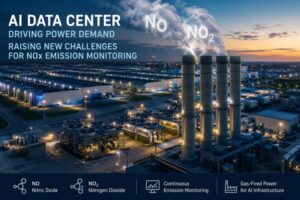




Industrial combustion does not always announce problems with visible smoke or sudden shutdowns. In many plants, the first warning sign is a shift in nitrogen oxide emissions: a boiler load changes, an SCR system becomes less efficient, or a stack measurement begins to drift from the expected value. When NOx data is delayed, incomplete, or inaccurate, operators may face compliance risk, unnecessary fuel loss, unstable denitrification control, and greater pressure from environmental reporting requirements. At ESEGAS, we see a NOx analyzer not only as a measurement instrument, but as a practical tool for helping industrial plants understand combustion behavior, verify emission control performance, and make decisions based on reliable gas data.
A NOx analyzer is an industrial gas analysis instrument used to measure nitrogen oxides, mainly nitric oxide (NO) and nitrogen dioxide (NO₂), in flue gas, process gas, or emission monitoring applications. It helps plants monitor NOx concentration, support continuous emissions monitoring systems, optimize combustion, and verify whether stack emissions remain within required limits. NO₂ and other NOx compounds can react in the atmosphere to form particulate matter and ozone, while CEMS is used to continuously measure actual emissions from stationary sources.
Knowing the definition is only the starting point. The real value of a NOx gas analyzer depends on how it measures NO and NO₂, how it handles complex flue gas, how quickly it responds to process changes, and whether it can be integrated into a complete CEMS or flue gas analyzer system. The following sections explain how we approach NOx emissions monitoring from an industrial application perspective.
How Does a NOx Analyzer Measure NO and NO₂?
A NOx analyzer becomes truly useful when it can separate what is happening in the stack from what is only assumed by the control system. If a plant relies on delayed laboratory testing or indirect calculations, NOx peaks may be missed, SCR performance may be misunderstood, and operators may continue adjusting air, fuel, or ammonia injection without seeing the real effect. For this reason, an industrial NOx gas analyzer should provide direct, stable, and responsive data for both NO and NO₂ whenever the application requires it.
In practical emissions monitoring, NOx usually refers to the combined concentration of NO and NO₂. Different analyzer technologies can be used, including chemiluminescence, UV absorption, and UV-DOAS gas analyzer technology. Some traditional systems measure NO and then use a converter to transform NO₂ into NO before calculating total NOx. This approach can work, but it adds a component that requires maintenance and may introduce additional uncertainty when the converter condition changes.
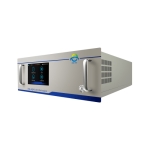
At ESEGAS, our UV-GAS-500 NOx Gas Analyzer uses UV-DOAS and PLS technology to measure gases including NO, NO₂, SO₂, NH₃, Cl₂, O₃, and H₂S. For NOx measurement, it obtains NOx by directly measuring NO and NO₂ without relying on a NO₂-to-NO converter. This design supports faster response, lower maintenance complexity, and more transparent NO/NO₂ analysis in demanding industrial gas analysis applications. (Gas Analyzer Manufacturers)
Where Is a NOx Analyzer Commonly Used?
NOx emissions are not limited to one industry. They are formed in high-temperature combustion processes, which means the measurement conditions can vary widely from one plant to another. A gas turbine exhaust, a cement kiln, a waste incineration line, and a steel reheating furnace may all require NOx monitoring, but their flue gas temperature, dust load, moisture content, acid gas composition, and process fluctuation can be very different. Choosing a generic analyzer without considering these conditions can lead to unstable readings and higher maintenance costs.

A NO NO₂ analyzer is commonly used in:
| Application | Why NOx Monitoring Matters |
| Power plants | Tracks stack NOx emissions and supports combustion optimization |
| Cement kilns | Monitors NOx from high-temperature kiln operation |
| Steel and metallurgy | Supports emission control in furnaces, sintering, and heating processes |
| Waste incineration | Helps verify denitrification performance and emission compliance |
| Industrial boilers | Provides continuous NOx data for fuel and air adjustment |
| Gas turbines | Tracks NOx changes under different load conditions |
| CEMS systems | Supplies continuous NOx concentration data for regulatory reporting |
Our NO/NO₂ Gas Analyzer product category is designed for applications such as power plant stack NOx monitoring, vehicle exhaust analysis, and industrial combustion facilities including cement, steel, and waste incineration. Available ranges from 100 ppm to 10,000 ppm make it adaptable to different monitoring requirements. (Gas Analyzer Manufacturers)
Why Should Industrial Plants Monitor NOx Continuously?
Periodic testing can show what happened during a short inspection window, but it cannot reveal every process fluctuation. A plant may pass a manual test and still experience NOx spikes during load changes, burner adjustment, fuel variation, or unstable SCR/SNCR operation. Without continuous data, operators may only discover the issue after emissions reports, alarms, or process inefficiencies appear.
Continuous NOx emissions monitoring helps plants in several important ways:
- Compliance control
A CEMS continuously measures actual emissions levels from a stationary source, and NOx CEMS can directly monitor NOx concentration in process stack effluent. (US EPA) - Combustion optimization
NOx trends help operators understand whether changes in air-fuel ratio, burner staging, oxygen level, or load are improving or worsening combustion performance. - SCR and SNCR performance verification
Real-time NOx data makes it easier to evaluate whether denitrification systems are reducing emissions effectively. - Lower risk of over-control
Without accurate NOx measurement, ammonia injection may be increased unnecessarily, which can lead to operating cost increases and ammonia slip concerns. - Better environmental reporting
Continuous data gives environmental and operations teams a clearer basis for recordkeeping, reporting, and long-term emission strategy.
What Features Matter Most When Choosing a NOx Analyzer?
Many buyers begin with range and price, but the long-term performance of a NOx analyzer depends on more than the specification sheet. If the analyzer cannot handle real flue gas conditions, if it responds too slowly, or if it requires frequent converter maintenance, the total cost of ownership can become much higher than expected. A reliable industrial gas analysis solution should match both the measurement target and the operating environment.
When selecting a NOx gas analyzer, we recommend evaluating these factors:
| Feature | Why It Matters |
| Direct NO and NO₂ measurement | Helps calculate NOx without depending on a NO₂-to-NO converter |
| Measurement technology | UV-DOAS, chemiluminescence, FTIR, or other technologies should fit the application |
| Response time | Faster response supports real-time combustion and denitrification control |
| Detection limit | Important for low-emission and ultra-low-emission applications |
| Temperature drift | Lower drift improves long-term data stability |
| Cross-interference resistance | Complex flue gas may contain SO₂, NH₃, H₂S, O₃, CO, CO₂, and moisture |
| Sampling and conditioning system | Critical for high-dust, high-moisture, or corrosive gas streams |
| CEMS integration | The analyzer should communicate smoothly with data acquisition and control systems |
| Maintenance requirements | Lower maintenance helps reduce downtime and ownership cost |
Our UV-GAS-500 NOx Analyzer is designed with low detection limit, low temperature drift, high measurement accuracy, fast response, and wide application scope. These features are especially valuable where stable long-term emissions monitoring is required. (Gas Analyzer Manufacturers)
How Does ESEGAS Support Reliable NOx Emissions Monitoring?
A NOx analyzer should not be selected as an isolated instrument. In real industrial projects, the analyzer must work with sampling probes, heated lines, filtration, gas conditioning, calibration systems, data acquisition, and sometimes multi-gas CEMS platforms. If these parts are not matched correctly, even a high-quality analyzer may deliver poor field performance.
At ESEGAS, we support NOx monitoring by combining analyzer technology with application-based system design. Our gas analysis portfolio includes NOx gas analyzers, flue gas analyzers, emissions gas analyzers, CEMS solutions, FTIR gas analyzers, TDL gas analyzers, NDIR gas analyzers, portable gas analyzers, and gas conditioning accessories. This allows us to recommend a configuration based on the actual stack condition, target gases, measurement range, and integration requirements. (Gas Analyzer Manufacturers)
For applications that require NO and NO₂ measurement, our UV-DOAS solution provides direct NO/NO₂ detection. For multi-gas emissions monitoring, our flue gas analyzer systems can measure components such as SO₂, NO, NO₂, CO, CO₂, and O₂, helping operators build a more complete picture of combustion performance and emission status. (Gas Analyzer Manufacturers)
What Is the Difference Between a NOx Analyzer and a General Flue Gas Analyzer?
It is common for plant teams to ask whether they need a dedicated NOx analyzer or a broader flue gas analyzer. The wrong choice can create gaps in measurement: a single-component system may be too limited, while a multi-gas system may be unnecessary if the only target is NOx. The best answer depends on the plant’s regulatory requirements, process control goals, and existing monitoring infrastructure.
A NOx analyzer focuses on nitrogen oxides, mainly NO and NO₂. It is suitable when NOx is the primary compliance or process-control parameter. A flue gas analyzer usually measures multiple gases in the same system, such as SO₂, NO, NO₂, CO, CO₂, and O₂. This broader configuration is useful when operators need to evaluate combustion efficiency, acid gas emissions, oxygen correction, and overall stack performance in one monitoring platform.
At ESEGAS, we often recommend a dedicated NO NO₂ analyzer when the user needs precise NOx tracking, fast response, and direct NO/NO₂ measurement. We recommend an integrated flue gas analyzer or CEMS configuration when the plant needs multi-gas reporting, continuous compliance data, and centralized emission management.
How Can a NOx Analyzer Improve Combustion and Emission Control?
Without real-time NOx data, operators may adjust combustion blindly. Too much excess air can waste energy; too little air can increase CO or unstable combustion; excessive ammonia injection can raise operating cost and increase the risk of ammonia slip. A NOx analyzer gives operators a measurable signal that connects combustion behavior with emission results.
A properly configured NOx gas analyzer can help improve plant operation by:
- Showing how NOx responds to load changes and burner adjustment
- Supporting air-fuel ratio optimization
- Helping operators evaluate low-NOx burner performance
- Improving SCR or SNCR control strategy
- Reducing unnecessary reagent consumption
- Supporting ultra-low emission operation
- Providing continuous data for environmental reporting
- Improving coordination between operations, maintenance, and environmental teams
For many industrial plants, NOx measurement is no longer only a compliance requirement. It has become part of a broader strategy for efficiency, stability, and responsible environmental management.
How Should a NOx Analyzer Be Maintained for Long-Term Accuracy?
Even advanced gas analyzers require proper maintenance. In harsh stack environments, dust, moisture, corrosive gases, temperature changes, and sampling system contamination can affect measurement stability. If maintenance is ignored, the analyzer may drift gradually, and the plant may not notice the issue until data quality becomes difficult to defend.
To keep a NOx analyzer reliable, we recommend paying attention to:
- Sampling system cleanliness
Filters, probes, and lines should be inspected regularly to prevent blockage or adsorption. - Calibration and zero checks
Routine calibration helps verify that the analyzer remains within acceptable accuracy limits. - Optical path condition
For optical analyzers, contamination or stray light interference can affect stability. - Gas conditioning performance
Moisture control, temperature control, and sample transport should match the gas composition. - Data trend review
Slow drift, abnormal response delay, or sudden baseline movement should be investigated early.
Our FAQ guidance also notes that analyzer drift may be related to aging, pollution, or stray light interference, and recommends regular calibration, maintenance, and optical path cleaning to keep the instrument in good working condition. (Gas Analyzer Manufacturers)
Conclusion
A NOx analyzer is more than a device for measuring NO and NO₂. It is a critical part of modern industrial emissions monitoring, combustion optimization, CEMS integration, and environmental compliance strategy. By using direct NO/NO₂ measurement, stable UV-DOAS gas analyzer technology, and application-oriented system design, ESEGAS helps industrial plants obtain reliable NOx data from complex flue gas conditions. Whether the requirement is a dedicated NOx gas analyzer, a multi-gas flue gas analyzer, or a complete CEMS solution, our goal is to provide the measurement confidence needed for cleaner, safer, and more efficient industrial operation.