


Companies today are under growing pressure to prove that their carbon data is not only available, but also trustworthy. Many organizations have already started measuring emissions, preparing carbon reports, and setting reduction targets, yet a major problem often appears at the most critical moment: the data may not stand up to regulatory review, customer audits, ESG disclosure requirements, or third-party scrutiny. When carbon figures cannot be fully trusted, even a well-intended sustainability strategy can lose credibility. At ESEGAS, we see carbon emissions verification as the step that turns raw emissions data into a dependable foundation for compliance, reporting, and long-term carbon management.

Carbon emissions verification is the systematic review of an organization’s greenhouse gas emissions data, boundaries, methodologies, and supporting records to confirm that the reported results are accurate, complete, consistent, traceable, and aligned with applicable standards or regulatory requirements. In practical terms, it helps ensure that carbon reports can be relied on for compliance, ESG disclosure, customer audits, and emissions reduction planning.
That definition gives the basic answer, but for most businesses, the more important question is what carbon emissions verification means in practice. To use carbon data effectively, companies need to understand why verification matters, how it differs from monitoring and accounting, what the process usually involves, and how reliable gas analysis supports stronger results. These are the issues that determine whether a carbon management system is merely documented or genuinely credible.
Why Is Carbon Emissions Verification Important for Businesses?
Many companies invest significant time in emissions data collection, only to find that uncertainty in methods, inconsistent records, or missing evidence weakens the final report. This becomes a serious issue when the data is used for formal disclosure, supply chain review, carbon reduction planning, or regulatory submission. The challenge is not simply having numbers on paper, but proving that those numbers deserve confidence. That is exactly why carbon emissions verification has become so important in modern carbon management.
At ESEGAS, we believe the value of carbon emissions verification goes far beyond a compliance exercise. It helps businesses in several critical ways:
- It improves the credibility of emissions data for internal and external stakeholders.
- It reduces the risk of errors, omissions, double counting, or inconsistent calculation logic.
- It supports compliance with reporting frameworks, industry expectations, and audit requirements.
- It strengthens trust with customers, investors, regulators, and supply chain partners.
- It provides a more reliable basis for emissions reduction decisions and long-term sustainability planning.
In other words, carbon emissions verification helps transform carbon reporting from a simple reporting task into a management tool that businesses can confidently act on.
What Is the Difference Between Carbon Monitoring, Carbon Accounting, and Carbon Emissions Verification?
Many organizations use these terms interchangeably, which can create confusion in both operational planning and sustainability strategy. When teams do not clearly distinguish between monitoring, accounting, and verification, they may invest in the wrong processes or misunderstand the role of data collection equipment. A strong carbon management system depends on understanding how each stage connects to the next. From our perspective at ESEGAS, good verification always starts with good measurement.
Here is a practical way to understand the difference:
| Process | Main Purpose | Focus Area | Typical Output |
| Carbon Monitoring | Collect emissions-related data | Gas concentration, flow, process conditions, operating status | Raw or continuous data |
| Carbon Accounting | Calculate total emissions | Activity data, emission factors, methodologies, boundaries | Emissions inventory or report |
| Carbon Emissions Verification | Confirm the reliability of the report | Data sources, assumptions, calculations, records, traceability | Verification statement or conclusion |
In this chain, carbon emissions verification does not replace monitoring or accounting. Instead, it evaluates whether those earlier steps were done correctly and supported by sufficient evidence. This is why reliable monitoring instruments and disciplined data handling are essential from the beginning.
How Does the Carbon Emissions Verification Process Work?
For many businesses, verification seems straightforward until the actual review begins. Then problems emerge: incomplete records, unclear emissions boundaries, inconsistent data sources, or undocumented calculation changes. These issues can slow the process, create uncertainty, and lead to repeated corrective actions. A better understanding of the workflow helps companies prepare earlier and avoid preventable weaknesses. In our experience, successful carbon emissions verification depends as much on preparation as on the final review itself.
A typical carbon emissions verification process includes the following steps:
- Defining the verification scope
The organization clarifies which facilities, operations, emission sources, and reporting period are included. - Reviewing organizational and operational boundaries
The verifier examines whether the emissions boundary is clearly defined and consistently applied. - Checking activity data and source records
Fuel use, production data, process information, meter readings, and monitoring records are reviewed. - Evaluating calculation methods
Emission factors, formulas, assumptions, and methodologies are assessed for suitability and consistency. - Assessing supporting documentation
The verifier looks for traceability across records, internal procedures, maintenance logs, calibration records, and data management systems. - Conducting site visits or sampling checks
In many cases, on-site review helps confirm whether reported practices align with real operating conditions. - Identifying discrepancies and corrective actions
Any gaps, inconsistencies, or material misstatements are flagged for clarification or correction. - Issuing a verification conclusion
The final result reflects whether the emissions report is sufficiently accurate and compliant for its intended purpose.
At ESEGAS, we often remind customers that smoother carbon emissions verification usually begins much earlier, with more stable measurement, clearer records, and better traceability at the source.
What Standards Are Commonly Used in Carbon Emissions Verification?
Carbon data may appear detailed and well organized, but without recognized rules, it can still fail to meet market or regulatory expectations. Businesses often discover that the real challenge is not producing a report, but producing one that fits the standards required by customers, auditors, or authorities. That is why standards matter so much. Effective carbon emissions verification is only meaningful when it is aligned with the framework relevant to the reporting objective.
Commonly used standards and frameworks include:
- ISO 14064
Widely used for greenhouse gas quantification, reporting, and verification at the organizational or project level. - GHG Protocol
A common framework for corporate greenhouse gas accounting, especially in international business and ESG reporting contexts. - National or regional regulatory requirements
Some markets define their own emissions reporting and verification rules for compliance purposes. - Sector-specific MRV frameworks
Monitoring, Reporting, and Verification systems may apply in industries such as energy, manufacturing, or environmental compliance.
Different goals often require different approaches. For example:
- ESG disclosure may emphasize transparency and consistency.
- Regulatory reporting may focus on strict compliance and approved methodologies.
- Supply chain assessments may prioritize comparability and auditability.
- Carbon market participation may require highly specific evidence and verification procedures.
At ESEGAS, we encourage companies to define the intended use of their report early, because the purpose of the report directly shapes the expectations for carbon emissions verification.
How Do Gas Analyzers Support More Reliable Carbon Emissions Verification?
Verification is often viewed as a document review, but documents are only as strong as the data behind them. If emissions figures come from unstable measurements, poorly maintained instruments, or incomplete operating records, then even a carefully prepared report may rest on weak foundations. That is where equipment quality becomes critical. In our view, better carbon emissions verification starts with better emissions data.
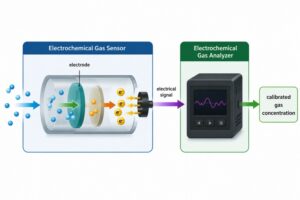
Gas analyzers support carbon emissions verification in several important ways:
- Improving data accuracy
High-performance analyzers help measure gases such as CO₂, CH₄, and other process-related components with greater precision. - Supporting continuous monitoring
Continuous and stable measurement reduces reliance on assumptions and fills data gaps that can weaken verification results. - Strengthening traceability
Reliable instruments, combined with proper data logging, create a clearer evidence chain for review. - Helping identify abnormal conditions
Stable monitoring makes it easier to detect unusual emissions behavior, process shifts, or instrument drift before reporting errors grow larger. - Supporting long-term consistency
When data is collected with repeatable performance over time, year-to-year reporting becomes more credible and more useful.
At ESEGAS, we design gas analysis solutions with real industrial conditions in mind. We understand that customers need more than nominal measurement capability. They need response stability, dependable operation, maintainable systems, and data quality that can stand up to carbon emissions verification and ongoing carbon management demands.
What Challenges Do Companies Face During Carbon Emissions Verification?
Many businesses take carbon reporting seriously, yet the verification stage often reveals deeper structural weaknesses. The issue is rarely a single mistake. More often, it is a combination of scattered data, inconsistent methods, incomplete records, and weak coordination across departments. These gaps can reduce confidence in the report even when the company has invested significant effort. Recognizing these risks early makes carbon emissions verification far more manageable.
Common challenges include:
- Data coming from multiple systems without unified control
- Incomplete raw monitoring records
- Unclear emissions boundaries or source definitions
- Inconsistent calculation methods across sites or reporting periods
- Missing calibration, maintenance, or instrument performance records
- Weak traceability between source data and final reported values
- Differences between site conditions and reported assumptions
- Limited internal readiness for audits or third-party review
From our perspective at ESEGAS, many of these problems can be reduced when companies strengthen the quality of front-end measurement and create more disciplined data management practices before carbon emissions verification begins.
How Can Companies Prepare for Successful Carbon Emissions Verification?
When businesses wait until the last minute to organize emissions records, verification becomes more expensive, more stressful, and less efficient. Last-minute fixes may patch obvious gaps, but they rarely create the level of consistency and traceability that a strong review requires. A better approach is to build verification readiness into daily operations. That is the most effective way to make carbon emissions verificationsmoother and more credible.
We recommend that companies focus on the following actions:
- Establish a clear inventory of emission sources and reporting boundaries
- Standardize data collection and record retention procedures
- Use suitable monitoring and gas analysis equipment for critical emission points
- Maintain calibration, servicing, and instrument performance records carefully
- Apply calculation methods consistently across the organization
- Conduct internal pre-checks before formal review
- Improve coordination between operations, EHS, sustainability, and reporting teams
- Work with experienced technical partners that understand emissions data quality requirements
At ESEGAS, we see our role as more than supplying instruments. We support customers in building stronger emissions data foundations that are better prepared for carbon emissions verification, more useful for decision-making, and more resilient as reporting expectations continue to rise.
In the end, carbon emissions verification is about turning carbon data from a simple record into something credible, usable, and defensible. As regulatory expectations, ESG disclosure demands, and supply chain scrutiny continue to grow, verified emissions information will become increasingly important for responsible business operations. At ESEGAS, we believe that strong verification starts with strong measurement. When businesses invest in reliable gas analysis and better data discipline, they place themselves in a much stronger position to meet verification requirements and manage carbon with greater confidence.