



Water removal in a gas sample conditioning system sounds straightforward—until moisture starts changing the sample itself. In real industrial environments, sample gases rarely contain only water vapor. They often include volatile organic compounds (VOCs), acidic gases, condensable species, and reactive components. Under these conditions, a standard moisture removal method can unintentionally dissolve, adsorb, react with, or even destroy the target gas before it reaches the gas analyzer. Therefore, that turns a measurement problem into a process control problem.
This article explains the main moisture removal technologies used in gas sample conditioning system, how each method works, and how to select the right approach. It also explores a challenging case involving acrylic acid (AA), methyl methacrylate (MMA), and water vapor, showing why traditional dehumidification methods sometimes fail—and what works instead.
Why Is Moisture Control Critical in a Gas Sample Conditioning System?
In online gas analysis systems—including infrared (IR), laser-based gas analyzers, gas chromatography (GC), and mass spectrometry (MS)—water vapor remains one of the most disruptive interference sources.
If moisture is not managed correctly, it can lead to:
- Spectral overlap that reduces analytical accuracy, especially in NDIR measurement
- Corrosion or blockage inside sampling lines
- Sensor contamination and premature failure
- Dissolution loss of water-soluble target gases
- Reduced process reliability and unstable readings
For this reason, one of the core functions of a gas sample conditioning system is not simply drying gas—it is removing water while preserving sample integrity.
Moisture Removal Technologies
| Methods | Typical Technologies | How It Works | Advantages | Limitations | Best Applications |
|---|---|---|---|---|---|
| Condensation Dehydration | -Compressor-based cold traps -Electronic gas coolers -Vortex tube cooling | The sample temperature drops below its dew point, causing water vapor to condense into liquid and separate from the gas stream. | -Continuous operation -Handles large gas volumes -Mature and widely adopted technology | -Water-soluble gases may dissolve into condensate -Low temperatures can cause icing -Risk of losing target compounds | -Flue gas monitoring -Process gas analysis -Ambient air monitoring |
| Adsorption Drying | -Silica gel -Molecular sieve -Activated alumina -Magnesium perchlorate | Porous materials physically capture water molecules through intermolecular attraction. | -Deep drying capability -Dew points below −60°C are achievable | -Requires regeneration or replacement -Target gases may also be adsorbed or chemically altered | -High-purity gas systems -Trace gas measurement -Laboratory sampling |
| Membrane-Based Drying | Nafion® membrane dryers | Water selectively permeates through the membrane and is removed by a sweep gas. | -Continuous drying -No condensate generation -Minimal impact on many VOCs | -Polar compounds may also permeate -Membrane cost is relatively high | -VOC monitoring -CEMS systems -Portable gas analyzers |
| Heated Wet Sampling (Hot-Wet Method + Dilution) | -Heated probes -Dilution sampling systems | Instead of removing water, the system keeps moisture in vapor phase and lowers relative humidity through dilution. | -Eliminates condensate-related losses -Effective for high-humidity and corrosive gases | -Dilution raises detection limits -System design becomes more complex | -Wet flue gas after desulfurization -Incineration exhaust monitoring |
| Cyclone and Gas–Liquid Separation | -Cyclone separators -Gas-liquid separation tanks | Centrifugal force or gravity removes free liquid droplets. | -Simple structure –No consumables | Cannot remove vapor-phase moisture | -Wet fuel gas -Wellhead gas -Processes containing condensate droplets |
How Do You Choose the Right Gas Sample Conditioning System?
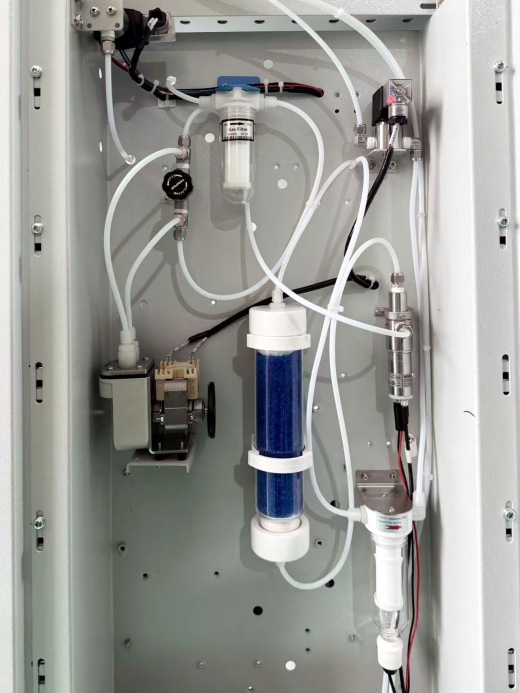
Selection should begin with chemistry—not hardware.
Ask these five questions:
1. Does water interfere with measurement?
Check for chemical reactions or spectral overlap.
2. Is the target gas water-soluble?
Compounds such as NH₃, HCl, alcohols, and organic acids require special attention.
3. What is the moisture level?
Trace moisture and saturated gas streams demand different solutions.
4. Is continuous operation required?
Online monitoring and batch sampling have different design priorities.
5. What maintenance cycle is acceptable?
Adsorbents regenerate, condensers drain, and membranes require purge gas.
Why Does Conventional Moisture Removal Fail for Acrylic Acid and MMA Sampling?
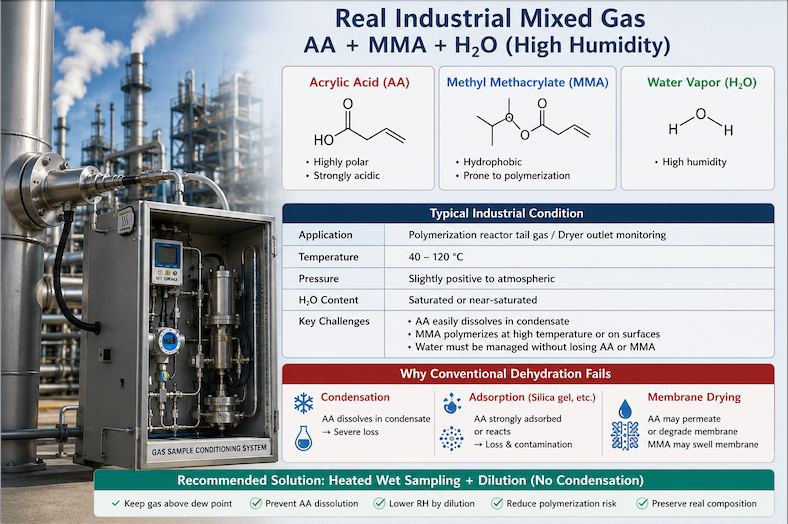
Consider a mixed gas containing: acrylic acid (AA) — highly polar and acidic, methyl methacrylate (MMA) — hydrophobic and prone to polymerization, and water vapor — high humidity.
Typical applications include polymer reactor tail gas monitoring and dryer outlet analysis.
The challenge is that these compounds behave very differently during cooling. For example, acrylic acid condenses easily and dissolves readily into condensed water. MMA remains volatile and difficult to condense. Elevated temperatures increase polymerization risk.
As a result, condensation removes both water and acrylic acid. Adsorbents may capture or react with acrylic acid. Membranes can experience swelling or degradation.
What Is the Recommended Gas Sample Conditioning System for AA + MMA + Water?
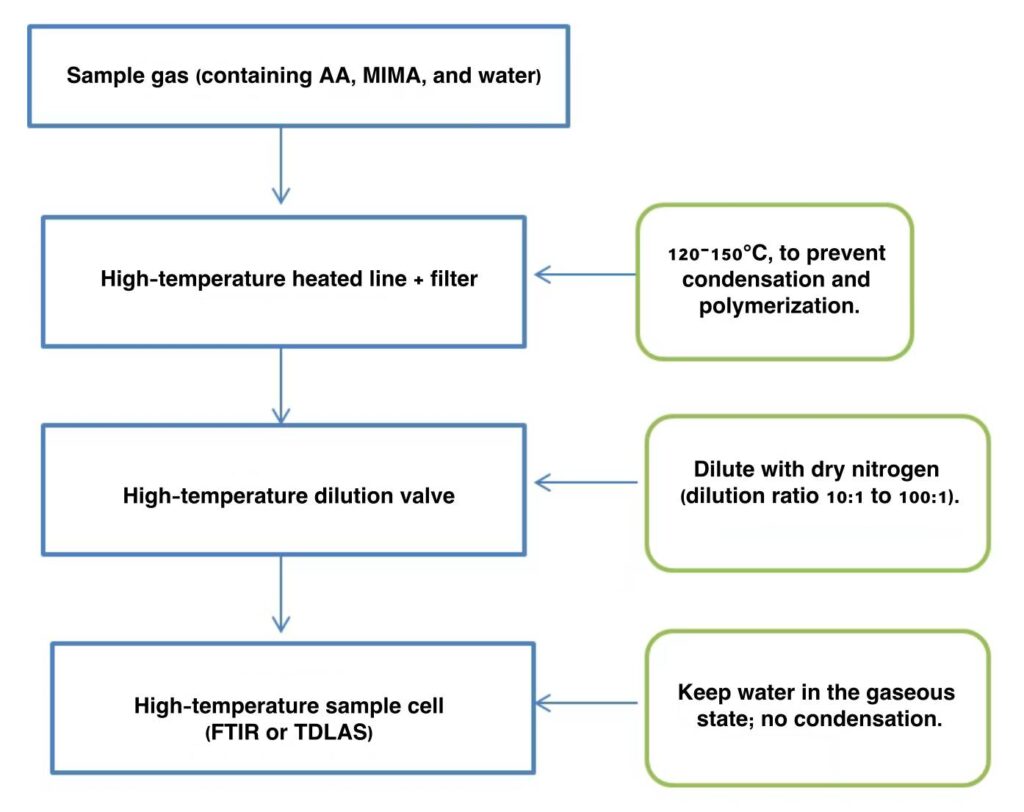
For this specific application, the preferred solution is: Heated Wet Sampling + Controlled Dilution. The design principle is simple: avoid phase change, avoid component loss, and preserve composition.
Why This Method Works
| Evaluation Item | Heated Wet + Dilution | Conventional Drying |
|---|---|---|
| Moisture removal | No | Yes |
| Acrylic acid loss | Minimal | Significant |
| Polymerization risk | Controlled | Higher |
| Detection limit | Higher | Lower |
| Maintenance | Heated cleaning | Adsorbent/cooler maintenance |
This approach prevents acrylic acid from dissolving into condensate and reduces the chance of polymer formation inside the conditioning line. If drying cannot be avoided—for example, when using moisture-sensitive NDIR gas analyzers—a compromise solution may be used:
- Low-temperature condensation at 5–10°C
- Gas–liquid separation
- Rapid reheating
- Calibration correction for unavoidable analyte loss
This approach works better for trend monitoring than high-accuracy quantification.
Conclusion
A high-performance gas sample conditioning system does more than remove moisture—it protects measurement truth. Condensation, adsorption, membrane drying, dilution, and gas–liquid separation each have strengths and limitations. The right choice depends on gas chemistry, moisture level, measurement goals, and process conditions.
When water-soluble, reactive, or polymerizable compounds are present, aggressive dehydration can become the source of analytical error. The most reliable strategy is often not the driest sample—but the one that reaches the gas analyzer unchanged.
If you want to design your gas sample conditioning system, contact with us please!
FAQs
Does every gas sample conditioning system need to remove water?
No. In some applications, especially with reactive or soluble gases, maintaining water in vapor phase delivers more accurate measurements.
Which moisture removal method causes the least sample loss?
Membrane drying and heated wet sampling generally preserve more target components than condensation or adsorption.
Can condensation remove VOCs together with water?
Yes. Condensation may dissolve or co-condense VOCs and acidic gases, creating measurement bias.
Why is heated wet sampling used in high-humidity processes?
Because it prevents condensation and reduces analyte loss while enabling continuous monitoring.
What is the biggest mistake when selecting a gas sample conditioning system?
Choosing dehydration technology based only on moisture content instead of evaluating gas chemistry and component interactions first.