



In the technical parameters of gas analyzers, two units appear frequently: VOL% and ppm. They are like “two languages” that describe gas concentration. If you understand them, you will master the key password to understand the gas detection range.
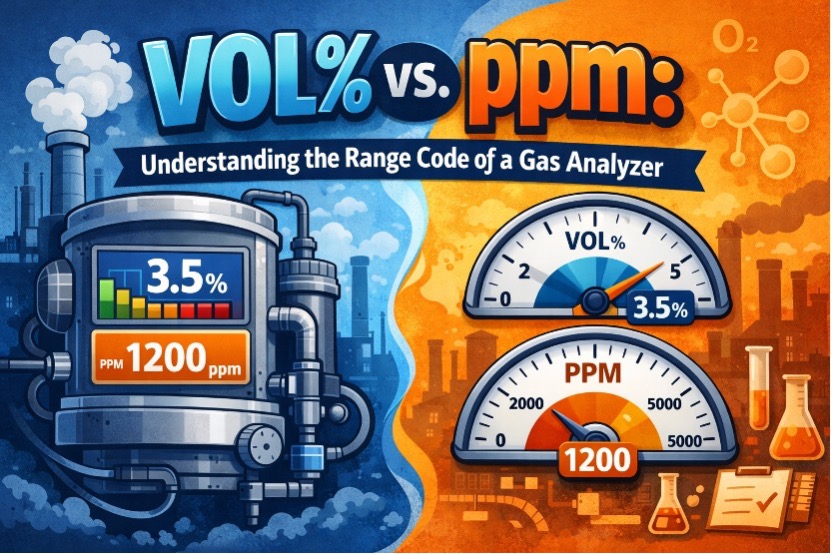
Part One: Two Units, Two “World Views”
VOL% – The “Scale” of the Macro World
- Definition: Volume percentage, indicating the proportion of a certain gas in the total volume
- Conversion: 1% = 1/100 = 10,000ppm
- Application Scenarios:
- Oxygen content monitoring (normal about 20.9%)
- Concentration of carbon dioxide during fermentation (5-15%)
- Analysis of flue gas components in combustion control
ppm – The “Magnifying Glass” of the Micro World
- Definition: Parts per million (ppm) concentration, indicating the volume of gas contained in one million volumes of air
- Conversion: 1ppm = 1/1,000,000 = 0.0001%
- Application Scenarios:
- Detection of toxic gases (e.g., CO safety limit of 50ppm)
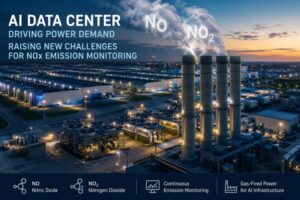
- Monitoring of environmental pollutants (SO₂, NOx)
- Detection of ultra-pure gases in the semiconductor industry
Part 2: Range Selection – Matching the Application is Key
When to use VOL%?
When the target gas is the main component or the concentration is high:
- Oxygen purity monitoring in air separation equipment: 99.6% VOL
- Carbon dioxide fertilization in greenhouses: 0.1-0.15% VOL (i.e., 1000-1500 ppm)
- Oxygen residual in inert protective atmosphere: 0.1-5% VOL
When to use ppm?
When detecting trace or minor components is required:
- Hydrogen sulfide monitoring in factory environments: 0-50 ppm
- Sulfur dioxide in the atmospheric environment: 0-5 ppm
- Impurity gases in semiconductor workshops: ppb level (1 ppb = 0.001 ppm)
Part 3: Practical Analysis – How to Correctly Understand and Select
Case 1: Combustible Gas Detection
- Methane Lower Explosive Limit (LEL): 5% VOL = 50,000 ppm
- Safety regulations require the alarm threshold to be set at 20% LEL, which is 1% VOL or 10,000 ppm
- This illustrates the conversion relationship between the two units
Case 2: Indoor Air Quality
- Comfortable carbon dioxide concentration: <1000 ppm
- Converted to VOL%: 1000 ppm = 0.1% VOL
- Although the value is very small, it has a significant impact on the human body
Case 3: Industrial Process Control
- Oxygen control in heat treatment furnaces: <100 ppm (0.01% VOL)
- It can be expressed in ppm or VOL%
- However, process documents typically use ppm because it is more precise
Part 4: Considerations Behind the Technology – Why Different Ranges Are Needed
Range Selection Driven by Accuracy Requirements
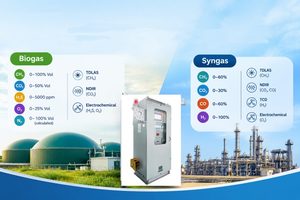
- VOL% Range: Usually 0-100% or 0-25%
- ppm Range: Varies from 0-50ppm to 0-5000ppm
- Ultra-Low Range: ppb level (billionth of a percent)
Sensor Technology Determines the Range
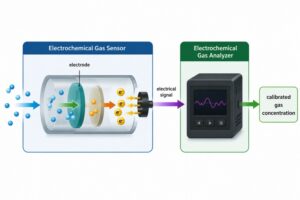
- Electrochemical Sensors: Suitable for ppm-level detection
- Infrared Sensors: Cover the range from ppm to VOL%
- Thermal Conductivity Sensors: Primarily used for VOL% level detection
Part 5: Common Misunderstandings and Precautions
Misunderstanding 1: Misinterpretation of numerical magnitude
- 100 ppm ≠ 100%,
- Actually, 100 ppm = 0.01%,
- The difference is a full ten thousand times!
Misunderstanding 2: Overly wide range selection
- Measuring a 10 ppm concentration with a 0-100% VOL range
- It’s like using a kitchen scale to weigh gold—the precision is completely insufficient
Misunderstanding 3: Ignoring background concentration
- The background CO₂ in the air is about 400 ppm (0.04% VOL)
- Background values need to be subtracted during instrument measurement
Range Extension
The same instrument covers both ppm and VOL%
Automatic range switching technology
Development of wide-range sensors
Accuracy Improvement
Development from ppm level to ppb level
Ultra-high purity gas detection: 99.9999% purity = 1 ppm impurity
Online real-time monitoring replaces offline analysis
Conclusion
VOL% and ppm are not opposing concepts, but two complementary dimensions for describing gas concentration. Just as telescopes and microscopes each have their specific uses, in the world of gas analysis, we need to choose the appropriate “observation tool” based on the specific application scenario.
Remember this simple conversion: 1% VOL = 10,000 ppm
Next time when you see the range of a gas analyzer, why not ask yourself:
- What is the approximate range of the gas concentration I need to measure?
- Is it the main component or trace impurities?
- What are the safety limits or process requirements?