



A carbon capture unit can remove a large share of carbon dioxide while creating a new emissions question at the absorber stack. Solvent may be carried out as vapour or droplets, and reaction products can form as the capture liquid is exposed to oxygen, heat and impurities. If operators track only capture efficiency, they may miss releases that affect permit compliance, public confidence and solvent management.
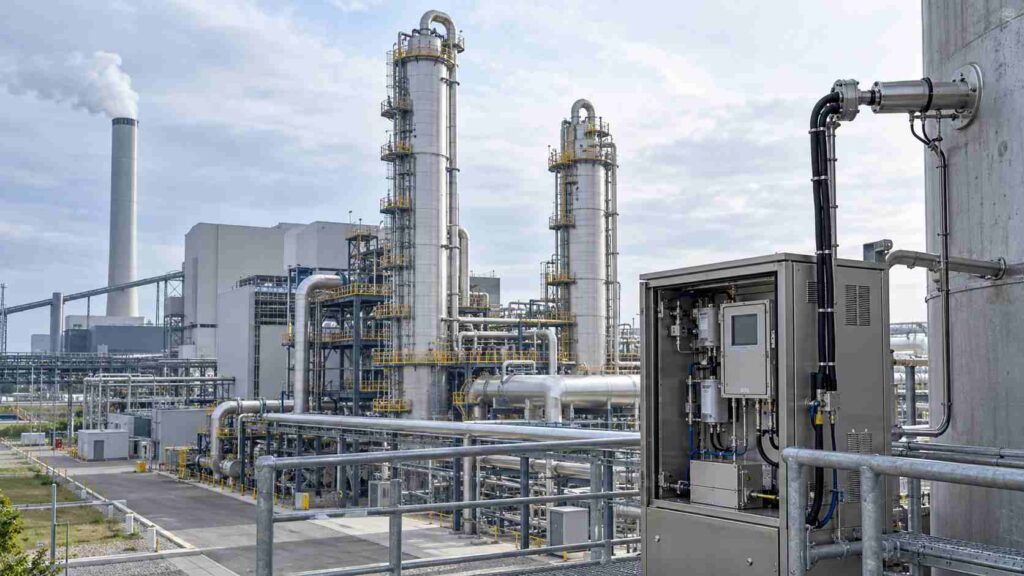
Amine-based carbon capture plants should monitor the parent solvent, relevant nitrosamines, ammonia, formaldehyde, acetaldehyde, oxygen and carbon dioxide at representative points. The exact list, method and frequency must follow the solvent formulation, plant permit, risk assessment and the rules of the jurisdiction in which the plant operates.
The measurement challenge is broader than adding one analyzer to an existing stack. Each target behaves differently in wet gas, and several important compounds still require carefully controlled manual sampling or laboratory analysis. A defensible plan starts by defining the question for every measurement and then designs the probe, transport path, method and data system around it.
Why Is CO₂ Measurement Alone Insufficient?
A capture-rate dashboard can look reassuring while a small amount of solvent or a reaction product leaves the absorber. Because those releases are not described by the CO₂ percentage, relying on one value can hide changes in wash-section performance, solvent condition or aerosol formation.
The capture system changes both gas composition and gas volume. It also introduces liquid solvent, water washing, cooling and chemical reactions that were not present in the untreated stack. Absorber outlet monitoring must therefore address two linked questions: how much CO₂ is removed and whether the new treatment stage releases other compounds.
A useful measurement boundary separates the parent plant, the capture plant and the final release point. Existing combustion pollutants may still need to be measured under the parent permit, while solvent-related species are assessed at the capture outlet. Bypasses, start-up vents and maintenance routes should be included when they can avoid the normal treatment path.
Which Compounds Should the Monitoring Plan Include?
Selecting only the parent amine can understate the chemical mixture that reaches the stack. Conversely, adding every conceivable compound makes the programme costly and difficult to validate. The target list should be tied to the actual solvent, degradation studies and permit conditions.
| Measurement group | Examples | Main purpose |
| Parent solvent | Configured amine or solvent components | Detect vapour or droplet carryover and evaluate wash-section performance |
| Nitrogen products | Relevant nitrosamines and ammonia | Assess reaction products and solvent degradation |
| Carbonyls | Formaldehyde and acetaldehyde | Track volatile degradation products where relevant |
| Process parameters | CO₂, O₂, H₂O and gas flow | Confirm capture performance, reference conditions and mass release |
| Parent-plant pollutants | Permit-dependent gases and particles | Maintain the original plant’s compliance boundary |
Solvent degradation products are formulation- and process-dependent. Operators should use supplier information, pilot data, process chemistry and periodic screening to determine whether additional aldehydes, amides or other compounds need to be included. A nominal gas list from an instrument brochure is not a substitute for this assessment.
At ESEGAS, we would first define which compounds require continuous operational trends and which require accredited periodic testing. We would not present a general-purpose FTIR channel as proof of nitrosamine compliance unless the specific method, sensitivity, calibration and matrix performance had been demonstrated.
Why Do Droplets and Moisture Change the Sampling Strategy?
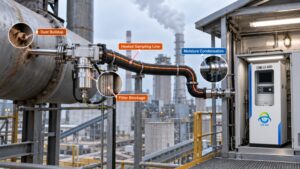
A probe that measures vapour correctly may still miss solvent contained in droplets. Wet gas can also condense inside the line, dissolve reactive compounds and create an apparently stable result that is systematically low.
The absorber outlet may contain saturated flue gas, fine mist and larger liquid droplets. Where droplets contribute to the reported emission, amine aerosol sampling should collect a representative fraction of both gas and particle phases. Isokinetic sampling may be needed unless a site-specific demonstration shows that mist and droplets are absent or irrelevant to the method.
Sample temperature requires special control. Heating that is routine for conventional stack gas can decompose a solvent or its reaction products. The September 2026 guidance for England limits heated elements to no more than 100 °C for specified breakdown-product sampling and no more than 80 °C for the nitrosamine method described there. These values should not be copied into another jurisdiction without checking the applicable method.
- Survey the stack for velocity, moisture, droplet loading and concentration homogeneity.
- Use wetted materials that do not react with or adsorb the target compounds.
- Control condensation rather than allowing it to occur at an unknown location.
- Deliver calibration or recovery checks through as much of the normal sample path as practicable.
- Record probe, line, filter and impinger temperatures with the analytical result.
Which Measurements Can Be Continuous?
Continuous numbers are attractive, but a fast data stream is not useful if the compound cannot be measured selectively at the required level. Some targets are suited to automated analysis, while others still depend on collection and laboratory determination.
A post-combustion capture CEMS can provide time-resolved CO₂, O₂, water vapour, ammonia or selected carbonyl information when the analytical method is validated for the real matrix. FTIR may support several infrared-active gases simultaneously, while dedicated optical or electrochemical channels may be appropriate for other duties.
Nitrosamine stack testing generally requires specialised manual collection and laboratory analysis, although advanced research instruments are being evaluated. Parent-amine measurements may also require impingers, filters and chromatographic analysis when aerosol and vapour phases must be combined. The monitoring plan should therefore define periodic and continuous layers rather than forcing every compound into one platform.
- Continuous layer: process trends, alarms and mass-release calculations where an approved method exists.
- Periodic layer: parent solvent, nitrosamines and other targets requiring laboratory separation or very low reporting levels.
- Diagnostic layer: short campaigns used to investigate wash-section changes, solvent condition or unexpected peaks.
Where Should Samples Be Collected?
A convenient port at the final stack may confirm the release but cannot show whether the absorber, water wash or upstream gas caused a change. Well-chosen intermediate points turn the monitoring programme into a diagnostic tool as well as a reporting system.
| Location | Primary question |
| Absorber inlet | What enters the capture plant and how stable is the parent gas? |
| Wash-section outlet | Is solvent or aerosol being retained as intended? |
| Final stack | What is released after the complete treatment train? |
| Bypass or start-up route | Are emissions avoiding normal capture or wash stages? |
| Solvent loop | Do liquid composition and degradation indicators explain the gas result? |
Possible locations include the absorber inlet, the gas above the wash section, the absorber outlet, the common final stack and any bypass or emergency route. Temporary sampling before and after individual wash stages can help identify where solvent carryover is being controlled or generated.
Every location should be assessed for gas homogeneity and safe access. Transport delay must be known when trends are compared across points. If one analyzer switches between locations, purge time and memory effects should be flagged so that a transient from one stream is not assigned to the next.
How Should Results Be Normalised and Reported?
A concentration can rise after CO₂ removal even when the mass of another compound is unchanged, simply because the total gas volume is smaller. Reporting only concentration can therefore lead to the wrong conclusion about plant performance.
The data system should preserve the measured wet or dry basis, temperature, pressure, oxygen concentration and corresponding gas flow. Dry-gas correction must be applied consistently, and any reference-oxygen correction should reflect the parent plant’s regulatory basis rather than an arbitrary value at the capture outlet.
Mass emissions require a representative gas quantity as well as concentration. Operators should document how the reduction in flue-gas volume caused by CO₂ removal is handled, which period each flow value represents and how invalid data are substituted. Reporting should retain both the original readings and the calculated result.
What Quality Controls Are Required?
A plausible spectrum or laboratory result does not prove that the sample survived the trip from the stack. For reactive, soluble and semi-volatile compounds, the sampling train is often the largest source of uncertainty.
The quality plan should cover the complete chain from probe to reported value. It should define blank tests, field recovery, calibration, leak checks, flow verification, sample preservation, laboratory holding time, detection limits and uncertainty. Manual and automated methods must be linked to the same operating period.
At ESEGAS, we recommend commissioning online channels against independent reference measurements under normal, start-up and abnormal conditions. We also recommend retaining raw spectra, instrument status, sample-system temperatures and process data so that an unexpected result can be investigated rather than simply removed.
- Verify zero, span and multipoint response at the intended range.
- Test interference from water, CO₂, ammonia and the selected solvent matrix.
- Measure response and recovery through the complete heated or conditioned path.
- Synchronise analyzer data with solvent circulation, wash operation and plant load.
- Review the target list whenever the solvent formulation or capture operating window changes.
Amine carbon capture emissions monitoring should show both what the plant removes and what the capture process may add to the final gas. At ESEGAS, we approach the task as a layered measurement programme: validated online analysis for suitable gases, specialised periodic methods for amines and nitrosamines, representative wet-stack sampling, and flow-linked data that preserve the correct reference conditions. This creates a clearer basis for compliance, solvent management and continuous improvement without overstating what one analyzer can prove.