



A network operator may know the amount of hydrogen commanded at an injection skid without knowing the composition actually delivered farther downstream. Mixing, changing gas flow, measurement delay and additional entry streams can all alter the final mixture. If these changes are not measured, billing calculations, appliance compatibility and operating decisions may be based on an assumed composition rather than the gas moving through the pipeline.
Hydrogen-blended natural gas should be monitored for hydrogen concentration, hydrocarbon composition and relevant inert or contaminant gases. Operators should also determine calorific value, density, Wobbe index, moisture and other quality properties required by the applicable network code, contract or national specification.

The final measurement architecture depends on its purpose. A process analyzer used to control an injection skid may not satisfy custody-transfer requirements, while a billing chromatograph may not respond quickly enough to support an automatic shutdown. Each measurement point should therefore be connected to a clearly defined operational or commercial decision.
Why Has Gas-Quality Measurement Become More Important?
Relying on historical pipeline composition becomes less dependable when several renewable or low-carbon gases enter a network. Effective natural gas quality monitoring must identify how the mixture develops over time, particularly where cross-border gas quality differences can restrict flows or affect connected equipment.
Regulation (EU) 2024/1789 strengthens transparency and coordination concerning natural-gas quality and hydrogen blends. It specifically identifies parameters such as gross calorific value, Wobbe index and oxygen content as relevant to information exchange and network interoperability.
The regulation does not require every national network to accept the same mixture under every condition. Member States retain important responsibilities for their domestic systems, and adjacent transmission systems may agree arrangements for individual interconnection points. Operators should therefore translate the applicable rules into a site-specific measurement matrix covering:
- Required components and calculated properties.
- Applicable national gas-quality limits.
- Contractual delivery specifications.
- Approved measuring methods.
- Averaging and reporting intervals.
- Alarm and rejection procedures.
- Measurement uncertainty.
- Data retention and exchange.
The analyzer should support this framework rather than define the permitted mixture by itself.
Which Components Should Be Included?
Measuring hydrogen alone can confirm the hydrogen blend percentage but cannot show whether another entry stream has changed the energy content or introduced an unacceptable contaminant. A broader composition analysis is normally required wherever the result supports gas-quality acceptance or energy determination.
Potential parameters include:
| Parameter | Monitoring purpose |
|---|---|
| H₂ | Confirms blending level and detects changing injection conditions |
| CH₄ | Measures the principal combustible component of conventional natural gas |
| C₂–C₆+ hydrocarbons | Supports energy, density and dew-point calculations |
| CO₂ | Identifies inert dilution and supports gas-quality control |
| N₂ | Quantifies non-combustible dilution |
| O₂ | Detects air ingress and supports network-quality assessment |
| H₂O | Supports moisture control and condensation prevention |
| H₂S and other sulfur compounds | Supports corrosion, safety and contractual gas-quality requirements |
| Pressure and temperature | Supports sampling, volume conversion and flow calculations |
The permanent gas list should come from the network specification and source-gas assessment. A stream containing biomethane, stored gas or imported pipeline gas may require different impurity channels from a controlled hydrogen–natural-gas blending skid.
At ESEGAS, we first establish the expected composition range and background gas before deciding whether individual analyzer channels or a chromatographic method are appropriate.
How Should Calorific Value and Wobbe Index Be Determined?
A hydrogen reading cannot be converted into an accurate energy value without knowing the remaining composition. Assuming that every non-hydrogen fraction is methane can create errors when ethane, propane, carbon dioxide or nitrogen varies.
ISO 6976 provides methods for calculating gross calorific value, net calorific value, density and Wobbe indices when the gas composition by mole fraction is known. A defensible Wobbe Index calculation therefore requires adequate component coverage and a composition total that is analytically consistent.
Operators may use:
- Gas chromatography: Measures the relevant components and supplies composition data for property calculations.
- Direct calorimetry: Measures energy content without first resolving every component.
- Inferential measurement: Estimates properties from selected measurements, provided the system is demonstrated to be fit for the defined composition envelope.
- Combined systems: Use a fast hydrogen channel for control and a chromatograph or calorimeter for commercial-quality information.
The chosen approach should maintain a clear basis for the gross calorific value, reference temperature, pressure and dry or wet condition. Calculated and directly measured results should not be mixed without documenting their units and reference states.
Where Should Measurements Be Taken?
One analyzer installed at the injection point cannot prove that the mixture is uniform throughout a changing network. Additional entry streams, line packing and varying demand can alter the composition reaching an interconnection or sensitive customer.
Possible locations include:
- The hydrogen supply immediately before injection.
- The natural-gas line before blending.
- The mixed stream after sufficient mixing distance.
- Compressor and storage entry or exit points.
- Cross-border and regional interconnection stations.
- Custody-transfer metering stations.
- Distribution zones with changing sources.
- Entrances to sensitive industrial or power-generation users.
The mixed-stream sample should not be placed where stratification, pulsation or incomplete mixing produces an unrepresentative result. The engineering review should consider pipe diameter, velocity, injection geometry, operating range and the time required for composition changes to reach the analyzer.
Where several locations share an instrument, switching and purging time must be included in the response assessment.
Which Analyzer Technologies Are Suitable?
Choosing one technology for the entire duty can leave important gases unmeasured. Hydrogen, hydrocarbons, oxygen, water and sulfur compounds have different analytical properties.
A system may combine:
- Process gas chromatography for hydrogen, inert gases and hydrocarbon composition.
- Thermal-conductivity detection for a dedicated hydrogen channel in a defined gas matrix.
- NDIR analysis for configured gases such as CH₄ and CO₂.
- Paramagnetic or electrochemical analysis for oxygen.
- Moisture or dew-point analysis for water content.
- Dedicated sulfur analysis where H₂S or total sulfur is contractually relevant.
- Flow, temperature and pressure measurement where blending or energy flow must be calculated.
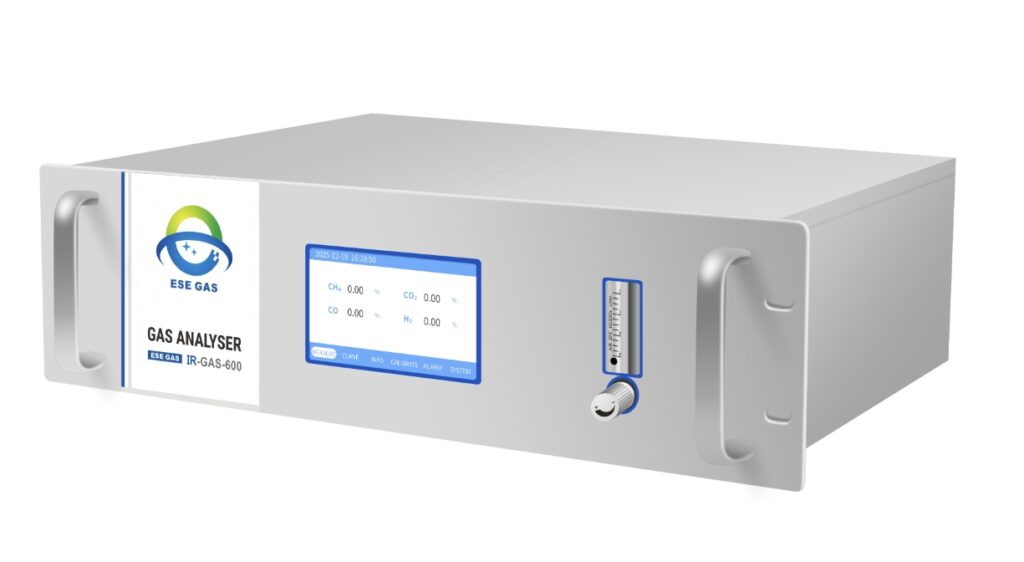
ESEGAS process analyzers can combine selected H₂, CH₄, CO₂ and O₂ channels for operational measurement. A hydrogen-ready metering installation used for custody transfer, however, must also satisfy the applicable metrological standards, approvals and uncertainty requirements. Process capability should not be presented as automatic evidence of billing acceptance.
How Should a High-Pressure Sample Be Conditioned?
A valid calibration cannot compensate for a sample that leaks, cools below its dew point or changes during pressure reduction. Hydrogen’s physical properties also make leak-tight construction and representative calibration particularly important.
The sample system should address:
- Probe placement and filtration.
- Pressure reduction in controlled stages.
- Joule–Thomson cooling or heating effects.
- Materials and seals compatible with the gas mixture.
- Minimum sample-line volume.
- Stable analyzer pressure and flow.
- Prevention of hydrocarbon or water condensation.
- Safe venting or sample return.
- Leak testing.
- Isolation and purging for maintenance.
The water dew point and hydrocarbon dew point should be treated separately where both affect the network specification. If a regulator or sample line changes temperature significantly, the design should demonstrate that heavier hydrocarbons and moisture remain representative.
How Should the System Be Validated?
An analyzer calibrated on conventional natural gas may remain stable while becoming biased as the hydrogen fraction increases. Background-gas effects, calibration composition and property calculations must therefore be tested across the intended operating envelope.
A validation program should include:
- Multipoint verification covering the expected hydrogen range.
- Representative hydrocarbon and inert-gas backgrounds.
- Gas chromatograph validation using traceable standards.
- Checks of composition closure and unmeasured fractions.
- Verification of energy and density calculations.
- Sample-line response and recovery testing.
- Pressure- and flow-sensitivity testing.
- Analyzer and network-data time synchronisation.
- Documented treatment of invalid or missing data.
- Revalidation after a material source or blending change.
Trend data should be compared with injected hydrogen flow, total pipeline flow and travel time through the network. This makes it easier to distinguish genuine composition changes from analyzer drift or an incorrect blending calculation.
What Should Be Confirmed Before Selecting the System?
Ordering an analyzer based only on the expected hydrogen percentage can leave the energy calculation, contaminants and approval requirements unresolved. We recommend confirming:
- Measurement purpose at every point.
- Applicable gas-quality specification.
- Minimum and maximum hydrogen concentration.
- Full expected gas composition.
- Pressure, temperature and flow.
- Moisture and condensation conditions.
- Required response time.
- Required properties and calculation standard.
- Calibration-gas composition.
- Metrological or custody-transfer approvals.
- Alarm, control and reporting interfaces.
- Maintenance and validation responsibilities.
Hydrogen-blended natural gas monitoring should connect injection control, gas quality, energy determination and network interoperability without confusing their different accuracy and approval needs. At ESEGAS, we begin with the measurement duty and real gas matrix, then combine appropriate H₂, hydrocarbon, CO₂, O₂ and moisture channels with representative sampling and traceable data handling.