



If you work in industrial emissions, environmental compliance, or process safety, you likely depend on infrared gas monitors every single day. But have you ever wondered why these critical machines like gas analyzers rely so heavily on the Near-Infrared (NIR) spectrum?
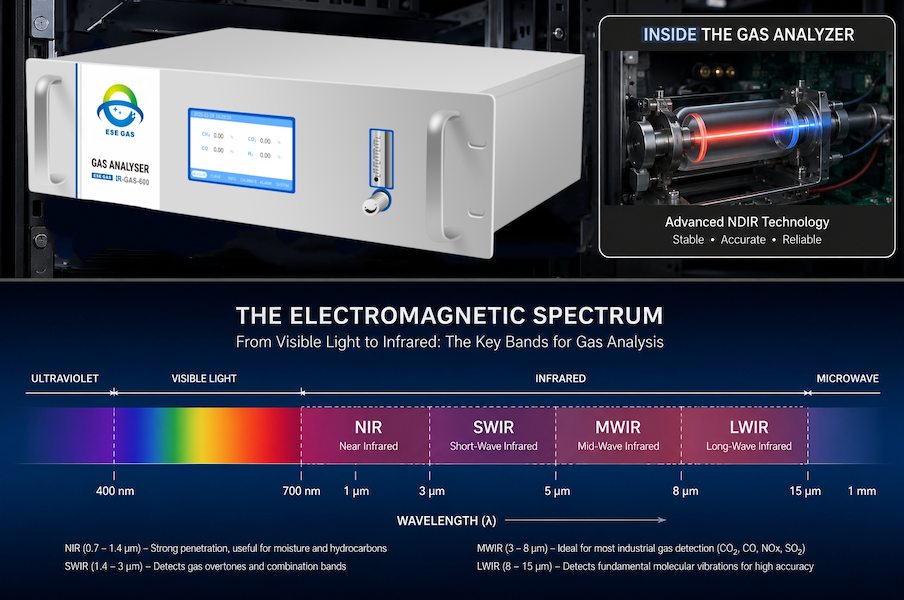
Infrared light spans across several distinct bands: Near-Infrared (NIR), Short-Wave Infrared (SWIR), Mid-Wave Infrared (MWIR), and Long-Wave Infrared (LWIR). On paper, longer wavelengths like MWIR and LWIR boast much stronger gas absorption properties. Yet, if you open up a standard, rugged industrial gas analyzer, you will almost always find an optical bench tuned specifically to the NIR or Non-Dispersive Infrared (NDIR) region.
Why does industrial engineering seem to contradict pure physics? The answer does not lie in how strongly a gas absorbs light, but rather in how reliably an instrument can measure that light in a dirty, real-world factory environment. Let us break down exactly why NIR remains the reigning champion for industrial gas detection.
What Are the Different Infrared Bands in Gas Sensing?
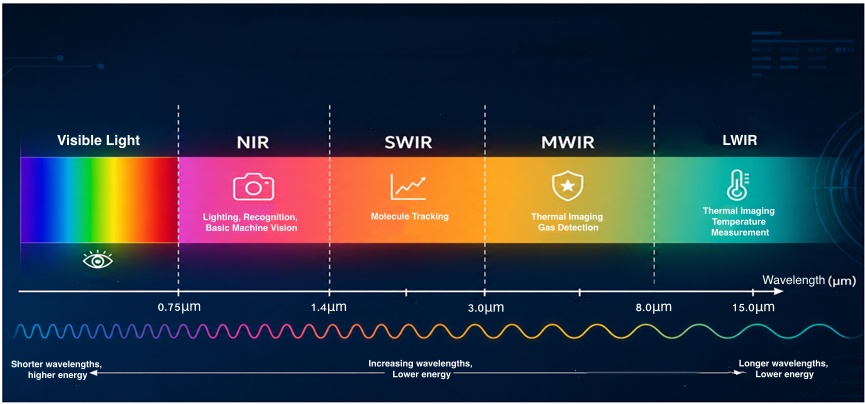
To understand this choice, we must first look at how the infrared family tree splits up. Infrared light sits just beyond visible red light on the electromagnetic spectrum. Scientists categorize it into four main regions based on wavelength:
- Near-Infrared (NIR): 0.75 to 1.4 micrometers (μm)
- Short-Wave Infrared (SWIR): 1.4 to 3.0 (μm)
- Mid-Wave Infrared (MWIR): 3.0 to 8.0 (μm)
- Long-Wave Infrared (LWIR): 8.0 to 15.0 (μm)
In gas analysis, we exploit a simple rule of nature: different gas molecules absorb different wavelengths of light. When you pass an infrared beam through a gas sample, target gases block specific wavelengths, leaving a unique “fingerprint” or shadow. By measuring the darkness of that shadow, a gas analyzer calculates the exact concentration of the gas.
Each of these four bands possesses distinct physical traits that define its core capability in industrial sensing:
1. Near-Infrared (NIR): High Stability and Low Interference
NIR photons carry the highest energy in the infrared family. Because these waves are so short, they do not trigger messy, wide absorption patterns. Instead, NIR excels at reading sharp, narrow “overtone” bands of common industrial gases like CO and CO2. Its primary capability is high environmental stability. NIR light passes through standard glass effortlessly and ignores the heavy water vapor that usually blinds other optical sensors.
2. Short-Wave Infrared (SWIR): Specialized Molecule Tracking
SWIR acts as the bridge between near-infrared and deep thermal bands. It can capture both unique molecular overtones and early fundamental vibrations. This gives SWIR the capability to isolate complex organic molecules and specific greenhouse gases, such as methane (CH4), with higher sensitivity than NIR. However, SWIR components cost more and start to struggle with moisture interference in raw exhaust streams.
3. Mid-Wave Infrared (MWIR): Ultra-Trace Sensitivity
MWIR strikes the exact point where gas molecules undergo intense “fundamental” physical stretching. Because gases absorb MWIR light with incredible violence, this band gives instruments the capability to detect microscopic gas traces. If you need to find faint leaks or measure background atmospheric pollution down to parts-per-billion (ppb) levels, MWIR provides the raw optical power to do it.
4. Long-Wave Infrared (LWIR): Thermal Imaging and Remote Sensing
LWIR deals with low-energy photons that match the natural thermal radiation emitted by warm objects. Because of this, its core capability lies in thermal visualization and long-range remote sensing. Instead of pulling gas into a sample cell, LWIR sensors can look at a distant pipe stack from hundreds of feet away and visually map out escaping gas plumes against the background temperature.
Why Does NIR Win the Gas Analyzer Battle?
While fundamental bands offer superior sensitivity on a physics blackboard, building a practical, affordable, and durable gas analyzer around them is an engineering nightmare. NIR wins the industrial market because it utilizes vastly superior hardware materials.
| Feature | NIR / NDIR Systems | MWIR / LWIR Systems |
| Optical Windows | Durable Quartz, Sapphire, fused Silica | Fragile Germanium, Zinc Selenide |
| Light Sources | Low-cost Incandescent, stable MEMS | Pricey Quantum Cascade Lasers (QCL) |
| Detectors | Uncooled, solid-state (InGaAs, Pyroelectric) | Cryogenically cooled, power-hungry sensors |
| Moisture Resistance | High | Low (Highly sensitive to water vapor) |
| Relative Component Cost | Low to Moderate | Extremely High |
1. Robust and Affordable Optical Materials
Every optical gas analyzer needs windows to isolate its delicate sensor components from the harsh sample gases. Because NIR sits right next to visible light, it passes effortlessly through standard, rugged optical materials like quartz, sapphire, and fused silica glass. These materials are cheap, physically tough, scratch-resistant, and chemically inert.
On the flip side, MWIR and LWIR light cannot pass through standard glass; the glass simply absorbs the light and blinds the machine. Instead, longer-wave instruments must use exotic crystals like Germanium, Zinc Selenide, or Sodium Chloride. These materials are incredibly fragile, prone to scratching, expensive, and can degrade rapidly when exposed to moisture or corrosive ambient air.
2. Simple Light Sources and Uncooled Detectors
NIR gas monitors keep things beautifully simple. They generate light using long-life incandescent lamps or compact Micro-Electro-Mechanical Systems (MEMS) emitters. These components cost very little and run reliably for years without fading. To read the light, NIR systems use uncooled solid-state detectors like Indium Gallium Arsenide (InGaAs) or robust pyroelectric sensors. They work perfectly at room temperature.
Move over to the MWIR or LWIR spectrum, and the hardware requirements skyrocket. Generating precise long-wave lines often requires expensive, heat-sensitive Quantum Cascade Lasers (QCL). Worse yet, to pick up faint thermal signals without getting drowned out by the machine’s own heat, long-wave detectors frequently require active, cryogenic cooling systems. This adds massive cost, weight, and failure points to the instrument.
How Do Industrial Gas Analyzers Avoid the Water Vapor Trap in NIR?
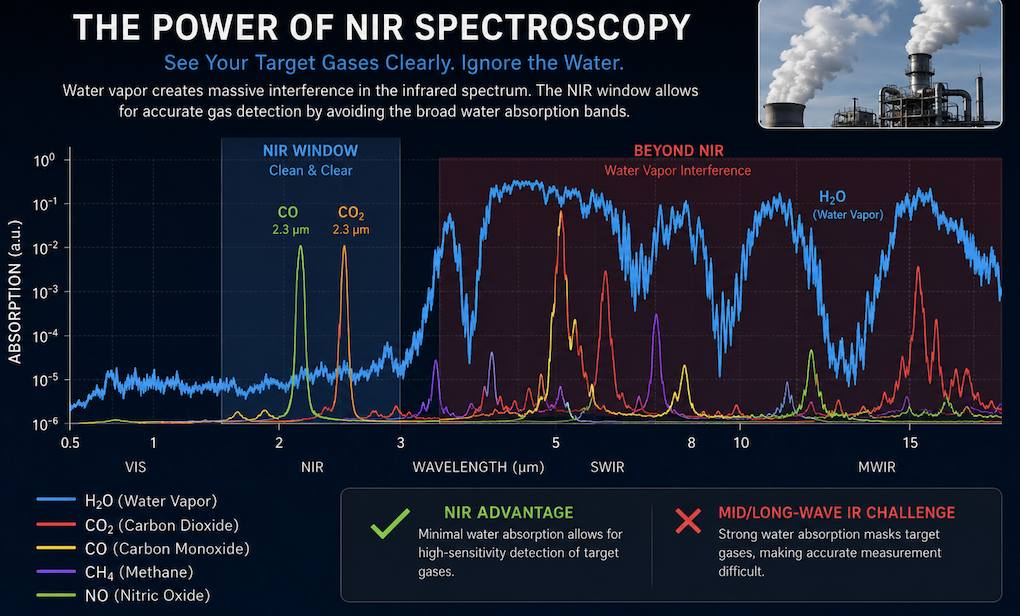
If you are running a continuous emissions monitoring system (CEMS) on a smokestack or analyzing engine exhaust, your sample gas will be loaded with steam and moisture. This is where the true brilliance of NIR comes to light.
Water vapor (H2O) is a notorious bully on the infrared spectrum. In the SWIR, MWIR, and LWIR regions, water exhibits massive, sprawling fundamental absorption bands. If your sample gas contains even a small amount of humidity, the water vapor signals can completely swamp the delicate footprints of the gases you actually want to measure, such as Carbon Monoxide (CO), Carbon Dioxide (CO2), or methane (CH4).
The NIR spectrum provides clean, narrow windows where water vapor interference drops significantly. Engineers can easily isolate sharp, distinct overtone peaks for (CO), (CO2), and various hydrocarbons (HC) without the moisture clouding the reading. By avoiding this cross-interference, a standard multi-gas analyzer delivers highly accurate data without requiring massive, ultra-expensive sample drying systems upfront.
Which Infrared Technology Fits Your Gas Analyzers in Specific Facility Best?
While NIR is the optimal choice for mainstream industrial applications, it is helpful to know exactly when to deploy each technology. Use this quick checklist to guide your next equipment evaluation:
Opt for NIR / NDIR Analyzers When:
- You need to monitor standard process gases or emissions like (CO2), (CO), methane, or propane.
- The system will operate in harsh environments with high vibrations, dust, or variable temperatures.
- You want to keep your initial equipment investment and long-term maintenance budgets low.
- Your accuracy goals are in the standard parts-per-million (ppm) or percentage volume ranges.
Opt for MWIR / LWIR Systems Only When:
- You are building a high-end scientific laboratory or a specialized research facility.
- You must detect specialized gases down to ultra-trace, single-digit parts-per-billion (ppb) levels.
- You are deploying remote Optical Gas Imaging (OGI) cameras to spot fugitive pipe leaks from hundreds of feet away.
Conclusion
In the world of industrial gas analyzers, reliability always trumps theoretical performance. While Mid-Wave and Long-Wave Infrared bands offer incredibly strong absorption signals, their delicate components, high price tags, and vulnerability to water vapor make them impractical for everyday factory duty.
By leveraging the sharp, clean overtone bands of the Near-Infrared spectrum, modern ESEGAS gas analyzers achieve the ultimate balance. They give industrial operators exactly what they need: pinpoint accuracy, years of uninterrupted service, minimal maintenance, and a price point that makes sense for business.
If you need a designed NDIR-based gas analyzers for your industries, contact with us please!
FAQs:
1. Why do industrial gas analyzers prefer NIR over MWIR if MWIR has stronger gas absorption?
While Mid-Wave Infrared (MWIR) light creates much stronger absorption signals, it requires highly fragile, exotic optical windows and expensive, cryogenically cooled detectors. Near-Infrared (NIR) components use rugged, inexpensive sapphire or quartz glass and uncooled solid-state sensors. NIR balances sufficient measurement accuracy with vastly superior physical durability and lower hardware costs for harsh factory floors.
2. Can an NIR gas analyzer measure multiple gases at the same time?
Yes. Modern multi-gas analyzers use the NIR spectrum alongside Non-Dispersive Infrared (NDIR) technology to monitor up to five distinct gases simultaneously. By using a single stable light source and spinning a wheel of narrow bandpass filters, the instrument can cleanly isolate the unique overtone wavelengths for Carbon Monoxide (CO), Carbon Dioxide (CO2), and various hydrocarbons (HC)) without cross-talk.
3. How does water vapor affect gas measurements in the different infrared bands?
Water vapor is a major interference challenge in gas analysis. In the SWIR, MWIR, and LWIR bands, moisture exhibits massive, wide fundamental absorption peaks that can overwhelm and hide the signals of target process gases. The NIR spectrum contains narrow, clear “windows” where water vapor absorption drops significantly. This allows NIR analyzers to deliver highly accurate readings in high-humidity environments like exhaust flues without requiring complex, aggressive sample drying systems.
4. What are the main maintenance advantages of an NIR-based optical bench?
NIR-based optical benches offer exceptional baseline stability because they utilize uncooled detectors and long-life incandescent or MEMS emitters. These solid-state components are highly resistant to factory vibrations and ambient temperature shifts. As a result, NIR systems experience minimal calibration drift, allowing industrial facilities to extend their routine calibration cycles from a weekly requirement to a simple semi-annual check.
5. When should a facility upgrade from an NIR system to an MWIR or LWIR analyzer?
You should only invest in specialized MWIR or LWIR systems if your application requires ultra-trace, parts-per-billion (ppb) sensitivity for scientific research, or if you are deploying remote Optical Gas Imaging (OGI) cameras to visualize fugitive pipe leaks from a distance. For standard continuous emissions monitoring (CEMS), process control, and safety tracking in parts-per-million (ppm) or percentage volume ranges, NIR remains the most cost-effective and reliable choice.