



A single oxygen spike in converter gas can trigger an explosion, damage equipment, and endanger workers. Without fast and accurate monitoring, steel plants face significant safety and financial risks.
In-Situ TDL Gas Analyzers continuously monitor oxygen (O₂) and carbon monoxide (CO) in converter gas systems. Their fast response, high accuracy, and real-time alarms help operators prevent explosive gas mixtures, improve gas recovery efficiency, and protect personnel and assets.
However, explosion prevention is only one part of the duty. To understand why In-Situ TDL gas analyzers have become critical safety instruments in converter gas recovery systems, it is important to examine the composition, process requirements, and monitoring challenges of steelmaking converter areas.
Why Is Converter Gas a High-Risk Environment?
Basic Oxygen Furnace (BOF) steelmaking generates large volumes of converter gas during oxygen blowing. This gas contains both valuable fuel components and significant safety hazards.
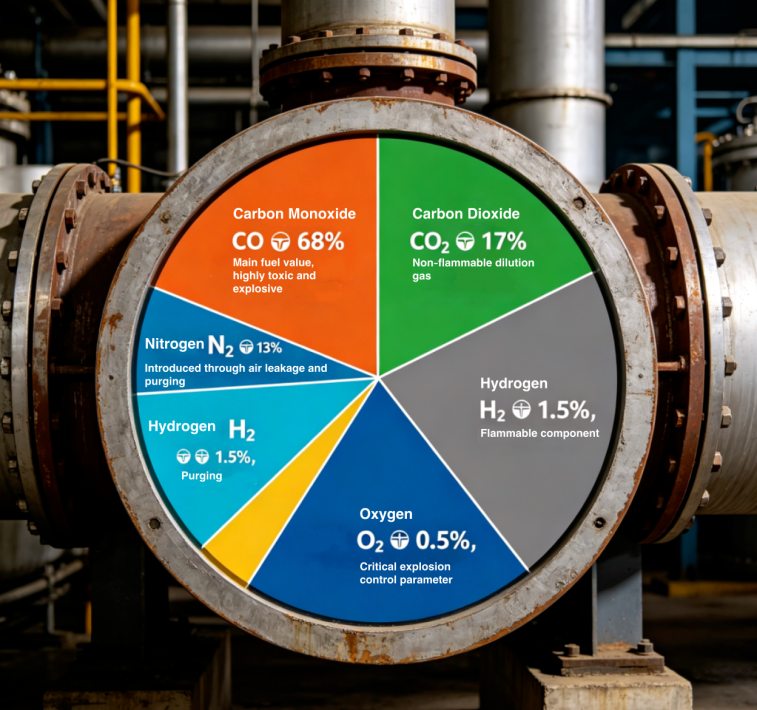
Typical Converter Gas Composition
| Gas Component | Typical Concentration | Function |
|---|---|---|
| Carbon Monoxide (CO) | Up to 68% | Main fuel value, highly toxic and explosive |
| Carbon Dioxide (CO₂) | 15–20% | Non-flammable dilution gas |
| Hydrogen (H₂) | Trace amount | Flammable component or purging |
| Oxygen (O₂) | Around 0.5% | Critical explosion control parameter |
| Nitrogen (N₂) | Variable | Introduced through air leakage and purging |
Among these gases, carbon monoxide presents the greatest safety concern. It is colorless, odorless, highly toxic, and has a wide explosive range when mixed with oxygen. Meanwhile, oxygen is the key trigger for explosions. When oxygen concentration rises beyond process limits, CO and H₂ can form an explosive mixture capable of ignition from sparks, hot surfaces, or static electricity. Industry safety systems therefore rely heavily on continuous oxygen monitoring to maintain safe operating conditions.
In-situ TDL gas analyzer measures oxygen and carbon monoxide directly inside the converter gas pipeline. This eliminates sampling delays and provides continuous, real-time data that operators can use to prevent explosive conditions before they develop.
How Do In-Situ TDL Gas Analyzers Prevent Converter Gas Explosions?
The gas recovery decision is primarily based on CO and O₂ concentrations. When CO concentration exceeds 30% or O₂ concentration remains below 2%, the recovery-side hood valve opens, allowing valuable converter gas to enter the gas holder for storage. If these conditions are not satisfied, the flare-side hood valve opens, and the gas is safely combusted through the flare tower.
Furthermore, installing additional oxygen monitoring points before and after the gas holder to ensure oxygen concentration remains below 1%, providing an extra layer of explosion protection. Converter gas recovery systems widely adopt this operating philosophy.
Typical Installation Points
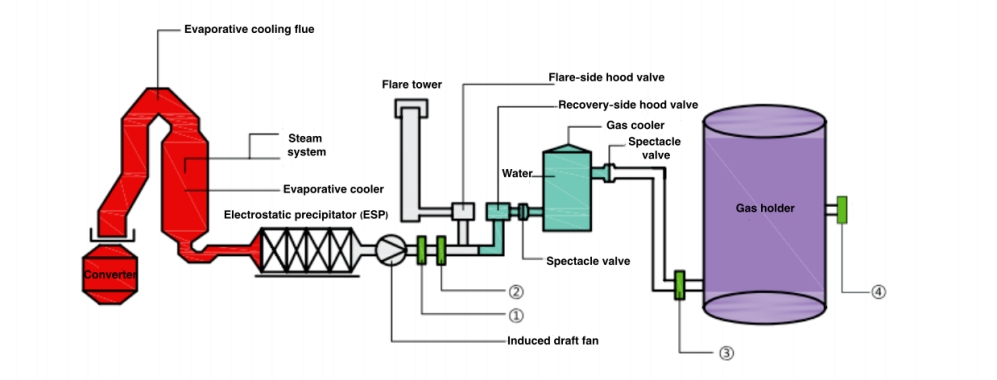
For maximum safety coverage, steel plants commonly deploy gas analyzers at several key locations.
| In-Situ TDL Analyzers | NO. | Installation Points | Purposes |
|---|---|---|---|
| In-Situ TDL O2 Analyzer (O2: 0-5%) | 1 | After the Induced Draft Fan | -Determine whether gas meets recovery conditions -Control switching between recovery and flare systems -Detect oxygen ingress |
| In-Situ TDL CO Analyzer (CO: 0-100%) | 2 | ||
| In-Situ TDL O2 Analyzer (O2: 0-5%) | 3 | Before the Gas Holder | -Verify oxygen remains below safety limits before storage |
| In-Situ TDL O2 Analyzer (O2: 0-5%) | 4 | After the Gas Holder | -Continuously protect downstream users -Confirm gas quality and storage safety |
This multi-point monitoring architecture ensures continuous safety verification from gas generation to storage throughout the converter gas recovery process.
What Are the Main Components of an In-Situ TDL Gas Analyzer?
The In-situ TDL gas analyzer is specifically designed for harsh steelmaking environments where high temperatures, dust, moisture, and corrosive gases often challenge traditional monitoring technologies.
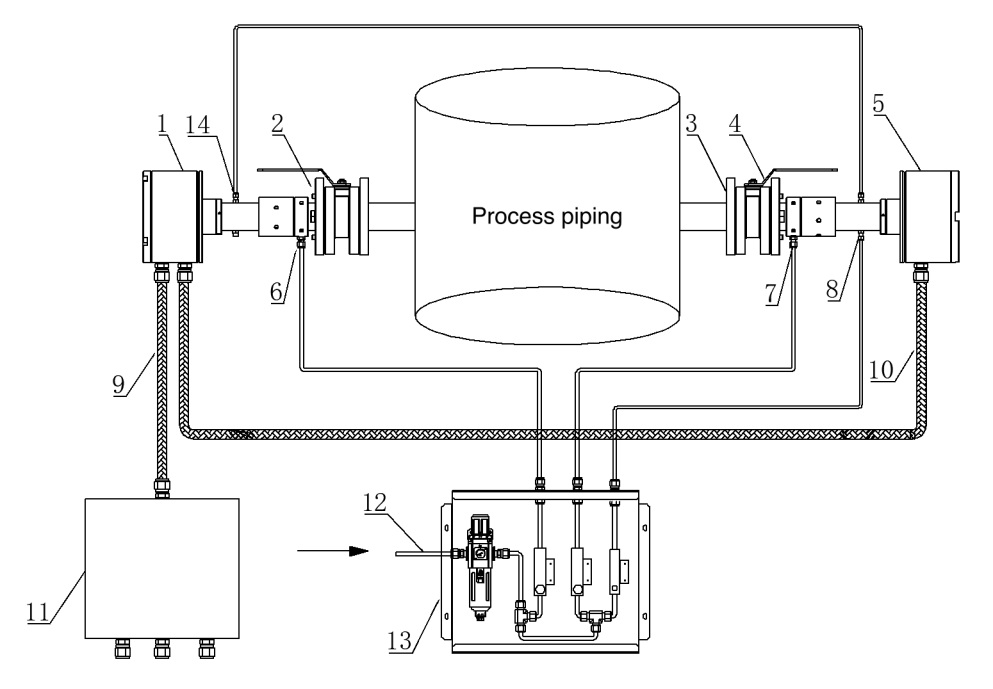
| NO. | Components |
|---|---|
| 1 | Transmitter Unit (Human-Machine Interface (HMI), Laser driver module, Central processing module, Tunable semiconductor laser, and Precision optical components) |
| 2 | Flange |
| 3 | Welded Flange |
| 4 | Root Valve |
| 5 | Receiver Unit (Photoelectric detector, Power supply module, Precision optical components) |
| 6 | Purge Gas Inlet |
| 7 | Purge Gas Inlet |
| 8 | Purge Gas Inlet |
| 9 | Signal Output Cable |
| 10 | Internal Connection Cable |
| 11 | Terminal Box |
| 12 | Compressed Air Inlet |
| 13 | Purge Unit (Filter regulator, Flow meter, Purge gas distribution system) |
| 14 | Purge Gas Inlet |
Together, these components form a complete optical measurement system capable of continuously monitoring O₂ and CO concentrations in converter gas pipelines.
Why Choose ESEGAS In-Situ TDL Gas Analyzers for Converter Gas Monitoring?
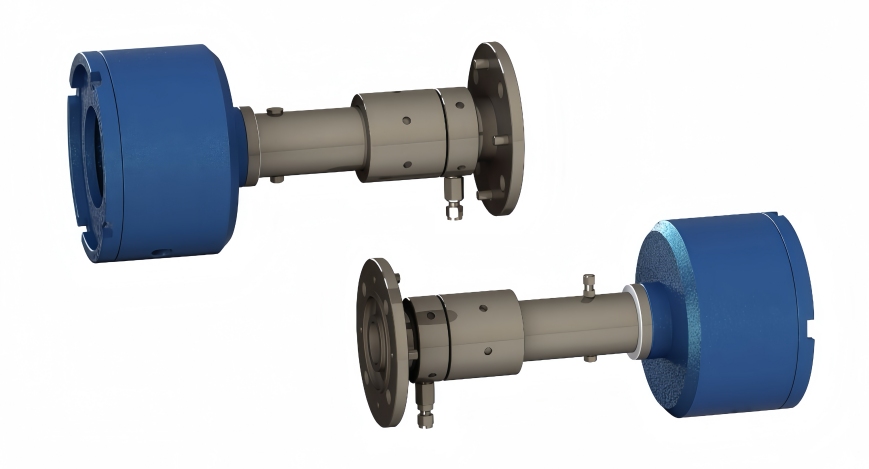
Converter gas monitoring requires fast, accurate, and reliable measurement under challenging conditions. By combining Tunable Diode Laser Absorption Spectroscopy (TDLAS) with an in-situ cross-duct measurement design, ESEGAS designe in-situ TDL gas analyzers to deliver stable O₂ and CO monitoring even in dusty, high-temperature steelmaking environments.
Immune to Background Gas Interference
Unlike traditional NDIR analyzers, which can be affected by overlapping absorption from other gases, ESEGAS TDL gas analyzers use an ultra-narrow semiconductor laser tuned to a specific gas absorption line. This eliminates cross-interference from CO₂, N₂, H₂, and other background gases, ensuring highly accurate measurements.
Unaffected by Dust and Window Contamination
The gas analyzer continuously distinguishes gas absorption from signal loss caused by dust, moisture, or optical window fouling. This allows reliable operation in converter gas ducts where dust concentrations are typically high.
Automatic Temperature and Pressure Compensation
Changes in process temperature and pressure can affect measurement accuracy. ESEGAS analyzers automatically compensate for these variations, ensuring precise gas concentration readings under changing operating conditions.
Stable Performance with Long Calibration Intervals
The highly stable laser source minimizes measurement drift. In most applications, calibration is required only twice per year, reducing maintenance workload and operating costs.
True Real-Time Response
Installed directly on the process duct, the analyzer measures gas concentrations in real time without sample extraction, transport delays, or conditioning systems. Operators receive immediate warning of unsafe O₂ or CO levels.
Virtually Maintenance-Free Operation
Because no sampling system, pumps, filters, or gas conditioning units are required, routine maintenance is greatly reduced. At the same time, this improves gas analyzer availability while lowering lifecycle costs.
These advantages make ESEGAS In-Situ TDL Gas Analyzers an ideal solution for explosion prevention, gas recovery control, and safe operation in converter gas systems.
Conclusion
In converter gas recovery systems, oxygen and carbon monoxide monitoring directly determines plant safety. By delivering fast, accurate, and continuous measurements, In-Situ TDL Gas Analyzers help prevent explosions, maximize gas recovery, and protect personnel and equipment. For reliable converter gas monitoring solutions, contact ESEGAS to discuss your specific steelmaking application.
FAQs
Q: What is an In-Situ TDL Gas Analyzer?
A: An In-Situ TDL Gas Analyzer uses Tunable Diode Laser Absorption Spectroscopy (TDLAS) to measure gas concentrations directly inside industrial ducts, pipelines, or process vessels without extracting gas samples.
Q: Why is oxygen monitoring important in converter gas systems?
A: Oxygen is the primary parameter used to prevent explosive mixtures in converter gas. Excess oxygen can combine with CO and H₂, creating conditions that may lead to combustion or explosion.
Q: What oxygen level is considered safe for converter gas recovery?
A: Many converter gas recovery systems allow gas recovery when O₂ remains below 2%. Additional monitoring around the gas holder often keeps oxygen below 1% for enhanced safety.
Q: Why monitor carbon monoxide in converter gas?
A: Carbon monoxide is the main combustible component of converter gas and determines its fuel value. It is also highly toxic and flammable, making continuous monitoring essential.
Q: Where should In-Situ TDL Gas Analyzers be installed in a BOF converter system?
A: Typical installation points include after the induced draft fan, before the gas holder, and after the gas holder to provide comprehensive explosion prevention and gas recovery control.
Q: What advantages does TDLAS offer over extractive analyzers?
A: TDLAS analyzers provide faster response, higher accuracy, lower maintenance, reduced sampling errors, and direct in-situ measurement without complex sample conditioning systems.