



When food spoils prematurely, trust erodes. That’s why gas composition inside packaging matters—and Headspace Gas Analyzers ensure it’s right, every time.
Headspace Gas Analyzers are essential in food manufacturing for accurately measuring the levels of oxygen, carbon dioxide, and nitrogen within sealed packages. These measurements are crucial to preserving product freshness, extending shelf life, and complying with safety regulations.
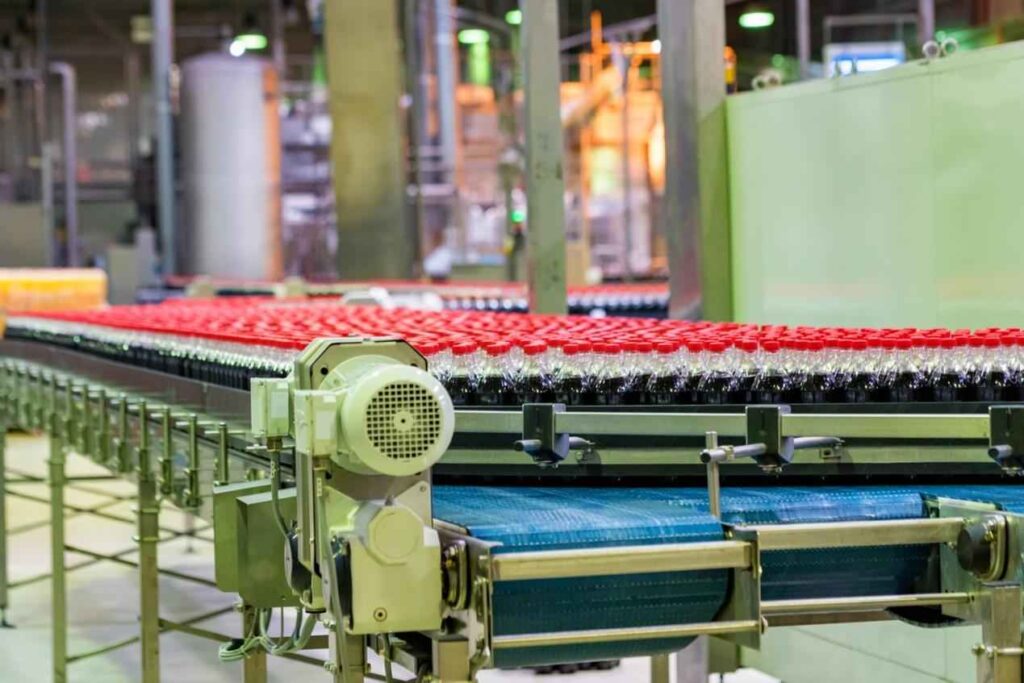
Even with a basic understanding of their benefits, many food producers overlook the full potential of headspace gas analysis. Let’s explore the key roles these analyzers play across the food manufacturing industry.
Why Is Headspace Gas Analysis Crucial for Packaged Food Quality?
Invisible air, visible damage. Even trace amounts of residual oxygen left inside a food package can silently compromise product integrity, shorten shelf life, and lead to spoilage—before the product ever reaches the consumer.
When food is packaged, especially under Modified Atmosphere Packaging (MAP) conditions, the goal is to replace ambient air with a carefully controlled mix of gases—typically nitrogen and carbon dioxide—to inhibit microbial growth and oxidation. However, if this balance is disturbed due to packaging leaks, poor sealing, or inaccurate gas flushing, oxygen levels can rise unnoticed.
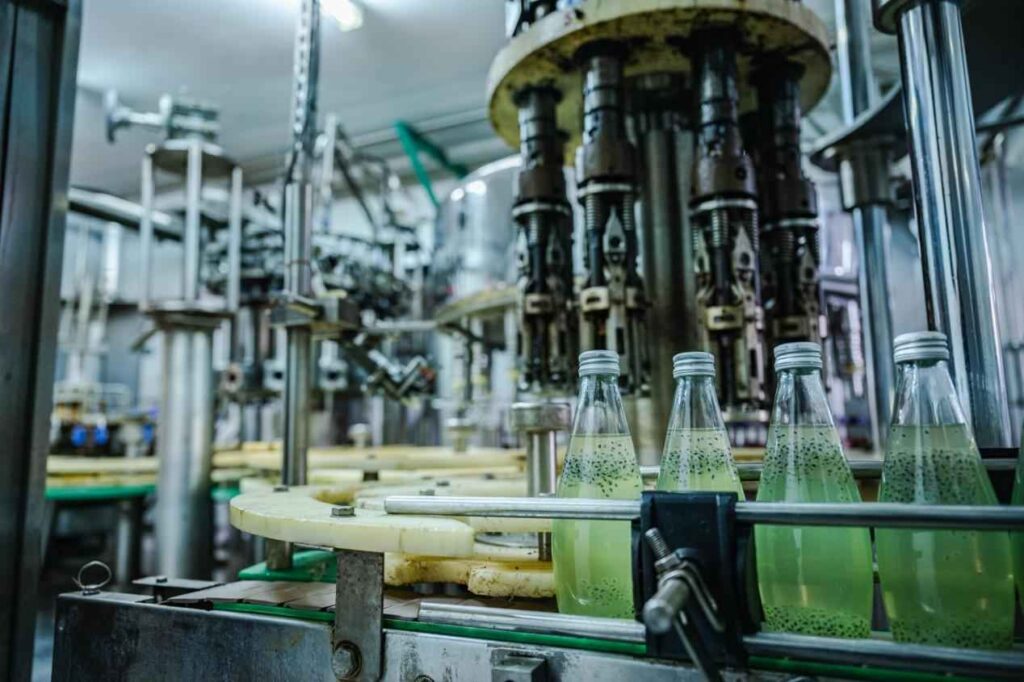
Headspace Gas Analyzers play a vital role by providing accurate, non-destructive measurements of the gases trapped inside sealed packaging. These analyzers detect whether oxygen levels exceed target thresholds or if the gas mixture has drifted from its intended ratio. With real-time data, manufacturers can immediately identify inconsistencies, stop compromised batches, and take corrective action without halting the entire production process.
The impact on food quality is substantial. In meats, excess oxygen leads to discoloration and rancidity. In baked goods, it accelerates mold growth. In dairy, it alters taste and texture. Across all categories, the presence of residual oxygen can destroy sensory appeal and safety. Headspace analysis ensures that every product leaving the factory maintains the quality promised by the brand—fresh, safe, and shelf-stable.
In a competitive market where shelf life, taste, and appearance dictate consumer choice, the cost of guessing is too high. Headspace Gas Analyzers eliminate the guesswork and safeguard quality at scale.
How Do Headspace Gas Analyzers Work in Modified Atmosphere Packaging (MAP)?
The science behind freshness. Modified Atmosphere Packaging (MAP) is only effective if the gas mixture inside each package is precise and stable—but without verification, even the most advanced packaging line becomes a liability.
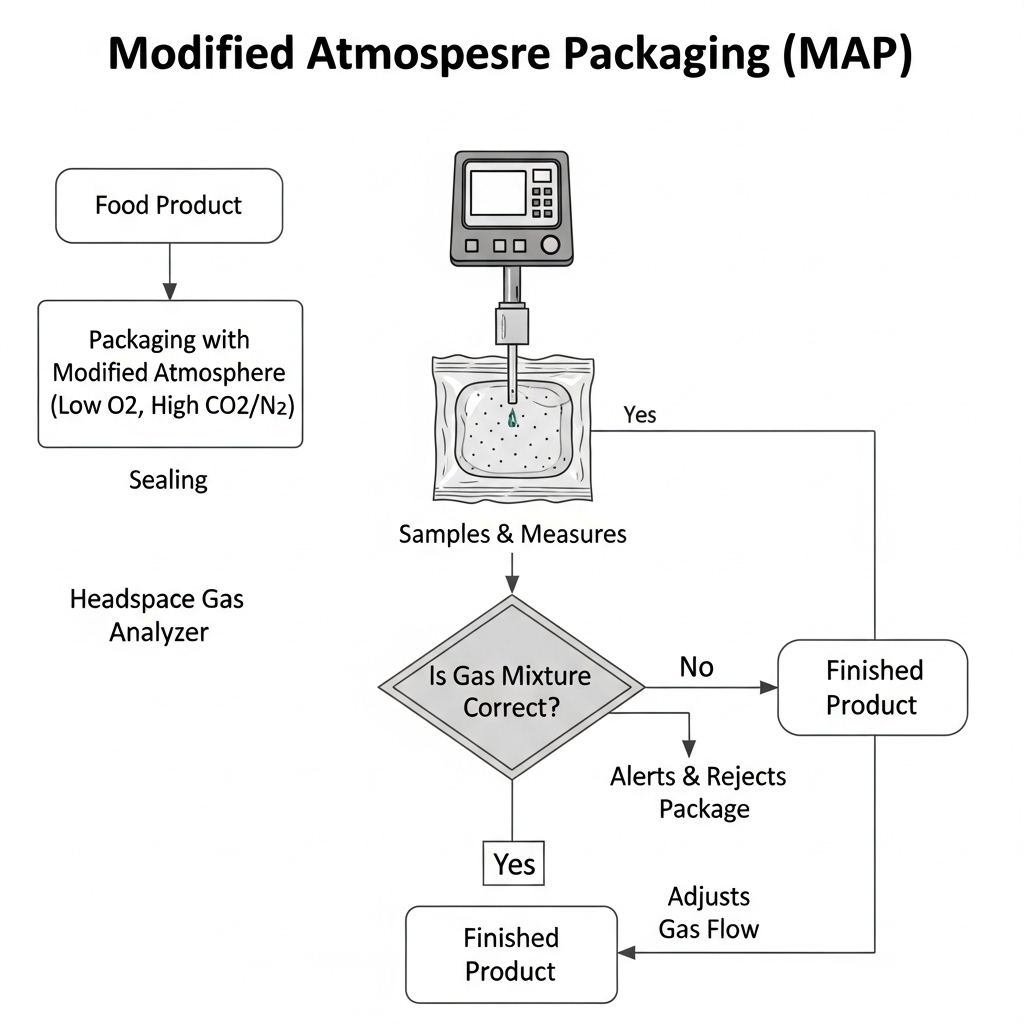
MAP involves replacing the ambient air inside a food package with a specific combination of gases, usually low oxygen and higher levels of carbon dioxide or nitrogen. This artificial atmosphere is engineered to inhibit bacterial growth, prevent oxidation, and extend the shelf life of sensitive products like meats, cheeses, produce, and baked goods.
Here’s where Headspace Gas Analyzers become essential. After a package is sealed, the analyzer samples the internal atmosphere—typically through a small puncture or by non-destructive laser technology—and measures the concentration of gases like O₂, CO₂, and N₂. These measurements are highly precise, often within ±0.1%, and are used to validate that the packaging process is delivering the expected gas composition.
Many systems are fully automated and integrated directly into production lines. This enables continuous sampling without disrupting throughput. If a deviation is detected—such as oxygen levels that are too high—the analyzer can trigger alerts, reject faulty packages, or even adjust upstream gas flow parameters in real time.
Without this closed-loop feedback, manufacturers risk delivering products with suboptimal atmospheres, leading to spoilage, shorter shelf life, and ultimately customer dissatisfaction. Worse yet, the problem may only become evident weeks later, damaging brand reputation and causing product recalls.
Headspace Gas Analyzers ensure that MAP isn’t just a theoretical benefit—it’s a verified, real-time guarantee of food quality and consistency.
What Types of Food Products Benefit Most from Headspace Gas Analysis?
Not all food spoils at the same pace—but all deserve protection. While every packaged food product can benefit from controlled atmosphere packaging, certain categories are far more sensitive to gas composition and require tighter monitoring to maintain quality and safety.
- Meat and Poultry Products
These are among the most oxygen-sensitive items in the food supply chain. Even minimal residual oxygen can lead to rapid microbial growth, off-odors, and discoloration—especially in red meats, where oxygen turns myoglobin brown. Using Headspace Gas Analyzers, producers can ensure oxygen levels remain below the critical thresholds that cause oxidation and spoilage, preserving the meat’s color, texture, and flavor.
- Dairy Products
Cheese, yogurt, and milk-based snacks are highly susceptible to spoilage due to both oxidation and microbial contamination. CO₂ levels must be precisely maintained to inhibit bacteria, while low O₂ levels prevent rancidity in fat-rich items. Gas analysis ensures that dairy products stay within the narrow atmospheric range needed to maintain freshness and extend shelf life.
- Baked Goods and Snack Foods
These typically have low water activity but are still vulnerable to mold and oxidation. For items like bread, pastries, and chips, residual oxygen can accelerate staleness and microbial growth. Headspace Gas Analyzers validate that the packaging contains enough nitrogen to displace oxygen and maintain crispness and flavor.
- Fresh Produce and Pre-Packaged Salads
Fruits and vegetables continue to respire post-harvest, altering the internal atmosphere of sealed containers. Headspace analysis helps maintain the correct balance of O₂ and CO₂ to slow respiration without causing anaerobic conditions, which can degrade texture and taste.
- Ready-to-Eat and Convenience Foods
From sandwiches to sushi, these items often combine protein, carbohydrates, and moisture—all highly reactive to oxygen. By using Headspace Gas Analyzers, manufacturers can verify that the internal environment is tailored for multi-ingredient stability and safety.
Across all these categories, the key value of gas analysis lies in its ability to offer precision at scale. Instead of relying on sampling alone, inline Headspace Gas Analyzers make it possible to verify every unit—offering unmatched consistency in quality assurance for high-volume food production.
How Do These Analyzers Support Regulatory Compliance and Safety?
In food production, safety isn’t just best practice—it’s the law. As global food supply chains grow more complex, regulatory bodies are tightening their oversight on how products are packaged, stored, and monitored. Headspace Gas Analyzers help manufacturers meet these stringent demands with measurable, auditable precision.
Many international standards and food safety programs—such as the FDA’s Food Safety Modernization Act (FSMA), European Union Regulation (EC) No 852/2004, ISO 22000, and HACCP (Hazard Analysis and Critical Control Points)—explicitly or implicitly require monitoring of packaging integrity and control of atmospheric conditions, especially for perishable goods.
One of the core expectations is that manufacturers can demonstrate that their packaging processes consistently deliver products that are safe to consume and shelf-stable. Residual oxygen levels that exceed set limits can not only lead to product degradation but may also trigger regulatory non-compliance, recalls, or export restrictions.
Headspace Gas Analyzers provide the data and documentation needed to prove compliance. Their integration into Critical Control Points (CCPs) within a HACCP plan enables automated monitoring and digital recordkeeping of gas concentration levels for every production batch. This traceability is invaluable during audits or inspections, offering proof that the packaging environment was verified and met required standards.
In addition, many markets—such as organic, baby food, or medical nutrition—have even stricter tolerances for oxygen and CO₂ levels. Gas analyzers ensure that such products meet specific labeling claims and quality certifications, which is critical for both legal protection and brand trust.
In short, Headspace Gas Analyzers not only enhance food safety—they fortify legal compliance, reduce risk exposure, and provide the documentation manufacturers need to operate confidently in a tightly regulated environment.
Can Headspace Gas Analyzers Improve Production Efficiency and Reduce Waste?
Every faulty package is money lost. In a fast-paced food manufacturing environment, even minor inconsistencies in gas composition can lead to large-scale waste, costly recalls, and production delays. Headspace Gas Analyzers help mitigate these risks by embedding quality control directly into the production process—reducing waste while improving efficiency.
Traditionally, gas analysis was conducted manually on random samples pulled from each batch. While this method provided some insight, it couldn’t catch real-time variations or packaging faults that occurred between samples. This left entire runs vulnerable to undetected errors. In contrast, modern Headspace Gas Analyzers can be installed inline, enabling continuous or high-frequency sampling during production.
This real-time feedback loop allows manufacturers to detect anomalies such as leaking seals, misaligned gas injection systems, or faulty packaging equipment as soon as they occur. When oxygen or carbon dioxide levels deviate from set thresholds, automated systems can halt the line, reject the affected packages, or alert operators to make immediate adjustments.
The result is a significant reduction in both product and packaging waste. Instead of discovering issues days later through shelf-life testing or consumer complaints, manufacturers can resolve them on the spot—saving time, materials, and reputational damage.
Furthermore, Headspace Gas Analyzers contribute to process optimization. By analyzing historical gas data, operations managers can fine-tune gas flushing parameters, adjust fill speeds, and improve line balancing. Over time, this leads to more consistent quality, less overuse of protective gases, and lower energy costs.
In industries where margins are tight and volumes are high, these incremental gains quickly add up. With Headspace Gas Analyzers, food producers move from reactive troubleshooting to proactive quality management—turning control into a competitive advantage.
In conclusion, Headspace Gas Analyzers are indispensable tools for any food manufacturer aiming to ensure quality, meet regulations, and operate efficiently. Their role spans far beyond detection—they are guardians of freshness, safety, and brand trust.
If you would like to know more, please contact us and we will reply as soon as possible!