



Running multiple gasifiers but still dealing with unstable readings, clogged sampling lines, or delayed gas analysis? These problems reduce efficiency, increase maintenance costs, and make safe operation much harder.
A modern syngas analyzer combines NDIR, TCD, and electrochemical technologies with dedicated sample conditioning system for the continuous measurement of CO, CO₂, H₂, CH₄, O₂, and H₂S from multiple gasifiers. When paired with independent sampling systems, it delivers accurate, real-time monitoring even in tar-rich, dusty, and high-pressure coal gasification processes.
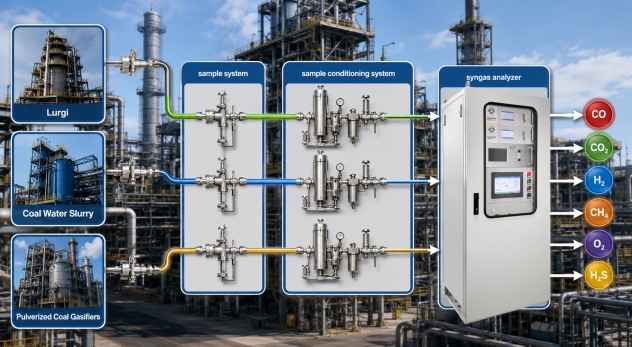
However, sensor technology is only part of the solution. Coal gasification presents one of the most demanding environments for continuous gas analysis. To achieve reliable data, the gas analyzer, sampling system, and gas conditioning unit must work together as a complete syngas process analysis system.
Why Is Multi-Gasifier Monitoring More Challenging Than Monitoring a Single Gasifier?
Operating a single gasifier is already complex. Running several Lurgi, Coal Water Slurry (CWS), or Pulverized Coal (PC) gasifiers in parallel adds another level of difficulty. Each gasifier operates under different process conditions. Feedstock quality changes, oxygen flow varies, and pressure fluctuates throughout production. Shortly, syngas composition can change from one furnace to another within minutes. Operators need continuous, synchronized measurements to optimize gasification efficiency and maintain stable downstream processes.
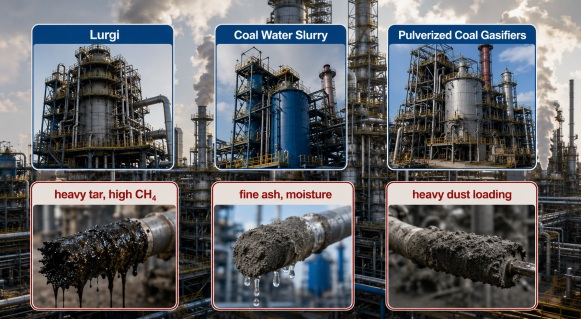
The challenge becomes even greater because each gasifier technology produces different contaminants. For example, Lurgi fixed-bed gasifiers generate syngas with relatively high methane content, making CH₄ an important performance indicator. At the same time, the raw gas contains significant amounts of tar, oils, and condensable hydrocarbons that can quickly foul sampling systems if they are not properly conditioned. In contrast, Coal Water Slurry (CWS) gasifiers produce much finer ash particles, while Pulverized Coal gasifiers often create extremely dusty gas streams with rapidly changing process conditions. These contaminants increase maintenance frequency and reduce analyzer reliability if conventional sampling systems are used. The table below summarizes the main monitoring challenges.
| Gasifier Type | Primary Challenge | Critical Gas Components |
|---|---|---|
| Lurgi Fixed-Bed | Heavy tar, high CH₄ | CO, CO₂, H₂, CH₄, O₂, H₂S |
| Coal Water Slurry | Fine ash, moisture | CO, H₂, O₂, H₂S |
| Pulverized Coal | Heavy dust loading | CO, CO₂, H₂, O₂ |
Consequently, a single gas analyzer connected to multiple shared sampling lines often struggles to provide fast and reliable measurements. Instead, each gasifier requires an independent sampling path and application-specific gas conditioning to ensure that every measurement truly represents the actual process conditions.
Which Gas Components Should a Syngas Analyzer Measure Simultaneously?
An effective syngas analyzer should continuously measure the six key gases that determine gasifier performance, product quality, and plant safety. Since syngas composition varies with feedstock and gasification technology, real-time multi-gas monitoring is essential for stable operation.
- CO – Indicates gasification efficiency and carbon conversion.
- CO₂ – Helps evaluate combustion balance and process optimization.
- H₂ – Measures syngas quality for downstream hydrogen, ammonia, and methanol production.
- CH₄ – Particularly important in Lurgi gasifiers, where higher methane content directly affects heating value and synthetic natural gas (SNG) production.
- O₂ – Detects air leakage and supports safety interlock systems.
- H₂S – Protects downstream equipment from corrosion and helps ensure environmental compliance.
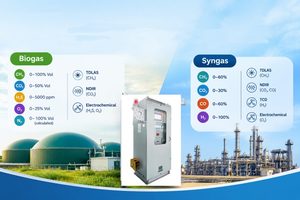
To measure these gases accurately, the syngas analyzer integrates multiple sensing technologies into one platform:
| Gas Component | Measurement Technology | Primary Purpose |
|---|---|---|
| CO, CO₂, CH₄ | NDIR | Process efficiency and heating value |
| H₂ | TCD | High-concentration hydrogen analysis |
| O₂ | TDLAS or Electrochemical or Paramagnetic | Air leakage and safety monitoring |
| H₂S | TDLAS or Electrochemical | Corrosion control and emissions monitoring |
By combining multiple sensing principles, the syngas analyzer delivers synchronized measurements for process control instead of isolated gas readings. Within the entire syngas process analysis system, the syngas analyzer is only one component; there is also a sample conditioning unit for each gasifier.
How Does a Syngas Process Analysis System Prevent Cross-Contamination Between Multiple Gasifiers?
As coal chemical plants expand, many projects operate several gasifiers simultaneously. While sharing one gas analyzer may reduce initial investment, using a common sampling line often introduces a more expensive problem—cross-contamination.
When sample streams from different gasifiers share filters, tubing, or conditioning equipment, residual gas remains inside the pipeline. The next sample may mix with the previous one, producing delayed or inaccurate readings. Even worse, if one sampling line becomes blocked by tar or ash, measurements from the remaining gasifiers may also be interrupted.
To avoid these issues, the syngas process analysis system uses an independent sample conditioning unit for each gasifier. Each sampling path includes its own sample gas probe, heated sampling line, filtration system, moisture removal unit, flow control components, and sampling pump before the gas reaches the gas analyzer. This design offers several advantages:
- Eliminates cross-contamination between gasifiers
- Reduces response time by shortening sample residence time
- Keeps one gasifier online even if another sampling line requires maintenance
- Simplifies troubleshooting and preventive maintenance
- Improves overall measurement reliability
For multi-gasifier projects, independent sampling is not simply a convenience—it is a requirement for reliable process control.
How Does the Syngas Process Analysis System Handle Heavy Tar and Dust?
Sampling is often the weakest part of any syngas monitoring system. Lurgi gasifiers generate sticky tar and condensable hydrocarbons, while Coal Water Slurry and Pulverized Coal gasifiers produce large quantities of fine ash and dust. Without proper gas conditioning, these contaminants clog probes, foul filters, block tubing, and eventually force analyzer shutdowns.
Tar management remains one of the major technical challenges in continuous gasification systems. Instead of relying on simple filtration, the syngas process analysis system uses multiple protection stages.
First, a multi-stage filtration system removes coarse particles before they enter the sampling line.
Next, an automatic blowback system periodically cleans the probe using compressed gas, reducing maintenance and extending filter life.
For tar-rich applications such as Lurgi gasification, steam tracing and heated sampling lines maintain the gas temperature above the tar dew point. This prevents condensation inside the pipeline and preserves the original gas composition during transport.
Finally, the sample conditioning system removes remaining moisture and fine particulates before the gas enters the gas analyzer, protecting sensitive optical components and ensuring stable long-term operation.
As a result, the gas analyzer receives a clean, representative gas sample while the original process remains undisturbed.
What Operational Benefits Does an ESEGAS Integrated Syngas Process Analysis System Deliver?
A complete syngas monitoring solution improves more than measurement accuracy. It also enhances production efficiency, equipment reliability, and plant safety. Compared with conventional monitoring systems, an integrated solution provides measurable operational advantages.
| Operational Challenge | Conventional System | ESEGAS Solution |
|---|---|---|
| Multiple gasifiers | Shared sampling lines | Independent conditioning for each gasifier |
| Heavy tar | Frequent plugging | Steam tracing + automatic blowback |
| Coal dust | High maintenance | Multi-stage filtration |
| Multi-gas monitoring | Multiple analyzers | One integrated analyzer platform |
| O₂ safety | Delayed detection | Fast TDLAS or electrochemical monitoring |
| H₂ measurement | Limited sensor range | Wide-range TCD analysis |
These improvements translate into several practical benefits:
- More stable gasification control
- Faster response to process fluctuations
- Reduced analyzer downtime
- Lower maintenance costs
- Improved operator safety
- Higher availability of critical process data
- Easier integration with PLC and DCS systems for automated control
For large coal chemical complexes operating around the clock, reliable gas analysis directly supports higher plant availability and more consistent product quality.
Conclusion
Accurate syngas monitoring depends on far more than selecting the right syngas analyzer. It requires the right sensing technologies, independent sample conditioning, and a system designed to withstand heavy tar, dust, moisture, and continuously changing process conditions.
The ESEGAS Syngas Process Analysis System combines NDIR, TCD, and TDLAS technologies with dedicated sampling and gas conditioning for each gasifier, providing reliable real-time analysis of CO, CO₂, H₂, CH₄, O₂, and H₂S across even the most demanding coal gasification applications.
If you’re planning a new gasification project or upgrading an existing monitoring system, the ESEGAS engineering team can help you design a customized syngas analysis solution that delivers accurate data, minimizes maintenance, and supports safe, efficient plant operation.
FAQs:
1.Which gas analyzer technology is best for syngas analysis?
There is no single sensing technology suitable for every gas. The most reliable solution combines multiple technologies:
- NDIR for CO, CO₂, and CH₄
- TCD for high-concentration H₂
- TDLAS or Electrochemical sensors for O₂ and H₂S
This multi-technology approach delivers higher accuracy and better long-term stability in complex syngas applications.
2.Why is sample conditioning important in a syngas process analysis system?
Raw syngas often contains tar, dust, moisture, and corrosive compounds that can damage analyzers or affect measurement accuracy. A properly designed sample conditioning system removes contaminants while preserving the original gas composition before it reaches the analyzer.
3.How does a syngas process analysis system prevent cross-contamination between multiple gasifiers?
The most effective solution is to provide a dedicated sample conditioning unit for each gasifier. Independent sampling lines eliminate gas mixing, reduce response time, and ensure that maintenance on one gasifier does not interrupt monitoring of the others.
4.How can a syngas analyzer operate reliably in tar-rich Lurgi gasifiers?
Lurgi gasifiers produce high levels of tar and condensable hydrocarbons that can clog sampling systems. A robust syngas process analysis system typically includes:
- Syngas analyzer
- Multi-stage filtration
- Automatic probe blowback
- Steam tracing
- Heated sampling lines
These features help prevent tar condensation and maintain continuous, stable measurements.
5.Why is methane (CH₄) monitoring especially important in Lurgi gasifiers?
Unlike many entrained-flow gasifiers, Lurgi fixed-bed gasifiers naturally produce higher methane concentrations. Continuous CH₄ monitoring helps operators evaluate gasifier performance, calculate heating value, and optimize Synthetic Natural Gas (SNG) production.
6.Why is oxygen (O₂) monitoring critical in coal gasification?
Even small amounts of oxygen entering a syngas stream can create explosion hazards and reduce gasification efficiency. Continuous O₂ monitoring quickly detects air leakage and supports safety interlock systems before hazardous conditions develop.
7.Can one syngas analyzer monitor multiple gasifiers?
Yes. A single syngas analyzer platform can monitor multiple gasifiers when combined with an automatic sampling system and independent sample conditioning units for each process line. This configuration improves reliability while reducing equipment costs and maintenance.