


Many facilities already invest in air quality monitoring, yet they still struggle to answer a more urgent question: are they actually tracking the gases that matter for climate impact and emissions control? When greenhouse gases are not monitored continuously, small leaks, process inefficiencies, and long-term emission trends can remain hidden until they become compliance, cost, or sustainability problems. At ESEGAS, we see this gap often, which is why we believe an air quality monitoring device should do more than measure general environmental conditions—it should help users turn gas data into actionable greenhouse gas insight.
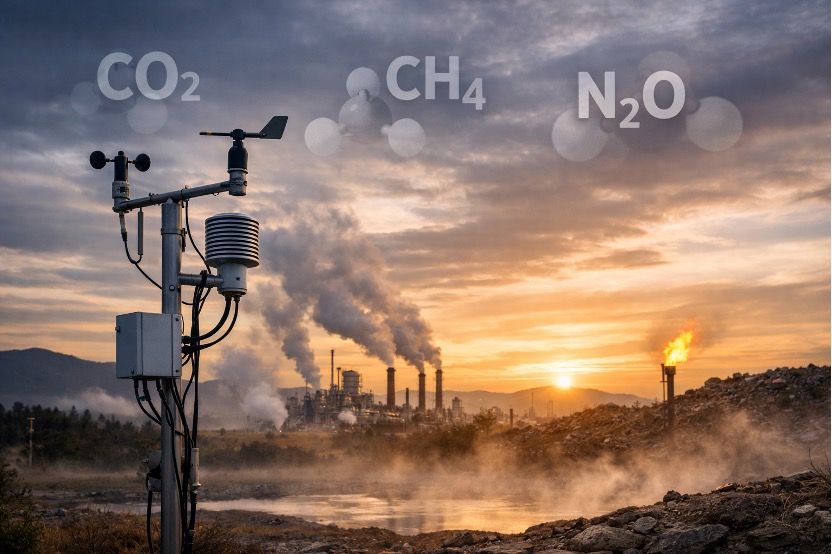
An air quality monitoring device can be used for greenhouse gas monitoring when it is configured to detect and quantify climate-relevant gases such as CO₂, CH₄, and, in some applications, N₂O. In practice, its value comes from continuous measurement, trend analysis, leak identification, emissions management, and data support for environmental reporting. The final performance depends on the target gas, sensing technology, installation location, calibration strategy, and data integration capability. Greenhouse-gas monitoring commonly focuses on gases such as carbon dioxide, methane, and nitrous oxide, and ESEGAS positions its greenhouse gas analyzer platform around this kind of practical measurement demand. (Gas Analyzer Manufacturers)
That direct answer is helpful, but it does not tell the full story. In real projects, the question is not only whether an air quality monitoring device can monitor greenhouse gases, but also which gases should be measured, how measurement works, where the analyzer should be installed, and how the resulting data should be used. That is where application-driven system design matters most.
What greenhouse gases can an air quality monitoring device detect?
A device becomes relevant for greenhouse gas monitoring only when it is designed around the right target gases. Many users begin with CO₂ because it is the most recognized greenhouse gas in industrial, environmental, and building-related applications. But in many field conditions, methane is just as important, especially where leakage, combustion efficiency, waste treatment, oil and gas processes, or coal-related operations are involved. In more advanced monitoring scenarios, nitrous oxide also becomes important.
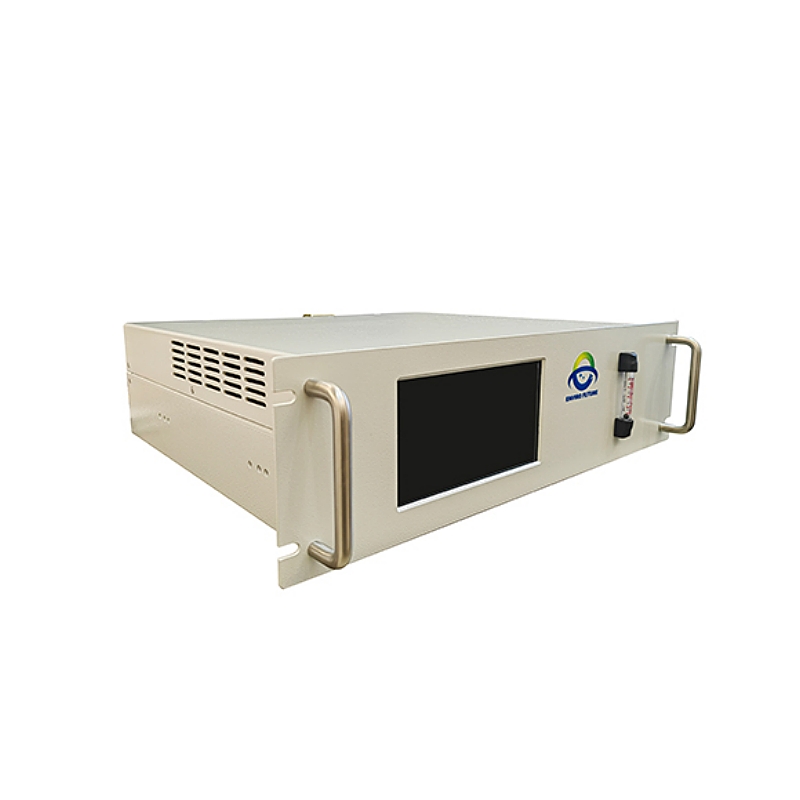
At ESEGAS, we approach this issue from the standpoint of application value rather than generic sensing. Our Greenhouse Gas Analyzer ESE-GH-2080 is described for measuring greenhouse-gas-related components including CO₂, CH₄, CO, and in related product-page descriptions N₂O, with NDIR-based analysis used as a core technical route. The same product page also presents the analyzer as suitable for environmental monitoring, industrial research, agricultural studies, and greenhouse-gas monitoring in typical industries such as thermal power, steel, oil and gas exploration, coal mining, and waste treatment. (Gas Analyzer Manufacturers)
In practical terms, the most useful monitoring targets often include:
- CO₂ for carbon monitoring, combustion assessment, indoor accumulation, and process emissions
- CH₄ for methane leakage detection, landfill gas analysis, biogas applications, and oil & gas monitoring
- N₂O in selected environmental and process-related greenhouse gas studies
- CO as a supporting gas for combustion and process-status interpretation in some industrial settings
This is why we do not view an air quality monitoring device as a single-purpose instrument. When properly specified, it becomes part of a broader greenhouse gas monitoring strategy.
How does an air quality monitoring device measure greenhouse gases?
One of the biggest mistakes in greenhouse gas monitoring is assuming that every air quality monitor works the same way. It does not. Greenhouse gas measurement depends heavily on sensing principle, optical design, range, stability, and the need for field-ready data. Without the right detection method, even a device that appears suitable on paper may underperform in real conditions.
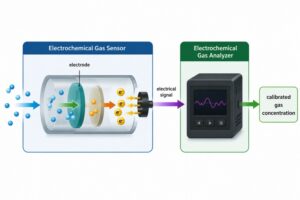
ESEGAS integrates this understanding into product design. On the ESE-GH-2080 product page, we state that the analyzer is mainly based on non-dispersive infrared photoelectric detection technology (NDIR), supported by infrared wavelength filtering technology (GFC) and a self-designed long optical path gas absorption cell, with infrared spectroscopy used to measure gases that have characteristic absorption behavior in the relevant infrared range. The same page lists a response time of ≤60 seconds, indication error of ≤2% FS, drift of ≤±1% FS/24h, and output interfaces including RS-232, RS-485, and 4–20 mA. (Gas Analyzer Manufacturers)
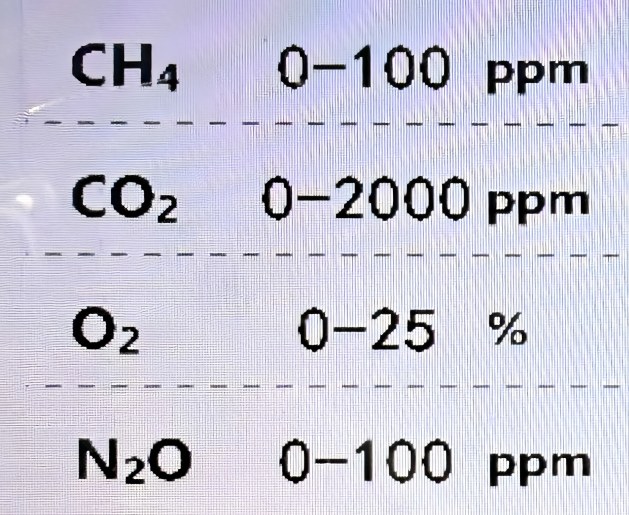
From an application perspective, greenhouse gas measurement usually depends on several factors:
- Target gas and absorption characteristics
Different gases require different optical or sensing strategies. CO₂ and CH₄ are especially well suited to infrared-based detection in many industrial applications. - Measurement range and required precision
A low-level environmental trend study is different from a stationary-source discharge application. Range selection should follow the actual process. - Sampling and gas conditioning
Stable flow, moisture control, and representative sampling are essential for trustworthy data. - Calibration and long-term stability
A greenhouse gas monitoring plan only works when the analyzer maintains repeatability over time. - Output and data integration
Monitoring is far more valuable when concentration data can be transmitted, stored, reviewed, and used for alarms or reporting.
Why is continuous monitoring better than occasional greenhouse gas checks?
Many organizations still rely on periodic spot checks and assume that these are enough. The problem is that greenhouse gas behavior is rarely static. Emissions can drift slowly, spike during process changes, or appear only under certain environmental conditions. When data is collected only occasionally, the most important patterns are often missed.
This is why continuous monitoring creates a major advantage. The ESEGAS product page for the ESE-GH-2080 specifically highlights long-term data storage, extended trend analysis, and historical review, all of which are central to practical greenhouse gas management. ESEGAS also describes the analyzer as helping users make data-driven decisionsto reduce their carbon footprint. (Gas Analyzer Manufacturers)
In real greenhouse gas monitoring programs, continuous data helps users:
- identify abnormal concentration increases earlier
- detect leakage or process inefficiency faster
- compare baseline and post-improvement performance
- build traceable historical records
- support internal environmental management and external reporting
For us at ESEGAS, this is where an air quality monitoring device becomes more than a sensor. It becomes a decision-support tool.
Where should greenhouse gas monitoring devices be installed?
Even a high-quality analyzer can produce weak results if it is installed in the wrong location. Users often focus on device specifications first, but placement has an equally strong influence on whether the final data is meaningful. Poor installation can lead to diluted samples, missed leaks, false trends, or maintenance difficulties.
The correct installation point depends on the monitoring objective. In our experience, users should begin with the question: what exactly are we trying to understand?
| Monitoring goal | Recommended installation logic |
| Process or stack emission tracking | Near discharge outlet or controlled sampling point |
| Boundary or ambient impact monitoring | At plant perimeter or representative outdoor location |
| Methane leak awareness | Near storage, transport, waste, or gas-handling areas |
| Indoor greenhouse gas buildup | In enclosed process areas or occupied zones |
| Long-term environmental trend analysis | At stable, representative locations with minimal disturbance |
Because the ESE-GH-2080 is positioned by ESEGAS for greenhouse gas applications across environmental monitoring and multiple industries, installation planning should always be tied to the process, gas behavior, and data objective—not just to available mounting space. (Gas Analyzer Manufacturers)
What data matters most in greenhouse gas monitoring?
Some users focus only on the live concentration number on the screen. That is understandable, but it is not enough for serious greenhouse gas management. A single reading may show current conditions, yet it does not explain whether emissions are rising, repeating, seasonal, or linked to a process event.
At ESEGAS, we recommend paying attention to a broader data picture:
- Instant concentration to understand current gas conditions
- Trend lines over time to identify drift, recurring peaks, or improvement
- Historical records to support review and audits
- Alarm thresholds to catch abnormal events quickly
- Integrated outputs for connection to control systems, data platforms, or reporting workflows
This aligns with how we present the ESE-GH-2080: not only as a gas analyzer, but as a tool that supports long-term storage, historical analysis, and repeatable measurement for greenhouse gas decision-making. (Gas Analyzer Manufacturers)
How do you choose the right air quality monitoring device for greenhouse gas applications?
The wrong selection usually happens when buyers choose by product category alone. A device labeled “air quality monitor” may not be suitable for greenhouse gas work unless its gas list, range, technology, and operating design match the application. That creates unnecessary cost, weak data, and avoidable rework.
At ESEGAS, we recommend selecting a greenhouse gas monitoring solution by reviewing the following points:
- Which gas or gases must be measured?
CO₂ alone, or CO₂ with CH₄, CO, or N₂O? - What concentration range is expected?
The ESE-GH-2080 page lists ranges such as (0–10/50/500/2000) ppm, with customization available. (Gas Analyzer Manufacturers) - What level of precision and response is required?
Environmental trend analysis and process control may require different priorities. - Is the project fixed-site, process-integrated, or research-oriented?
This affects installation, interface requirements, and maintenance planning. - How will the data be used?
Local indication only, or transmission into a larger environmental management system?
For greenhouse gas applications, we believe the best choice is rarely the most generic device. It is the analyzer that matches the actual monitoring objective most closely.
How does ESEGAS support greenhouse gas monitoring projects?
Greenhouse gas monitoring works best when instrumentation is chosen with both gas-analysis expertise and field use in mind. At ESEGAS, our role is not limited to supplying a device. We aim to help users align target gases, detection principles, system outputs, and application needs into a workable monitoring solution.
Our Greenhouse Gas Analyzer ESE-GH-2080 is positioned on our product platform for measurement of greenhouse-gas-related components using NDIR-based analysis, with application references spanning environmental monitoring, industrial research, agriculture, climate-related study, and multiple industrial sectors. We present the analyzer with features such as high precision, good stability, rapid response, long-term storage capability, and standard industrial outputs, which makes it a strong fit for users seeking practical greenhouse gas data rather than isolated readings. (Gas Analyzer Manufacturers)
For customers evaluating how an air quality monitoring device can contribute to greenhouse gas monitoring, this is the perspective we bring: measure the right gases, with the right method, in the right place, and use the data in a way that improves both environmental understanding and operational control.
Conclusion
An air quality monitoring device can absolutely be used for greenhouse gas monitoring—but only when it is designed and deployed with that purpose in mind. The real question is not simply whether the device can detect gas, but whether it can monitor the right greenhouse gases, with the right sensing technology, installation strategy, and data value.
At ESEGAS, we view greenhouse gas monitoring as a practical combination of accurate gas analysis, long-term data visibility, and application-focused system design. By integrating solutions such as our Greenhouse Gas Analyzer ESE-GH-2080 into the monitoring workflow, users can move beyond basic air observation and build a more meaningful foundation for emissions awareness, trend analysis, and environmental decision-making. (Gas Analyzer Manufacturers)
FAQs
1. Can an air quality monitoring device really measure greenhouse gases?
Yes, it can—provided the device is designed for greenhouse gas analysis rather than only for conventional air pollutants. In practical applications, an air quality monitoring device can be configured to measure gases such as CO₂and CH₄, and in some cases N₂O, depending on the sensing technology, range, and monitoring objective. At ESEGAS, we recommend matching the analyzer configuration to the actual greenhouse gas application instead of relying on a general-purpose monitor.
2. Which greenhouse gases are most important to monitor?
The most commonly monitored greenhouse gases are carbon dioxide (CO₂), methane (CH₄), and nitrous oxide (N₂O). However, the priority depends on the industry and process. For example, CO₂ is often central in combustion and environmental monitoring, while CH₄ is especially important in landfill, biogas, oil and gas, and coal-related applications. In some industrial projects, supporting gases such as CO can also help interpret process conditions.
3. What is the difference between air quality monitoring and greenhouse gas monitoring?
Air quality monitoring often focuses on pollutants that affect health and local environmental conditions, such as particulate matter, VOCs, SO₂, NOx, or ozone. Greenhouse gas monitoring, by contrast, focuses on gases that contribute to climate impact and long-term emissions management, especially CO₂, CH₄, and N₂O. In many projects, the two overlap, but they are not identical. That is why choosing the right analyzer matters.
4. Why is continuous greenhouse gas monitoring better than manual sampling?
Manual checks provide only isolated readings, while continuous monitoring reveals trends, abnormal events, and recurring emission patterns. This is especially important when greenhouse gas concentrations fluctuate during process changes, equipment startups, or leakage events. At ESEGAS, we see continuous monitoring as a more reliable foundation for environmental management, historical analysis, and data-driven emissions control.
5. Where should a greenhouse gas analyzer be installed?
The installation point depends on the monitoring goal. If the objective is process emission tracking, the analyzer should be placed near a representative sampling point or discharge location. If the goal is ambient or boundary monitoring, it should be installed in an area that reflects actual environmental conditions. For methane-focused applications, placement near potential leak sources is often critical. Proper installation is just as important as the analyzer itself.
6. How do I choose the right greenhouse gas analyzer?
The selection should start with the target gas, expected concentration range, required accuracy, and the intended use of the data. Buyers should also consider response time, output interfaces, operating environment, maintenance needs, and whether the system is for fixed installation or integrated process monitoring. At ESEGAS, we recommend choosing a greenhouse gas analyzer based on application requirements rather than product category alone.
7. Is CO₂ monitoring alone enough for greenhouse gas management?
Not always. CO₂ is an essential greenhouse gas and often the first parameter users monitor, but it may not be sufficient in applications where methane or nitrous oxide plays a major role. For example, waste treatment, natural gas handling, and certain industrial or agricultural settings may require CH₄ or N₂O monitoring as well. A complete greenhouse gas strategy depends on the actual emission profile of the site.
8. How can ESEGAS support greenhouse gas monitoring projects?
At ESEGAS, we support greenhouse gas monitoring by combining gas analysis expertise with application-focused product design. Our greenhouse gas analyzer solutions are intended to help users measure relevant gases, collect stable data, review long-term trends, and improve the practical value of monitoring results. Our goal is not only to provide instrumentation, but to help customers build a more useful and reliable greenhouse gas monitoring approach.