



Ammonia production depends on tight control of gas composition from reforming through synthesis. Unstable gas composition can reduce ammonia yield, waste energy, and disrupt catalyst performance. An industrial process gas analyzer provides continuous data to keep critical process streams under control.
Industrial process gas analyzers with different technologies monitors key gases such as H₂, N₂, NH₃, CO, CO₂, and CH₄ across ammonia production units. Continuous composition data helps operators control reforming, shift conversion, gas purification, synthesis, and purge streams for stable and efficient plant operation.
Ammonia production is not controlled at one measurement point. Gas composition changes significantly from feed preparation to synthesis and recycle. Therefore, the right analyzer strategy must follow the process and measure the gases that matter at each critical stage.
Why Are Industrial Gas Analyzers Critical to Ammonia Production?
Industrial gas analyzers are critical because ammonia production depends on gas composition, not simply gas flow. Operators need to know what is actually in the process stream before they adjust temperature, steam, air, purge, or recycle conditions.
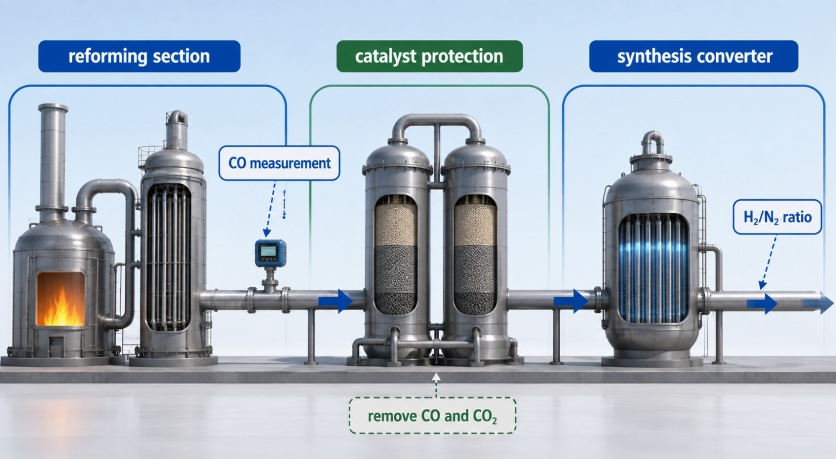
The value becomes clear in the reforming section. Residual methane after reforming can indicate incomplete conversion, while CO measurement helps evaluate the gas entering the shift converters. At the shift stage, CO analysis shows how effectively the process converts CO into additional H₂ and CO₂.
The next concern is catalyst protection. Before ammonia synthesis, the process must remove CO and CO₂ to very low levels because these compounds can damage or disrupt the synthesis catalyst and downstream operation. Continuous analysis therefore provides an early warning before a small composition change becomes a larger process problem.
At the synthesis converter, the focus shifts again. The feed should maintain an H₂/N₂ ratio close to the required stoichiometric relationship.
The important point is that the gas analyzer does not operate in isolation. Each measurement should answer a specific process question.
Which Gases Should Industrial Process Gas Analyzers Measure in an Ammonia Plant?
There is no single gas list that fits every ammonia plant. The required components depend on the measurement point, process design, feedstock, and control objective. However, H₂, N₂, CO, CO₂, CH₄, and NH₃ are among the most important gases for process monitoring.
| Gas | Typical Measurement Point | Why Measure It? |
|---|---|---|
| H₂ | Synthesis gas / recycle | Monitor synthesis-gas composition (ammonia synthesis reaction: N₂ + 3H₂ → 2NH₃) |
| N₂ | Secondary reformer / synthesis feed | Control H₂/N₂ balance |
| CH₄ | Reformer outlet / purge | Check methane conversion and inert buildup |
| CO | Reformer / shift converter / methanator | Evaluate conversion and catalyst protection |
| CO₂ | Shift outlet / CO₂ removal | Check shift and CO₂ removal performance |
| NH₃ | Converter outlet / synthesis loop | Evaluate ammonia conversion |
| Ar | Synthesis loop / purge | Track inert accumulation |
| H₂O | Reforming and process streams | Support process and dry/wet-basis analysis |
Ultimately, the best industrial process gas analyzer for ammonia production is not the one that measures the largest number of gases. It is the system that measures the right gases, at the right process points, with the right ranges and sampling configuration. This principle provides the foundation for selecting suitable gas analyzer technologies for the different sections of an ammonia plant.
Which Gas Analyzer Technologies Are Suitable for Ammonia Production?
There is no single analyzer technology that fits every ammonia process stream. The better approach is to match the target gas, concentration range, process conditions, and response requirement with the appropriate measurement principle. Ammonia plants commonly use several technologies across reforming, shift conversion, purification, synthesis, recycle, and purge streams.
| Technology | Typical Ammonia Plant Gases | Best Fit |
|---|---|---|
| NDIR | CO, CO₂, CH₄ | Continuous measurement of infrared-active gases |
| TCD | H₂ and mixed gases | Process composition and H₂ measurement |
| TDLAS | NH₃, CO, CO₂, CH₄, O₂ | Fast, selective measurement |
| FTIR | NH₃ and multiple IR-active gases | Multi-component analysis |
| GC | H₂, N₂, CH₄, CO, CO₂, Ar, NH₃ | Detailed composition analysis |
| Electrochemical / Paramagnetic | O₂ | Oxygen monitoring |
The practical rule is simple: choose the technology around the process question, not around the gas analyzer name.
How Does ESEGAS Design Industrial Process Gas Analyzers for Ammonia Production?
The design starts with four questions:
What gas needs to be measured? Where is it measured? What are the operating conditions? How will the plant use the result?
ESEGAS then matches the measurement technology and sampling system to those requirements.
| Process Area | Main Measurement Focus | Possible Technology |
|---|---|---|
| Reformer outlet | CH₄, CO, H₂ | 1 NDIR + 1 TCD |
| Shift converter | CO, CO₂ | 1 NDIR |
| CO₂ removal outlet | CO₂, CO | 1 NDIR / 2 TDLAS |
| Methanator outlet | CO, CO₂, CH₄ | 1 NDIR / 3 TDLAS |
| Synthesis feed | H₂, N₂ | 1 TCD /1 GC |
| Converter outlet | NH₃, H₂, N₂ | 1 TDLAS / 1 FTIR / 1 GC |
| Recycle gas | H₂, N₂, CH₄, Ar | 1 GC / 1 TCD |
| Purge gas | H₂, N₂, CH₄, Ar | 1 GC / 1 TCD |
The exact configuration should be finalized from the customer’s process data rather than copied from a standard template.
ESEGAS has developed multiple sensing technologies. For ammonia production, that flexibility is important because CO₂, CH₄, H₂, NH₃, and O₂ do not present the same measurement challenge. The result is a more practical design:
Target gas → Suitable technology → Suitable sampling → Stable measurement → Useful process data
For procurement managers, this also makes technical specifications easier to define. For distributors, it provides room to adapt the gas analyzer configuration to different ammonia-plant designs.
Conclusion
Industrial process gas analyzers support ammonia production by turning gas composition into actionable process information. The most effective system combines the right gas analyzer technology with proper sampling, conditioning, calibration, and plant integration.
NDIR, TCD, TDLAS, FTIR, and GC each have a specific role. Therefore, the best solution is rarely a single technology. ESEGAS combines multiple sensing principles and application-based system design to match gas analyzer performance with the actual ammonia process.