



Nitric acid plants can produce rapidly changing nitrous oxide emissions, particularly when production load or abatement performance changes. If the monitoring system cannot capture these variations, annual greenhouse-gas reports may understate important operating periods or rely on data that is difficult to defend. A complete monitoring design must therefore measure both concentration and the gas quantity needed to calculate emissions.

For covered EU installations, nitric acid production must use continuous emissions measurement for N₂O. The system should determine representative N₂O concentration after any relevant abatement equipment, combine it with flue-gas flow, cover both abated and unabated conditions, and produce validated mass-emission data for reporting.
This means that selecting an N₂O analyzer is only one part of the project. Sampling location, range selection, moisture treatment, gas-flow determination, quality assurance and data handling all influence whether the reported annual result is complete.
What Sources Must Be Included in the Monitoring Boundary?
Measuring only the normal outlet of one production train can omit bypasses, parallel trains or emissions associated with control equipment. These omissions become significant when the plant calculates annual totals. A source inventory prevents apparently small gaps from becoming reporting weaknesses.
The EU ETS Monitoring and Reporting Regulation identifies production-process emissions arising from:
- Catalytic oxidation of ammonia.
- NOₓ or N₂O abatement units.
- Each relevant production train or emission source.
- Periods when abatement is operating.
- Periods when emissions are unabated or control performance changes.
The provisions discussed here concern process N₂O from the listed chemical production activity, not N₂O produced by ordinary fuel combustion.
Each source should be recorded with its operating mode, duct arrangement, abatement equipment, expected concentration range, flow-determination method and connection to the plant’s reporting system.
Where Should N₂O Be Measured?
A convenient sample port may not provide a representative result. Poor mixing, air ingress or sampling before the final abatement stage can bias the measured concentration and weaken the link between the data and actual atmospheric discharge.
For each source, the measurement-based methodology should use a representative post-abatement sampling point where abatement is installed. The site assessment should consider:
- Duct geometry and upstream disturbances.
- Homogeneity of concentration and velocity.
- Distance from reagent injection or catalyst stages.
- Possible dilution from leakage or purge air.
- Temperature, pressure and moisture.
- Access for calibration and reference testing.
- Sample-line length and response time.
- Safe maintenance under plant operating conditions.
A traverse or flow-profile assessment may be needed to demonstrate that the location represents the full gas stream. If the flow is not homogeneous, the monitoring approach and uncertainty assessment must account for it.
Which Analyzer Technology Is Suitable for N₂O?
An analyzer selected only for its nominal gas list may encounter interference, saturation or unstable sample conditions. Nitric acid tail gas can contain water vapour, NOₓ, oxygen and changing N₂O concentrations, so the analytical method must be validated in the real matrix.
Possible measurement approaches include:
- FTIR: Measures multiple infrared-active gases and can include N₂O, NO, NO₂, water vapour and other configured components.
- Dedicated infrared analysis: Can provide continuous N₂O measurement where range, interference and moisture effects are properly addressed.
- Reference laboratory or periodic methods: Useful for verification, but they do not replace continuous measurement where it is required.
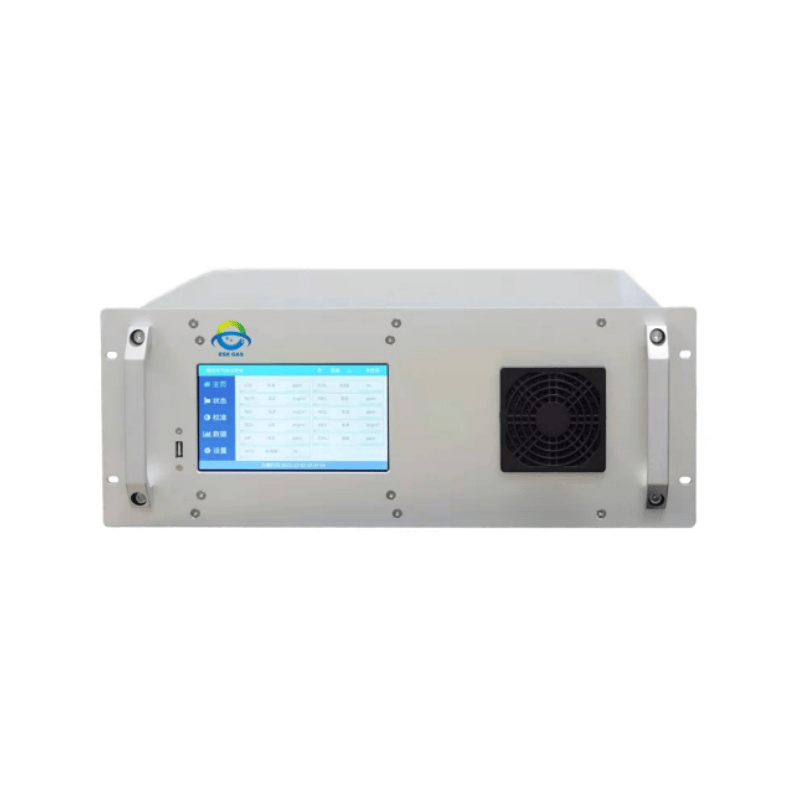
Our ESEGAS FTIR CEMS can be configured for N₂O and other relevant infrared-active gases. Before proposing a configuration, we review the expected minimum and maximum concentrations, interferents, moisture, sampling temperature and required validation procedure. Inclusion on an analyzer’s gas list alone should never be treated as proof that it meets a particular monitoring plan.
Why Is Concentration Measurement Alone Insufficient?
A concentration can fall while the total emitted mass rises if production and exhaust flow increase. Reporting concentration without flow therefore gives an incomplete picture and can misrepresent the effect of plant-load changes.
Hourly N2O emissions are derived from concentration and the corresponding gas volume. The monitoring system should consequently align:
| Parameter | Monitoring purpose |
|---|---|
| N₂O concentration | Determines the fraction of N₂O in the exhaust |
| Flue-gas flow | Converts concentration into an emission rate |
| Oxygen concentration | Supports indirect flow determination where applicable |
| Moisture | Enables consistent wet-to-dry correction |
| Temperature and pressure | Supports flow normalisation |
| Operating status | Distinguishes production, shutdown and abnormal periods |
| Production rate | Supports plausibility checks and performance analysis |
For nitric acid production, the regulation provides an input-air method for determining flow and allows an alternative approach where the prescribed method is technically infeasible and approved by the competent authority. Continuous flue gas flow measurement may therefore be part of an approved alternative rather than the automatic choice for every plant.
All connected parameters must use compatible timestamps, reference conditions and averaging periods.
How Should Moisture and Reference Conditions Be Managed?
Mixing wet and dry concentration data can introduce a systematic reporting error that remains hidden throughout the year. The risk increases when moisture changes with plant load or when different instruments apply corrections independently.
Measurements should be adjusted to a dry gas basis where required and reported consistently. Plants should document:
- Whether N₂O is measured on a wet or dry basis.
- How water vapour is measured or removed.
- The location of moisture measurement.
- Temperature and pressure reference conditions.
- Correction equations used by the data system.
- Treatment of condensate in extractive systems.
- Whether soluble or reactive co-measured gases could be lost during drying.
A hot-wet FTIR configuration retains water in the sample and can measure it alongside other gases. A cold-dry configuration removes moisture before analysis but requires documented correction and confirmation that the target measurement remains representative.
How Can One System Cover Abated and Unabated Conditions?
A range selected for normal catalyst performance may saturate during startup, bypass or abatement failure. A high range selected only for upset conditions may provide poor resolution during stable operation. Either mismatch can create gaps precisely when emissions change most.
The system should be capable of measuring all relevant sources during both abated and unabated operation. Depending on the application, this may require:
- Multiple analytical ranges.
- Automatic range switching with documented logic.
- Controlled dilution.
- Separate channels for different emission points.
- Validation at low and elevated concentrations.
- Alarm handling for over-range conditions.
- Response-time testing through the complete sample path.
- Recording of catalyst bypass and plant operating status.
Range transitions should be included in quality testing rather than assessed only after an abnormal event occurs.
How Should Data Quality and Missing Periods Be Controlled?
A year of high analyzer availability can still contain invalid results if drift, calibration failure or communication faults are not identified correctly. Clear rules make it possible to distinguish genuine emission changes from measurement-system problems.
The monitoring plan should define:
- Zero and span checks.
- Calibration and reference-test schedules.
- Drift and range acceptance criteria.
- Maintenance and out-of-control periods.
- Analyzer, flow and oxygen status flags.
- Procedures for failed calibrations.
- Data substitution rules for missing concentration or supporting parameters.
- Retention of raw signals and calculated results.
- Uncertainty assessment.
- Access control and audit trails.
The data-acquisition system should calculate and retain the hourly values used to build the annual total. Operators should also compare N₂O trends with production rate, ammonia input and abatement status to identify implausible results.
What Should Be Confirmed Before Configuring the CEMS?
Starting with a generic instrument specification can leave essential monitoring-plan decisions unresolved. A short design review helps align the analytical package with both process conditions and reporting duties.
Before selecting the system, confirm:
- Every included production unit and emission source.
- Applicable permit and approved monitoring plan.
- Expected abated and unabated N₂O ranges.
- Gas matrix, moisture and temperature.
- Sampling location and flow profile.
- Flow-determination method.
- Required reference conditions.
- Complementary measurements such as O₂ or H₂O.
- Calibration and verification procedures.
- Data interfaces, calculations and record retention.
Reliable N₂O reporting requires a coordinated measurement chain rather than a standalone analyzer. At ESEGAS, we approach nitric-acid applications by matching the analyzer, heated sampling path, supporting flow and oxygen measurements, and data system to the approved monitoring method. This helps plants obtain continuous results that remain representative during stable production, abatement changes and abnormal operating periods.