



Air-quality authorities face a difficult balance: they must prepare for stricter European rules while continuing to operate networks designed under earlier requirements. Replacing instruments too early can waste public investment, but waiting until national rules are finalised may leave too little time to review station locations, measurement methods and data systems. A structured readiness assessment allows authorities to identify real gaps before committing to a network-wide upgrade.
AQMS networks should prepare by reviewing zone classifications, regulated pollutants, sampling-point coverage, instrument approval, measurement quality and reporting capability against the revised EU framework. The appropriate response is a risk-based network upgrade, not the automatic replacement of every existing analyzer or station.
pic source: EU Environment
The practical challenge is that compliance depends on the complete monitoring architecture. A suitable analyzer can still produce unusable regulatory data if it is installed at an unrepresentative site, operated without adequate quality controls or connected to a reporting system that cannot preserve the required time resolution and validation status.
What Changes Should AQMS Operators Review Before December 2026?
A network that focuses only on the new 2030 concentration limits may miss earlier implementation responsibilities. This can create a gap between the instruments installed and the assessment approach required by national authorities. Reviewing the complete legal framework helps operators separate immediate preparation from longer-term attainment planning.
Directive (EU) 2024/2881 must be transposed by Member States by 11 December 2026, with specified provisions applying from 12 December 2026. It introduces or strengthens several areas relevant to monitoring networks:
- Revised air-quality standards to be attained by 2030.
- Classification of zones using defined assessment thresholds.
- Greater integration of fixed measurements, indicative measurements and modelling.
- Additional attention to air-pollution hotspots.
- Requirements for urban and rural background monitoring supersites.
- Reference measurement methods and equipment-performance expectations.
- More consistent public information and electronic reporting.
- Measurement of emerging pollutants and atmospheric characteristics at selected sites.
The directive applies through national implementation, so operators should also track the laws, technical instructions and approval procedures adopted in each Member State.
How Do Zone Classifications Affect the Monitoring Strategy?
Installing the same number and type of stations in every area can create poor coverage and unnecessary cost. Pollution levels, population exposure and existing evidence differ between zones, so the assessment method must reflect the local classification.
Where concentrations are above the applicable assessment thresholds, fixed measurements form the core of the assessment. Modelling or indicative measurements can supplement them by showing spatial distribution and helping authorities evaluate whether fixed sampling points are representative.
In lower-concentration zones, modelling, indicative measurements, objective estimation or a combination of these methods may be sufficient. Operators should therefore document:
- The pollutants assessed in each zone.
- Historical concentration data used for classification.
- Locations of population exposure and likely hotspots.
- The spatial area represented by each fixed station.
- Gaps identified through dispersion modelling or mobile surveys.
- Industrial, traffic and background contributions.
- Changes in land use, transport or major emission sources.
This review should be completed before deciding whether the network needs additional stations, relocated inlets or supplementary sensors.
Which Pollutants Should Different AQMS Stations Measure?
Adding every possible instrument to every shelter would be expensive and technically unnecessary. The required pollutant list depends on the station’s purpose, the zone and the relevant annexes of the directive.
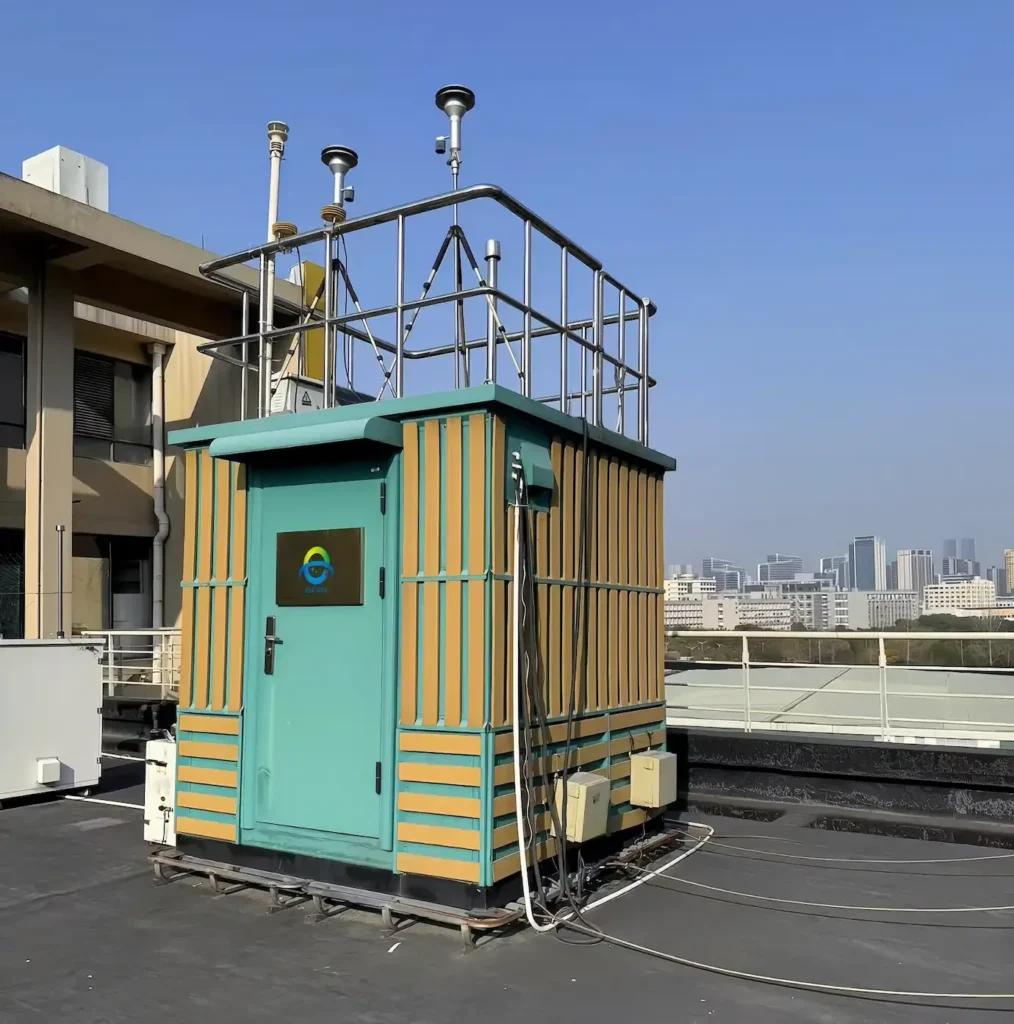
A practical measurement map may distinguish between the following roles:
| Station role | Typical measurement priorities |
|---|---|
| Urban traffic station | NO₂, CO, PM₂.₅, PM₁₀ and locally relevant pollutants |
| Urban background station | PM, O₃, NO₂, SO₂, CO and benzene where required |
| Industrial or hotspot station | Pollutants linked to the local source and exposure pathway |
| Rural background station | Regional O₃, particulate matter, nitrogen compounds and long-range transport indicators |
| Urban supersite | Core pollutants plus black carbon, ultrafine particles, chemical PM composition and selected deposited substances |
| Rural supersite | Core pollutants plus ammonia, ultrafine particles, black carbon and wider atmospheric-composition measurements |
Monitoring supersites have a broader scientific and policy role than ordinary compliance stations. For example, the directive identifies fixed measurements for PM₁₀, PM₂.₅, ultrafine particles, black carbon, NO₂ and O₃ at urban background supersites, while other components may use fixed or indicative measurements.
At ESEGAS, we recommend creating a station-by-station measurement matrix before selecting or expanding an AQMS configuration.
How Should Analyzer Technology and Reference Methods Be Reviewed?
An instrument may measure the correct pollutant yet still be unsuitable for official reporting. If its measurement principle, approval evidence or performance has not been assessed against the applicable method, replacing an older analyzer with a newer model may not improve regulatory defensibility.
The revised framework requires Member States to apply specified reference measurement methods. Alternative methods may be accepted where the required conditions and equivalence are demonstrated.
The review should cover:
- The applicable method for each pollutant.
- Required measuring range and detection capability.
- Type-approval or performance-test evidence.
- Demonstration of equivalence where an alternative method is used.
- Environmental sensitivity to temperature, humidity and pressure.
- Zero and span facilities.
- Data capture, averaging and status-flag functions.
- Availability of traceable calibration standards.
- Maintenance and spare-part support.
ESEGAS AQMS solutions can combine technologies such as chemiluminescence, UV fluorescence, UV absorption and NDIR according to the target pollutant. The final configuration must still be matched to the applicable national approval and project requirements.
How Can Networks Meet Data Quality Objectives?
A station may operate continuously while still losing a significant amount of valid data through calibration failures, inlet contamination or poorly documented maintenance. These weaknesses become more serious when data is used to classify zones, identify exceedances or inform the public.
Data quality objectives should be translated into operating controls for the complete measurement chain:
- Establish preventive maintenance intervals for each analyzer.
- Record zero, span and multipoint checks.
- Verify sampling manifolds, inlet height and residence time.
- Synchronise analyzer, meteorological and data-system clocks.
- Retain raw values, validated values and status flags.
- Define rules for invalidation and data substitution.
- Track data capture by pollutant and station.
- Document software changes and configuration access.
- Review uncertainty and equivalence evidence.
- Participate in intercomparison or quality-assurance programmes where required.
Ozone precursor monitoring and expanded supersite measurements may also require sampling, laboratory analysis and data workflows beyond conventional continuous gas analyzers. These functions should be designed as part of one network rather than as disconnected projects.
What Is the Most Practical AQMS Upgrade Sequence?
Buying equipment before the assessment strategy is settled can lock a network into the wrong ranges, station design or communication architecture. A phased sequence makes procurement easier to justify and reduces the risk of stranded instruments.
We recommend the following approach:
- Phase 1 — Legal mapping: Convert the directive and emerging national rules into a pollutant-by-pollutant requirement register.
- Phase 2 — Network audit: Review zone classification, site purpose, coverage and historical data.
- Phase 3 — Equipment gap analysis: Compare installed analyzers with required methods, performance and approval evidence.
- Phase 4 — Data review: Test acquisition, validation, public reporting and archiving functions.
- Phase 5 — Pilot upgrades: Upgrade the highest-risk stations first and verify performance under real conditions.
- Phase 6 — Network rollout: Standardise successful configurations while retaining site-specific flexibility.
- Phase 7 — Ongoing review: Reassess classifications and station coverage when pollution sources or urban conditions change.
The revised directive makes representative, comparable and transparent air-quality information more important than simply increasing the number of instruments. At ESEGAS, we recommend beginning with the measurement purpose of every station, then selecting analyzers, sampling systems, calibration equipment and data infrastructure as one integrated AQMS. This creates a more defensible path toward national implementation in 2026 and the tighter air-quality objectives ahead.