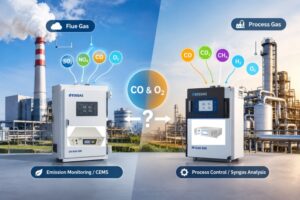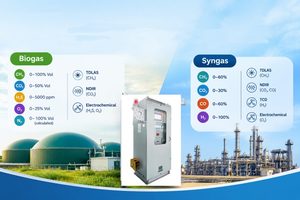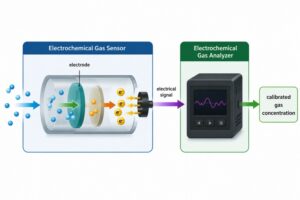




Industrial operators today are under constant pressure to meet stricter emission targets while keeping their processes efficient, stable, and cost-effective. In exhaust gas monitoring, that pressure becomes even greater when traditional measurement methods struggle with slow response times, cross-interference, or unreliable performance in harsh stack conditions. When data is delayed or inaccurate, the result is not just a monitoring problem. It can quickly become a compliance risk, an efficiency loss, and an operational burden. At ESEGAS, we see laser gas analyzers as a practical answer to these challenges because they deliver fast, selective, and dependable measurement for demanding exhaust applications.
Laser gas analyzers are widely used in exhaust gas monitoring to measure key gas components in real time with high selectivity and fast response. They are especially valuable in harsh industrial environments where accurate continuous monitoring of gases such as O₂, CO, CO₂, CH₄, NH₃, HCl, and HF is essential for emission compliance, combustion optimization, and process control. By using laser absorption technology, these analyzers help improve measurement reliability while reducing interference from complex gas backgrounds.
That direct answer explains the basic role of laser gas analyzers, but for industrial users, the real question goes further. It is not only about whether laser technology can detect exhaust gases. It is about why this technology performs so well under difficult conditions, which gas components it can monitor, how it supports both compliance and efficiency, and what factors matter when selecting the right solution. From our perspective at ESEGAS, these are the points that determine whether an exhaust gas analysis system truly creates long-term value.
Why Is a Laser Gas Analyzer Suitable for Exhaust Gas Monitoring?
Exhaust gas measurement is rarely performed under ideal conditions. In real industrial environments, operators must deal with high temperatures, high dust loads, moisture, corrosive gas components, and continuous process fluctuations. Under these conditions, a less selective analyzer may produce unstable readings, while a slower analyzer may fail to reflect rapid process changes in time. That creates uncertainty at exactly the moment when accurate data is needed most. At ESEGAS, we rely on laser gas analysis because it is designed to perform where conventional approaches often become less dependable.
Laser gas analyzers are especially suitable for exhaust monitoring for several reasons:
• High selectivity
Laser-based measurement targets the specific absorption characteristics of a gas molecule. This allows the analyzer to distinguish the target gas more accurately from other background gases.
• Fast response time
Real-time or near-real-time response makes it easier to detect process changes quickly, which is important for both emission control and combustion adjustment.
• Strong resistance to cross-interference
In complex exhaust streams, multiple gases may be present at the same time. Laser technology helps reduce the effect of unwanted interference and improves confidence in the result.
• Adaptability to harsh conditions
Laser gas analyzers are well suited for demanding industrial environments, including stacks, ducts, furnaces, kilns, and incineration systems.
• Support for continuous monitoring
For facilities that require stable online measurement, laser analyzers provide continuous data that can be integrated into process control and environmental management systems.
From our experience at ESEGAS, this combination of precision, speed, and durability is exactly why laser technology has become increasingly important in modern exhaust gas analysis.
Which Exhaust Gas Components Can Be Measured with Laser Gas Analyzers?
Many industrial users do not monitor exhaust gas for a single reason. They need to track several gas components at once to understand combustion quality, control pollutant emissions, protect downstream equipment, and demonstrate environmental compliance. If critical gas components are missed or measured unreliably, both operations and reporting can suffer. That is why gas coverage matters just as much as measurement stability.
At ESEGAS, laser gas analyzers can be applied to the measurement of a range of important exhaust gas components, depending on the process and application requirements.
Gas Component Why It Matters in Exhaust Monitoring Typical Application Areas
- O₂ Evaluates combustion efficiency and excess air control Boilers, furnaces, kilns, incinerators
- CO Indicates incomplete combustion and safety risks Power plants, waste incineration, industrial heating
- CO₂ Supports combustion analysis and process optimization Combustion systems, process heaters
- CH₄ Detects unburned hydrocarbons and process leakage Chemical plants, waste treatment, fuel gas systems
- NH₃ Important for ammonia slip monitoring in denitrification systems SCR/SNCR systems, power and waste industries
- HCl Tracks acid gas emissions for compliance and corrosion control Waste incineration, chemical processing
- HF Monitors hazardous fluoride emissions Metallurgy, chemical processing, waste treatment
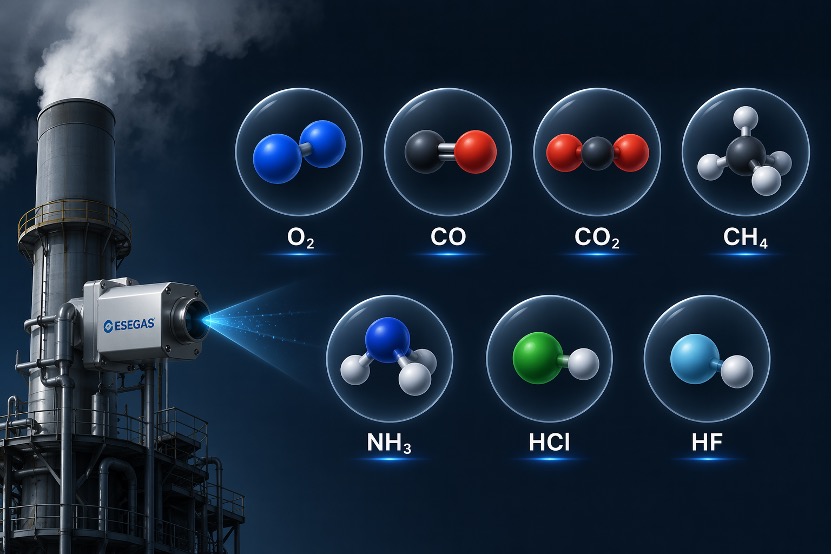
The exact gas selection depends on the emission profile, regulatory requirements, and process objectives of the facility. From the ESEGAS point of view, the value of a laser gas analyzer lies not only in what it measures, but in how confidently it measures under real operating conditions.
How Do Laser Gas Analyzers Improve Compliance and Process Efficiency?
Many facilities initially invest in exhaust gas monitoring because they need to satisfy environmental requirements. But once the system is in place, they quickly realize that gas analysis is also a process optimization tool. When measurement is delayed, inconsistent, or difficult to trust, operators lose the ability to react quickly. That can lead to excessive fuel use, unstable combustion, poor denitrification performance, or elevated emissions. In other words, poor gas analysis can increase both regulatory and operating costs. At ESEGAS, we view accurate exhaust monitoring as a direct contributor to better plant performance.
Laser gas analyzers improve compliance and efficiency in several ways:
• Better emission compliance
Continuous and reliable measurement helps operators identify abnormal gas trends earlier and take corrective action before small deviations become larger compliance problems.
• Improved combustion control
Monitoring gases such as O₂ and CO helps optimize the air-to-fuel ratio, improving combustion stability and reducing energy waste.
• Enhanced denitrification performance
In applications where NH₃ monitoring is needed, accurate measurement supports better control of reagent injection and helps reduce ammonia slip.
• Faster process decisions
Because laser analyzers respond quickly, operators can make process adjustments based on more immediate data instead of relying on delayed feedback.
• Lower maintenance burden
A well-designed laser analysis system can reduce the maintenance challenges associated with some conventional measurement approaches in difficult exhaust environments.
At ESEGAS, we believe the strongest exhaust monitoring solutions do more than generate data. They help plants act on that data with confidence.
In Which Industries Are Laser Gas Analyzers Commonly Used for Exhaust Monitoring?
Not all exhaust applications look the same. Gas composition, process temperature, dust concentration, moisture level, and system design vary significantly from one industry to another. A solution that works in one sector may need major adaptation in another. That is why application knowledge is essential. At ESEGAS, we approach exhaust gas analysis with the understanding that industry-specific conditions shape both analyzer design and installation strategy.
Laser gas analyzers are commonly used in industries such as:
• Power generation
Used for combustion optimization, ammonia slip monitoring, and continuous exhaust analysis in boilers and flue gas systems.
• Steel and metallurgy
Applied in high-temperature and dusty environments where reliable gas measurement is necessary for both process control and emission management.
• Chemical and petrochemical processing
Supports monitoring of reactive or hazardous gas components in exhaust streams and process off-gases.
• Waste incineration
Particularly valuable for monitoring acid gases and combustion-related parameters under variable waste feed conditions.
• Cement production
Helps measure key gas components in kiln exhaust systems, where dust and temperature create challenging monitoring conditions.
• Other industrial thermal processes
Suitable for furnaces, kilns, heaters, and other exhaust-intensive operations that require accurate online gas analysis.
From our perspective at ESEGAS, one of the most important advantages of laser technology is that it can be tailored to different sectors without losing its core strengths in selectivity and responsiveness.
What Should You Consider When Selecting a Laser Gas Analyzer for Exhaust Applications?
Choosing an exhaust gas analyzer is not simply a matter of comparing product specifications. In many projects, the real difficulty appears after installation, when the analyzer must perform continuously in conditions that are far more demanding than the datasheet alone suggests. A system that is poorly matched to the application may create ongoing problems in maintenance, calibration, integration, or long-term reliability. That is why proper selection matters from the beginning. At ESEGAS, we always recommend evaluating both measurement goals and field conditions together.
Key selection factors include:
• Target gas and measurement range
The analyzer must be matched to the exact gas component and concentration range required by the application.
• Process conditions
Temperature, pressure, dust, moisture, and corrosive constituents all affect system configuration and installation design.
• Installation method
The application may require an in-situ approach, an extractive system, or another customized arrangement depending on process conditions and maintenance preferences.
• Response time requirements
Some applications prioritize rapid control feedback, while others focus more on long-term compliance monitoring.
• Reliability and maintenance expectations
Stable long-term operation is critical in industrial environments where downtime is costly.
• Integration with control systems
Data communication, automation compatibility, and plant-wide monitoring requirements should be considered early in the project.
At ESEGAS, we believe the right analyzer is not just the one that can measure a gas. It is the one that can continue measuring it accurately, safely, and efficiently throughout the life of the application.
Why Choose ESEGAS for Exhaust Gas Analysis?
Industrial customers do not only need instrumentation. They need a partner that understands how gas analysis performs in real operating environments. Many exhaust monitoring challenges are not solved by theory alone. They require practical application knowledge, dependable system design, and the ability to adapt to complex industrial conditions. That is the standard we aim for at ESEGAS.
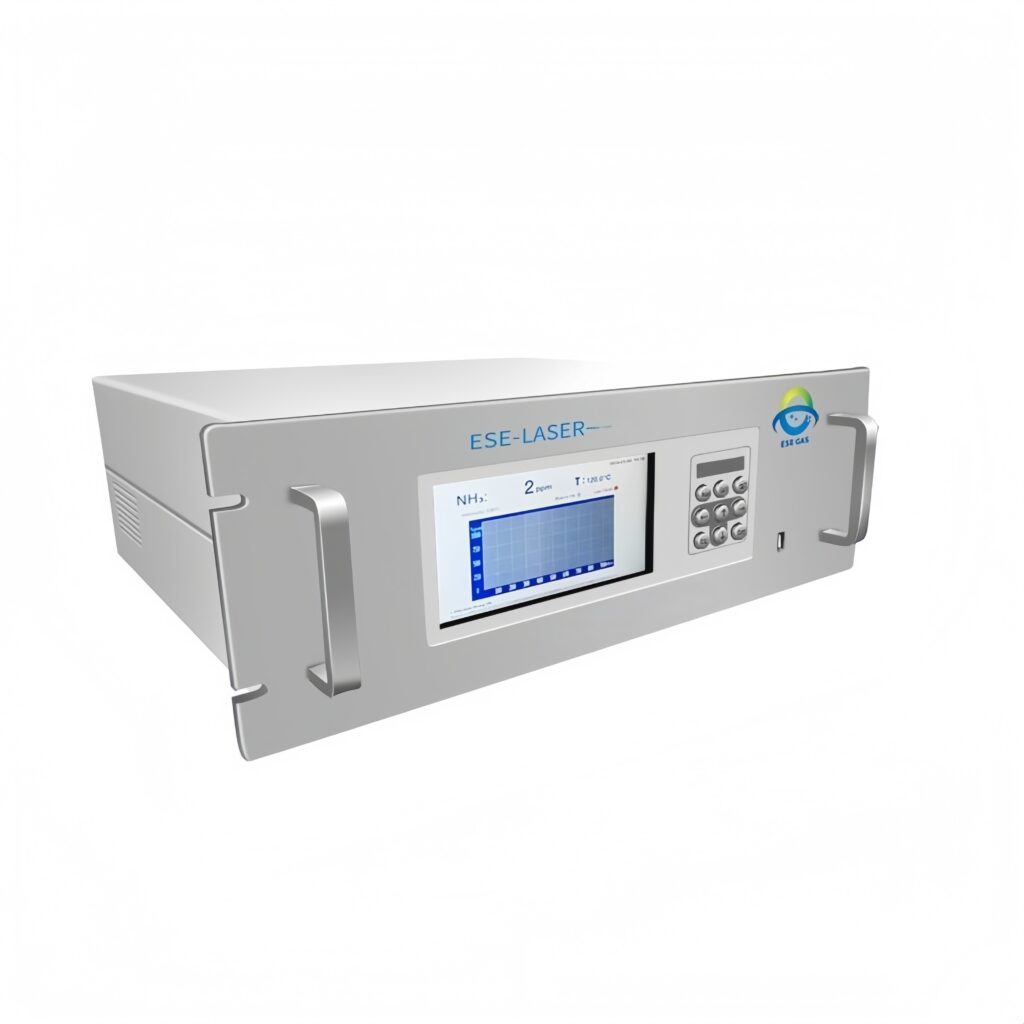
We support exhaust gas analysis projects by focusing on the factors that matter most in the field:
• We understand the challenges of harsh industrial exhaust conditions.
• We emphasize stable and accurate gas measurement for real process demands.
• We support application-specific solutions rather than one-size-fits-all configurations.
• We prioritize reliability, usability, and long-term performance.
• We work to help customers improve both environmental compliance and operational efficiency.
From the ESEGAS perspective, laser gas analyzers are not simply advanced instruments. They are practical tools that help industrial operators gain clearer process insight and stronger control over emissions.
Conclusion
In exhaust gas monitoring, laser gas analyzers offer a powerful combination of accuracy, speed, selectivity, and durability. They are well suited for measuring critical gas components in challenging industrial environments and can support both environmental compliance and process optimization at the same time. As emission standards continue to tighten and industrial processes become more data-driven, the role of laser gas analysis will only become more important. At ESEGAS, we are committed to delivering gas analysis solutions that help our customers monitor exhaust gases with greater confidence, better efficiency, and stronger long-term reliability.