


Industrial facilities cannot afford uncertainty in emissions monitoring. When exhaust data is inconsistent, delayed, or incomplete, the consequences quickly become serious: environmental compliance becomes harder to manage, combustion efficiency suffers, maintenance teams lose visibility into process conditions, and operators face greater safety and reputational risks. At ESEGAS, we understand that emissions monitoring is not just about meeting a reporting requirement. It is about gaining reliable data that supports cleaner operation, better control, and more confident decision-making across the entire system.
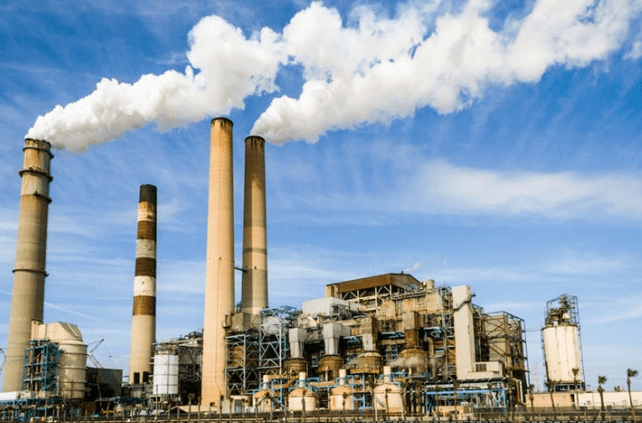
UV-GAS-500 emission gas analyzer is an instrument used to measure the concentration of gases in industrial exhaust streams, including oxygen, carbon monoxide, carbon dioxide, nitrogen oxides, sulfur dioxide, methane, and other target components. It plays a critical role in emissions compliance, combustion optimization, process control, and safety management by delivering accurate and continuous gas composition data under real operating conditions.
That definition gives the basic answer, but the real value of an emissions monitoring solution lies in how well it matches the application. Different industries, gas compositions, operating environments, and compliance demands require different analyzer capabilities. At ESEGAS, we believe that choosing the right solution starts with understanding what an analyzer measures, how it works, and what performance factors matter most in the field.
What Does an Emission Gas Analyzer Measure?
Many industrial users know they need emissions data, but they are not always sure which gas components matter most for their process. This gap can lead to poor instrument selection, incomplete monitoring strategies, and data that does not fully support compliance or optimization goals. At ESEGAS, we help customers evaluate the actual gas profile of their application so that every Emission Gas Analyzer is aligned with the monitoring objective from the beginning.
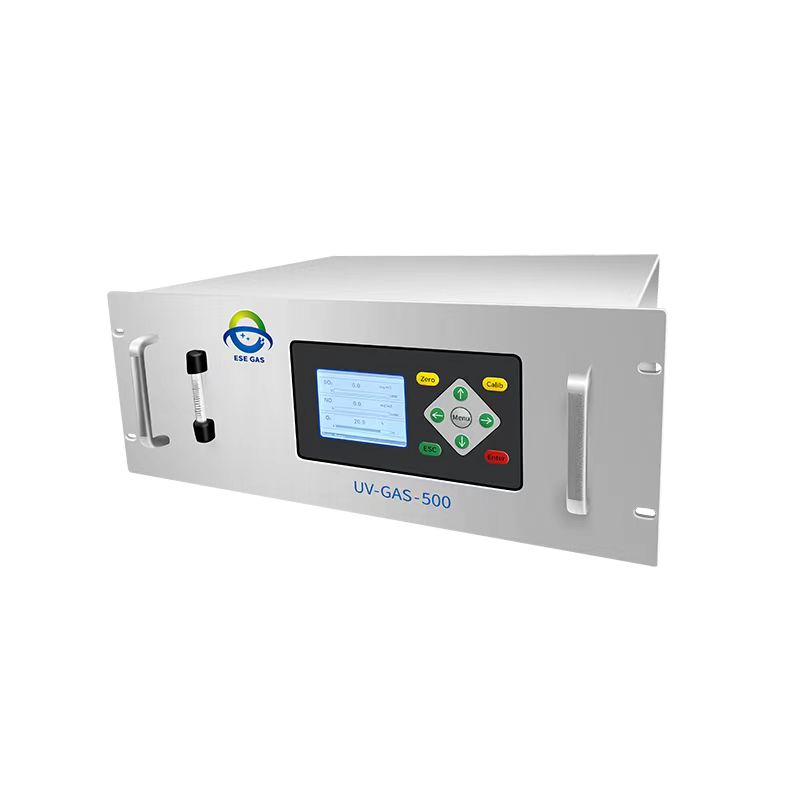
UV-GAS-500 Emission Gas Analyzer is typically used to detect one or more of the following gas components in flue gas or exhaust streams:
| Gas Component | Why It Is Measured | Common Applications |
| O₂ | Evaluates excess air and combustion efficiency | Boilers, furnaces, combustion systems |
| CO | Indicates incomplete combustion and safety risk | Industrial burners, thermal processes |
| CO₂ | Reflects combustion performance and carbon output | Energy systems, process plants |
| NOx | Supports environmental compliance | Power generation, incineration, kilns |
| SO₂ | Monitors sulfur-related emissions | Refineries, coal combustion, chemical plants |
| CH₄ | Detects methane slip or fuel leakage | Biogas, landfill gas, engine exhaust |
| H₂S | Tracks corrosive and hazardous sulfur compounds | Biogas treatment, petrochemical processes |
The target gases vary by industry and by process conditions. In some applications, oxygen and carbon monoxide are enough to optimize combustion. In others, continuous monitoring of NOx, SO₂, and CO₂ is essential for environmental reporting. That is why we at ESEGAS focus on practical measurement needs rather than one-size-fits-all configurations.
How Does an Emission Gas Analyzer Work?
One of the most common mistakes in analyzer selection is focusing only on price or gas list without understanding the sensing technology behind the measurement. This creates problems later, especially when the analyzer is exposed to moisture, dust, temperature variation, or cross-interference from other gases.
At ESEGAS, we know that the long-term reliability of an Emission Gas Analyzer depends heavily on choosing the right detection principle for the actual process environment.
Different analyzer technologies are used for different gases:
| Detection Principle | Typical Target Gases | Main Advantages | Typical Considerations |
| NDIR (Non-Dispersive Infrared) | CO, CO₂, CH₄, SO₂ | Stable, selective, suitable for many industrial gases | Requires proper optical path protection |
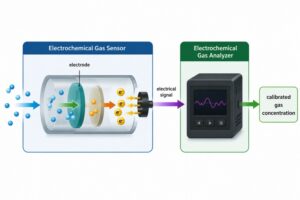
| Electrochemical | O₂, CO, H₂S, SO₂, NO | Compact and cost-effective | Sensor life and maintenance must be managed |
| Paramagnetic | O₂ | High accuracy for oxygen measurement | Best suited for dedicated O₂ analysis |
| TDLAS | NH₃, HCl, H₂O, O₂ and others in specific setups | Fast response, in-situ capability | Application-specific system design needed |
| FID | Total hydrocarbons | High sensitivity for hydrocarbon measurement | Requires fuel gas and more complex operation |
UV-GAS-500 Emission Gas Analyzer works by converting gas concentration into an electrical or optical signal that can be processed, displayed, and transmitted to plant control systems. In practice, performance also depends on the complete sampling path, including filters, pumps, heated lines, moisture removal, calibration strategy, and signal integration. This is why ESEGAS always views the analyzer as part of a full measurement solution, not just a standalone box.
Why Is an Emission Gas Analyzer Important for Compliance and Process Control?
Many facilities initially invest in emissions monitoring only because regulations require it. However, when operators treat the analyzer as a compliance-only device, they often miss its broader operational value. A well-designed UV-GAS-500 Emission Gas Analyzer does more than provide numbers for reporting. At ESEGAS, we see it as a core source of process intelligence that improves environmental performance and production efficiency at the same time.
Its importance can be understood in several ways:
- Environmental compliance
Accurate gas measurement helps facilities document emissions, meet local regulations, and reduce the risk of penalties or reporting errors. - Combustion optimization
Monitoring O₂, CO, and CO₂ helps operators fine-tune burner conditions, reduce fuel waste, and improve thermal efficiency. - Process stability
A reliable Emission Gas Analyzer provides continuous feedback that supports better control of combustion, oxidation, or treatment processes. - Safety improvement
Detection of incomplete combustion, toxic gases, or abnormal gas trends can provide early warning of process issues and hazardous conditions. - Maintenance planning
Stable trend data helps teams identify fouling, burner imbalance, sensor drift, or system degradation before they become larger operational problems.
At ESEGAS, we believe the best emissions monitoring systems are the ones that create measurable value every day, not only during inspections or audits.
Which Industries Need Emission Gas Analyzers the Most?
It is easy to assume that all emissions monitoring applications are the same, but industrial reality is far more complex. Gas composition, dust loading, humidity, pressure, and temperature vary greatly from one process to another. Choosing the wrong Emission Gas Analyzer for a specific industry can lead to unstable readings, excessive maintenance, and poor long-term results. That is why ESEGAS takes an application-based approach to analyzer selection.
Industries that commonly rely on Emission Gas Analyzer solutions include:
- Power generation for combustion monitoring and regulated emissions control
- Oil and gas for process exhaust, flare monitoring, and combustion analysis
- Chemical and petrochemical plants for process safety and environmental performance
- Steel and cement for high-temperature combustion and exhaust gas measurement
- Waste incineration for strict monitoring of NOx, SO₂, CO, and related gases
- Boiler systems for burner tuning and energy efficiency improvement
- Biogas and landfill gas facilities for methane, H₂S, and combustion-related measurements
In each of these sectors, the monitoring objective may differ. Some users need portable diagnostics. Others require continuous online systems integrated with plant controls. At ESEGAS, we support these varied needs by focusing on durability, accuracy, and suitability for real industrial operating conditions.
What Features Should You Look for When Choosing an Emission Gas Analyzer?
Many buyers compare analyzers by looking only at measurable gases or initial purchase cost. That approach often creates avoidable problems after installation, especially when harsh environments and long operating cycles reveal weaknesses in design or compatibility. At ESEGAS, we recommend evaluating an Emission Gas Analyzer based on total application fit, not just basic specifications.
The most important selection factors include:
- Measurement accuracy
The analyzer should provide dependable data across the required concentration range. - Response time
Fast response is essential when process changes happen quickly or when real-time control is needed. - Gas range and configuration
A suitable Emission Gas Analyzer must cover the actual target gases and expected concentration levels. - Resistance to interference
Cross-sensitivity can distort results, especially in mixed-gas industrial exhaust streams. - Sampling system compatibility
Moisture, dust, corrosive gases, and temperature must all be considered in the sample handling design. - Calibration and maintenance requirements
Lower maintenance burden often improves uptime and reduces total lifecycle cost. - Signal output and communication
Integration with PLC, DCS, or SCADA systems should be straightforward and reliable. - Environmental durability
Industrial analyzers must perform consistently under vibration, variable temperature, and demanding site conditions.
At ESEGAS, we emphasize practical reliability because a technically advanced analyzer only creates value when it performs well in the field over time.
Portable or Online Emission Gas Analyzer: Which One Is Better?
Many users hesitate between a portable unit and a continuous online system. This is a critical decision because the wrong choice can either limit visibility or increase cost without adding real value. At ESEGAS, we help customers evaluate how often they need data, how stable the process is, and whether the analyzer will be used for troubleshooting, compliance, or continuous control.
Here is a simple comparison:
| Type | Best For | Advantages | Considerations |
| Portable Emission Gas Analyzer | Spot checks, maintenance, field diagnostics | Flexible, convenient, lower initial investment | Not ideal for uninterrupted monitoring |
| Online Emission Gas Analyzer | Continuous process control and compliance | Real-time data, automation integration, trend visibility | Requires installation planning and system support |
A portable Emission Gas Analyzer is often the right choice for periodic inspections, service work, and temporary measurements. An online Emission Gas Analyzer is better suited to applications where continuous data is essential for emissions reporting, process stability, or automated control. The better option depends on the monitoring objective, not simply on budget.
How Can Regular Maintenance Improve Analyzer Performance?
When gas data becomes unreliable, the analyzer itself is not always the only cause. In many cases, the real issue is poor maintenance of filters, sampling lines, moisture control, or calibration routines. Over time, even a high-quality Emission Gas Analyzer can lose performance if the surrounding system is neglected. At ESEGAS, we encourage customers to view maintenance as part of measurement accuracy, not as a separate afterthought.
Regular maintenance improves performance in several ways:
- Calibration checks help confirm measurement accuracy and detect drift early
- Filter replacement protects the analyzer from particulate contamination
- Sampling line inspection prevents blockage, leakage, and delayed response
- Moisture management reduces condensation-related errors and corrosion risk
- Sensor health review supports stable long-term operation
- Routine cleaning helps preserve response speed and repeatability
A properly maintained Emission Gas Analyzer delivers more stable readings, longer service life, lower downtime, and greater confidence in reported data. For industrial users, that means better compliance and better control with fewer unexpected interruptions.
Conclusion
An emission gas analyzer is far more than a measuring device. It is a critical tool for understanding exhaust composition, improving combustion performance, supporting environmental compliance, and maintaining safe, efficient industrial operations. The right analyzer must be chosen based on target gases, process conditions, installation method, and long-term maintenance needs.
At ESEGAS, we believe that effective gas analysis starts with real application understanding and ends with dependable field performance. That is why we focus on delivering Emission Gas Analyzer solutions that are accurate, practical, and built for the realities of industrial monitoring. When emissions data matters, reliable analysis makes all the difference.