



In industrial gas analysis, inaccurate readings are more than a technical inconvenience. A drifting signal can lead to poor process control, unreliable emissions data, unnecessary maintenance, or delayed safety decisions. When gas concentrations must be measured continuously and confidently, choosing the wrong sensing principle can make the entire monitoring system unstable. That is why we focus on non-dispersive infrared technology as a practical foundation for accurate, long-term gas measurement in demanding industrial and environmental applications.
An NDIR gas sensor is a non-dispersive infrared sensor that measures gas concentration by detecting how target gas molecules absorb infrared light at specific wavelengths. It is important for accurate gas analysis because it provides strong selectivity, stable measurement, fast response, and reliable performance for infrared-active gases such as CO₂, CO, CH₄, C₃H₈, N₂O, and other molecular gases.ESEGAS NDIR solutions apply infrared absorption principles to deliver reliable concentration data for gas analyzer systems used in environmental monitoring, process analysis, and industrial emission applications. (Gas Analyzer Manufacturers)
However, understanding the definition is only the starting point. In real applications, measurement performance depends on optical path design, filter selection, detector stability, signal processing, gas cell structure, temperature compensation, and the way the sensor is integrated into the full gas analyzer. Below, we explain how this technology works and how we approach NDIR measurement from an engineering and application perspective.
How Does an NDIR Gas Sensor Work?
A gas analyzer can only be as reliable as the sensing principle behind it. When users only compare measuring range or price, they may overlook the most important question: whether the sensor can maintain stable readings under real operating conditions. An NDIR gas sensor solves this challenge by using a physical optical measurement method rather than a consumable chemical reaction.
An NDIR gas sensor typically includes an infrared light source, a gas absorption cell, optical filters, an infrared detector, and a signal processing circuit. When sample gas enters the absorption cell, target gas molecules absorb infrared radiation at their characteristic wavelength. The detector measures the reduction in transmitted infrared energy, and the system converts that signal into gas concentration according to the Lambert–Beer law. ESEGAS NDIR analyzers use this infrared absorption principle to measure gases such as CO, CO₂, CH₄, C₃H₈, and other infrared-active molecular species. (Gas Analyzer Manufacturers)
In simple terms, the stronger the absorption at the selected wavelength, the higher the concentration of the target gas. This is why optical path length, wavelength selection, detector sensitivity, and signal processing accuracy all matter. A well-designed NDIR gas sensor does not just “detect” gas; it transforms optical absorption into stable, repeatable, and traceable concentration data.
What Gases Can an NDIR Gas Sensor Detect?
Not every gas can be measured effectively with infrared technology. If the target gas does not absorb infrared radiation strongly enough at a usable wavelength, an NDIR system may not be the right choice. This is why gas selection must come before sensor selection, especially in complex industrial processes.
An NDIR gas sensor is suitable for many infrared-active gases, including:
| Target gas | Common application area |
| CO₂ | Environmental monitoring, combustion control, greenhouse gas monitoring |
| CO | Emission monitoring, process gas analysis, safety-related measurement |
| CH₄ | Biogas, natural gas, process control, greenhouse gas monitoring |
| C₃H₈ | Hydrocarbon monitoring, industrial gas analysis |
| N₂O | Environmental monitoring, industrial emission analysis |
| Other infrared-active gases | Customized gas analyzer applications |
At ESEGAS, we design NDIR-based solutions for applications where optical absorption offers a reliable measurement path. Our NDIR gas analyzer platform is used for CO, CO₂, CH₄, C₃H₈, N₂O, and other molecular gases, depending on the required range and application conditions. (Gas Analyzer Manufacturers)
Why Is NDIR Technology Reliable for Industrial Gas Analysis?
Industrial gas analysis often happens in environments where temperature, humidity, dust, background gases, and long operating hours can affect measurement stability. If the sensor is sensitive to aging, poisoning, or frequent drift, the analyzer may require more calibration and maintenance than expected. This is where an NDIR gas sensor provides a clear advantage.
NDIR technology is reliable because it is non-consumptive. The sensor measures infrared absorption rather than relying on a chemical reaction that gradually depletes over time. This makes it suitable for continuous gas monitoring and long-term deployment. In addition, wavelength-specific detection improves selectivity because the analyzer focuses on the absorption characteristics of the target gas.
Key advantages include:
- High selectivity for infrared-active gases
- Stable long-term measurement performance
- Fast response for real-time monitoring
- Lower maintenance compared with consumable sensing methods
- Suitability for ppm-level and percentage-level gas analysis
- Strong compatibility with online gas analyzer systems
For process gas analysis, emission monitoring, and environmental applications, these advantages help users reduce uncertainty and obtain more dependable data.
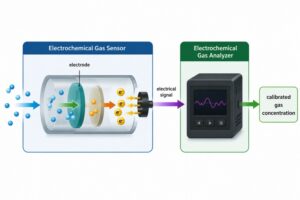
What Is the Difference Between an NDIR Gas Sensor and an Electrochemical Sensor?
Choosing between sensor technologies can be confusing because both may appear to measure similar gases. However, the wrong choice can create long-term problems such as frequent replacement, unstable baselines, or poor suitability for continuous online monitoring. Understanding the difference helps users choose the correct technology from the beginning.
| Comparison item | NDIR gas sensor | Electrochemical sensor |
| Detection principle | Infrared absorption | Chemical reaction |
| Sensor consumption | Non-consumptive | Consumptive over time |
| Typical target gases | CO₂, CO, CH₄, hydrocarbons, N₂O | CO, NO₂, SO₂, H₂S, O₂ and others |
| Long-term stability | Generally strong for continuous monitoring | Depends on electrolyte and operating environment |
| Maintenance demand | Lower in suitable applications | Higher due to aging and replacement needs |
| Cross-interference control | Managed through wavelength/filter design and algorithms | Depends on electrode selectivity and gas chemistry |
| Industrial suitability | Strong for online gas analysis and process monitoring | Useful for compact safety detection and specific toxic gases |
| Typical applications | Emission monitoring, process gas analysis, combustion control | Portable detectors, safety alarms, toxic gas detection |
An NDIR gas sensor is often preferred when the target gas is infrared-active and the application requires continuous, stable, and repeatable measurement. Electrochemical sensors remain useful for certain toxic gases and compact instruments, but they may not offer the same long-term optical stability for gases such as CO₂ and CH₄.
Where Are NDIR Gas Sensors Used?
Gas measurement problems rarely happen in the laboratory alone. They occur in stacks, pipelines, combustion systems, biogas plants, industrial workshops, and environmental monitoring stations. In these places, users need gas data that remains consistent over time. An NDIR gas sensor supports this requirement by delivering stable optical measurement in many analyzer configurations.
Common applications include:
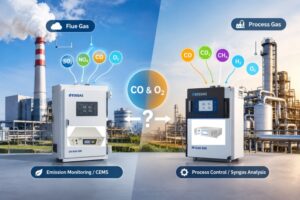
- Emission monitoring: Measuring CO, CO₂, CH₄, and other gases in flue gas and industrial exhaust.
- Process gas analysis: Supporting control decisions in chemical, heat treatment, and industrial production processes.
- Combustion optimization: Monitoring gas composition to improve combustion efficiency and reduce emissions.
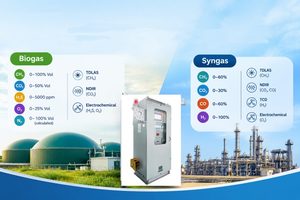
- Biogas monitoring: Measuring methane and carbon dioxide for process control and energy recovery.
- Environmental monitoring: Tracking greenhouse gases and air quality-related components.
- Laboratory gas measurement: Providing accurate gas concentration data for research and calibration systems.
- Industrial safety monitoring: Supporting gas concentration awareness in environments where gas buildup may create risk.
ESEGAS NDIR analyzer solutions are designed for industrial site emission gas analysis, process gas analysis, and environmental monitoring, with configurations depending on the target gas and operating conditions. (Gas Analyzer Manufacturers)
What Should You Consider When Choosing an NDIR Gas Sensor?
A technically advanced sensor can still perform poorly if it is not matched to the application. Many measurement issues begin with incomplete selection: the target gas is known, but the range, interference, humidity, flow rate, and sample condition are not fully evaluated. Selecting an NDIR gas sensor should be an engineering decision, not just a component purchase.
Important selection factors include:
- Target gas
Confirm that the gas has a clear infrared absorption feature and that the selected wavelength is suitable. - Measuring range
Define whether the application requires ppm-level detection, percentage-level measurement, or a wide dynamic range. - Accuracy and repeatability
Evaluate not only the accuracy specification but also how stable the reading remains over time. - Optical path length
A longer optical path can improve sensitivity for low concentrations, while a shorter path may be better for high-concentration gases. - Response time
Fast-changing processes require a sensor and gas path design that can respond quickly. - Temperature and humidity compensation
Industrial gas streams may vary significantly, so compensation and sample conditioning are often critical. - Cross-interference control
Background gases, overlapping absorption bands, and water vapor must be considered during analyzer design. - Output and integration
The sensor should be compatible with the analyzer’s control system, communication interface, and calibration logic. - Calibration and maintenance
Long-term performance depends on proper calibration strategy, gas path cleanliness, and system-level maintenance planning.
At ESEGAS, we evaluate these factors together because accurate gas analysis depends on the complete measurement chain, not only the sensor module.
How Does ESEGAS Improve NDIR Gas Sensor Performance?
A standard sensor module may work well in simple environments, but industrial gas analysis often requires stronger optical design, better signal handling, and application-specific integration. When users face drifting data, slow response, or uncertain repeatability, the issue is often not the NDIR principle itself but how the technology is engineered. That is why we develop each NDIR gas sensor solution around real gas analyzer requirements.
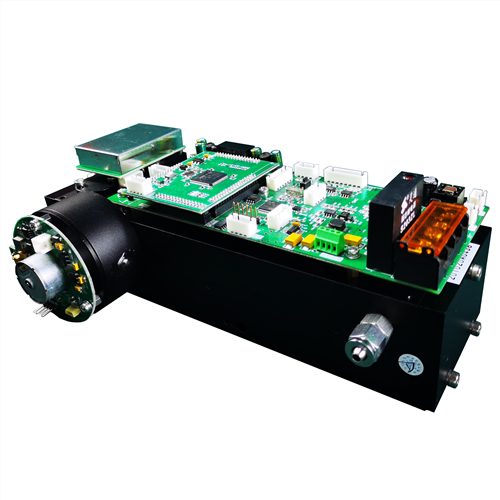
Our ESE-IR-100M infrared gas sensor uses GFC infrared correlation filter technology, a self-designed long optical path gas absorption cell, wavelength filters, an infrared detector, and a high-precision signal processing circuit to support quantitative infrared gas analysis. The product is designed for accurate and reliable detection in industrial and environmental applications, with characteristics including high precision, good stability, and fast response. (Gas Analyzer Manufacturers)
From our perspective, NDIR performance is improved through four key areas:
- Optical structure: A stable gas absorption cell helps improve sensitivity and repeatability.
- Filter and detector matching: Proper wavelength selection supports target gas selectivity.
- Signal processing: High-precision circuits help convert optical changes into usable concentration data.
- Analyzer integration: Gas flow, sampling, temperature control, and calibration strategy are designed as part of the complete system.
This system-level approach allows us to support gas analyzer applications where accuracy, stability, and long-term reliability are essential.
Is an NDIR Gas Sensor the Right Choice for Your Gas Analysis System?
NDIR technology is powerful, but it should still be selected based on the measurement task. If users apply it without checking gas composition, concentration range, or sample condition, they may not achieve the expected result. The best performance comes when the NDIR gas sensor is matched with the correct gas path, optics, electronics, and calibration method.
An NDIR gas sensor is usually a strong choice when:
- The target gas is infrared-active.
- Continuous online monitoring is required.
- Long-term stability is important.
- The application involves CO₂, CO, CH₄, hydrocarbons, or similar gases.
- Maintenance reduction is a priority.
- The analyzer must support industrial or environmental compliance data.
However, additional evaluation may be needed when the sample contains heavy dust, high moisture, corrosive components, or gases with overlapping infrared absorption. In these cases, sample conditioning, optical filtering, and compensation algorithms become especially important.
Conclusion
An NDIR gas sensor is more than a sensing component; it is a core technology that influences the accuracy, stability, and operating cost of the entire gas analyzer. By measuring infrared absorption at characteristic wavelengths, it provides a reliable method for continuous gas analysis in industrial, environmental, combustion, and process applications.
At ESEGAS, we focus on turning NDIR technology into practical gas analysis solutions. Through optical design, detector selection, signal processing, and system integration, we help users obtain stable, accurate, and application-ready gas concentration data for real-world monitoring conditions.