



VOCs monitoring can feel deceptively simple—until you’re the one explaining missing data, drifting baselines, or sudden “spikes” that later turn out to be condensation artifacts. When regulators, EHS teams, and production managers all need trustworthy numbers, the real problem isn’t whether to monitor—it’s how to keep monitoring stable in real industrial conditions. That’s exactly why we at ESEGAS build VOC solutions as a system, not just an analyzer.

Online VOC monitoring is reliable only when sampling, conditioning, analysis, calibration, and data handling are engineered as one closed loop. In practice, that means dust-free extraction, heat-traced transport to prevent condensation, proven quantification technology (like GC-FID for hydrocarbons), automated calibration checks, and a control/data subsystem that can report consistently to your platform. (esegas.com)
If you already know “we need an online VOC system,” the next question becomes more practical: What design decisions separate a system that runs for years from one that becomes a maintenance headache? At ESEGAS, we’ve learned that stable compliance-grade monitoring is rarely limited by the detector—it’s limited by the gas path, the conditioning strategy, and the way data is captured and communicated. (esegas.com)
So below, we’ll walk through the most important engineering questions we address when building an online monitoring project—especially when the target is volatile organic compounds with real-world stack conditions, variable humidity, and challenging particulate loads.
Why does online VOC monitoring fail in real plants—even with a “good analyzer”?
Here’s the pain: you install equipment to meet compliance, but the data ends up unreliable—baseline drift, slow response, blocked lines, or unexplained downtime. Then the situation escalates: you’re not just managing emissions anymore; you’re managing credibility.

For volatile organic compounds, the most common failure modes are almost always “upstream” of the analyzer:
- Moisture condenses in a cool section of the line and absorbs or strips VOCs, flattening peaks and distorting trends.
- Dust loading gradually clogs filters or valves, creating unstable flow and inconsistent response times.
- A sampling probe location captures a non-representative stream (poor mixing, boundary-layer effects, pulsation).
That’s why our ESEGAS VOC solution emphasizes the sampling and conditioning infrastructure: a sampling probe with ceramic filtration for dust-free gas, plus heat-traced sampling lines and a system-level approach to keeping the sample stable. (esegas.com)
What we recommend (and engineer into our deployments):
- Prevent condensation before it starts: heat tracing isn’t a “nice to have” when VOCs are water-soluble or when temperature drops happen along the gas path. (esegas.com)
- Treat dust as a system threat: ceramic filtration at the probe protects the entire downstream chain. (esegas.com)
- Design for maintenance, not miracles: blowback and purge strategies matter because even the best filter will load over time. (esegas.com)
What does a complete VOC online monitoring system actually include?
A common mistake is treating VOC monitoring like a single-box purchase. But for compliance-grade monitoring—especially for volatile organic compounds—you need a system architecture that keeps measurements defensible day after day.
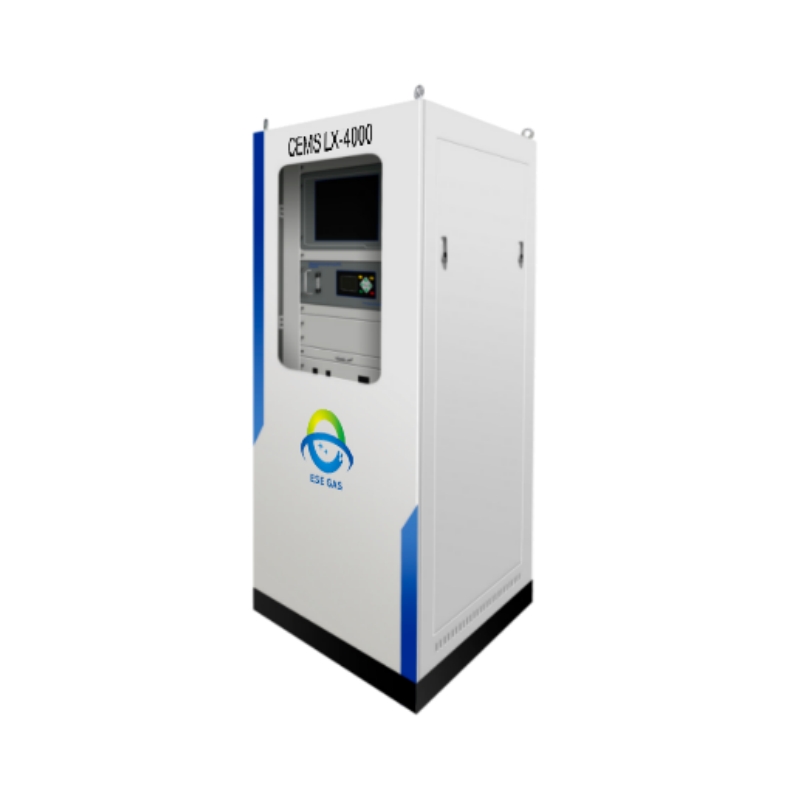
In our ESEGAS VOC online monitoring structure, we integrate four subsystems as one solution: (esegas.com)
1) Gaseous pollutant monitoring subsystem
This is where the sample is extracted and protected. It typically includes:
- Sampling probe
- Ceramic filtration for dust-free gas extraction
This subsystem is the difference between “a number on a screen” and “a number you can defend.” (esegas.com)
2) Flue gas monitoring subsystem (TPF and related parameters)
For VOC interpretation, context matters. We integrate monitoring for:
- Temperature
- Oxygen
- Humidity / moisture
- Flow velocity
If you can’t explain VOC changes with TPF context, you’ll struggle to distinguish real emission events from process or dilution effects. (esegas.com)
3) Calibration and assistant subsystem
Online monitoring is a long game. Accuracy must be maintained, not merely achieved on commissioning day. This subsystem supports routine verification and helps maintain long-term data credibility. (esegas.com)
4) Control and data collection subsystem
We package control, heating modules, pumping, IPC/data handling, and the cabinet-level architecture so the system operates as a coherent unit rather than a collection of components. (esegas.com)
To make this more concrete, here’s how we often explain it internally:
| System layer | What it protects | Why it matters for volatile organic compounds |
| Sampling & filtration | Sample representativeness + particulate control | Prevents clogging and flow instability |
| Heat tracing & conditioning | Phase stability (no condensation) | Prevents VOC loss/adsorption in wet, cool lines |
| Analyzer & method (GC-FID) | Quantification integrity | Provides stable hydrocarbon measurement |
| Calibration & verification | Long-term accuracy | Keeps trends defensible for audits |
| Data/communications | Reporting continuity | Ensures the data is usable, not stranded |
(All elements align with the system structure described for our VOC analyzer solution.) (esegas.com)
Which pollutants and operating parameters should we monitor together for compliance-grade VOC management?
If you only track a single VOC value without process context, troubleshooting becomes guesswork. That’s why we like pairing VOC metrics with key stack parameters—so your data tells a story you can act on.
Our ESEGAS VOC Analyzer platform supports targets commonly required for industrial VOC compliance and management, such as: (esegas.com)
- NMHC: 0–1000 ppm (customizable), GC-FID
- HC (Total Hydrocarbon): 0–1000 ppm (customizable), GC-FID
- Benzene series: 0–10 ppm (customizable), GC-FID
And it complements them with stack/condition parameters such as: (esegas.com)
- Oxygen: 0–25% (zirconia)
- Temperature: up to 300℃ (customizable)
- Pressure: −10 to +10 kPa (customizable)
- Flow velocity: up to 40 m/s (Pitot tube)
- Humidity: up to 40% vol (Humicap or dry/wet oxygen)
How these parameters help you “explain the VOC number”:
- If VOCs rise while flow velocity drops, you may be seeing less dilution (or a ventilation change) rather than a true increase in mass emissions.
- If VOCs appear “flat” during high humidity, you may be seeing condensation losses in sampling—exactly why heat tracing and maintenance strategies are central to stable volatile organic compoundsmonitoring. (esegas.com)
Why do we use GC-FID for volatile organic compounds monitoring in industrial online systems?
When accuracy, linearity, and repeatability matter for hydrocarbon-type VOCs, GC-FID remains a widely adopted industrial approach—especially for NMHC/THC style reporting and benzene-series tracking.
In our system approach:
- Gas chromatography (GC) helps separate components in complex exhaust streams, which is valuable when multiple organics coexist and you need interpretable results. (esegas.com)
- Flame ionization detection (FID) provides strong response characteristics for hydrocarbons, which supports stable quantification in many VOC applications. (esegas.com)
What this means for your project:
- You’re less dependent on a single “composite signal” that can be hard to interpret.
- You can build more meaningful alarms and trends (for example, NMHC behavior vs. benzene-series behavior).
- You have a measurement method that can be explained clearly during internal reviews or compliance discussions.
How do we keep sampling lines stable when humidity and temperature swing?
This is where many VOC projects struggle, because humidity and temperature aren’t just “background conditions”—they actively change what reaches the analyzer. For volatile organic compounds, a small amount of condensation can remove organics from the gas phase, introduce lag, and create false low readings that look “stable” but are actually wrong.
In ESEGAS system design, we address this in three practical ways:
1) Heat-traced sampling lines as a core design element
We implement heat tracing to reduce the risk of condensation and to keep the sample in a stable phase during transport. It’s a reliability decision, not an accessory. (esegas.com)
2) Front-end dust control and flow stability
A dust-free sample protects not just filters, but also valves, pumps, and the consistency of flow—directly affecting response time and repeatability. Ceramic filtration at the probe is part of the structure we reference for our VOC analyzer system. (esegas.com)
3) Blowback and line maintenance strategy
When pipelines foul, systems “age” quickly. Our structure includes support for air compressor–driven pipeline blowback, helping maintain the gas path and improve long-term uptime. (esegas.com)
How do we make VOC data usable for audits, reporting, and plant control systems?
Even the best measurement is wasted if it can’t be trusted, trended, and exported. So we design VOC monitoring with the last mile in mind: reporting and integration.
From an ESEGAS system perspective, there are three pillars:
1) Keep accuracy maintainable, not theoretical
We include a calibration and assistant subsystem to support verification routines—because long-term success in volatile organic compounds monitoring is mostly about consistency over months, not just performance on day one. (esegas.com)
2) Engineer continuity into the hardware
Stable sampling, heat tracing, and blowback maintenance all contribute to “continuous” monitoring in the real sense: fewer data gaps, fewer unexplained anomalies, and fewer emergency interventions. (esegas.com)
3) Output and protocol compatibility for integration
We support common industrial outputs like 4–20 mA, RS232, RS485, and Modbus protocol so VOC data can integrate with your DCS/PLC, data historian, or compliance reporting platform. (esegas.com)
Which industries benefit most from online VOC monitoring—and how do we approach selection?
VOC requirements and exhaust conditions vary widely, which is why “one-size-fits-all” solutions often disappoint. We typically see strong value from continuous monitoring in industries such as plastics manufacturing, petrochemical operations, pharmaceutical production, coating and painting processes, rubber, and printing—anywhere VOC behavior is dynamic and compliance pressure is high.
When we support selection at ESEGAS, we focus on factors that directly impact whether the system will stay stable:
- Target definitions: Are you reporting NMHC, THC/HC, benzene series, or a combination? (esegas.com)
- Range and variability: Do you need a fixed range or a customizable range to match process swings?
- Humidity and temperature profile: Will heat tracing be essential due to condensation risk? (Often yes for volatile organic compounds.) (esegas.com)
- Particulate loading: Will ceramic filtration and blowback maintenance be critical?
- Integration requirements: What outputs and protocols are needed—4–20 mA, RS485, Modbus, etc.? (esegas.com)
Our goal isn’t to “oversell hardware.” It’s to prevent the most expensive outcome: a system that technically exists but produces data you can’t rely on.
Conclusion
Reliable online VOC monitoring isn’t “buy an analyzer and hope.” It’s a systems engineering problem: protect the sample, control moisture and dust, select a defensible quantification method, maintain accuracy through calibration strategy, and deliver data through the interfaces your plant and regulators actually use.
That’s how we approach volatile organic compounds monitoring at ESEGAS—as a complete online monitoring system designed for stability in real industrial conditions, from sampling probe and ceramic filtration to heat tracing, GC-FID measurement, calibration support, and industrial communication outputs. If you’re planning a VOC project (or trying to fix one that’s underperforming), we’re ready to help you map NMHC/HC/benzene-series requirements to the right architecture and integration approach. (esegas.com)