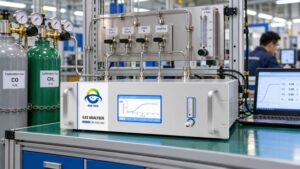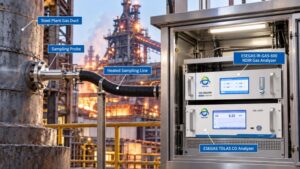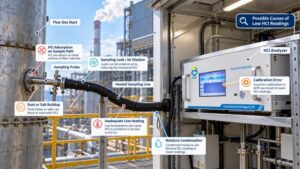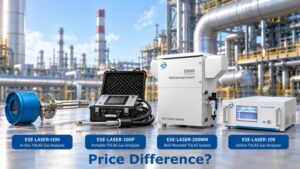




Industrial plants need reliable flue gas data. However, portable testing and continuous monitoring serve different operational purposes.
Portable flue gas analyzers support on-site inspections, commissioning, and troubleshooting. Online flue gas analyzers monitor fixed measurement points over time. The right choice depends on monitoring frequency, process requirements, data needs, and emission compliance obligations.
Both approaches provide useful measurement data. However, they differ in installation, sampling, operation, and system integration. This guide compares their main differences and explains when industrial plants should use either solution or combine both.
What Is the Difference Between Portable and Continuous Flue Gas Analyzers?
Portable and continuous flue gas analyzers measure gas concentrations in industrial exhaust streams. Their main difference lies in how and where they collect measurement data.
A portable analyzer moves between measurement locations. A continuous analyzer normally operates at a fixed measurement point.
What Is a Portable Flue Gas Analyzer?
A portable flue gas analyzer is a mobile instrument designed for field measurements.
Technicians carry it to different measurement locations. They connect its sampling probe to a suitable exhaust sampling point and collect gas readings.
Typical applications include:
- Boiler combustion inspections.
- Furnace performance checks.
- Industrial equipment commissioning.
- Routine maintenance measurements.
- Emission troubleshooting.
- Multi-point flue gas inspections.
Portable analyzers are useful when engineers need to check several combustion systems without installing a separate analyzer at every location.
For example, a maintenance engineer can use one portable analyzer to inspect several industrial boilers during a scheduled maintenance visit.
The instrument provides measurement data at each testing location. However, it does not automatically provide uninterrupted monitoring between inspections.
What Is a Continuous Flue Gas Analyzer?
A continuous flue gas analyzer is installed at a designated measurement location.
It measures selected gas components over time and provides ongoing measurement data.
Depending on the system design, it may use an extractive sampling arrangement or an in-situ measurement configuration.
Typical applications include:
- Continuous emission monitoring.
- Boiler combustion monitoring.
- Industrial furnace process monitoring.
- Power plant emission control.
- Waste incineration emission monitoring.
- Long-term process performance evaluation.
Continuous analyzers can connect to plant control and monitoring systems. This allows operators to monitor changing gas concentrations without manually performing each measurement.
Is a Continuous Flue Gas Analyzer the Same as CEMS?
No. A continuous flue gas analyzer is a measurement instrument. CEMS is a complete monitoring system.
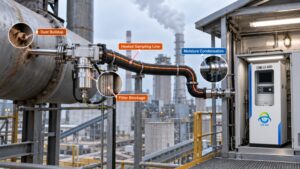
A CEMS may include:
- Gas sampling probes.
- Heated sample lines.
- Gas conditioning equipment.
- Gas analyzers.
- Data acquisition systems.
- Calibration and quality assurance functions.
A fixed analyzer may support process monitoring without forming part of a regulatory CEMS.
When compliance monitoring is required, engineers must evaluate the complete system against applicable standards and regulations.
For a broader explanation, see the ESEGAS Flue Gas Analyzer Technical Guide.
How Does a Portable Flue Gas Analyzer Work?
A portable flue gas analyzer collects a gas sample from a selected measurement point and analyzes its composition.
Although product designs vary, a typical measurement process follows these steps.
1. Connect the Sampling Probe
The technician inserts the sampling probe into the exhaust duct or stack through a suitable sampling port.
The probe collects a representative sample from the measurement location.
Sampling position and probe insertion depth can affect measurement representativeness.
2. Transport the Gas Sample
The sampling system transfers gas from the probe to the analyzer.
Depending on the application, the system may use a sampling hose, heated line, filter, or other conditioning components.
These components help manage particulate matter and moisture.
3. Measure Gas Concentrations
The gas enters the analyzer’s measurement unit.
Different sensors measure different gas components.
For example, a portable multi-gas analyzer may combine UV-DOAS for SO₂ and NOx, NDIR for CO and CO₂, and an electrochemical sensor for O₂.
The exact technology depends on the analyzer model and configuration.
4. Display and Record Results
The analyzer processes the sensor signals and displays gas concentrations.
Depending on the model, it may also provide data logging, USB connectivity, or other data export functions.
Technicians can use these readings to evaluate combustion conditions and identify potential operating problems.
What makes portable measurement useful?
Its main advantage is flexibility.
One instrument can serve several measurement locations. Engineers can also compare readings before and after maintenance or process adjustments.
However, each measurement represents a particular location and testing period. It cannot replace continuous data collection when uninterrupted monitoring is required.
How Does a Online Flue Gas Analyzer Work?
A continuous flue gas analyzer monitors a designated point within an industrial process.
Unlike portable instruments, it normally remains installed during operation.
1. Fixed Sampling or In-Situ Installation
An extractive analyzer uses a sampling probe to collect exhaust gas from the process.
The sample travels through a sampling line to the analyzer.
An in-situ analyzer measures gas directly within the duct or stack, depending on its design.
The installation method depends on gas conditions, process layout, measurement technology, and maintenance requirements.
2. Continuous Sample Conditioning
Extractive systems may require continuous sample conditioning.
Typical components include:
- Sampling filters.
- Heated sample lines.
- Gas coolers.
- Condensate separators.
- Sample pumps.
- Flow control components.
The configuration must protect the analyzer while preserving the target gas components.
For example, condensation can remove water-soluble gases from a sample. This may lead to lower readings than the actual flue gas concentration.
Therefore, sample conditioning must match the target gases and measurement principle.
3. Continuous Gas Measurement
The analyzer measures the selected gas components at the fixed measurement point.
Depending on the model, it may measure SO₂, NOx, CO, CO₂, O₂, or other components.
The system converts the sensor response into concentration data.
Operators can then review changes in gas concentrations during plant operation.
4. Data Transmission and System Integration
Continuous analyzers can transmit measurement data to plant monitoring systems.
Common interfaces include:
- 4–20 mA analog outputs.
- RS485 communication.
- Modbus communication, where supported.
- Digital data interfaces, depending on the model.
These interfaces support integration with PLCs, DCS platforms, data acquisition systems, and CEMS configurations.
The available protocols and output channels must be confirmed for the selected analyzer.
5. Routine Calibration and Maintenance
Continuous operation requires a planned maintenance strategy.
Operators should inspect sampling lines, filters, pumps, conditioning units, and analyzer components.
Calibration procedures should follow the manufacturer’s instructions and applicable monitoring requirements.
Continuous measurement does not mean maintenance-free operation.
Portable vs. Online Flue Gas Analyzer: What Are the Key Differences?
The two monitoring approaches solve different operational problems.
Portable analyzers prioritize mobility and flexible testing. Continuous analyzers prioritize ongoing measurement at designated process locations.
The following table summarizes their main differences.
| Comparison Factor | Portable Flue Gas Analyzer | Continuous Flue Gas Analyzer |
|---|---|---|
| Installation | Mobile, temporary setup | Fixed installation |
| Measurement frequency | Periodic or on-demand | Continuous or configured measurement cycles |
| Measurement locations | Multiple locations | Designated measurement points |
| Data collection | Spot readings and logged measurements | Ongoing data collection |
| Sampling arrangement | Portable probe and sampling accessories | Fixed sampling or in-situ configuration |
| Data transmission | Local display and model-dependent data export | Integration with plant monitoring systems |
| Maintenance | Inspection before and after field use | Planned routine maintenance |
| Initial investment | Generally lower for a single testing instrument | Depends on analyzer and installation scope |
| Typical applications | Inspections, commissioning, troubleshooting | Process monitoring and emission monitoring |
| Main advantage | Mobility and flexibility | Ongoing measurement and process visibility |
| Main limitation | Cannot provide uninterrupted monitoring between tests | Higher installation and system integration requirements |
Which System Provides Better Measurement Accuracy?
Neither type is automatically more accurate. Measurement accuracy depends on the analyzer’s specifications, sensor technology, calibration, sample handling, and operating conditions.
A high-quality portable analyzer may provide reliable measurements during field inspections.
A properly configured online analyzer can also provide reliable long-term measurement data.
However, their measurement conditions differ.
Portable measurements depend on the sampling position and testing procedure. Continuous measurements depend on installation quality, sampling stability, and maintenance.
Engineers should compare verified specifications under equivalent test conditions rather than judging accuracy by analyzer type alone.
Which System Is More Cost-Effective?
The cost depends on the monitoring objective and number of measurement locations.
A portable analyzer may be more economical when technicians need periodic measurements at several locations.
A continuous system may provide better operational value when a process requires ongoing monitoring.
However, the initial purchase price is only part of the total cost.
Engineers should also consider installation, sampling equipment, calibration, maintenance, spare parts, and data integration.
For regulated emission monitoring, compliance-related costs and system requirements must also be included.
When Should You Choose a Portable Flue Gas Analyzer?
A portable analyzer is suitable when measurement requirements involve periodic testing, multiple locations, or temporary diagnostic work.
Consider the following situations.
Routine Boiler and Furnace Inspections
Industrial boilers and furnaces require periodic combustion checks.
A portable analyzer allows maintenance engineers to measure O₂, CO, and other selected components at different equipment locations.
These readings help identify combustion changes and potential operating problems.
Equipment Commissioning
During commissioning, engineers need to verify combustion conditions and evaluate equipment performance.
Portable measurements allow them to check different operating points.
They can also compare measurements before and after adjustments.
Troubleshooting and Maintenance
Unexpected CO increases or changes in O₂ concentration may indicate combustion problems.
A portable analyzer helps technicians investigate these conditions.
They can move between sampling points to identify where the readings change.
Multi-Point Testing
Some facilities operate several boilers, furnaces, or combustion units.
Installing a separate continuous analyzer at every location may not be necessary.
A portable instrument can support scheduled inspections across multiple units.
However, the testing schedule must provide enough measurement coverage for the operational objective.
Portable monitoring is particularly useful when:
- Measurements are required periodically.
- Technicians need to inspect several locations.
- The plant needs commissioning or maintenance support.
- Engineers need temporary diagnostic measurements.
- Continuous monitoring is not required at every measurement point.
When Do You Need a Continuous Flue Gas Analyzer?
Continuous analyzers are more suitable when operators need ongoing measurement data from a critical process location.
Continuous Emission Monitoring
Industrial plants subject to emission monitoring requirements may need continuous measurements of selected pollutants.
Depending on the applicable regulations, a complete CEMS may be required.
A fixed flue gas analyzer can serve as the measurement component within that system.
Boiler and Furnace Process Monitoring
Combustion conditions can change with fuel composition, load, and operating parameters.
Continuous O₂ and CO measurements can help operators identify these changes.
This information supports process adjustment and combustion management.
Power Plant and Industrial Production Monitoring
Power plants, cement kilns, and waste incineration facilities may require ongoing emission data.
Fixed analyzers provide measurements at designated points.
Operators can use the data to review process trends and evaluate emission-control performance.
Integration with Automated Control Systems
Continuous analyzers can transmit readings to PLC or DCS systems.
This allows operators to review measurements alongside other process variables.
Depending on the control architecture, measurement data may also support alarms, process adjustments, and monitoring records.
Continuous monitoring is particularly useful when:
- The process requires ongoing gas measurement.
- Operators need measurement trends.
- Emission monitoring requires continuous data.
- The analyzer must integrate with a plant control system.
- The facility needs long-term monitoring at a fixed location.
Can Portable and Online Flue Gas Analyzers Work Together?
Yes. In many industrial facilities, portable and continuous analyzers provide complementary measurement functions.
A continuous analyzer monitors a critical process point. A portable analyzer helps engineers inspect additional locations and verify operating conditions.
For example, consider a power plant with a fixed emission monitoring system.
The continuous analyzer measures selected gas components at the stack. Meanwhile, maintenance engineers use a portable analyzer to inspect boiler outlets and other combustion points.
The two systems support different tasks.
What Should Engineers Consider When Using Both Systems?
The two analyzers should have compatible measurement objectives.
Engineers should compare:
- Target gas components.
- Measurement ranges.
- Measurement principles.
- Sampling locations.
- Calibration procedures.
- Sample conditioning requirements.
- Data recording and reporting methods.
Measurements from different instruments may not match exactly.
Differences can result from sampling positions, measurement timing, gas conditioning, calibration, and instrument specifications.
Therefore, engineers should define suitable comparison procedures before using portable measurements to verify fixed-system readings.
A portable analyzer should not automatically be treated as a regulatory reference instrument. Its suitability for verification depends on the applicable method and regulatory requirements.
How Should You Choose Between Portable and Continuous Flue Gas Monitoring?
The right monitoring approach starts with the purpose of the measurement.
Before selecting an analyzer, engineers should answer the following questions.
1. How Often Do You Need Gas Measurements?
If measurements are only required during scheduled inspections, a portable analyzer may be sufficient.
If operators need ongoing data, a continuous analyzer is generally more suitable.
2. How Many Measurement Locations Are Required?
Portable analyzers can serve multiple locations through field testing.
Continuous analyzers are generally installed at specific monitoring points.
If a plant needs continuous monitoring at several locations, engineers must evaluate the number of analyzers and the associated system costs.
3. Is the Application Related to Process Control or Emission Compliance?
Process monitoring and regulatory emission monitoring have different requirements.
For process diagnostics, a portable or fixed analyzer may provide the necessary information.
For regulated emissions, the complete monitoring arrangement must satisfy the relevant regulatory requirements.
Do not assume that a portable measurement can replace a required CEMS.
4. What Gas Components Need to Be Measured?
Identify the target components before comparing models.
Common measurement targets include:
- O₂ for combustion evaluation.
- CO for incomplete combustion monitoring.
- CO₂ for combustion and process analysis.
- SO₂ and NOx for pollutant monitoring.
The analyzer must support the required gases and concentration ranges.
Different measurement technologies may be needed for different components.
5. What Sampling Conditions Must the Analyzer Handle?
Consider gas temperature, moisture, dust, pressure, and corrosive components.
Portable systems may use integrated sampling accessories or external conditioning equipment.
Continuous extractive systems may require permanently installed probes, heated lines, and gas conditioning units.
The sampling design must preserve representative gas composition and protect the measurement system.
6. Does the Analyzer Need to Connect to Existing Control Systems?
For portable measurements, local display and data export may be sufficient.
Continuous systems often require analog or digital communication.
Confirm the available interfaces and protocols with the manufacturer before specifying the equipment.
7. What Are the Long-Term Maintenance Requirements?
Portable analyzers need routine inspection and calibration.
Continuous systems require planned maintenance of both the analyzer and its sampling equipment.
Compare calibration procedures, consumables, spare parts, and technical support before making a decision.
Which Monitoring Approach Fits Your Application?
| Application | Recommended Approach | Reason |
|---|---|---|
| Periodic boiler inspection | Portable | Flexible field measurements |
| Furnace commissioning | Portable | Testing at different operating points |
| Maintenance troubleshooting | Portable | Mobile diagnostic measurements |
| Continuous stack emission monitoring | Continuous / CEMS | Ongoing emission data |
| Automated combustion monitoring | Continuous | Fixed-point measurement and integration |
| Multi-point routine inspections | Portable | One instrument can serve multiple locations |
| Critical process monitoring plus maintenance verification | Both | Complementary measurement functions |
For a broader overview of analyzer technologies and gas measurement principles, see the ESEGAS Flue Gas Analyzer Guide.
How Does ESEGAS Support Portable and Continuous Flue Gas Monitoring?
ESEGAS provides portable flue gas analyzers and fixed monitoring solutions for industrial applications.
The selection depends on whether customers need flexible field testing or continuous measurement at designated process locations.
Portable Flue Gas Analyzer – UV-GAS-500P
The UV-GAS-500P is designed for portable flue gas measurement and field applications.
Its published configuration includes:
- UV-DOAS for SO₂, NO, and NO₂.
- NDIR for CO and CO₂.
- Electrochemical measurement for O₂.
- Measurement ranges configurable according to the product specification.
- RS485 and USB interfaces for data communication and export.
The analyzer supports on-site inspections, combustion measurements, and industrial emission testing.
Its portable design allows technicians to move between different measurement locations.
Online Flue Gas Analyzer – UV-GAS-500
The UV-GAS-500 supports continuous flue gas measurement in industrial applications.
Its published product configuration includes:
- UV-DOAS for SO₂ and NOx.
- NDIR for CO and CO₂.
- Electrochemical or paramagnetic oxygen measurement, depending on configuration.
- Measurement of up to five gas components in a single analyzer.
- RS485 and 4–20 mA outputs for system integration.
The analyzer can connect to PLC, DCS, and CEMS configurations according to project requirements.
Its measurement ranges and gas combinations should be confirmed against the selected model specification.
Complete Continuous Emission Monitoring System – LX-4000 CEMS
For applications requiring a complete emission monitoring solution, ESEGAS also provides the LX-4000 CEMS.
The published system integrates:
- Gas sampling and transportation.
- Gas conditioning.
- Gas analysis.
- Automatic calibration.
- Data acquisition and processing.
- Emission data recording and reporting.
It supports applications in power plants, waste incineration, cement production, steel manufacturing, and other industrial facilities.
The system offers cold-dry and hot-wet configurations for different application requirements. esegas.com+2
Which ESEGAS Solution Should You Consider?
| Your Requirement | ESEGAS Solution |
|---|---|
| Periodic field measurements | UV-GAS-500P |
| Multi-point combustion inspections | UV-GAS-500P |
| Continuous fixed-point gas measurement | UV-GAS-500 |
| Complete industrial emission monitoring | LX-4000 CEMS |
| Plant control system integration | UV-GAS-500 / LX-4000 CEMS, according to configuration |
The final selection depends on target gases, measurement ranges, sampling conditions, installation requirements, and applicable regulations.
Contact ESEGAS to discuss your monitoring requirements and identify a suitable configuration.
Frequently Asked Questions
Q1: What is the main difference between a portable and a continuous flue gas analyzer?
A portable analyzer performs measurements at different locations during field inspections. A continuous analyzer remains installed at a designated point and provides ongoing gas measurement data.
Q2: Can a portable flue gas analyzer replace a CEMS?
Not automatically. A portable analyzer supports periodic testing and field verification. A CEMS provides a complete continuous monitoring arrangement. Regulatory requirements determine whether portable measurements are acceptable for a particular monitoring purpose.
Q3: Which gases can portable and continuous flue gas analyzers measure?
Both types can measure gases such as SO₂, NOx, CO, CO₂, and O₂. The available components depend on the model, measurement technologies, and configuration.
Q4: Do continuous flue gas analyzers require regular maintenance?
Yes. Continuous systems require routine inspection, calibration, and maintenance. Engineers should check sampling probes, filters, sample lines, pumps, conditioning components, and analyzer performance.
Q5: Should industrial plants use both portable and continuous analyzers?
They can. Continuous analyzers provide ongoing measurements at critical locations. Portable analyzers support inspections, troubleshooting, and measurements at additional locations. Together, they provide broader monitoring coverage.
Conclusion
Portable and continuous flue gas analyzers serve different industrial monitoring requirements.
Portable analyzers are suitable for field inspections, commissioning, maintenance, and multi-point testing.
Continuous analyzers support ongoing measurements at fixed process locations. They are particularly useful when operators need continuous process data or emission monitoring.
For regulated emission applications, engineers should evaluate the complete CEMS configuration and applicable compliance requirements.
Some industrial facilities benefit from using both approaches. Continuous systems monitor critical points, while portable instruments support field verification and troubleshooting.
ESEGAS provides portable flue gas analyzers, fixed measurement instruments, and complete CEMS solutions for different industrial applications.
Not sure which monitoring solution your plant needs?
Contact ESEGAS with your target gases, measurement frequency, sampling conditions, and application requirements. Our team can help evaluate a suitable portable or continuous monitoring solution.